
2026-08-19
How Titanium CNC Machining Services Handle the Toughest

Titanium CNC machining services use computer-controlled cutting tools to produce precision parts from titanium alloys, most commonly Grade 2 (commercially pure) and Grade 5 (Ti-6Al-4V). Titanium’s high strength-to-weight ratio, corrosion resistance, and biocompatibility make it the material of choice for aerospace, medical, and industrial applications. Because titanium work-hardens quickly and generates intense cutting heat, it demands specialized tooling, coolant strategies, and machining expertise that standard shops often lack.
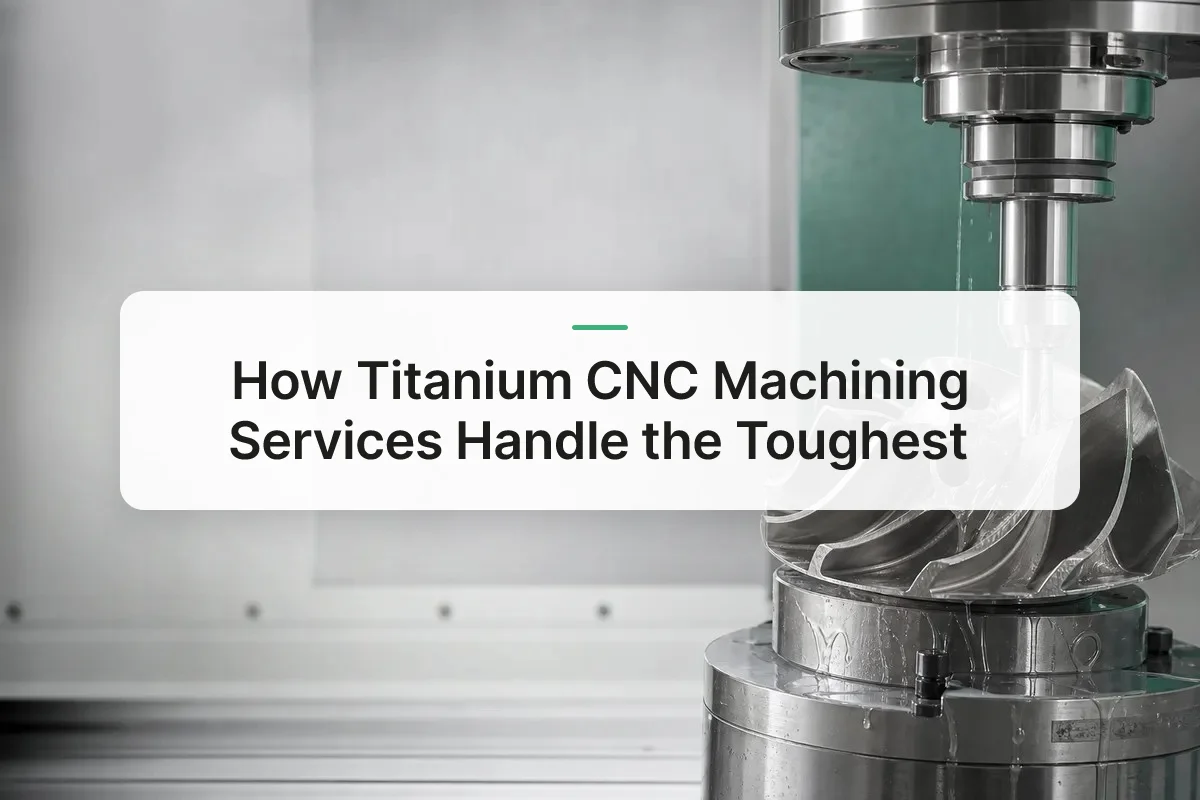
What Titanium CNC Machining Services Actually Involve, and Why the Material Is Different
Titanium CNC machining services cover milling, turning, drilling, and 5-axis contouring, each requiring parameter settings that differ significantly from aluminum or steel runs.
The operations themselves are familiar. What changes is everything around them: spindle speeds, feed rates, tooling selection, coolant pressure, and cycle times. Titanium punishes shops that treat it like a generic metal.
“Titanium is one of the most unforgiving materials in precision machining. The margin for error on cutting parameters is narrow, and shops that underestimate its thermal behavior pay for it in scrapped parts and burned tooling.” — Dr. John Agapiou, Senior Research Engineer, Manufacturing Systems Research Lab
Is titanium easily machinable compared to aluminum or steel?
Titanium’s machinability rating sits at roughly 40% relative to free-machining steel, which is rated at 100%. Aluminum rates above 300% on the same scale, meaning titanium is more than seven times harder to cut than a comparable aluminum workpiece.
The core problem is thermal. Aluminum dissipates heat through the chip and into the surrounding material. Titanium’s low thermal conductivity does the opposite — heat concentrates directly at the cutting edge, accelerating tool wear at rates that catch unprepared shops off guard. Active coolant management is not optional; it’s the primary defense against premature tool failure. Proper CNC coolants and lubricants strategy is a prerequisite for any stable titanium operation.
Titanium also work-hardens rapidly. A dwell or a tool rub, even briefly, can harden the surface ahead of the next pass, compounding wear. This is why feed rates must stay consistent and tools must remain sharp throughout the cut.
The result: longer cycle times, higher tooling consumption, and tighter process control requirements than most other metals. Surface finish requirements add another layer of complexity, since the same thermal effects that damage tools can also degrade part surface quality.
What titanium grades are most commonly used in CNC machining (Grade 2 vs. Grade 5)?
Grade 2 and Grade 5 account for the large majority of titanium CNC machining production volume, and they serve distinctly different applications.
Grade 2 (commercially pure titanium) contains at least 99% titanium and delivers superior corrosion resistance in aggressive chemical environments. Medical implant manufacturers and chemical processing engineers favor it precisely because it resists oxidation and remains biocompatible without alloying additions.
Grade 5 (Ti-6Al-4V) adds 6% aluminum and 4% vanadium to produce tensile strengths that can exceed 950 MPa, roughly double that of Grade 2. Aerospace structural components, turbine parts, and high-load fasteners are its natural territory. It is the most widely machined titanium alloy globally.
Choosing between them is not a preference decision — it’s an engineering one. Grade 5 machines slightly more predictably than Grade 2 in many setups, but both grades demand the same disciplined approach to heat and tool management. According to ASM International, titanium alloys are classified across more than 30 grades, but Grades 2 and 5 represent the overwhelming majority of industrial machining demand due to their balance of mechanical properties and availability.
The Main Challenges in Titanium CNC Machining Services and How Skilled Providers Solve Them
Titanium’s low thermal conductivity, tendency to work-harden, and chemical reactivity with tooling make it one of the most demanding metals to machine accurately at production volume.
How do CNC shops manage tool wear and heat buildup when machining titanium?
Titanium work-hardens during cutting. When a tool dwells or feed rate drops even briefly, the material strengthens at the contact point, dulling the insert within seconds. Experienced shops counter this by maintaining a consistent chip load throughout every pass and never allowing the tool to rub against the workpiece surface.
Heat evacuation is the other critical variable. Unlike steel, titanium retains heat at the cutting zone rather than carrying it away in the chip. High-pressure coolant systems, typically operating between 70 and 1,000 psi directed precisely at the cutting zone, are the industry standard for managing this. Shops running titanium CNC machining services without high-pressure coolant produce inconsistent surface quality and burn through tooling at a rate that makes production runs uneconomical.
Tooling selection compounds the challenge. Carbide inserts with sharp edge geometry and positive rake angles outperform general-purpose tooling on titanium. Coatings matter too: TiAlN or uncoated fine-grain carbide are preferred, while TiN-coated tools underperform because titanium’s chemical affinity for titanium causes the coating to adhere and transfer to the workpiece, accelerating edge failure. For threaded features, thread-milling in titanium requires the same discipline — consistent feed, correct helix angle, and adequate coolant. See our CNC threading optimization guide for the full parameter breakdown. Deep-hole drilling in titanium bores introduces additional chip evacuation demands covered in our CNC hole drilling technology resource.
“Cutting speed is the single most controllable variable in titanium machining. Reducing surface footage by even 20% can double tool life — a trade-off that almost always makes economic sense in production environments.” — Dr. Toshiyuki Obikawa, Professor of Manufacturing Engineering, Tokyo Institute of Technology
What surface finish requirements and quality control methods ensure precision in titanium parts?
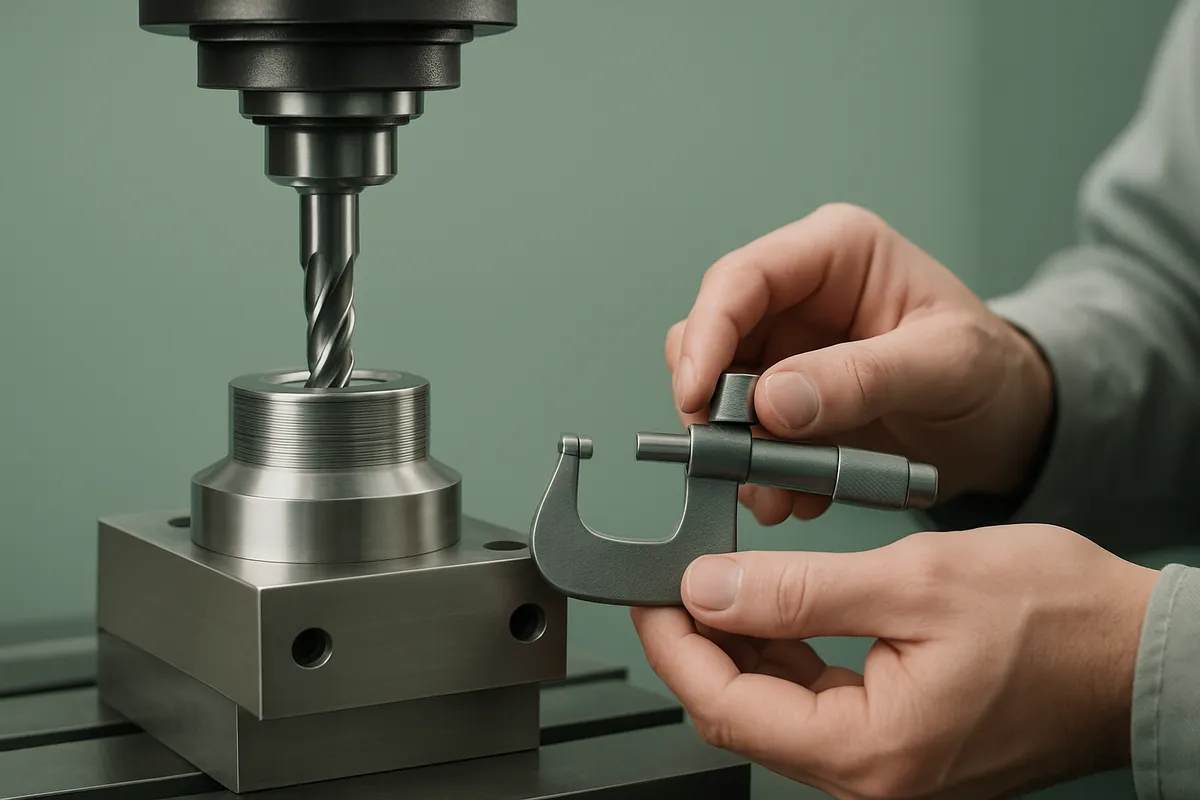
Medical implants and aerospace skin panels set the tightest finish targets — Ra values below 0.8 µm are standard for these applications. Achieving that threshold requires dedicated finish passes at controlled spindle speeds, separate from the roughing strategy, so the tool engages the surface under stable, repeatable conditions.
Post-process treatments extend the quality chain beyond the machine. Bead blasting removes micro-burrs and produces a uniform matte surface; anodizing adds a controlled oxide layer that improves corrosion resistance without altering dimensional tolerances. Dimensional verification, using CMM inspection against the original CAD model, closes the loop before any part ships. According to the National Institute of Standards and Technology (NIST), dimensional traceability through calibrated measurement systems is a foundational requirement for any precision manufacturing quality program. For more information, see Services.
What Drives the Cost of Titanium CNC Machining Services
Titanium CNC machining sits firmly in the premium tier — raw material cost, tool wear, cycle time, and coolant infrastructure all compound above what aluminum or steel requires.
Is machining titanium more expensive than other precision machining services, and why?
Four factors stack against titanium from the start. Stock material costs more than aluminum or mild steel at the outset. Titanium’s low thermal conductivity traps heat at the cutting edge, accelerating tool wear and increasing consumable spend per part. Slower recommended cutting speeds extend cycle times. High-pressure coolant systems, required to manage heat at the tool-workpiece interface, represent infrastructure investment that simpler materials don’t demand.
Grade selection is the single biggest cost lever within titanium itself. Grade 2 (commercially pure titanium) is softer and easier to cut than Grade 5 (Ti-6Al-4V), which contains aluminum and vanadium alloying elements that increase strength but also increase cutting resistance. A Grade 5 part with complex geometry and tolerances at ±0.005 mm will sit at the higher end of the premium range — more setups, longer CNC programs, and more inspection steps than a simple turned bushing in Grade 2.
Part complexity drives cost non-linearly. A 5-axis contoured aerospace bracket requires multiple fixturing setups, extended machine time, and coordinate measuring machine verification at each stage. A straightforward turned bushing in the same material costs a fraction of that — same metal, very different project scope.
Production volume also shifts the economics. Prototype and low-volume runs carry higher per-part cost because fixturing and setup time spreads across fewer pieces. High-volume batch orders, the kind MFG SOLUTION handles with 20 automatic lathes and 5-axis CNC machines, amortize those fixed costs across more parts, moving the per-unit price toward mid-premium rather than the top of the range.
How do lead times and production capacity affect the total cost of your titanium project?
Expedited turnaround on titanium parts competes directly for machine time. Providers who can prioritize your order may require overtime labor or dedicated capacity — costs that typically appear in project pricing. Standard lead times allow shops to schedule titanium work efficiently alongside other jobs, keeping overhead lower.
Submitting complete, accurate specifications upfront reduces back-and-forth and keeps your project on the standard schedule. MFG SOLUTION’s 8-hour quoting window is designed for exactly this: you provide the specs, and pricing reflects your actual geometry, grade, volume, and timeline — not a generic estimate revised later.
Industries and Real-World Applications for Custom Titanium CNC Machined Parts
Aerospace, medical devices, automotive, and chemical processing are the four primary industries driving demand for titanium CNC machining services today.
What are specific aerospace, medical, and automotive applications for machined titanium components?
Aerospace consumes more machined titanium than any other sector. Structural brackets, bulkheads, engine mounts, and airframe fasteners are typically machined from Grade 5 (Ti-6Al-4V) because titanium delivers comparable strength to steel at roughly 40% less weight — a direct reduction in fuel burn and payload cost. These are applications where every gram is an engineering decision.
Medical device manufacturing depends on Grade 2 and Grade 5 for orthopedic implants including hip stems, bone plates, and spinal cages, as well as surgical instruments and dental abutments. Two properties make titanium non-negotiable here: biocompatibility (the body does not reject it) and MRI compatibility (it produces no imaging artifacts, unlike cobalt-chrome alloys). The U.S. Food and Drug Administration (FDA) classifies many titanium implant components as Class II or Class III medical devices, requiring documented biocompatibility testing and manufacturing traceability before market clearance.
Automotive and motorsport teams machine titanium connecting rods, valve retainers, exhaust components, and suspension fasteners for high-performance vehicles. The weight reduction is direct and measurable — lighter rotating and reciprocating mass translates to faster engine response and lower lap times.
Industrial and chemical processing applications rely on Grade 2 titanium for pump housings, heat exchanger components, and valve bodies exposed to seawater or aggressive process chemicals. Grade 2 resists corrosion in environments that degrade 316L stainless steel within months.
For structural applications where near-net-shape production is preferable to machining from billet, forging stainless steel and forging block processes offer a cost-effective alternative, though they cannot match the dimensional precision achievable through CNC machining for complex geometries.
Certifications and Quality Standards to Require from a Titanium CNC Machining Services Provider
The certifications that matter most depend on your industry — ISO 9001:2015 for any sector, AS9100 for aerospace, and ISO 13485 for medical devices.
What compliance certifications (ISO, AS9100, FDA, NADCAP) matter most for your industry?
ISO 9001:2015 is the baseline. It governs documented process control, traceability, and corrective action systems — every credible titanium CNC machining services provider should hold it as a minimum requirement before you evaluate anything else.
AS9100 Rev D extends ISO 9001 with aerospace-specific requirements: risk management, configuration control, and first-article inspection (FAI) per AS9102. If your parts go into an aerospace supply chain, this certification is non-negotiable for Tier 1 programs.
NADCAP accreditation covers special processes applied to titanium aerospace parts — chemical processing, heat treatment, and non-destructive testing (NDT). Many Tier 1 aerospace customers mandate it contractually, so confirm it before sourcing.
ISO 13485:2016 is the quality standard for medical device manufacturing. It adds design controls, biocompatibility documentation, and sterile packaging requirements directly relevant to titanium implants and surgical instruments.
FDA 21 CFR Part 820 compliance is required for titanium components used in Class II and Class III medical devices sold in the US market. Providers serving this sector must demonstrate design history file (DHF) and device history record (DHR) capability — ask for documented evidence, not just a verbal claim.
How do quality certifications and compliance standards protect your titanium machining project?
Certifications are audit trails, not just wall plaques. Each standard requires a provider to document every process step, record material traceability back to the raw stock, and maintain corrective action logs when deviations occur.
MFG SOLUTION holds ISO 9001:2015, ISO 13485:2016, and IATF 16949 certifications with full process control — every step tracked, documented, and auditable for compliance. Use this checklist when vetting any provider:
- Request current certificate copies and verify expiry dates independently
- Confirm the certificate scope covers the specific processes your parts require
- Ask for a sample corrective action report to confirm the system is active, not dormant
- For aerospace titanium, require both AS9100 Rev D and NADCAP accreditation documentation
- For medical titanium, request DHF/DHR examples and confirm FDA 21 CFR Part 820 compliance procedures are in place

Frequently Asked Questions
Can titanium be welded or joined after CNC machining, and does that affect part design?
Yes, titanium can be welded after CNC machining, but the process requires an inert-gas shielded environment to prevent oxidation and embrittlement. If your part will be welded, design the weld zones before finalizing machined tolerances — post-weld distortion can shift critical dimensions by several thousandths of an inch, requiring secondary machining to restore them. Inform your machining partner early so joint areas can be left with appropriate stock.
What tolerances are achievable with titanium CNC machining services?
Standard titanium CNC machining holds tolerances of ±0.005 inches (±0.127 mm); 5-axis CNC setups can achieve ±0.001 inches (±0.025 mm) on critical features. Tighter tolerances increase cycle time and tooling cost, so specify them only where fit, function, or regulatory compliance demands it. For medical and aerospace components, document the required tolerance on every critical dimension in your drawing.
How long does it typically take to receive custom titanium CNC machined parts?
Lead times vary by supplier, complexity, and order volume — standard industry lead times run 2–4 weeks for production runs. MFG SOLUTION compresses that cycle significantly: quotes arrive within 8 hours of specification submission, and approved orders ship within 3 days, making it a practical option when supply chain disruptions or new product launches demand fast turnaround.
What post-processing options are available for titanium CNC machined parts?
Common post-processing options include anodizing (Type II or Type III for color-coding and surface hardness), passivation, bead blasting, polishing, and PVD coating. Medical parts often require electropolishing to meet biocompatibility surface-finish standards. Heat treatment, specifically stress relief at 480–650°C, is also applied after machining to reduce residual stresses in tight-tolerance components before final inspection.
How do I choose the right titanium CNC machining services provider for my project?
Evaluate providers on four criteria: certification scope (ISO 9001:2015 minimum, AS9100 or ISO 13485 for regulated industries), equipment capability (5-axis CNC and high-pressure coolant systems are essential for complex titanium work), quality documentation practices (CMM inspection reports, material traceability records), and demonstrated experience with your specific alloy grade and application. Request sample inspection reports and ask for references from comparable projects before committing to a production run.
Conclusion
Titanium’s strength-to-weight ratio, corrosion resistance, and biocompatibility make it the right material for demanding applications — but those same properties make it genuinely difficult to machine without the right equipment, tooling strategy, and process controls. Three things matter most: selecting the correct alloy grade for your application (Grade 2 for corrosion resistance, Grade 5 Ti-6Al-4V for structural load), specifying tolerances only where function or compliance requires them, and choosing a certified manufacturing partner who can document quality at every step.
If your next project requires small precision titanium parts up to 38mm in diameter, submit your specifications to MFG SOLUTION — you’ll have a detailed quote within 8 hours and your first batch on its way within 3 days.
Recommended Articles
Explore more from our content library: