
2026-07-19
The Complete Guide to Choosing and Using a Forging Block

A forging block is a heavy, hardened steel or cast iron tool used in metalworking to shape, support, and form hot or cold metal through hammering and pressing. Swage blocks, the most common type, feature an array of holes, slots, and shaped depressions that let blacksmiths and industrial forgers produce consistent profiles without custom dies. They are foundational tools in both traditional blacksmithing and precision production forging workflows. According to Runchi Forging’s technical resource library, these tools remain indispensable across both artisan and industrial metalworking contexts.
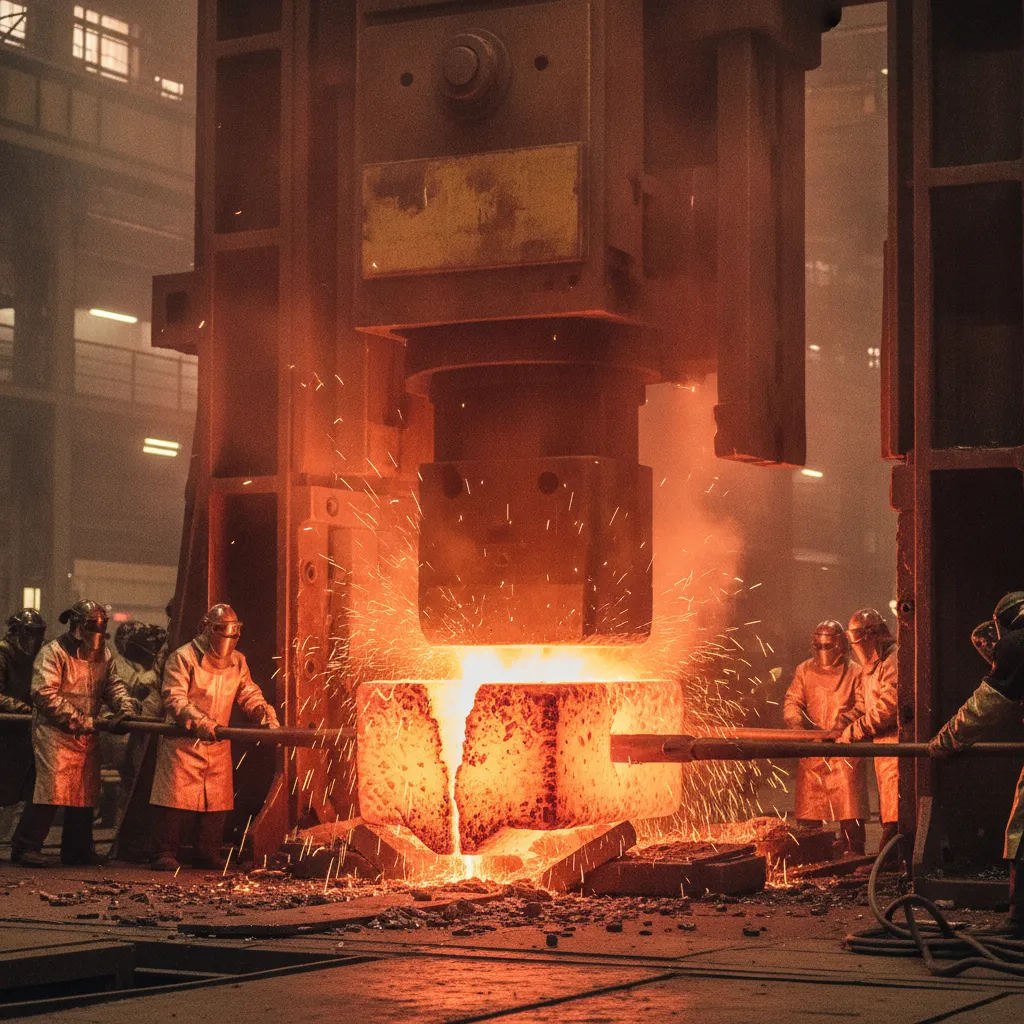
What Is a Forging Block and How Does It Work?
A forging block is a rigid, shaped steel or cast iron tool that absorbs hammer impact and transfers that force directly into the workpiece to produce a desired form.
Unlike a flat-faced anvil, which provides a general-purpose striking surface, this type of tooling is built around specific geometry. Its surface features cavities, slots, and contoured depressions that guide metal into precise shapes during each hammer blow. The block’s mass and hardness prevent energy from dissipating into the tool itself, so the full force of each strike works the metal.
One distinction worth making: a forging block is not the same as a forged block or forged plate. According to FRISA’s forged blocks and plates product line, forged blocks are finished structural steel components produced by the forging process — not the tooling used during it. These two terms appear in the same searches, but they refer to entirely different things.
“The geometry of a swage block determines the quality of the profile it produces — mass and hardness are prerequisites, but cavity design is what separates a precision tool from a generic support surface.” — James Batson, Author, The Blacksmith’s Craft
Forging Block vs. Blacksmith Block: Key Differences
A blacksmith block is typically a flat or lightly contoured support used for general shaping and bending. A swage block, by contrast, carries purpose-built cavities and profiles that produce repeatable cross-sections and forms. The swage block is the more specialized tool; the blacksmith block is the more general one. Smiths working on production runs of consistent profiles almost always reach for the swage block first.
Main Application Areas in Metalworking
These shaping tools appear across five primary areas: blacksmithing, industrial open-die forging, toolmaking, agricultural equipment fabrication, and artistic metalwork. They work in both hot forging setups, where metal is worked above its recrystallization temperature, and cold forging operations. Hot forging demands blocks made from high-alloy tool steel that resists thermal cycling; cold forging allows harder, less heat-tolerant block materials because no thermal stress is involved.
The following list summarizes the most common application areas and their specific requirements:
- Blacksmithing: Hand forging of decorative and functional ironwork using swage blocks and hardy tools
- Industrial open-die forging: Large-scale shaping of billets and bars using heavy tooling blocks rated for power hammer use
- Toolmaking: Forming dies, punches, and fixtures from tool steel blanks
- Agricultural equipment fabrication: Producing hooks, brackets, and structural components for farm machinery
- Artistic metalwork: Sculptural and decorative applications requiring complex curved profiles
Types of Forging Blocks: Swage Blocks, Hardy Tools, and More
These shaping tools fall into three main categories — swage blocks, hardy tools, and mandrel cones — each designed for a distinct set of shaping tasks.
What Is a Swage Block and What Makes It Unique?
A swage block is the most versatile option available for shop use. Typically cast from gray or ductile iron and weighing between 50 and 200 lb, it features through-holes in round, square, and hexagonal profiles, perimeter slots for bending bar stock, and shaped depressions for forming scrolls and tenons. That combination of hole types and surface profiles lets a single tool handle operations that would otherwise require several dedicated dies. For a detailed look at available swage block configurations, Centaur Forge’s swage blocks and mandrel cones catalog provides a useful reference for sizing and profile options.
A 100 lb cast iron swage block from suppliers like Peddinghaus or NC Tool Co. runs roughly $300–$700 new and handles stock up to approximately 2-inch diameter — a practical starting point for most production and craft forging setups.
“A well-chosen swage block eliminates the need for five or six dedicated dies in a small shop — it is the single most cost-effective investment a blacksmith can make after the anvil itself.” — Mark Aspery, Master Blacksmith and Author, Mastering the Fundamentals of Blacksmithing
The hardy block (or bottom tool) takes a different approach: it fits directly into the hardy hole of an anvil and handles cutting and bending tasks in a smaller footprint. The trade-off is limited profile variety compared to a swage block. The mandrel cone, sometimes called a bick iron, is a conical tool used to size and shape rings and tubes. Blacksmiths typically pair mandrel cones with swage blocks to cover the full range of round-stock operations.
The 4 Main Forging Types and Which Block Each Requires
Shaping blocks map directly to the four main forging processes. Swage blocks are most relevant to open-die forging, where the workpiece is shaped between flat or contoured dies without a fully enclosed cavity. Closed-die forging uses matched die sets rather than open blocks, trapping material to fill a precise cavity. Roll forging passes heated stock between contoured rolls and doesn’t use a block at all. Upset forging increases cross-sectional area at a specific point and relies on headed tooling rather than a flat or profiled block.
For manufacturers sourcing precision cold-forged components at scale — rather than hand-forging individual pieces — the block type matters less than the process control behind it. MFG SOLUTION’s cold forging operations, certified to ISO 9001:2015 and IATF 16949, apply closed-die and upset principles to produce small parts up to 38mm diameter with consistent dimensional accuracy across full production runs.
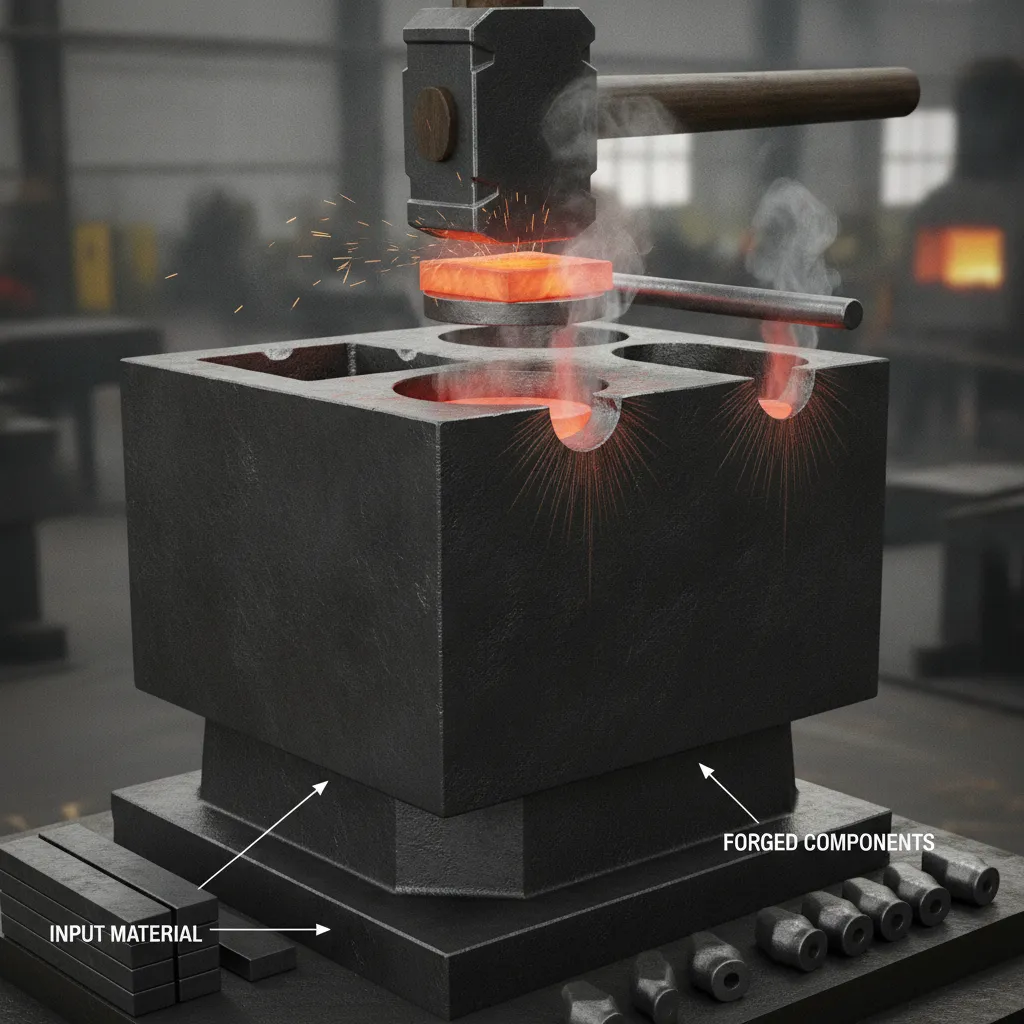
Swage Blocks vs. Modern Forging Block Alternatives
Swage blocks suit low-volume hand forging; CNC-machined die inserts deliver the repeatable precision that production runs demand — at 5–20× the upfront cost.
Traditional cast iron swage blocks cost little and last decades under normal shop use. Their surface finish typically holds only ±0.5 mm or rougher, which works for blacksmithing and artisan fabrication but rules them out for any application where dimensional consistency matters across thousands of parts.
CNC-machined steel die inserts change that equation. Tolerances down to ±0.05 mm are achievable with modern 5-axis equipment, and the profiles repeat accurately from the first part to the ten-thousandth. The trade-off is price — expect to pay 5–20× more than a comparable swage block, plus lead time for the machining itself.
Modular tooling systems with quick-change die holders sit between these two options. In production environments, they cut setup time by 40–60% compared to conventional die swaps. The catch: your press equipment must accept the compatible holder system, which means capital investment before you see any time savings.
How Forging Blocks Fit Into Precision Production Workflows
The core limitation of a swage block in precision production is process variation. Surface irregularities and manual handling introduce inconsistencies that make them unsuitable where tolerances tighter than ±0.25 mm are required — a threshold that applies to most automotive and medical components. Understanding machining tolerances explained helps clarify where the boundary falls.
The verdict is straightforward. Swage blocks win on cost and versatility for job shops and artisan work. CNC die inserts win for repeatable, high-volume precision forging — the kind governed by IATF 16949 or ISO 13485 standards. For manufacturers sourcing precision forged and machined parts under those standards, MFG SOLUTION’s cold forging capability — backed by 60+ engineering professionals and 3-day shipment windows — bridges the gap between raw forging and finished, tolerance-held components. See how precision tolerance stackup affects part performance downstream.
Material Specifications and Pricing: What to Look for When Buying a Forging Block
Match your shaping block material to your hammer type and production load — the wrong grade cracks under power hammer use and costs you more in the long run.
Tensile Strength and Hardness Ratings by Block Type
Cast iron swage blocks are the entry-level option: Brinell hardness of 180–230 HB and tensile strength of roughly 25,000–40,000 psi. That range handles hand hammer work without issue, but cast iron becomes a liability under power hammer setups with ram weights above 50 lb — the material can crack from repeated impact stress.
Ductile iron (nodular iron) blocks close that gap significantly. Tensile strength runs 60,000–100,000 psi with Brinell hardness between 140–300 HB depending on grade. The nodular graphite structure absorbs impact rather than fracturing, which is why most power hammer operators specify ductile iron as the minimum.
Tool steel blocks in D2 or H13 sit at the top of the performance range — tensile strength up to 200,000 psi and hardness of 54–58 HRC after heat treatment. Industrial closed-die and precision forging operations use these grades. The cost reflects the specification.
Pricing breaks down by size and material:
- Small cast iron swage block (30–50 lb): $150–$300
- Mid-size cast iron (75–100 lb): $300–$700
- Large industrial ductile iron (150–200 lb): $700–$1,500
- Custom tool steel blocks: $2,000 and up
Beyond price, four factors determine fit: hammer weight class, hole and slot variety for your target profiles, surface finish (ground vs. as-cast affects dimensional accuracy), and country of manufacture — domestic sourcing typically cuts lead time, while offshore blocks may require 6–12 weeks for custom specifications.
How to Use and Maintain a Forging Block Safely
Mount your shaping block on a stable stand, wear full PPE, and follow a simple maintenance routine to get decades of reliable service from the tool.
Start with the setup. Fix the swage block on a dedicated stand that positions the work surface 28–34 inches from the floor — anvil height — so you can apply controlled force without awkward angles. An unstable block is the leading cause of workpiece ejection injuries, so bolt or chain the block to the stand before the first strike.
Key Safety Considerations When Working with Forging Blocks
In environments below 40°F, preheat cast iron blocks slightly before use. Cold cast iron is brittle, and thermal shock from a hot workpiece can crack the block without warning. A short warm-up with a propane torch across the surface is enough.
Never strike the block directly with a hammer. Always work through the hot metal — the workpiece absorbs the impact energy and shapes into the cavity. Direct hammer blows chip the block’s edges and create dangerous spall.
Flying scale from hot stock is the primary injury vector in forging work, so PPE is non-negotiable: leather apron, full face shield (not safety glasses alone), heat-resistant gloves, and steel-toed boots. Every piece of that list serves a specific purpose when a workpiece shifts under the hammer. The Occupational Safety and Health Administration (OSHA) provides detailed guidance on personal protective equipment requirements for hot metalworking environments.
“Thermal shock is the most underestimated hazard in blacksmith shops — a cold cast iron block struck with a hot workpiece can crack explosively, sending fragments across the shop floor.” — Brian Gilbert, Certified Welding Inspector and Metalworking Safety Consultant
Maintenance Schedule and Durability Lifespan
After each session, wire-brush scale off all surfaces while the block is still warm. Apply a light coat of WD-40 or linseed oil immediately after — this two-minute step prevents rust pitting that degrades cavity geometry over time.
If you use the block with a power hammer, inspect it quarterly for hairline cracks using dye penetrant testing. Power hammer impacts concentrate stress at cavity edges in ways hand forging does not. The American Society for Nondestructive Testing (ASNT) outlines standard dye penetrant inspection procedures that apply directly to cast iron tooling evaluation.
A quality cast iron swage block used in hand forging lasts 20–50+ years with basic maintenance. Ductile iron blocks under power hammer use typically last 10–20 years before surface deformation requires resurfacing — a meaningful cost factor when specifying material grade at purchase.
Frequently Asked Questions
Can you use a forging block with a power hammer, or is it only for hand forging?
A forging block works with both power hammers and hand forging — the key requirement is that the block is rated for the impact forces your equipment generates. Power hammers deliver repeated high-energy blows, so the block must be positioned securely and made from a grade of steel or ductile iron that won’t crack under cyclic loading. Always verify the manufacturer’s rated impact capacity before pairing a block with any mechanical or pneumatic hammer.
What size forging block do I need for a beginner blacksmith setup?
A beginner setup typically works well with a block in the 50–100 lb range, offering enough mass to absorb hammer blows without shifting. Smaller blocks under 50 lb tend to move during use, which reduces accuracy. A block with a mix of square, round, and half-round swage cavities gives you the most versatility early on. Prioritize a flat, dressed top surface — that matters more than raw size for learning consistent technique.
How much does a forging block weigh, and does weight affect performance?
Forging blocks range from around 20 lb for small swage blocks up to several hundred pounds for industrial tooling blocks. Weight directly affects performance: a heavier block stays put under impact, transfers more energy into the workpiece, and reduces operator fatigue. As a general rule, a block should weigh at least 10 times the weight of your primary hammer head for efficient energy transfer.
Is a cast iron swage block the same as a forging block?
A swage block is a type of forging block, but not all forging blocks are swage blocks. Swage blocks are specifically shaped with multiple cavities and profiles for forming curved or hollow sections. The term “forging block” is broader — it covers flat tooling blocks, die blocks used in industrial presses, and the shaped swage variety used in blacksmithing. For a detailed breakdown of how these terms are used in industrial contexts, see Runchi Forging’s definition and application guide.
What is the difference between open-die and closed-die forging, and which requires a forging block?
Open-die forging shapes metal between flat or contoured dies without enclosing the workpiece, and swage blocks are commonly used in this process. Closed-die forging uses matched die sets that fully enclose the material, producing more precise net-shape parts without the need for an open block. For high-volume production requiring tight tolerances, closed-die methods are preferred, while open-die setups with swage blocks remain practical for lower-volume or custom work. The choice depends on part complexity, required tolerances, and production volume.
Conclusion
A forging block’s value comes down to three things: material grade, cavity geometry, and mass relative to your tooling. Get those right, and the block becomes a precision reference surface — not just a place to rest hot metal. For industrial applications, the grain flow and microstructure achieved through the forging process itself give forged blocks a measurable strength advantage over castings, as documented by FRISA’s forged blocks and plates technical specifications.
If your operation requires forged or precision-machined components at tight tolerances, start by submitting your part specifications to a certified manufacturer. MFG SOLUTION provides quotes within 8 hours for parts up to 38mm diameter, backed by ISO 9001:2015, ISO 13485:2016, and IATF 16949 certifications, so you get documented quality alongside fast turnaround.
Recommended Articles
Explore more from our content library: