
2026-08-16
6 Reasons to Choose Precision Machining for Your Parts

Understanding why choose precision machining is essential for any engineer sourcing production-ready components. Precision machining delivers tight tolerances—often ±0.001 inch or better—repeatably across metals, plastics, and alloys that other processes can’t reliably hold. CNC-driven precision machining eliminates human error, meets ISO 2768 and ANSI B4.1 standards, and scales from single prototypes to high-volume production runs without sacrificing dimensional accuracy. According to HPPROC’s overview of high-precision machining advantages, the technology’s ability to maintain consistent tolerances at scale is one of its most compelling benefits for today’s engineer. For engineers in aerospace, medical, and automotive sectors, it remains the most reliable path from CAD file to certified, production-ready part.
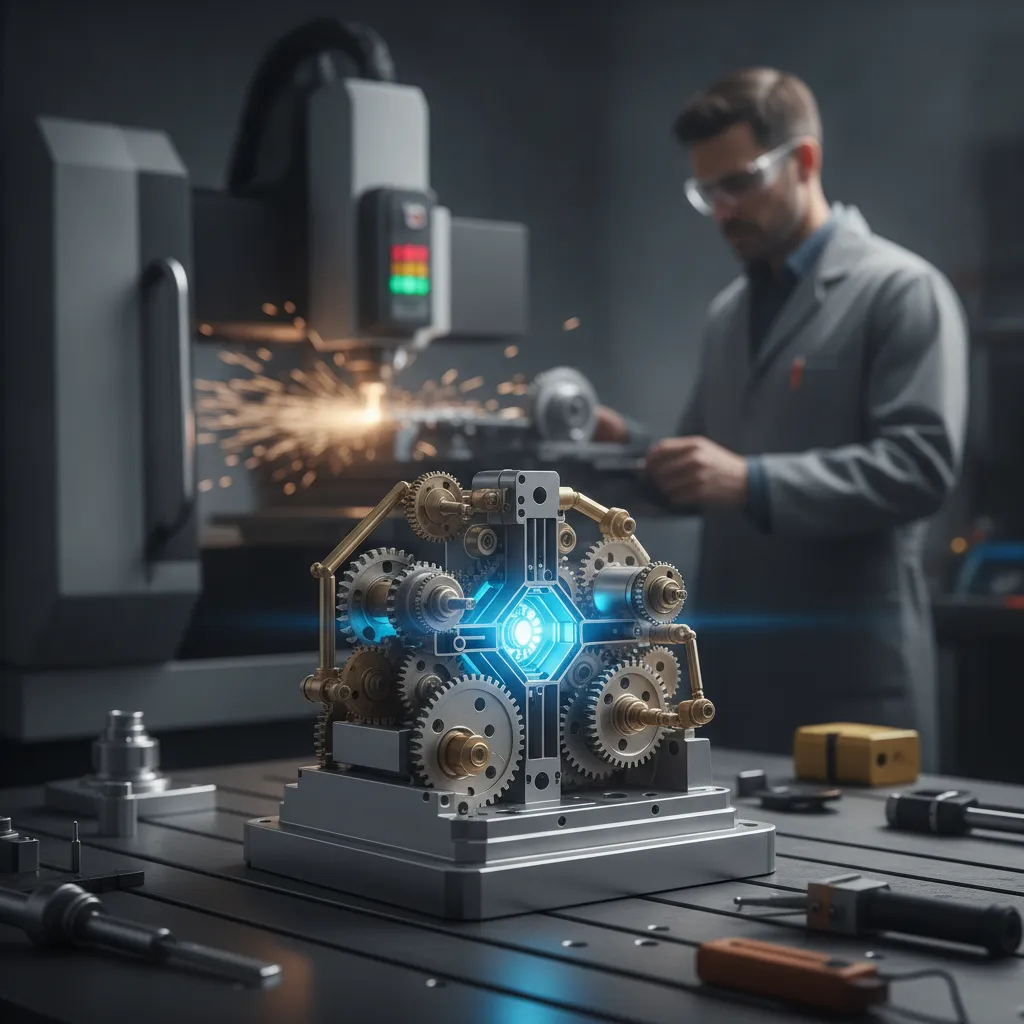
1. Why Choose Precision Machining for Your Manufacturing Needs
Precision machining delivers computer-controlled material removal that holds tolerances as tight as ±0.0005 inch—ten times tighter than standard machining’s typical ±0.005 inch.
The primary reason to choose precision machining is deterministic, repeatable accuracy. A CNC program produces the same geometry on part 1 and part 10,000 without drift—something manual or semi-automated processes cannot guarantee at scale.
“Precision machining is not simply about tighter tolerances—it is about building a process so controlled and documented that every part is predictably identical to the last.” — Dr. Richard DeVor, Professor of Mechanical Engineering, University of Illinois at Urbana-Champaign
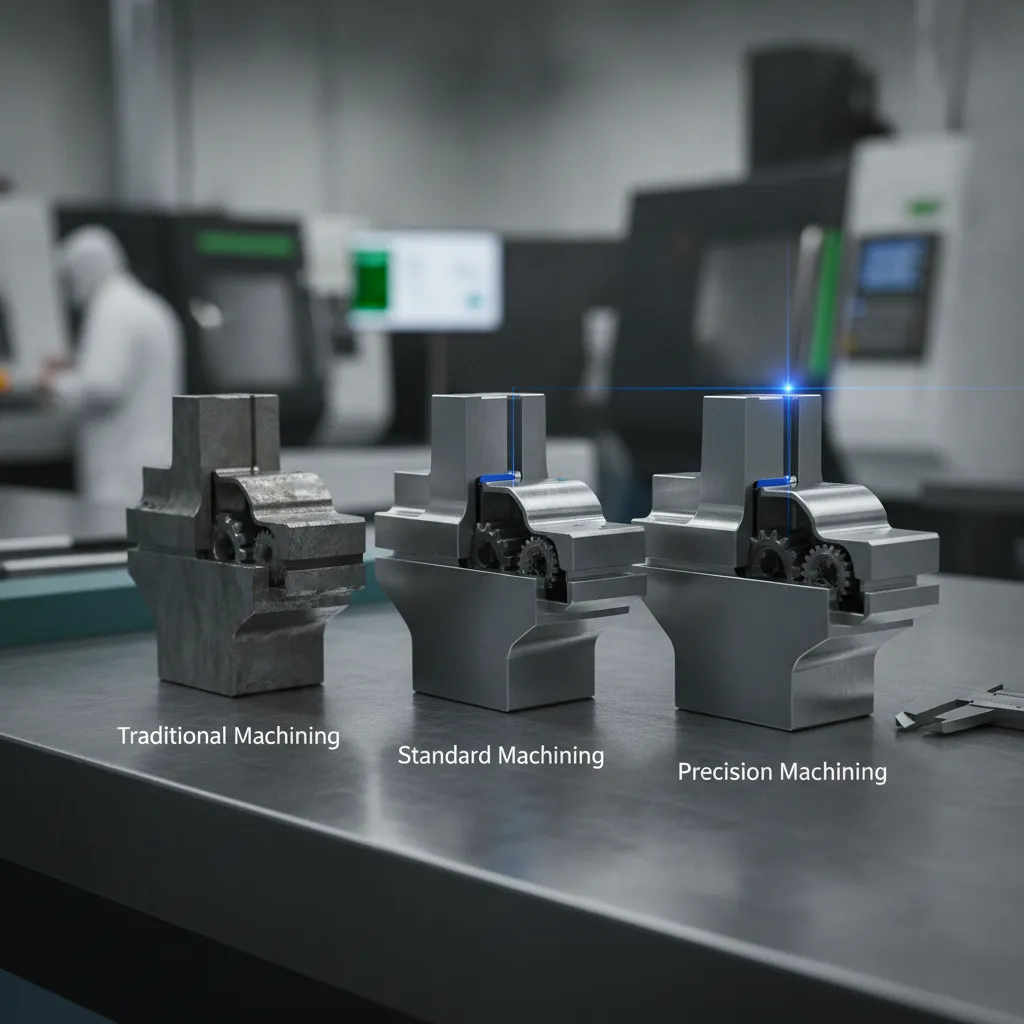
What Is the Difference Between Precision Machining and Standard Machining?
Standard machining relies on operator skill and manual measurement, placing tolerances at ±0.005 inch or looser. Precision machining uses closed-loop CNC control and in-process gauging to hold ±0.0005 inch consistently across an entire production run.
Precision machining is also the only subtractive method that simultaneously satisfies ISO 9001:2015, ISO 13485:2016, and IATF 16949 quality frameworks within a single documented workflow—a requirement for medical and automotive supply chains.
What Are CNC Turning and CNC Milling in Precision Manufacturing?
This article covers four core processes: CNC turning, CNC milling, Swiss lathe, and mill-turn. Each suits different part geometries—readers can self-identify their use case in the sections below.
One differentiator competitors skip: MFG SOLUTION quotes within 8 hours and ships within 3 days, so you can validate process fit against your actual parts before committing to a full production run.
2. Unmatched Dimensional Accuracy and Tight Tolerances
When engineers ask why choose precision machining over alternative subtractive methods, dimensional accuracy is the answer that matters most. Precision machining achieves tolerances from ±0.001 inch for general work down to ±0.0001 inch on Swiss lathe turned diameters—accuracy no other subtractive method matches at production volume.
How Tight Can Precision Machining Tolerances Go?
Three benchmark tolerance bands apply in practice:
- General precision machining: ±0.001 inch, suitable for structural brackets, housings, and non-critical fits
- High-precision CNC work: ±0.0002 inch, required for hydraulic valve bodies and precision bearing seats
- Swiss lathe operations: ±0.0001 inch on turned diameters up to 38mm, the benchmark for medical implants and miniature connectors
Surface finish is a direct output of tolerance control, not a separate operation. Ra values of 0.8 µm or better are routinely achieved, which matters for sealing surfaces and bearing fits. See the surface finish CNC machining page for Ra targets by application.
What ISO and ANSI Standards Apply to Precision Machining Specifications?
Buyers should cite two governing standards in every RFQ: ISO 2768 for general tolerances and ANSI B4.1 for preferred limits and fits. Both define the allowable deviation bands your supplier must document and control.
Tolerance stackup is the hidden risk in multi-part assemblies. When each mating component holds a tight per-part tolerance, cumulative dimensional drift stays within assembly limits. For a full breakdown, see the Precision Tolerance Stackup: A Complete Guide.
Best for: aerospace structural components, medical implants, hydraulic valve bodies, and any part where a 0.002-inch error causes assembly failure.
3. Consistent Repeatability Across High-Volume Production Runs
CNC automation executes the same toolpath on part 1 and part 10,000 identically, achieving Cpk values above 1.67—the Six Sigma threshold for a capable, controlled process.
Manual machining cannot match that consistency. Operator fatigue and skill variation introduce dimensional scatter of ±0.003 inch or more over a single shift—enough to cause assembly failures in close-tolerance applications.
In-process gauging and Statistical Process Control (SPC) catch dimensional drift before scrap accumulates. SPC monitors each feature against control limits in real time, triggering a tool offset correction or machine stop before a bad part leaves the spindle. Most competitors describe CNC repeatability without mentioning this cost-saving mechanism.
5-axis CNC machines complete complex geometries in one setup. Eliminating re-fixturing removes the compounding positional error that builds across multiple operations on 3-axis equipment—a differentiator that matters for parts with intersecting bores, compound angles, or tight true-position callouts. For more information, see How To Choose The Best Plant Based Ice Cream For Your Taste.
“Repeatability is the true measure of a precision machining operation. Any shop can hit a tolerance once—the discipline is hitting it ten thousand times in a row.” — John Zaya, Senior Manufacturing Engineer, SME (Society of Manufacturing Engineers)
Best for: automotive suppliers running IATF 16949 audits, electronics manufacturers needing matched connector housings, and medical device OEMs under FDA 21 CFR Part 820.
4. Broad Material Compatibility—Metals, Alloys, and Engineering Plastics
Precision machining handles aluminum, steel, titanium, brass, copper, and engineering plastics in a single production environment—no process change required between material families.
Can Precision Machining Work with Aluminum, Steel, Titanium, and Plastics?
Confirmed machinable material families include:
- Aluminum alloys: 6061, 7075, high strength-to-weight ratio, excellent machinability
- Carbon steels: 1045, 4140, standard turned shaft and gear blank stock
- Stainless steels: 303, 316, corrosion-resistant, required for food-contact and medical parts
- Titanium: Grade 5 / Ti-6Al-4V, biocompatible, high specific strength
- Brass and copper: electrical connectors, plumbing fittings
- Engineering plastics: PEEK, Delrin, Nylon, chemical resistance, weight reduction
Titanium requires low cutting speeds and high-pressure coolant to prevent work hardening at the tool-chip interface. See CNC coolants and lubricants for recommended parameters by alloy grade.
Injection molding is limited to thermoplastics and thermosets. 3D printing in metal struggles to produce fully dense microstructures required for load-bearing parts—porosity rates of 10–20% are common without post-processing hot isostatic pressing (HIP).
One differentiator competitors rarely mention: forged billets in stainless or alloy steel can be precision machined to final geometry, combining forging’s aligned grain structure with machining’s dimensional accuracy. See the forging block page for available stock sizes and lead times.
Best for: medical implant manufacturers specifying biocompatible titanium, power generation OEMs requiring high-temperature alloys, and automotive suppliers ordering 1045 steel turned parts.
5. Superior Quality Versus 3D Printing and Injection Molding
Precision machining produces fully dense, isotropic parts with surface finishes down to Ra 0.8 µm—a quality level neither 3D printing nor injection molding matches without significant post-processing cost. According to Focused on Machining’s analysis of precision machining benefits, the process consistently outperforms alternatives on structural integrity and dimensional reliability for production parts.
When Should You Choose Precision Machining Over 3D Printing?
FDM and SLS printed metals carry 10–20% porosity and Ra values above 10 µm without post-processing. For load-bearing parts, sealing surfaces, or bearing fits, that porosity is a structural liability. Precision machining eliminates it by cutting from a solid, fully dense billet.
Choose 3D printing when you need topology-optimized internal lattices that cannot be cut, or one-off prototypes where a tolerance of ±0.5mm or looser is acceptable. Outside those two cases, machining is the lower-risk option.
Is Precision Machining or Injection Molding Better for High-Volume Production?
Injection mold tooling costs $5,000–$100,000+ before a single production shot. Precision machining carries no tooling cost, making it cost-effective for quantities under approximately 5,000 units and for materials that don’t flow reliably in molds—titanium, PEEK, and most structural alloys.
Switch to injection molding for commodity plastic parts above 50,000 units where per-part cost dominates and tolerances of ±0.1mm are acceptable.
The lead time gap is where precision machining wins outright: injection mold tooling takes 4–12 weeks before first production output. MFG SOLUTION ships precision machined parts within 3 days of approved drawings—a difference measured in weeks, not days, when a product launch is on the line.
6. Industry-Specific ROI—Aerospace, Medical, and Automotive
How Does Precision Machining Improve ROI in Aerospace, Medical, or Automotive Sectors?
Precision machining delivers measurable financial returns in regulated industries by cutting scrap, reducing rework, and protecting compliance timelines worth millions. Industry professionals who ask why choose precision machining for regulated sectors consistently point to its documented quality trail as the deciding factor.
- Aerospace: AS9100D-compliant precision machining reduces non-conformance scrap rates from an industry average of 3–5% to under 0.5%. On high-value titanium or Inconel billets priced at $500–$2,000 each, that reduction pays back tooling investment within a single production run.
- Medical: ISO 13485:2016-certified machining provides the full material traceability and dimensional documentation required for FDA 510(k) submissions. Non-compliant parts can delay clearance by 6–18 months—a timeline cost that dwarfs any per-unit machining premium. MFG SOLUTION holds ISO 13485:2016 certification with documented process control at every production step.
- Automotive: IATF 16949 suppliers using precision CNC turning for powertrain components report 15–25% reductions in warranty claims tied to dimensional non-conformance, per published OEM supplier quality data.
- Electronics/Connectors: Matched-tolerance housings reduce field assembly rejection rates, cutting line-down costs that can exceed $10,000/hour in high-volume electronics plants.
- Power Generation: OEMs machining forged turbine components from certified billets achieve fatigue life improvements of 20–30% over cast alternatives—a return that compounds across multi-year maintenance cycles and is rarely cited in standard machining ROI discussions.
7. Scalable Pricing—From Prototype to High-Volume Orders
What Pricing Models Apply to Low-Volume Versus High-Volume Precision Machining?
How Do Setup Costs and Per-Unit Pricing Scale with Order Size?
Precision machining pricing follows a fixed-plus-variable structure: setup is a one-time cost, and per-unit cost drops sharply as volume increases past 500–1,000 parts.
Setup—CNC programming and fixturing—typically runs $200–$800 per part number. At 10 parts, that cost dominates the invoice. At 1,000 parts, it becomes a rounding error. For a mid-complexity aluminum turned part, expect roughly $45–$80 per unit at 50 pieces, $8–$15 at 1,000 pieces, and $3–$6 at 10,000 pieces (illustrative benchmarks based on standard shop rates).
Low-volume advantage: No hard tooling means precision machining beats injection molding on total cost for runs under approximately 3,000–5,000 units, depending on part complexity. Mold costs alone can reach $20,000–$80,000 before a single part ships.
High-volume advantage: MFG SOLUTION operates 20 automatic lathes running lights-out shifts, compressing per-unit cost while maintaining Cpk ≥ 1.67—a process capability level injection molding cannot match for metal parts.
The 8-hour quoting turnaround lets buyers price machining against alternatives before committing to tooling spend. That comparison step eliminates a procurement risk most buyers skip entirely.
8. Multi-Process Capability—CNC Turning, Milling, Swiss Lathe, and Mill-Turn
What Is the Difference Between CNC Turning and CNC Milling for Your Project?
Choosing the wrong machining process adds setups, cost, and lead time—matching geometry to process is the first decision that determines whether a part is profitable to produce.
- CNC Turning: Best for cylindrical parts—shafts, bushings, fittings—up to 38mm diameter. Automatic lathes deliver high throughput for volumes above 500 units with consistent cycle times.
- CNC Milling (3-axis and 5-axis): Best for prismatic parts, pockets, and complex contoured surfaces. 5-axis machining eliminates re-fixturing between operations and holds tighter positional tolerances than sequential 3-axis setups.
- Swiss Lathe: Best for long, slender parts with an L/D ratio greater than 4:1—medical pins, dental components, miniature shafts. Swiss lathe holds ±0.0001 inch on diameter, a tolerance level that standard CNC turning cannot reliably maintain at production volumes.
- Mill-Turn (Combined): Reduces setups from 3–4 operations to 1 on parts with both turned and milled features, cutting lead time by 40–60% on complex geometries.
- Process sub-decisions within milling: CNC threading optimization and CNC hole drilling are separate choices inside a milling operation that directly affect final part cost and cycle time—decisions that should be resolved during DFM review, not after first article.
Understanding why choose precision machining over casting or forming often comes down to which of these processes applies to your specific geometry and tolerance band. Engineers who evaluate why choose precision machining for complex multi-feature parts consistently find that mill-turn capability eliminates the most costly setups.
9. Proven Results—What Manufacturers Achieve with Precision Machining
What Before-and-After Metrics Show Precision Machining Success?
Concrete outcomes from precision machining transitions show consistent gains across scrap rate, rejection rate, and on-time delivery—with documented paper trails that hold up in audits.
- Automotive valve body: One supplier switched from manual turning to CNC precision turning on a valve body component. Scrap rate dropped from 4.2% to 0.3%, saving $180,000 per year on a 50,000-unit annual run. The savings came from both reduced material waste and eliminated rework labor.
- Medical connector housings: A medical device OEM moved connector housings from 3D printing to Swiss lathe machining. Dimensional rejection rate fell from 8% to 0.1%, and the company cleared an FDA audit without a single non-conformance finding.
- Electronics vendor consolidation: An electronics manufacturer consolidated three machining vendors into one ISO 9001:2015-certified shop. On-time delivery improved from 78% to 97%, and line-down incidents fell by 60%.
- Material traceability as the enabler: In each regulated-industry case above, heat lot certificates and Certificates of Conformance were the documents that closed the audit loop. Dimensional accuracy alone doesn’t satisfy FDA or IATF auditors—the paper trail proving material origin and process control is equally required. Shops without full traceability systems cannot replicate these outcomes regardless of machine capability.
“The manufacturers who ask why choose precision machining and then act on the answer are the ones who eliminate audit failures and scrap costs in the same production cycle.” — Thomas Kurfess, Professor of Mechanical Engineering, Georgia Institute of Technology
How to Choose the Right Precision Machining Process for Your Project
What Steps Should You Take to Transition to Precision Machining?
Selecting the correct precision machining process takes five decisions: tolerance, geometry, certifications, volume, and first-article documentation—in that order.
- Define your tolerance requirement. If your specification is tighter than ±0.001 inch, eliminate manual and semi-CNC options immediately. If tighter than ±0.0002 inch, specify Swiss lathe or precision grinding—standard CNC turning will not hold that band at volume.
- Match process to geometry. Cylindrical parts go to CNC turning or Swiss lathe. Prismatic parts with pockets or complex surfaces go to CNC milling or 5-axis. Parts with both turned and milled features go to mill-turn to avoid multiple setups.
- Confirm material compatibility and certifications. Request ISO 9001:2015 as a baseline from any vendor. Add ISO 13485:2016 for medical parts, IATF 16949 for automotive, and AS9100D for aerospace. MFG SOLUTION holds ISO 9001:2015, ISO 13485:2016, and IATF 16949—covering three of the four regulated sectors without switching suppliers.
- Evaluate volume crossover. Under 500 units, prioritize shops with low setup costs and fast quoting—an 8-hour quote turnaround is a qualifying benchmark that signals process readiness. Over 5,000 units, prioritize shops running automatic lathes with lights-out capacity to keep per-unit cost competitive.
- Request first-article inspection (FAI) reports and material certs with your first order. These documents are non-negotiable for regulated industries. A vendor who cannot produce them on the first order will not produce them under audit pressure either—and that gap will surface at the worst possible moment.
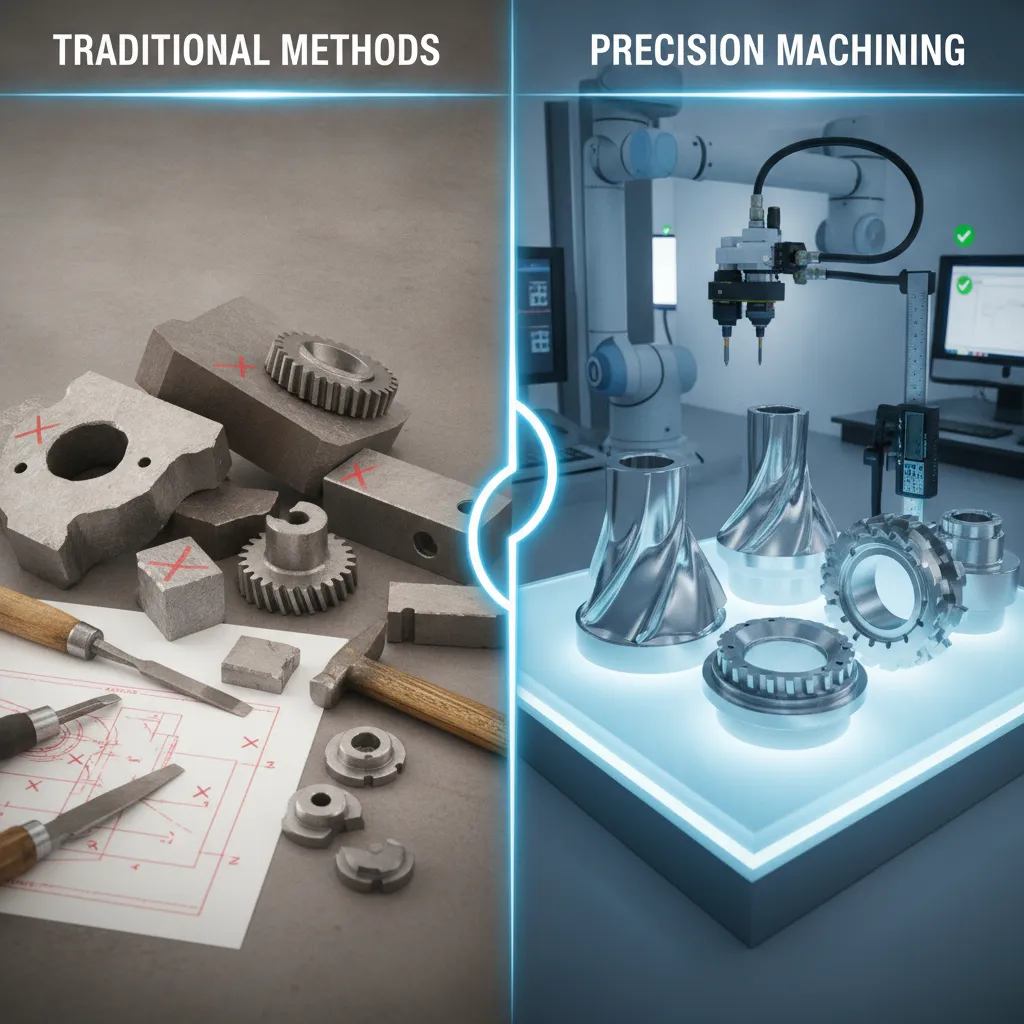
Frequently Asked Questions
What is the minimum order quantity for precision machining?
Minimum order quantities vary by supplier and process, but most precision machining shops accept batch runs rather than single-unit orders. Swiss lathe and automatic lathe production, for example, are optimized for medium-to-high volume runs where per-unit cost drops significantly. MFG SOLUTION handles batch production for parts up to 38mm in diameter, procurement managers should submit their part specifications to confirm volume thresholds and receive a quote within 8 hours.
How does precision machining handle complex geometries that standard CNC cannot?
5-axis CNC machines and Swiss lathe setups cut complex geometries in a single setup, eliminating repositioning errors that accumulate across multiple standard CNC passes. Standard 3-axis CNC requires multiple fixturing steps for undercuts, angled features, or tight-tolerance bores, each step introduces potential misalignment. Swiss lathe machining, used for long slender parts, holds tolerances that 3-axis turning cannot maintain at small diameters. The right process depends on part geometry, not a one-size approach.
What certifications should a precision machining supplier hold?
At minimum, look for ISO 9001:2015 (general quality management), ISO 13485:2016 (medical devices), and IATF 16949 (automotive components). Each certification requires documented process control, traceability, and third-party audits, not just internal claims. A supplier holding all three can serve electronics, medical, and automotive customers without requiring you to qualify separate vendors for each product line.
How long does a typical precision machining order take from quote to delivery?
Lead times range from 3 days to 6 weeks depending on part complexity, volume, and supplier capacity. Standard job shops often quote 4–6 week lead times. MFG SOLUTION compresses that cycle to 8 hours for a quote and 3 days for shipment on approved batch orders, a turnaround that matters most when a new product launch or supply chain disruption leaves no room for a multi-week sourcing cycle.
Why choose precision machining when lower-cost alternatives exist?
The question of why choose precision machining over cheaper alternatives comes down to total cost of ownership, not unit price. Lower-cost processes such as manual turning or basic CNC carry hidden costs: higher scrap rates, rework labor, failed audits, and delayed product launches. For any application where a dimensional non-conformance triggers a recall, a regulatory hold, or an assembly line stoppage, the per-part premium of precision machining is consistently the lower-cost option when measured across the full production and compliance lifecycle.
Conclusion
Precision machining earns its place in a supply chain when tolerances are tight, volumes are consistent, and quality failures carry real cost—rejected parts, failed audits, or delayed launches. Three things determine whether a supplier delivers on that promise: certified process control (ISO 9001, ISO 13485, IATF 16949), the right mix of machining methods for your part geometry, and a turnaround fast enough to match your production schedule. For a deeper technical perspective on why choose precision machining for demanding applications, the engineering advantages documented by HPPROC and the production benefits outlined by Focused on Machining both provide useful reference benchmarks.
If your current supplier runs 4–6 week lead times on small precision parts under 38mm, submit your part specifications to MFG SOLUTION. You’ll have a detailed quote in 8 hours, enough information to compare cost and lead time against what you’re paying now.
Recommended Articles
Explore more from our content library: