
2026-10-29
When Quick Turn Manufacturing Makes Sense for Your Project

Choose a quick turn manufacturing partner when schedule risk costs more than a per-unit price premium, prototype iterations, design validation before tooling investment, production gaps from a failed supplier, or a customer deadline that standard lead times can’t meet. Standard lead times make sense when volumes are high, designs are frozen, and per-unit cost matters more than speed. The decision comes down to comparing the cost of waiting against the cost of paying for speed on that specific project.

When Should You Choose Quick Turn Manufacturing Over Standard Lead Times?
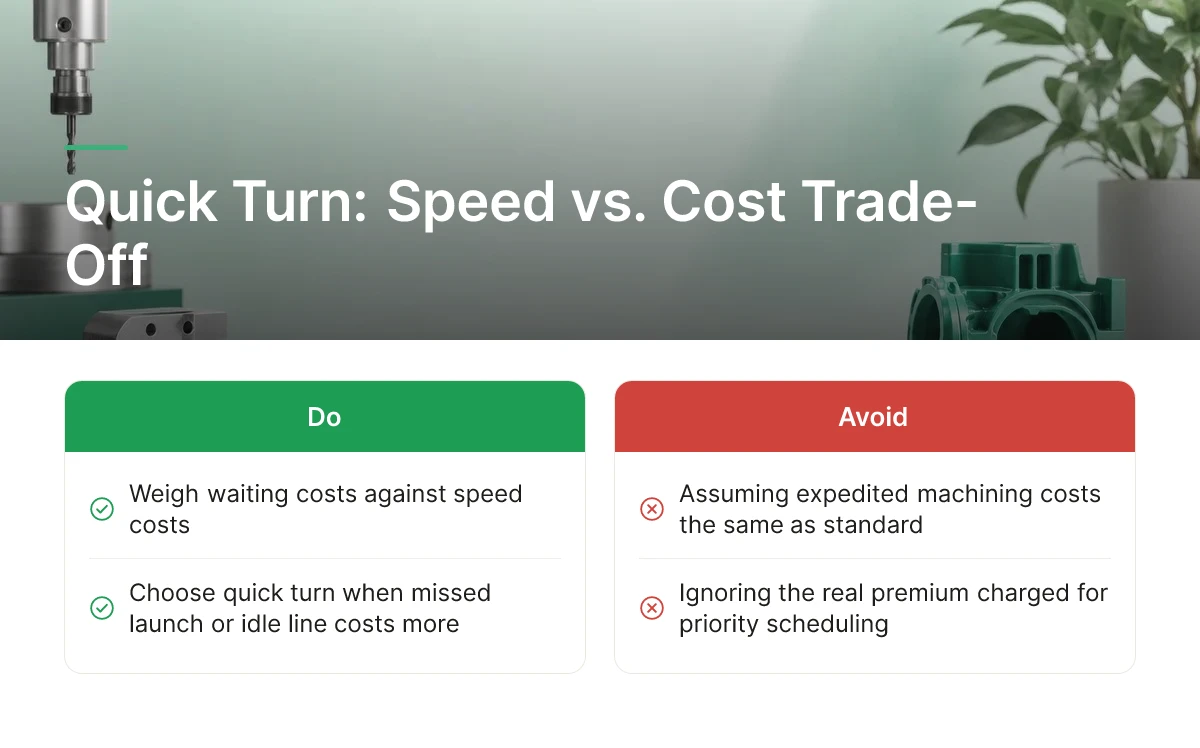
The decision is a straight tradeoff: weigh what waiting costs against what speed costs, and pick whichever number hurts less. A missed launch window, an idle assembly line, or a lost contract usually carries a steeper price tag than the premium charged for expedited scheduling.
That premium is real. Expedited machining runs typically cost more per part than standard scheduling, because a shop is reordering its queue, pulling overtime, or prioritizing your job ahead of others already in the system. The question isn’t whether quick turn manufacturing costs more, it almost always does. The question is whether the alternative, a delay, costs more than that.
Several concrete triggers tip the decision toward speed. A prototype needs validation before an engineering team commits to tooling. A production line hits a gap because a supplier failed to deliver or missed a date. An engineering change arrives late in the cycle and the next assembly step can’t wait. A customer has a contractual deadline that standard lead times simply won’t hit. Each of these situations shares one trait: the cost of schedule slippage outweighs the cost difference between expedited and standard production. As one overview of quick turn production notes in the context of circuit boards, the same logic applies broadly: speed exists to serve a deadline, not to replace good planning.
What Industries and Applications Benefit Most from Quick Turn Machining?
Aerospace and medical device programs lean on rapid turnaround more than most, because both involve frequent design iteration before a part design is locked. A medical device team validating a new fixture, or an aerospace supplier adjusting a bracket after a test failure, can’t afford to wait weeks between revisions. Automotive and electronics manufacturers turn to quick turn machining when a supply gap threatens an assembly line, a failed vendor or a part failure mid-run forces a fast replacement order to keep production moving. Startups use it differently: they need working parts to validate a design before spending on hard tooling, since committing to tooling on an unproven design is a costly mistake to reverse. This is also why many teams weigh custom prototyping against full production runs before deciding how much of a program should run through quick turn manufacturing versus a standard schedule.
How Do You Know If Your Project Timeline Requires Rapid Turnaround?
Run a simple self-check: calculate what a schedule slip costs you, in missed revenue, idle labor, or contract penalties, and compare it to the price difference between expedited and standard scheduling. If the slip costs more, rapid turnaround is the rational call, not a luxury. MFG SOLUTION’s 8-hour quoting and 3-day shipment window exists for exactly this calculation, giving procurement teams a fast answer when that comparison needs to happen quickly. This is precisely the scenario in which quick turn CNC machining proves ideal for prototypes rather than for every stable production run.
Standard lead times remain the better choice for stable, high-volume runs with a frozen design and no schedule pressure. If per-unit cost is the deciding factor and nothing is riding on this week versus next month, paying for speed buys nothing you need.
What Are the Real Cost Differences Between Quick-Turn and Standard Manufacturing?
The premium you pay for speed comes from schedule priority, setup amortization, and shift costs, not from the raw material itself. Understanding which line items actually move helps you negotiate rather than guess when evaluating a quick turn manufacturing quote.
What Cost Trade-Offs Should You Expect Moving from Standard to Rapid Turnaround?
Three mechanisms drive the cost gap between a rushed order and one left on a normal schedule. First, prioritizing your job means bumping other customers’ work in the queue, which a shop has to account for somewhere in its pricing. Second, hitting a tight deadline often means running machines on overtime or off-shift hours, which costs more than standard daytime production. Third, quick-turn orders are frequently small batches, so the fixed cost of setup, fixturing, and CNC programming gets spread across fewer parts instead of being amortized over a large run.
Material cost doesn’t change because you need parts faster. A block of aluminum or a bar of stainless steel costs what it costs regardless of your deadline. What changes is labor allocation, machine time scheduling, and how many units share the setup cost. This is a useful distinction when you’re reviewing a quote: ask the shop to break out setup and programming from material and machine-run time, so you can see exactly what you’re paying extra for. Guidance on short run manufacturing strategies covers this same cost-isolation approach for buyers evaluating low-volume orders.
Industry sources describe this pattern consistently: as order complexity, delivery speed, and volume all shift, fabrication and production costs move in response. A simple two-layer or single-operation part stays budget-friendly even on a short schedule, while a complex, multi-process part pushes into mid-range or premium pricing once speed is added on top of complexity.
Can You Get Volume Discounts on Quick-Turn Orders?
Yes, higher quantities still spread fixed costs across more units even when the overall schedule is compressed. If a shop builds a fixture and programs a CNC mill & turn operation for your part, that setup cost is the same whether you order 50 pieces or 500. Ordering more units on the same rapid schedule lowers your per-unit cost, because programming and fixturing get divided more ways, even though total turnaround time doesn’t change much.
This is where quick turn manufacturing decisions often get miscalculated. Buyers assume speed and volume savings are mutually exclusive, but a shop running automatic lathes or Swiss lathe equipment can often batch a larger quick-turn order without extending the ship date, since the machine time per part barely changes, only the setup cost per part drops. MFG SOLUTION, for example, quotes within 8 hours and ships within 3 days regardless of whether an order is a short prototype run or a larger production batch, choosing among CNC turning, Swiss lathe, cold forging, automatic lathe, and CNC mill & turn processes to keep the per-part economics reasonable at the requested quantity. The same logic behind quick turn tooling benefits applies here: reusable, low-overhead setups make it easier to scale a quick turn manufacturing order up without losing the speed advantage.
A Practical Cost Trade-Off Checklist
- What you gain: schedule certainty, faster time-to-market, reduced risk of a delayed product launch, and the ability to validate a design before committing to a large tooling investment.
- What you give up: some per-unit cost efficiency, less opportunity to optimize batch size against fixed costs, and sometimes less flexibility to shop multiple vendors for the lowest bid.
- What stays the same: raw material cost per part, regardless of how fast the order ships.

Which Materials and Part Geometries Can Actually Support Fast Turnaround Times?
Readily-stocked materials and simple, single-platform geometries machine fast; exotic alloys, heat treatment, and multi-setup parts add fixed time no amount of urgency removes.
Before requesting a rush quote, it helps to know which specs actually qualify for compressed lead times and which ones quietly reset the clock. Not every part is a realistic candidate for rapid turnaround, regardless of how badly a project needs it.
Are There Material Limitations That Prevent Certain Alloys from Being Machined on Quick-Turn Schedules?
Yes, common alloys that sit on the shelf machine fast, while exotic or special-order materials add procurement delays that speed alone cannot eliminate.
Aluminum alloys like 6061 and 7075, free-machining steels such as 1045, and standard stainless grades (303, 304, 316) are the backbone of quick turn manufacturing because shops and their suppliers keep them in stock in common bar and billet sizes. There’s no waiting on a mill order or minimum-quantity buy from a specialty supplier. Switch to a nickel superalloy, a titanium grade outside the common Ti-6Al-4V family, or a low-volume specialty polymer, and procurement time alone can erase whatever speed the machining process offers.
Secondary processing matters just as much as the raw material. Parts requiring extensive heat treatment, anodizing, plating, or certification testing, common in medical and aerospace-adjacent work, carry fixed process and cure times that run independently of how fast a machine can cut. A part that machines in an afternoon can still sit for days waiting on a heat-treat batch or a lab certificate.
What Part Complexity and Size Constraints Apply to Rapid Turnaround CNC Work?
Simple fixturing, few setups, and standard tolerances turn around fastest; oversized parts or extreme tolerance demands need specialized equipment with longer queues.
Geometry drives schedule as much as material. A part machinable complete on one platform, CNC turning or a mill-turn center, avoids the delays of re-fixturing on a second or third machine. Standard tolerances (generally ±0.05mm and looser) move through inspection quickly; tight tolerance stackups across multiple features demand slower cuts, more in-process measurement, and sometimes a second pass.
Size matters too. Very large parts or diameters beyond a shop’s standard capacity often require specialized fixtures or larger equipment that carries its own scheduling backlog. MFG SOLUTION, for example, structures its rapid 8-hour quoting and 3-day shipping around parts up to 38mm in diameter, a size band where its CNC turning, Swiss lathe, cold forging, automatic lathe, and mill-turn equipment can run without exception-handling delays. What a shop can expedite depends directly on what it owns in-house: 5-axis CNC and automatic lathes mean more geometries stay on the floor instead of getting sent out to a second vendor, which is often where fast timelines quietly fall apart in a quick turn manufacturing program.

How Do Minimum Order Quantities and Volume Affect Quick-Turn Pricing?
Order volume changes per-unit cost and setup economics, but it rarely changes whether a shop will take the job, most quick turn manufacturing providers accept single-piece orders alongside production batches.
What Are Typical Minimum Order Quantities for Quick-Turn Precision Machining?
Shops built around rapid turnaround typically carry low or no minimum order quantity, because one-off prototypes and bridge-production runs are a core part of their business, not an exception they tolerate. CNC turning, Swiss lathe work, and mill-turn operations don’t require dedicated tooling the way forging or injection molding do, so a shop can machine a single part without eating a tooling investment it needs to recover over thousands of units.
Compare that to cold forging or casting, where a die or mold can represent a substantial portion of program cost. Those processes often set minimums in the hundreds or thousands of units just to make the tooling spend worthwhile. MFG SOLUTION runs CNC turning, Swiss lathe, automatic lathe, cold forging, and CNC mill & turn side by side, which lets it route a low-volume part to a no-tooling process and a high-volume part to forging once the quantity justifies the die cost.
How Does Ordering a Single Prototype Differ from Ordering Production Quantities on a Fast Timeline?
A single prototype carries the full weight of setup and programming on one part, the machine still needs to be configured, the program written and proven out, and the first article inspected, regardless of whether you order one piece or one thousand. On a production-quantity order using the same fast schedule, that identical setup cost gets divided across every unit, which is why per-piece pricing drops as quantity climbs even though the calendar time to quote and ship stays compressed.
Expect pricing to move in qualitative tiers rather than a flat rate: low-quantity prototype orders sit at the budget-friendly-to-premium end per piece, while production volumes on the same expedited timeline land in a more cost-efficient per-unit range. A single prototype also tends to skip secondary tooling and custom fixturing that a production run would justify building, which keeps the one-off faster but limits how tightly some features can be controlled compared to a fixtured batch.
Quoting treats volume and urgency as one combined variable, not two separate charges added together. A shop evaluates batch size, material, tolerance, and deadline as a single picture before it issues a number, which is why two orders with the same quantity can price differently if one needs a 3-day ship and the other has three weeks of slack. This is one of the clearer ways quick turn manufacturing pricing differs from a standard quote built around a fixed catalog rate.
What Does the Quick-Turn Quoting and Production Process Actually Look Like?
The process runs in six steps: submit a drawing with full specs, receive a quote, confirm the order, enter machining with inspection built in, then ship, each step either adds or removes days depending on how complete your file is.
Quick turn manufacturing only works if the handoffs between steps are clean. A missing tolerance callout or an unclear finish note doesn’t stop production, it stalls the quote before production ever starts, which is where most of the delay actually happens.
How Long Does It Take to Get a Quote and Move from Quote to First Part Delivery?
Quote turnaround and shipping speed both depend on part complexity, but a well-specified job moves fast at every stage. MFG SOLUTION returns quotes within 8 hours of submission and ships completed orders within 3 days of order confirmation, covering CNC turning, Swiss lathe, cold forging, automatic lathe, and CNC mill & turn work on parts up to 38mm in diameter.
That timeline assumes a clear drawing. A simple turned part with standard tolerances moves through scheduling and machining faster than a multi-feature part needing tight geometric tolerances or a secondary finish. Treat any quoted timeline as tied to the part in front of you, not a fixed number that applies to every job regardless of complexity.
What Information Do You Need to Provide Upfront to Enable a Rapid Turnaround Quote?
Five details prevent nearly all quote delays: material spec, tolerances, finish requirements, quantity, and any certification requirement. Leave one out and the quote process turns into email back-and-forth instead of a same-day turnaround.
- Material spec: exact alloy or grade, not “aluminum”, 6061-T6 and 7075-T6 machine and price differently.
- Tolerances: critical dimensions called out explicitly, since default tolerances get assumed and often get it wrong.
- Finish requirements: anodize, passivation, plating, or as-machined, finish changes routing and lead time.
- Quantity: prototype quantities and production-batch quantities get quoted on different equipment and schedules.
- Certification needs: ISO 9001:2015, ISO 13485:2016, or IATF 16949 documentation requirements, flagged before quoting, not after the job is scheduled.
A drawing with all five lets an engineer, or an automated quoting system checking against known process capability, price the job in one pass. An ambiguous drawing forces a manual round trip: a request for clarification, a wait for your response, then a re-quote. That round trip is the single biggest avoidable delay in the entire process.
Once you confirm the order, the part enters the schedule, runs through in-process and final inspection, gets documented for traceability, and ships. Full process control means each of those steps is tracked and auditable, useful when a medical or automotive customer needs to show compliance later, not just receive a box.

Frequently Asked Questions
Does choosing rapid turnaround mean sacrificing part quality or inspection rigor?
No, speed and quality control are not mutually exclusive when the supplier builds rapid turnaround into its process rather than skipping steps. MFG SOLUTION ships within 3 days of order approval, but every batch still runs under ISO 9001:2015 process control, with documented and auditable inspection at each production stage.
Can quick-turn machining support certified industries like aerospace and medical devices?
Yes, provided the shop holds the relevant certifications rather than general machining credentials alone. MFG SOLUTION operates under ISO 13485:2016 for medical device components and IATF 16949 for automotive parts, so fast turnaround doesn’t mean stepping outside regulated process requirements.
What happens if a design change is needed mid-production on a fast-turn order?
A capable quick-turn partner pauses the affected batch, confirms the revised specification, and requotes before resuming, not after shipping bad parts. This is where engineering support matters: having 60+ engineering professionals available to assess a mid-run change quickly limits delay and scrap.
Is quick-turn machining only for prototypes, or can it support ongoing production?
Both, rapid turnaround applies to single prototypes and repeat batch production, not just one-off samples. MFG SOLUTION’s 5-axis CNC machines, 20 automatic lathes, and cold heading equipment are sized for recurring orders up to 38mm diameter, not only first-article runs.
How do you choose between a quick turn manufacturing partner and a standard-lead-time supplier for the same part?
Compare the two on schedule risk, not just price. If the part design is stable, volumes are predictable, and nothing depends on this week’s shipment, a standard supplier likely wins on cost. If a prototype, a supply gap, or a deadline makes waiting expensive, a quick turn manufacturing partner with transparent quoting and real certifications is usually the better fit, even at a higher per-unit price.
Conclusion
Rapid turnaround earns its keep when lead time risk, not unit cost, is what threatens your launch date, your production line, or your audit timeline. The decision isn’t speed versus quality; it’s whether your supplier has the certifications, equipment, and engineering staff to compress the schedule without cutting inspection steps. Before your next RFQ, map your actual constraint: is it the 4-6 week wait from your current vendor, or the part spec itself? If it’s the wait, submit specifications for a quote and compare the response time and documentation against what your current supplier offers today.
Recommended Articles
Explore more from our content library: