
2026-10-26
CNC Machining vs 3D Printing and When Each One Wins

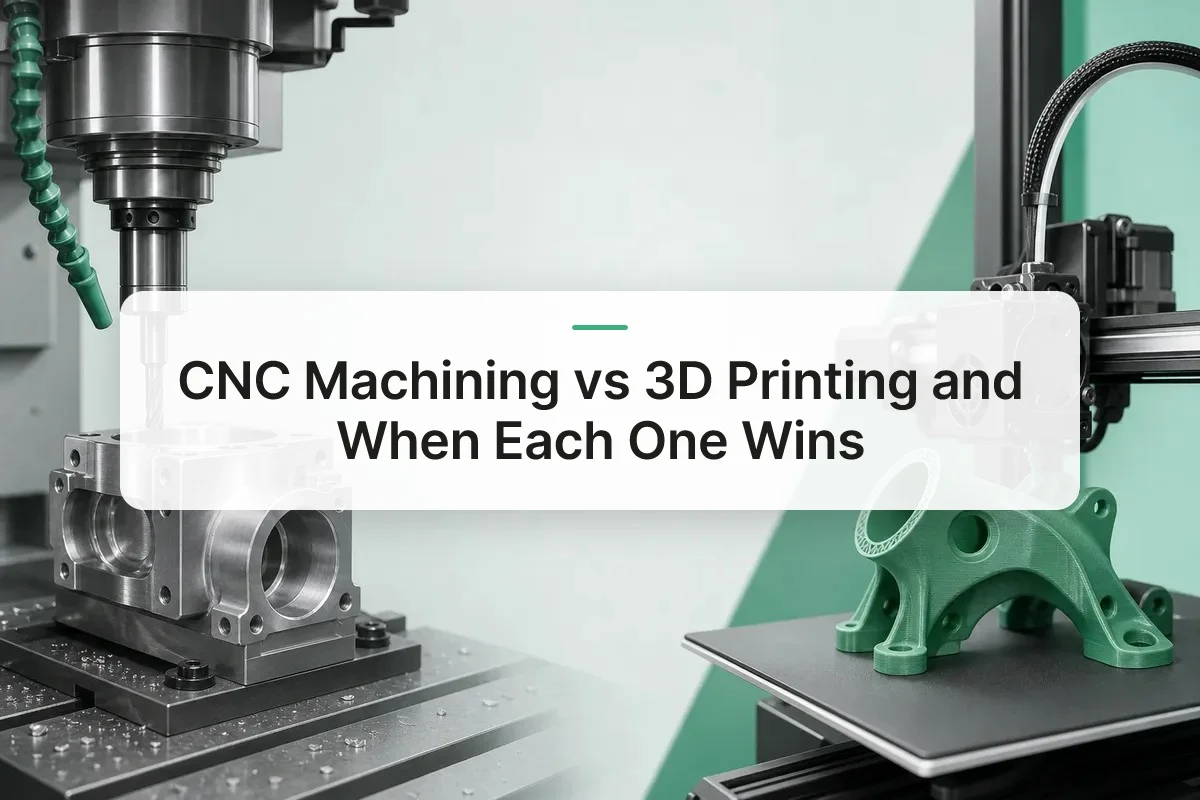
Understanding cnc machining vs 3d printing is essential. Choose CNC machining when you need tight tolerances, production-grade materials, or any volume above small prototype runs; choose 3D printing when you need a complex geometry fast, a one-off prototype, or a design that would be impossible or expensive to cut from solid stock. The two methods aren’t competitors so much as tools for different stages: 3D printing favors speed and shape freedom early in development, while CNC machining favors strength, surface finish, and repeatability once a part is ready to scale. Many manufacturers use both in the same workflow, printing patterns or jigs while machining the final functional parts.
CNC Machining vs 3D Printing: What Actually Separates Them?
One process cuts material away from a solid block; the other builds a part up layer by layer from nothing, that single difference explains almost every tradeoff between them.
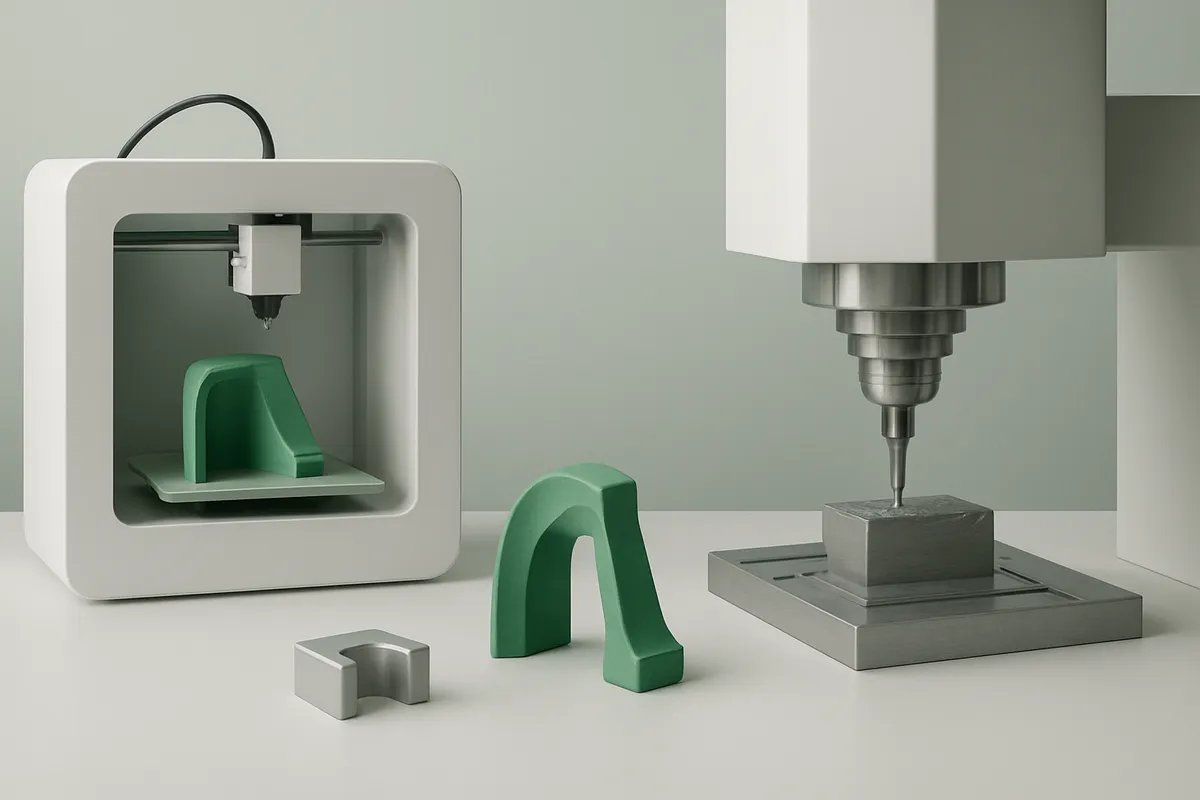
CNC machining is subtractive: a cutting tool removes material from a solid billet of metal or plastic until the finished geometry remains. Because the part starts as a single uniform block, the resulting piece has consistent grain structure and mechanical properties in every direction, what engineers call isotropy. 3D printing, or additive manufacturing, does the opposite. It deposits material in thin layers, fusing or curing each one before adding the next. That layer-by-layer construction is what makes complex internal geometries possible, but it also creates seams between layers that tend to be weaker than the layers themselves, especially under load applied perpendicular to the print direction. Surface finish follows the same logic: a machined part comes off the tool with a smooth, defined surface, while a printed part often shows visible layer lines unless it goes through secondary finishing.
Is a 3D Printer Considered a CNC Machine?
No, a 3D printer is not a CNC machine in the traditional sense, even though both are computer-numerically-controlled processes guided by digital files.
The “CNC” in CNC machining refers specifically to computer-controlled subtractive tools: mills, lathes, and Swiss-type machines that cut, drill, or turn stock into shape. A 3D printer uses the same underlying principle of computer-directed motion, but it adds material instead of removing it, which places it in a separate manufacturing category entirely. This terminology overlap causes real confusion for buyers comparing quotes, so it’s worth stating plainly: when someone asks about cnc machining vs 3d printing, they’re asking subtractive versus additive, not CNC versus “non-CNC.”
How Do Production Speed and Scalability Differ Between the Two Methods?
3D printing wins on speed for a single complex part because it needs no tooling or fixturing; CNC machining wins at volume once a program is set up.
A printer can start building a one-off part directly from a CAD file within minutes. CNC machining requires programming the toolpath and setting up fixturing first, time that doesn’t pay off until you’re running more than a handful of units. At MFG SOLUTION, that setup investment is handled during the 8-hour quoting process, so once a program is approved, batch runs ship within 3 days regardless of order size. Design changes reveal the same split: a printed part just needs a revised file and a reprint, while a machined part needs the program re-cut and often the fixture re-checked, making CNC slower to iterate but far more consistent once the design is locked.
How Do Precision, Accuracy, and Material Options Compare?
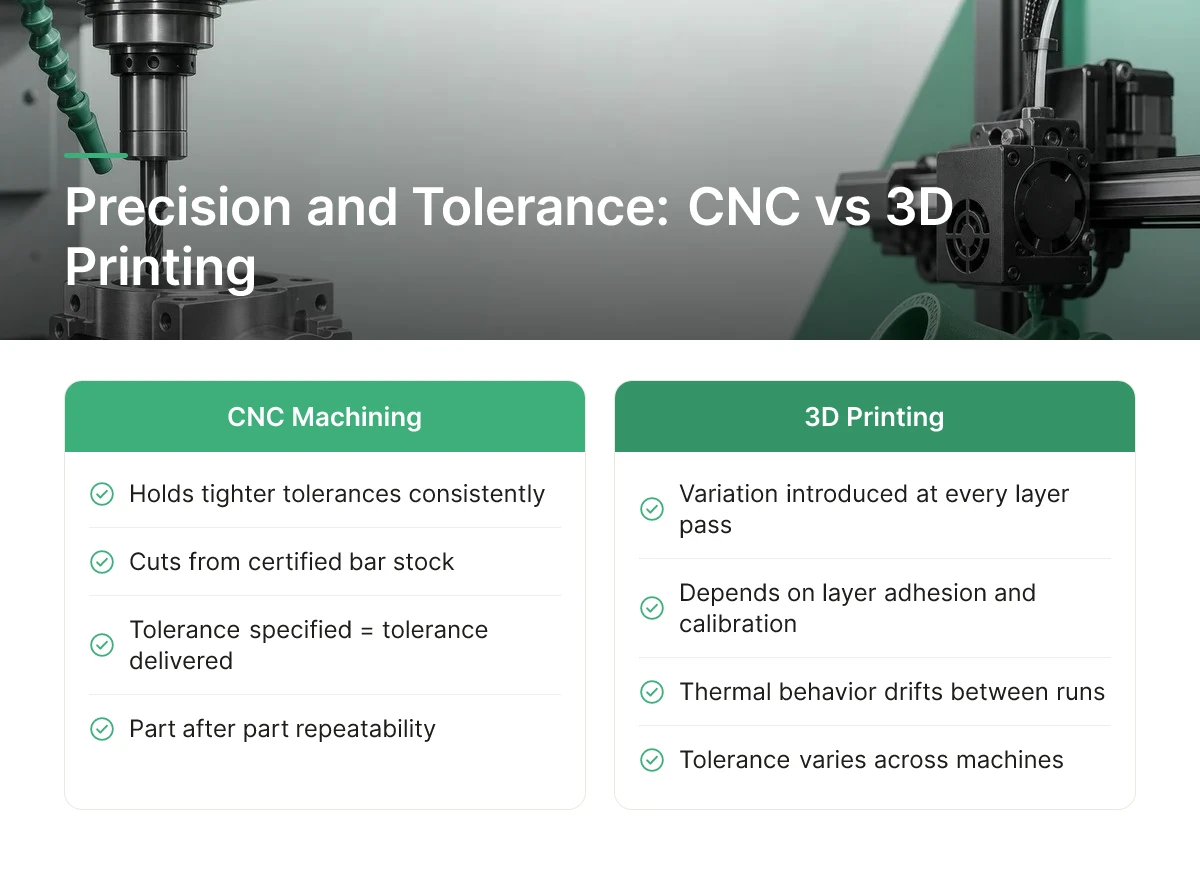
CNC machining holds tighter tolerances more consistently because a cutting tool removes material from a solid, uniform block, while 3D printing builds parts layer by layer with variation introduced at every pass. A Swiss lathe or CNC mill cuts directly into certified bar stock, so the tolerance you specify is the tolerance you get, part after part. Printed parts depend on layer adhesion, print bed calibration, and thermal behavior during the build, all of which can drift between machines, materials, and even print runs.
This is the core reason the question of CNC machining vs 3D printing keeps coming up for procurement teams writing specs: one process guarantees repeatable dimensional accuracy, the other offers design freedom at the cost of some precision. For parts with tolerances tighter than a few thousandths of an inch, or for production runs where the tenth part has to match the first, machining remains the more predictable choice.
What Material Constraints Exist for 3D Printing Compared to CNC Machining?
CNC machining cuts nearly any metal or engineering plastic available in solid, mill-certified form, aluminum, stainless steel, titanium, brass, nylon, PEEK, with full traceability back to a material certificate. 3D printing works from a narrower library: filaments, resins, or metal powders formulated specifically for a given printer and process. Load-bearing metal parts are the sharpest limitation. Metal additive processes exist, but qualified alloys, achievable density, and certified supply chains are far more restricted than what a machine shop can pull from standard stock.
For regulated industries, medical devices, automotive components, this matters beyond mechanical performance. MFG SOLUTION manufactures parts to ISO 13485:2016 and IATF 16949 standards using certified metal and plastic stock, which supports the material traceability documentation these industries require.
What Post-Processing and Finishing Costs Should You Factor Into Each Method?
CNC machining can deliver a smooth, usable surface straight off the spindle, though most parts still need deburring, and some benefit from secondary operations like anodizing or passivation. Printed parts typically come off the build plate with visible layer lines and support structures that must be removed before the part is usable. Depending on the process, finishing can mean manual support removal, chemical or UV curing, sanding, bead blasting, or a coating step just to approach the look and feel of a machined surface.
Mechanical properties diverge too. Printed parts are often anisotropic, weaker between layers than along them, because the bond between printed layers rarely matches the strength of the base material itself. Machined parts cut from solid stock retain consistent strength in every direction, which is why CNC remains the default for structural or load-bearing components rather than a print, regardless of how refined the printer’s resolution has become.
When Should You Choose CNC Machining Over 3D Printing, and Vice Versa?
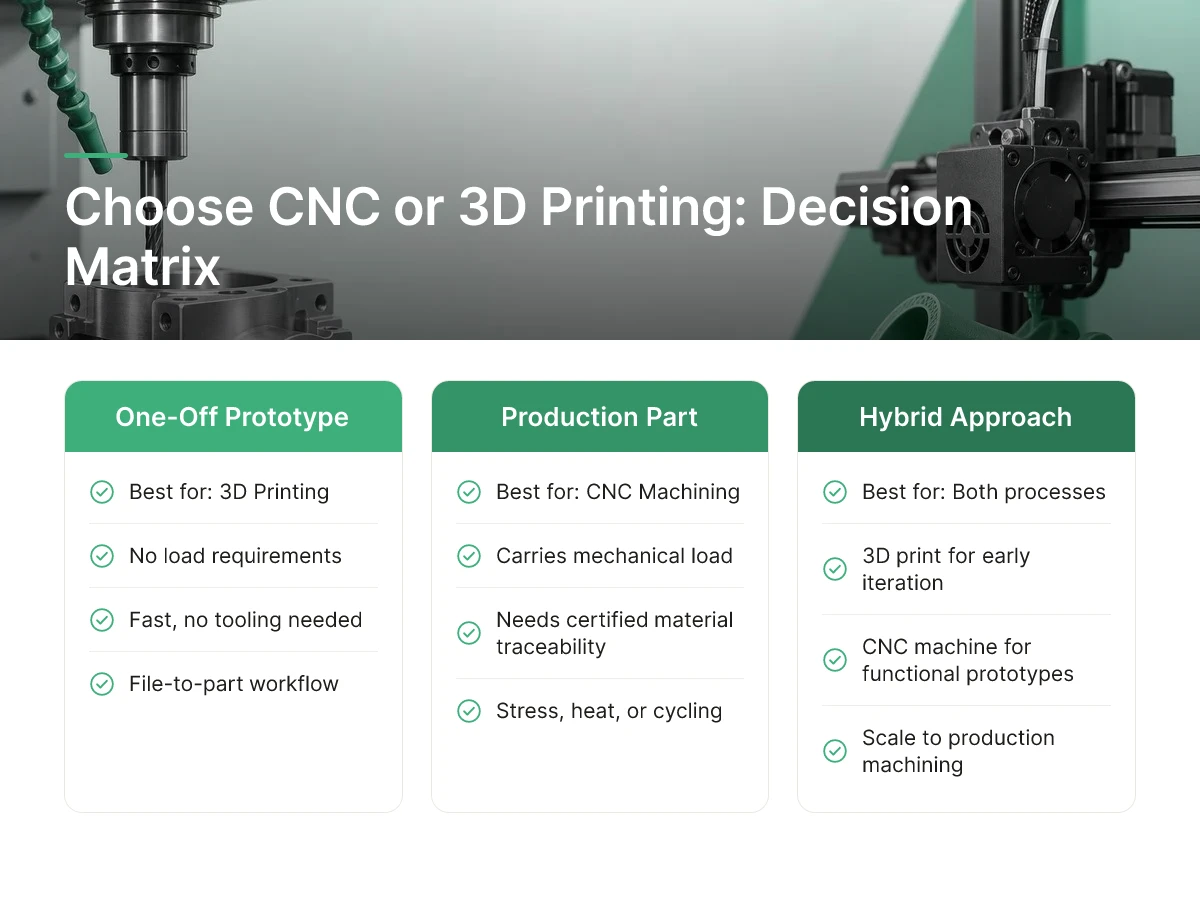
The choice comes down to three questions: is the part a prototype or a production part, does it need certified material traceability, and will it carry mechanical load in service.
Answer those three honestly and most cnc machining vs 3d printing decisions resolve themselves without much debate. A one-off prototype with no load requirements is a candidate for 3D printing almost by default, it’s fast and the file-to-part workflow skips tooling entirely. A production part destined for an assembly that bears stress, heat, or repeated cycling points toward CNC machining, where subtractive processes deliver the mechanical properties and surface finish that structural applications demand.
Material traceability is the question teams skip most often, and it’s the one that causes the most rework. Regulated industries, aerospace, medical, automotive safety systems, typically require certified material lots, documented heat treatment, and inspection records tied to each part. CNC machining from certified mill stock supports that paper trail directly; most 3D printing materials and processes do not carry the same certification infrastructure yet.
Can You Provide Real-World Examples From Aerospace, Medical, or Automotive Industries?
Each industry draws the line in a similar place: structural and regulated parts go to CNC, non-structural and iterative parts go to 3D printing. In aerospace, flight-critical brackets, structural housings, and load-bearing fittings favor CNC machining because certified aluminum and titanium alloys come with documented traceability that auditors expect; printed parts tend to serve non-structural brackets, ducting mockups, or rapid tooling fixtures used during assembly line setup.
Medical devices follow the same logic. Implants and surgical instruments usually require CNC-machined biocompatible metals, titanium, cobalt-chrome, certain stainless grades, machined to tight tolerances and traceable to ISO 13485-controlled processes, while anatomical models, surgical guides, and patient-specific planning tools suit 3D printing because they prioritize fast turnaround over long-term mechanical performance. MFG SOLUTION’s ISO 13485:2016 certification exists for exactly this split: it supports customers who need machined components with full process control and documentation that printed parts generally can’t match.
Automotive splits similarly. Fixtures, jigs, and low-volume custom brackets for the assembly line suit 3D printing because iteration speed matters more than long-term wear resistance. Engine components, drivetrain parts, and anything exposed to sustained heat or mechanical stress require CNC machining for the strength and heat tolerance that cast or printed polymers and most printed metals can’t reliably deliver at scale.
Will 3D Printing Eventually Replace CNC Machining for Precision Parts?
No, physics and material science keep the two complementary rather than making one obsolete. Layer adhesion in additive processes creates inherent anisotropy, meaning printed parts are often weaker along the Z-axis than within a single layer, a limitation CNC-machined parts from wrought or forged stock don’t share. Print bed size also caps part dimensions and batch economics in ways that automatic lathes and multi-axis CNC equipment don’t. For now, choosing between them case by case, rather than betting on one replacing the other, remains the more reliable strategy.
What’s the Real Cost Difference Between CNC Machining and 3D Printing?
CNC machining costs more upfront but gets cheaper per part as volume grows, while 3D printing costs less to start but stays flat no matter how many units you order.
The gap comes down to how each process spends money. CNC machining requires programming the toolpath, designing fixtures to hold the part, and setting up the machine before the first chip is cut. That setup cost is fixed, it doesn’t change whether you order 10 parts or 10,000. Spread across a larger batch, the setup cost per unit shrinks, and the per-part price drops toward the cost of material and machine time alone.
3D printing works almost the opposite way. There’s no tooling, no fixture design, and minimal file preparation, you upload a model and print. But each part still takes the full print time, layer by layer, regardless of how many you’ve already made. The tenth unit costs about the same as the first. That makes 3D printing cheap to start and expensive to scale.
What’s the Break-Even Point Between CNC and 3D Printing at Different Volumes?
At low volumes, single digits to a few dozen units, 3D printing usually wins because there’s no tooling investment to recover. You pay only for material and print time, which keeps a one-off prototype or a short run affordable.
As order quantity climbs, the math flips. CNC’s fixed setup cost gets diluted across more parts, and machining cycle times are typically faster than print times once a part is in production. Somewhere in the mid-volume range, the diluted setup cost plus faster per-part cycle time for CNC overtakes the flat, unchanging cost curve of 3D printing. Where exactly that crossover falls depends on part geometry, material, and tolerance requirements, so it’s worth evaluating case by case rather than assuming a fixed cutoff.
How Do Equipment Investment and Setup Costs Factor Into Total Cost of Ownership?
Cost per part is only half the picture, total cost of ownership includes equipment, labor, and waste. CNC machines represent a larger capital investment than most desktop or mid-range 3D printers, and running them well requires skilled machinists who can program toolpaths and set tolerances correctly. Maintenance costs also tend to run higher on multi-axis CNC equipment than on printers.
Material waste differs too. CNC machining is subtractive, it cuts away material, leaving scrap chips that get recycled but still represent lost raw stock. 3D printing is additive and generates less raw material waste, but many processes need support structures that are printed, then removed and discarded. Neither method is waste-free; the type of waste just differs.
For companies weighing cnc machining vs 3d printing on a budget, the practical sequence is usually this: prototype with 3D printing to validate form and fit quickly, then transition the design to CNC machining once order volume or mechanical performance requirements justify the setup investment. MFG SOLUTION supports that transition directly, parts up to 38mm in diameter move from CNC turning, Swiss lathe, or CNC mill & turn production with quotes delivered within 8 hours, so teams don’t lose momentum switching from a 3D-printed prototype to a production-ready machined part.
Can You Combine CNC Machining and 3D Printing in One Manufacturing Workflow?
Yes, most development pipelines use 3D printing for early iteration and CNC machining for functional prototypes and production, rather than treating cnc machining vs 3d printing as an either/or decision.
A typical hybrid pipeline starts with a 3D-printed concept model, often in a low-cost polymer, used purely to check fit, clearance, and ergonomics before anyone commits to a cutting program. Once the geometry is confirmed, the design moves to CNC machining for functional prototypes that need to behave like the real part, correct material, correct tolerance, correct surface finish. The same machined process then scales into the production run, so the part that validated the design is close to, or identical to, the part that ships.
3D printing also earns its place on the shop floor outside the part itself. Printed jigs, fixtures, and custom workholding can be produced in hours instead of the days or weeks a machined fixture takes, which matters most on low-volume or frequently changing jobs where a dedicated metal fixture would never pay for itself. That fixture then holds the actual workpiece steady while a CNC machine cuts it to tolerance, two processes, one setup.
What Are the Complementary Strengths When Using Both Methods Together?
Each method covers the other’s weak spot, so a single design can use both without compromise. 3D printing removes most geometric limits, making it the better choice for complex internal channels, lattice structures, or organic shapes that a cutting tool physically cannot reach. CNC machining delivers the dimensional accuracy, surface finish, and metal strength needed for load-bearing parts, press fits, and anything with a tight tolerance callout. Using both means the printed version proves the concept and the machined version carries the load.
How Do Digital Workflows Enable Hybrid Manufacturing Pipelines?
Both methods start from the same CAD file, which is what makes switching between them practical rather than a re-design project. The same model feeds a slicer for the 3D printer and CAM software for the CNC toolpath, so engineers adjust one file instead of building two separate design records. That shared digital base also means validation can happen on a printed part while CAM programming or fixture setup for the machined version runs in parallel, shortening overall development time instead of stacking the two processes end to end.
At MFG SOLUTION, that final machining stage covers CNC turning, Swiss lathe, cold forging, automatic lathe, and CNC mill & turn for parts up to 38mm in diameter, with quotes back within 8 hours so the switch from printed prototype to machined production part doesn’t stall the schedule.
Frequently Asked Questions
Is a 3D printer considered a CNC machine?
No, a 3D printer is not a CNC machine in the traditional sense, though both rely on computer-controlled motion to build parts. CNC machining removes material from a solid block using cutting tools, while 3D printers add material layer by layer. They share digital control and automation, but the processes work in opposite directions.
What material constraints exist for 3D printing compared to CNC machining?
3D printing offers a narrower range of production-grade materials, especially for load-bearing metal parts, compared to CNC machining. Most printers work with specific polymers or metal powders formulated for their process, and material properties can vary by print orientation. CNC machining cuts from standard mill and bar stock, giving access to a broader catalog of metals and plastics with consistent, documented properties—a key reason MFG SOLUTION machines parts to IATF 16949 and ISO 13485 standards.
Will 3D printing eventually replace CNC machining for precision parts?
Unlikely for the foreseeable future, since the two methods solve different problems rather than compete for the same jobs. CNC machining remains the standard for tight tolerances, repeatable surface finishes, and high-volume production of load-bearing components. Manufacturers increasingly treat the two as complementary—3D printing for prototypes and complex geometries, CNC machining for final production parts. Expect continued coexistence rather than replacement.
What’s the break-even point between CNC and 3D printing at different volumes?
3D printing tends to win on cost for very low quantities, while CNC machining becomes more economical as volume rises. The exact crossover depends on part geometry, material, and tolerance requirements, so there is no fixed unit count. For batch production of small precision parts up to 38mm, CNC methods like Swiss lathe and automatic lathe machining typically offer lower per-unit cost once quantities move beyond prototype runs.
How do equipment investment and setup costs factor into total cost of ownership?
Both methods carry setup costs, but CNC machining’s tooling and programming investment pays off faster at higher volumes. 3D printing avoids tooling costs entirely, which favors one-off or highly customized parts. Outsourcing to a machining partner removes the equipment investment question altogether, since the cost shifts to per-part pricing instead of capital expenditure.
Conclusion
Choosing between CNC machining and 3D printing comes down to three questions: how many parts you need, what tolerances and materials the application demands, and how fast you need them in hand. 3D printing wins for rapid prototyping and complex one-off geometries; CNC machining wins for repeatable precision, broader material options, and cost efficiency at production volume. For parts up to 38mm diameter requiring certified quality control, start by sending your specifications for a quote—MFG SOLUTION returns pricing within 8 hours and ships approved orders within 3 days, so you can validate the CNC route against your timeline before committing tooling budget.
Recommended Articles
Explore more from our content library: