
2026-10-27
7 Demands Oil and Gas Manufacturing Puts on Machined Parts

Precision-machined components in oil and gas equipment must hold tight dimensional tolerances, resist corrosion and extreme pressure or temperature, and come with documented traceability proving they meet industry specifications. These demands exist because a single out-of-spec part in a valve, pump, or wellhead can cause a failure that’s costly or dangerous to fix once in service. Oil and gas manufacturing puts seven specific pressures on machined parts: tight tolerances, material resilience, surface finish, certification and testing, extreme-condition durability, fast turnaround, and supply chain reliability. Meeting all seven at once is what separates a usable component from a liability.
In short, oil and gas manufacturing demands include:
- Tight dimensional tolerances for leak-free assemblies
- Corrosion- and temperature-resistant materials
- Pressure and temperature rating compliance
- Certified quality assurance and full traceability
- Durability under extreme and remote operating conditions
- Fast, reliable turnaround without sacrificing spec
- Resilient, transparent supply chain sourcing
1. Tight Dimensional Tolerances for Leak-Free Assemblies in Oil and Gas Manufacturing
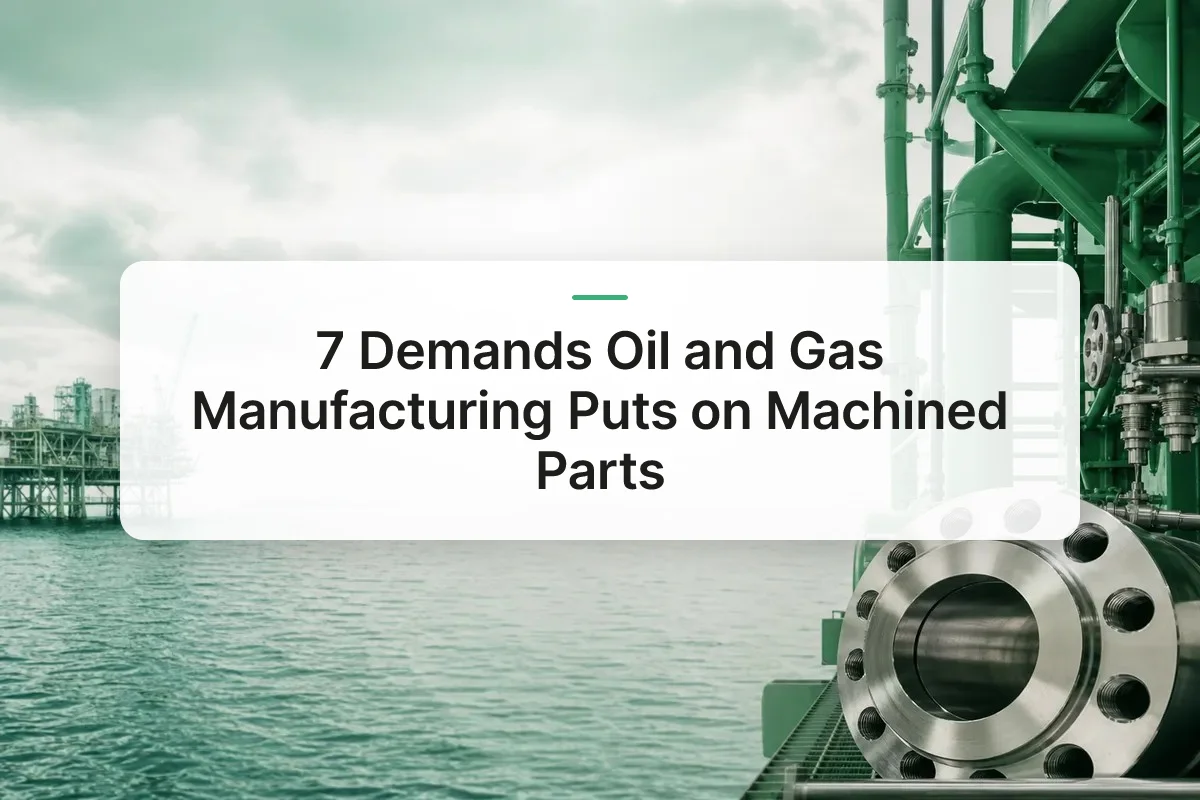
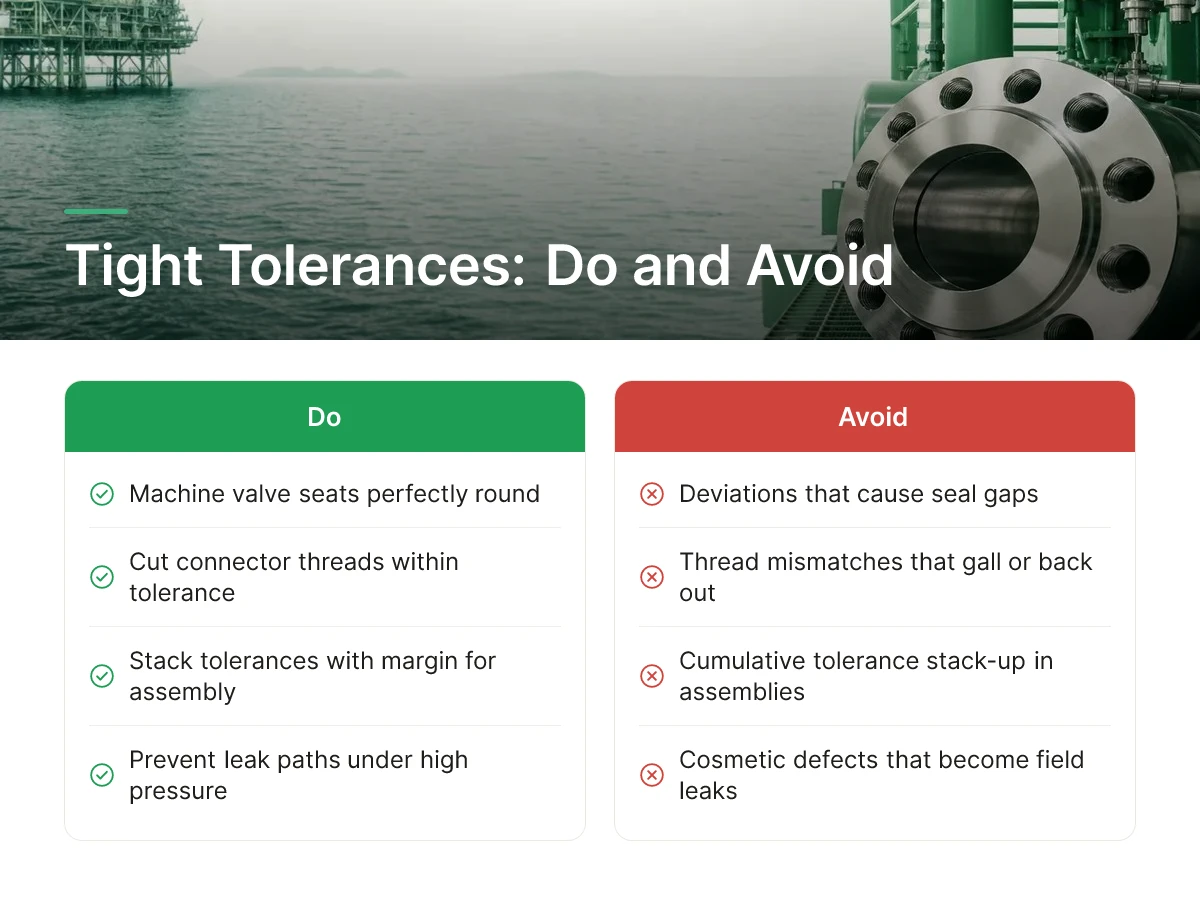
Oil and gas manufacturing requires tolerances tight enough to prevent leak paths, thread mismatches, and seal gaps under sustained high pressure.
A valve seat machined a few thousandths out of round will not seal evenly against its mating surface, and a connector thread cut outside tolerance can gall or back out under vibration. These aren’t cosmetic defects, they’re failure modes that show up as field leaks, often after the part is already installed downhole or subsea.
The problem compounds in multi-part assemblies. A fitting with a 0.002-inch deviation stacked against a mating housing with its own 0.002-inch deviation can add up to a gap large enough to compromise a seal, even though each individual part passed inspection on its own. This is why tolerance stacking analysis matters as much as single-part tolerancing in sealing-critical assemblies, a point explored further in this overview of how precision machining supports performance in oil and gas equipment.
What specific tolerances and surface finishes are required for oil and gas machined parts?
Valve components, fittings, and connectors commonly require tolerances in the thousandths of an inch, paired with controlled surface finishes to support metal-to-metal or elastomer seals. Engineers specifying high-pressure sealing systems should look for suppliers running in-process inspection, not just final inspection, catching dimensional drift mid-batch avoids scrapping an entire run after the fact.
2. Corrosion- and Temperature-Resistant Materials
Oil and gas manufacturing pushes material selection well past standard carbon steel toward alloys built to survive sour gas, saltwater, and heat cycling.
Standard carbon steel is cheap and easy to machine, but it corrodes fast in chloride-rich or hydrogen sulfide (H2S) environments common in sour service wells. That exposure, not cost alone, drives selection toward duplex stainless steel, Inconel, and precipitation-hardened grades like 17-4 and 15-5 stainless, which resist pitting and stress corrosion cracking under combined pressure and chemical load.
Alloy choice also changes the machining process itself. Harder, corrosion-resistant alloys demand different tooling, slower speeds, and more careful heat management to avoid work hardening or dimensional drift during cutting. For a closer look at how specialized shops handle these materials, see this resource on high accuracy machining for the oil and gas sector.
Which materials are best suited for high-pressure and high-temperature oil and gas applications?
Downhole, subsea, and wellhead component buyers generally specify duplex stainless, Inconel, or martensitic precipitation-hardened stainless depending on the specific pressure, temperature, and H2S exposure profile. The differentiator that matters most at this stage: material certificates and mill test reports must match the actual alloy heat used in production, not just the generic spec sheet, since heat-to-heat variation affects corrosion performance in service.

3. Pressure and Temperature Rating Compliance
Components must hold their rated pressure and temperature class for years without deforming, so wall thickness and feature geometry are never arbitrary.
Pressure class thinking, the kind that governs wellhead and flow-control hardware design, sets minimum wall thickness, bore geometry, and fillet radii well before a part reaches the machine. Thermal cycling adds another layer: repeated heating and cooling changes clearance fits, so machinists build in calibrated clearance allowances rather than machining to a single nominal dimension.
Material selection, covered above, interacts directly with pressure and temperature requirements, a higher-pressure class often forces a harder alloy, which then changes achievable tolerances and cycle time.
Buyers of wellhead, manifold, and flow-control components benefit most from suppliers who simulate and validate critical dimensions before cutting. Catching a geometry or clearance problem in simulation is far cheaper than discovering it after machining a long-lead alloy that can take weeks to resource.
4. Certified Quality Assurance and Full Traceability
Buyers need an auditable paper trail connecting every machined part back to its material lot, inspection data, and process records.
ISO 9001:2015 certification is the baseline framework procurement teams look for when qualifying a precision machining supplier, since it requires documented process control from incoming material through final inspection. MFG SOLUTION manufactures to ISO 9001:2015, ISO 13485:2016, and IATF 16949 with full process control, meaning every step is tracked and documented for audit.
Traceability in practice means lot tracking tied to material certificates, with dimensional inspection reports linked to each production batch rather than a single sample. Non-destructive testing and CMM dimensional inspection fit into this chain at defined checkpoints, confirming that internal defects and critical dimensions stay within spec before parts ship.
What certifications and compliance standards must precision-machined oil and gas parts meet?
Procurement teams preparing for operator audits need documentation that holds up years after shipment, not just a certificate of conformance at time of delivery. Consequence of equipment failure in this sector is severe enough that operators routinely request records long after a part has gone into service.

5. Durability Under Extreme and Remote Operating Conditions
Subsea and remote wellsite components are machined for years of unattended service because repair access is limited or nonexistent.
A subsea tree or downhole tool can’t be pulled for a quick fix the way onshore midstream equipment can during routine maintenance windows. That gap in accessibility pushes design margins higher: vibration resistance, sand and particulate tolerance, and thermal cycling allowances all get built into the machining spec rather than left to the material alone.
Onshore midstream equipment still faces harsh conditions, but scheduled maintenance access changes the calculus, tighter corrosion allowances and redundant sealing matter less when a technician can inspect and service the part regularly.
How do offshore, deepwater, and harsh-environment applications change machining requirements?
Operators specifying subsea trees, downhole tools, or remote compressor station parts should expect redundant sealing features and extra corrosion allowance machined directly into the part geometry, not treated as an afterthought of material choice. This distinction, designing margin into the machining spec itself, is what separates components rated for true remote deployment from parts simply upgraded to a tougher alloy. This kind of durability thinking is a core reason CNC machining plays such a vital role in the oil and gas industry.
6. Fast, Reliable Turnaround Without Sacrificing Spec
Fast-turn replacement parts matter most when an unplanned shutdown is costing money every hour, but oil and gas manufacturing still demands full inspection rigor on every piece that ships.
A rig or pipeline failure doesn’t wait for a standard six-week lead time. Downtime on critical rotating or pressure-containing equipment forces MRO teams to source a replacement fast, often for a part that was never meant to fail this early. The pressure to skip steps is real, and it’s exactly where defects slip through if a supplier cuts inspection to hit a date.
How can rapid prototyping and small-batch production reduce time-to-market for oil and gas components?
Rapid prototyping and small-batch runs let a buyer validate fit, form, and function before committing to a full production order, catching design issues on one part instead of fifty. Cost varies by what you’re machining: standard stock shapes in common alloys sit at the budget-friendly end, while custom runs in exotic, corrosion-resistant alloys land in premium territory because of material cost and machining difficulty, not supplier markup.
This approach suits MRO buyers and engineers who need a short run or a single replacement component, not a warehouse of inventory. The real differentiator isn’t shop floor speed, it’s quoting speed. MFG SOLUTION returns quotes within 8 hours and ships within 3 days, which shortens the front end of the lead time that buyers usually lose the most days to.
7. Resilient, Transparent Supply Chain Sourcing
Part lead times in oil and gas manufacturing are driven by specialty alloy availability and mill production schedules, not by politics itself.
When a mill is backlogged on a nickel alloy or duplex stainless heat, that delay moves straight downstream to the machine shop and then to the buyer waiting on a valve body or connector. Geopolitical disruption matters only insofar as it tightens that mill capacity or restricts where raw material can legally move.
What supply chain disruptions or sourcing challenges are currently affecting oil and gas component manufacturers?
Material scarcity for corrosion-resistant and high-temperature alloys remains the most direct constraint, and it hits hardest when a buyer has only one qualified mill or one approved supplier. Dual-sourcing raw material and qualifying a second machining supplier removes that single point of failure, if one source stalls, production doesn’t stop.
Domestic versus offshore sourcing changes more than cost. Domestic partners typically offer faster communication cycles and tighter IP control; offshore partners that hold recognized certifications can still deliver strong quality oversight, provided documentation and audit access are built into the relationship from the start.
This matters most for procurement teams running multi-year equipment programs who can’t afford a surprise six-month material delay mid-contract. The differentiator worth asking about upfront: does the supplier hold safety stock or quote material lead time before you commit, rather than discovering the delay after the purchase order is signed.
8. Advanced CNC and Automation for Repeatable Precision
Modern multi-axis CNC and in-process automation hold tighter tolerances batch after batch by cutting the manual steps where error gets introduced.
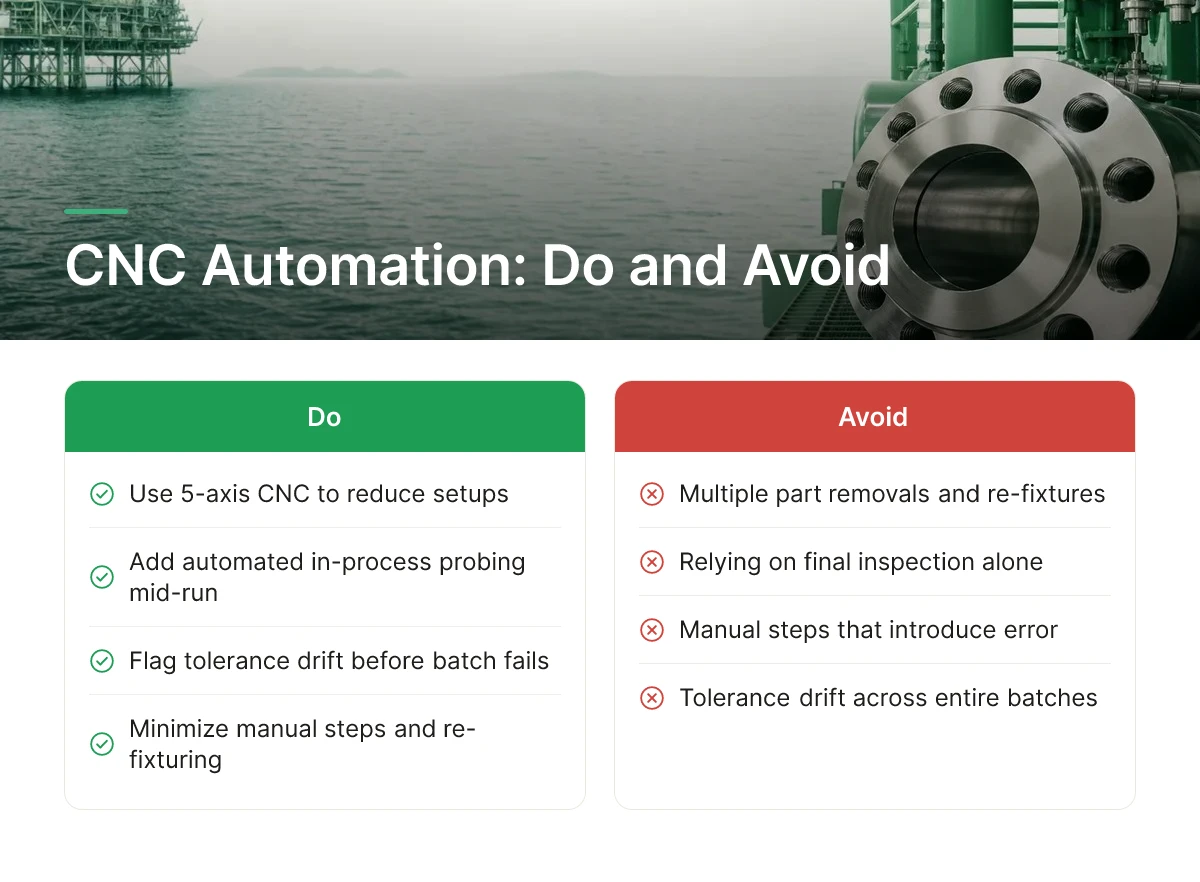
Every time a part is removed and re-fixtured on a machine, there’s a chance of misalignment. 5-axis CNC machining reduces the number of setups a part needs, which directly reduces how many chances there are to introduce that error. Automated in-process probing adds another layer of control, it measures features mid-run and flags tolerance drift before a whole batch runs out of spec, rather than after a final inspection catches it too late.
How are advanced CNC techniques and automation improving precision and reducing costs for oil and gas parts?
Fewer setups and mid-run correction mean less scrap and fewer reworked parts, which lowers the effective cost per good part even when per-hour machine rates stay flat. This is part of why precision manufacturing matters so much to operators who can’t afford repeated downtime.
What role do small-diameter machined components play in compressors, pumps, and valves?
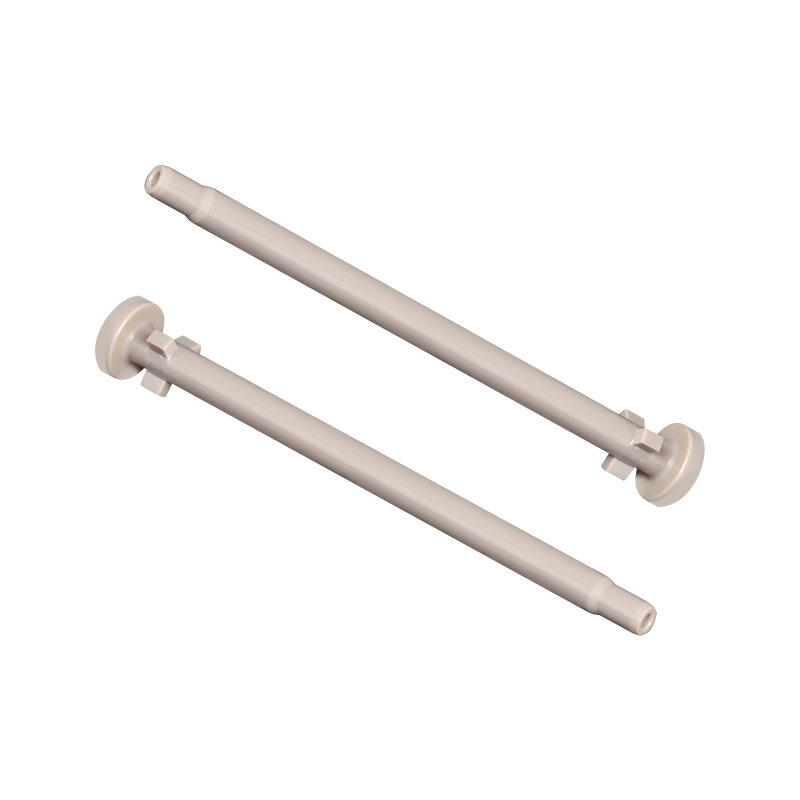
Small-diameter parts, seals, pins, fittings, valve stems, often carry the tightest tolerances in the whole assembly because they control pressure and flow at the point of failure. CNC turning handles simpler round geometries efficiently, Swiss machining holds tolerance on long, slender parts prone to deflection, and mill-turn combines milling and turning in one setup for complex small parts with off-axis features. MFG SOLUTION runs all three methods plus 5-axis equipment for parts up to 38mm in diameter, matching the process to the geometry instead of forcing one method on every job.
This fits buyers who need consistent quality across large volumes, where cycle-to-cycle variation matters more than raw cycle speed, a slightly slower process that holds tolerance every time beats a faster one that drifts.
How to Choose the Right Machining Partner for Oil and Gas Components
Evaluate a machining partner against four concrete criteria: certifications held, materials capability, tolerance capability, and a documented turnaround track record.
Start with certifications, ISO 9001:2015 for quality management and, where applicable, IATF 16949 for automotive-adjacent supply chains signal a documented process, not just a claim of quality. Confirm the shop has actually machined the alloys your application needs, not just common stock material, and ask for tolerance capability data on parts similar in size to yours. For a broader breakdown of what suppliers should offer, review this guide to precision oil and gas parts manufacturing.
Weigh cost tier against the cost of field failure, not against price alone. A budget-friendly quote on a component that fails downhole or offshore costs far more in nonproductive time and safety exposure than the premium a qualified supplier charges for exotic-alloy, tightly toleranced work.
When vetting a potential partner for oil and gas manufacturing work, confirm the following before signing a purchase order:
- Certifications held (ISO 9001:2015, ISO 13485:2016, IATF 16949, or equivalent)
- Materials capability for the specific alloys your application requires
- Tolerance capability data on comparable parts, not just general claims
- Traceability documentation, including lot tracking and material certificates
- In-house or qualified-partner non-destructive testing (NDT)
- Capacity signals: equipment list, engineering headcount, and automatic lathe count
What environmental compliance standards impact the design and manufacturing of oil and gas machined components?
Verify environmental and safety compliance directly with the supplier rather than assuming it, ask which standards apply to your specific component and request documentation, since certification scope varies by shop and by part type.
Ask prospective suppliers pointed questions: What traceability documentation ships with each lot? Is non-destructive testing (NDT) available in-house or through a qualified partner? Then check capacity signals, equipment list, engineering staff headcount, automatic lathe count, as a proxy for whether they can actually scale with a multi-year program rather than just a one-off order.

Frequently Asked Questions
How tight must machining tolerances be to prevent premature component failure in the field?
Most oil and gas components require tolerances in the range of ±0.001 to ±0.005 inches, depending on the part’s function and operating pressure. Sealing surfaces on valves and connectors demand the tightest control, since even minor deviations create leak paths under cyclic pressure and temperature swings. Tolerance requirements should be set by the failure consequence, not a generic shop default, a downhole fitting and a surface bracket don’t need the same precision.
What types of precision-machined parts are most commonly used in oil and gas systems?
Valves, pump components, connectors, fittings, and pressure-control fixtures make up the bulk of precision-machined parts in oil and gas systems. These parts appear across upstream drilling equipment, midstream pipeline hardware, and downstream refining machinery. Many are small-diameter components, seals, sleeves, and threaded fittings, that depend on CNC turning or Swiss lathe processes to hold tolerance under repeated pressure cycling.
What case studies demonstrate performance gains from high-precision machined parts in oil and gas applications?
Published case data specific to oil and gas performance gains is limited in available sourcing, so treat vendor claims with caution. Industry sources consistently link tighter tolerance control and corrosion-resistant material selection to fewer field failures and longer service intervals. Ask any supplier for documented process control records and material certifications rather than relying on unverified before-and-after figures.
How do pressure, temperature, and corrosion resistance requirements drive component specifications?
Pressure, temperature, and corrosive exposure together dictate material grade, wall thickness, surface finish, and tolerance class for every component. High-pressure drilling equipment needs materials and geometries that resist deformation under extreme loads, while downstream equipment handling sour gas or saltwater requires corrosion-resistant alloys and protective treatments. These three factors interact, a spec sheet that only addresses pressure without accounting for corrosive media invites premature failure.
Why is supplier experience specific to oil and gas manufacturing worth confirming before placing an order?
Oil and gas manufacturing involves alloy selection, tolerance control, and certification requirements that differ meaningfully from general industrial machining. A supplier without direct oil and gas manufacturing experience may lack the process controls, material sourcing relationships, or documentation habits that operators expect during an audit. Asking for examples of comparable parts the shop has produced for this sector is a reasonable screening step before committing to a larger order.
Conclusion
Precision requirements in oil and gas components come down to three things: tolerance control tight enough for the failure consequence, material selection matched to pressure and corrosion exposure, and documented process control that holds up to audit. Don’t accept a supplier’s “precision” claim without seeing their certifications and tolerance records. For teams sourcing small machined parts under 38mm, fittings, connectors, valve components, MFG SOLUTION provides ISO 9001:2015, ISO 13485:2016, and IATF 16949 certified production with quotes within 8 hours and shipment within 3 days. Start by submitting one current part drawing for a quote and compare the turnaround against your existing vendor’s lead time.
Recommended Articles
Explore more from our content library: