
2026-10-25
5 Rapid Prototyping Manufacturing Pitfalls to Avoid Early

The most common rapid prototyping manufacturing pitfalls are skipping design-for-manufacturability checks, choosing the wrong process for the part’s end use, ignoring the material gap between prototype and production, underestimating quality documentation, and failing to plan the handoff to full production. Each mistake adds rework cycles that erase the speed and cost advantages prototyping is supposed to deliver. Avoiding them early means validating tolerances, materials, and production transition points before the first part is cut, not after.
Across every one of these pitfalls, the pattern is the same: rapid prototyping manufacturing only delivers its promised speed and cost advantage when tolerances, materials, and process choices are locked before cutting starts, not corrected afterward. The sections below walk through each failure point in order, along with the specific checks that prevent it.
1. Skipping Design-for-Manufacturability Checks Before Rapid Prototyping Manufacturing Begins
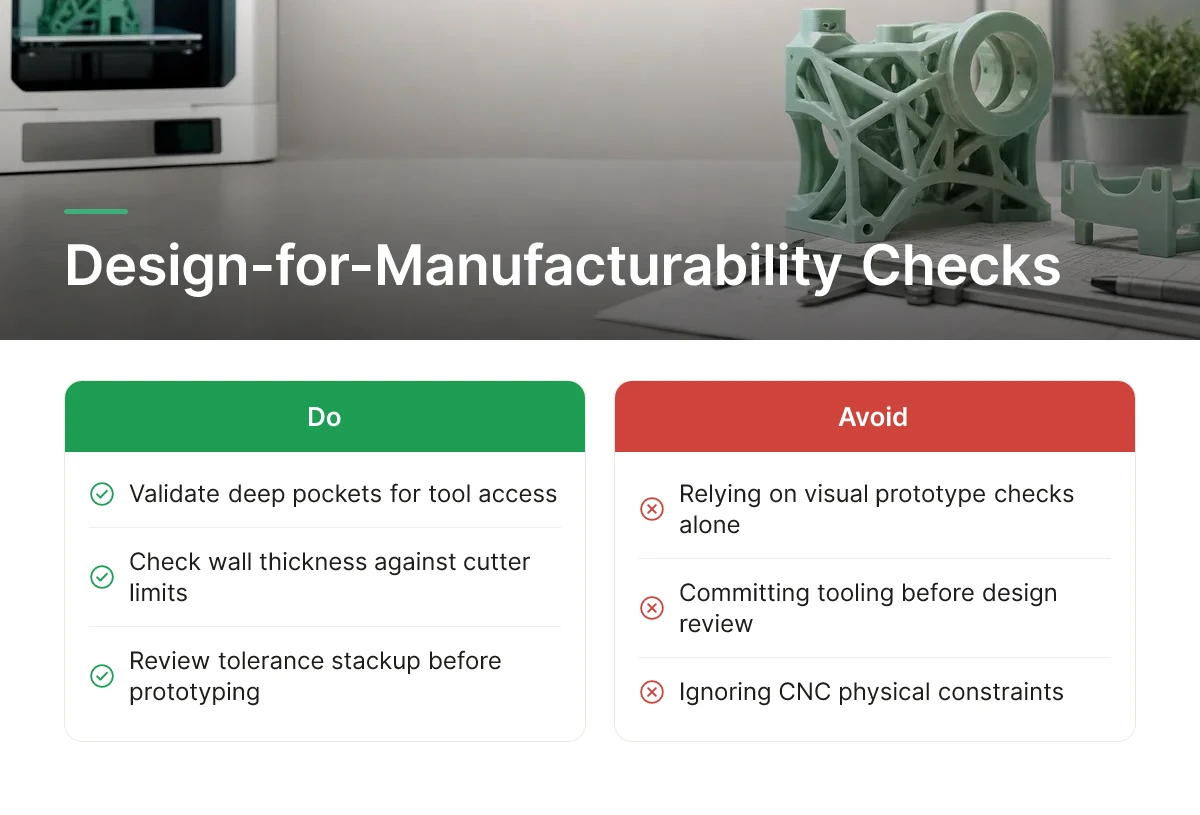
Parts that print or prototype cleanly can still be unmachinable at production volume because CNC tooling has physical constraints a 3D printer never faces.
A deep pocket with no tool access, a wall thinner than the cutter can support, or a tolerance stackup that looks fine on paper can all pass a quick visual prototype check and still fail the moment a CNC shop tries to cut them in batch. The cost shows up later, not immediately. Each design revision requested after tooling or fixturing has already been committed forces a re-quote and resets the machine’s changeover schedule, which is exactly the delay rapid prototyping manufacturing is supposed to eliminate.
This mistake is most common on teams that move straight from a concept sketch or a 3D-printed model into CNC quoting without a dedicated review step in between. Design for Manufacturability review connects design intent and production reality, and Fresh Consulting frames it as the throughline that runs across every stage from concept to final part. Their overview of rapid prototyping methods and best practices covers this review step in more depth.
The differentiator that matters here: a DFM check built around the CNC process itself, tool access, fixture points, achievable tolerances on the actual machine class, catches far more than a generic 3D-printing checklist, which assumes a different set of physical limits entirely.
A workable DFM review for rapid prototyping manufacturing typically checks:
- Tool access for every internal feature, pocket, or undercut on the part
- Minimum wall thickness against the cutter diameter planned for production
- Tolerance stackups validated against the actual machine class, not a generic assumption
- Fixture points confirmed before the first production-intent part is cut
- Material removal sequence checked for distortion risk on thin or asymmetric sections
2. Choosing the Wrong Prototyping Process for the Part’s End Use
Pick a prototyping method based on what the prototype needs to prove, not on which process is fastest or cheapest to run.
A prototype built to confirm form and fit, does it mount correctly, does it clear the housing, does it look right, asks a completely different question than one built to confirm mechanical performance under load, vibration, or repeated cycling. Stratasys separates these use cases explicitly, noting that prototyping strategy should match the validation goal rather than defaulting to one method for every stage. Their guide to rapid prototyping methods and processes breaks down which approach fits which validation goal. A printed part can nail the form check and still say nothing reliable about how a machined part will actually perform.
The mechanism behind the mistake: a non-machined prototype can mislead a team about tolerances and surface finish, because the geometry looks right while the dimensional precision and surface characteristics of the eventual CNC part are never actually tested. Teams validating functional, load-bearing, or regulated components need a rapid prototyping manufacturing process that matches the production method, not just the production shape.
How do rapid prototyping and traditional CNC manufacturing work together in a single operation?
Low-volume CNC runs can serve as the prototype step itself, producing parts in the actual production material and process so form, fit, and function get validated in one pass rather than two separate builds.
3. Ignoring the Material and Tolerance Gap Between Prototype and Production Parts
A prototype that passes testing in a substitute material or looser tolerance band can still fail once the part switches to its specified production alloy.
Softer, easier-to-cut materials get chosen for prototype runs because they machine faster and cost less per iteration. The problem surfaces when the production alloy, a hardened steel, a medical-grade titanium, an automotive aluminum spec, behaves differently under load, heat, or fatigue than the stand-in material did. The prototype’s test results don’t transfer, and that gap often isn’t caught until the first production batch fails inspection.
Tolerance drift compounds the issue. Prototype tolerances are frequently looser than the final production drawing calls for, which creates false confidence: a part that “fits” in the prototype stage can fall outside spec once production tolerances tighten. This mistake matters most on medical, automotive, and aerospace-adjacent parts, where material certification and dimensional conformance aren’t optional.
How do material properties and tolerances differ between rapid prototyping and final production parts?
Prototype materials and tolerances are often chosen for machinability and speed, while production specs are locked to certified alloys and tighter dimensional control, the two frequently diverge.
MFG SOLUTION addresses this by manufacturing to ISO 9001:2015, ISO 13485:2016, and IATF 16949 standards with full process control, meaning every material lot and dimensional check is tracked and documented from the prototype stage forward. That traceability is the piece generic 3D-printing guides never cover, because material certification and audit trails aren’t a concern for a printed plastic mockup, they’re a hard requirement for a machined part going into a medical device or vehicle.
4. Underestimating Scope Creep and Timeline Overruns
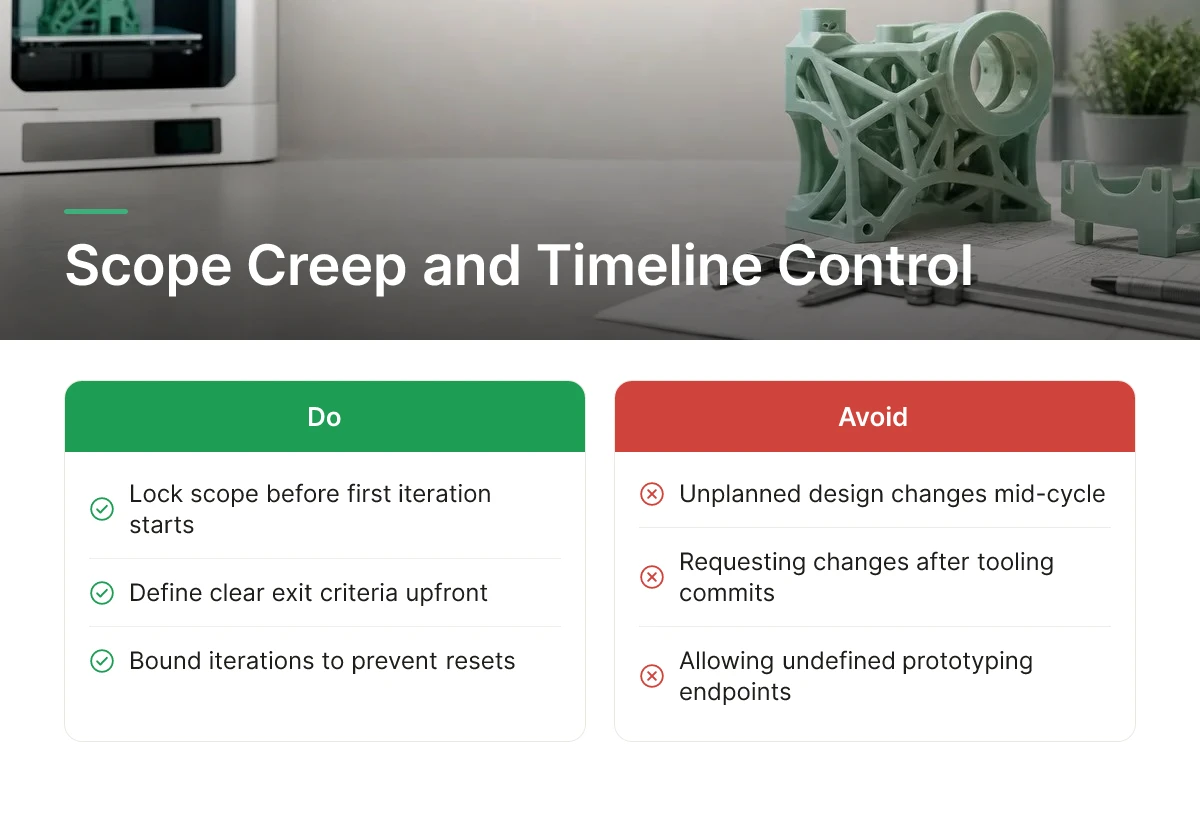
Rapid prototyping manufacturing loses its speed advantage the moment scope isn’t locked before the first iteration starts cutting.
Every unplanned design change resets the queue: the shop has to re-quote the revised geometry, rebuild or adjust fixturing, and slot the new version back into its production schedule. iMAC Engineering frames early, deliberate prototyping as the mechanism that prevents costly downstream errors, and its breakdown of how rapid prototyping saves development time and costs makes the same point, but that only holds if the iterations themselves stay bounded. Warning signs include no defined exit criteria for when prototyping is “done,” and stakeholders requesting design changes after tooling has already been cut.
Teams managing multiple internal stakeholders or external customers with evolving specifications are the most exposed, since each new voice in the review process tends to introduce another round of changes.
Why do rapid prototyping projects fail, and what warning signs should we watch for?
Projects fail when revisions keep arriving after fixturing is locked, with no agreed limit on how many iterations the schedule can absorb.
The fix isn’t a vague internal process memo, it’s a defined revision limit agreed with the machining partner before the first part is cut, so both sides know exactly how many iteration cycles the timeline and quote actually cover.
5. Treating Cost Reduction as an Afterthought Instead of a Design Input
Cost needs to be scoped into the design before the first prototype iteration, not reviewed after the fact once spending is already locked in.
Specific cost drivers tend to repeat across prototype cycles: manual programming time for each new revision, material waste on small non-standard batches, and custom fixturing built for a geometry that changes again two weeks later. Each of these compounds if cost isn’t checked at every iteration rather than only at the final production quote. Digital Leadership’s overview of rapid prototyping techniques and cost-reduction strategies covers several of these drivers in more detail.
Getting a quote on each iteration, not just the final design, gives a team early visibility into which design choices are driving cost, so there’s no surprise when the part scales from a handful of prototypes to a full production run. This is the approach MFG SOLUTION applies by quoting within 8 hours of each specification submission, so cost implications are visible before tooling commitments pile up, and shipping within 3 days of approval once the design is locked.
What are the specific cost drivers in rapid prototyping, and where can we cut waste?
Programming time per revision, material waste on small batches, and one-off fixturing are the main drivers, all three shrink when the design is scoped before iteration begins.
In-house prototyping setups tend to carry a premium cost structure once engineering labor and idle machine time are counted, while outsourcing to a shop running multiple methods, CNC turning, Swiss lathe, cold forging, automatic lathe, and CNC mill & turn, can land in a more budget-friendly range by matching each part to its most economical process. Either way, cost control works best as a scoping discipline built into the design brief, not a negotiation handled after parts are already cut.
Common cost drivers that repeat across rapid prototyping manufacturing programs include:
- Manual programming time required for each new design revision
- Material waste generated by small, non-standard prototype batches
- Custom fixturing built for a geometry that changes again before production
- Idle machine time when in-house equipment sits unused between projects
- Re-quoting costs triggered by design changes made after tooling is committed
6. Building In-House Capability Without the Volume to Justify It
Adding prototyping equipment or headcount before confirming repeat demand turns a planned efficiency gain into fixed overhead that sits idle between projects.
The mechanism is simple: a CNC prototyping cell, a Swiss lathe, or a dedicated engineer only pays for itself when it runs. Sporadic project volume means that equipment and staff capacity go unused for weeks at a time, and the depreciation and salary costs don’t pause just because the project pipeline does. Teams that confuse “we had one urgent program” with “we need permanent capacity” end up carrying costs that outsourced rapid prototyping manufacturing would have avoided entirely.
Should we build rapid prototyping capabilities in-house or partner with external service providers?
In-house control buys faster iteration and full process oversight, design changes move straight to the machine without a vendor approval loop. Outsourcing trades that immediacy for no capital tie-up and access to a broader range of processes, CNC turning, Swiss lathe, cold forging, automatic lathe, and mill-turn, than most internal shops can justify owning.
Base the decision on prototype frequency and part complexity, not enthusiasm for owning equipment. A useful cue: if iteration frequency and staff utilization stay high enough that machines run most weeks, in-house starts to pay off. If prototyping happens in bursts tied to product launches, outsourcing keeps costs variable instead of fixed.
7. Failing to Plan the Handoff from Prototype to Full Production
Skipping a structured handoff plan means a prototype that worked once rarely survives the jump to repeatable, high-volume production without rework.
The handoff requires three things: re-validating tolerances against production tooling instead of prototype fixtures, confirming material lot consistency since prototype stock and production stock aren’t always the same heat or batch, and locking final process documentation so operators aren’t improvising setup sheets on the floor. Skipping a pilot production run between the prototype and full-scale manufacturing is where most late-stage quality failures originate, a part that held tolerance on a one-off prototype setup can drift once it’s running on production fixtures at volume, and by then the defect has already reached inspection or the customer. Kickr Design’s rundown of common prototyping mistakes in product development flags this same handoff gap as a recurring failure point.
What does the handoff from rapid prototyping to injection molding or mass production actually look like?
For machined parts, the relevant handoff isn’t prototype-to-mold, it’s CNC prototype runs into higher-volume CNC or cold forging production. That shift changes cutting parameters, fixturing, and cycle time targets, so tolerances proven on a prototype lathe setup need re-confirmation once the part moves to production-volume tooling. Parts manufactured to ISO 9001:2015 and IATF 16949 process controls carry documentation through this step, which is what prevents the re-validation gap that causes rework downstream.
8. Not Measuring ROI, So the Pitfalls Repeat on the Next Program
Treating rapid prototyping manufacturing as a one-off activity with no tracked outcomes means the same mistakes resurface on the next program.
Three metrics matter: the number of design iterations before sign-off, the time elapsed from first prototype to production release, and the rework rate per program. Tracking iteration count and cycle time, not just final part cost, exposes exactly where a program lost its speed advantage, whether that’s a slow quoting cycle, an in-house machine sitting idle, or a skipped pilot run that triggered late rework.
What metrics and benchmarks should we track to prove rapid prototyping is delivering value?
Teams running multiple prototyping programs a year need this feedback loop most, since a single program rarely generates enough data to spot a pattern. Tie each metric back to the pitfalls already covered: high iteration counts often point to skipped tolerance confirmation upfront, long cycle times often trace to underutilized in-house equipment, and high rework rates often trace to a missing pilot run before full production. Treating ROI tracking as a root-cause audit, not a standalone finance exercise, is what turns one costly program into a corrected process for the next one.
How to Choose the Right Rapid Prototyping Approach for Your Precision Parts
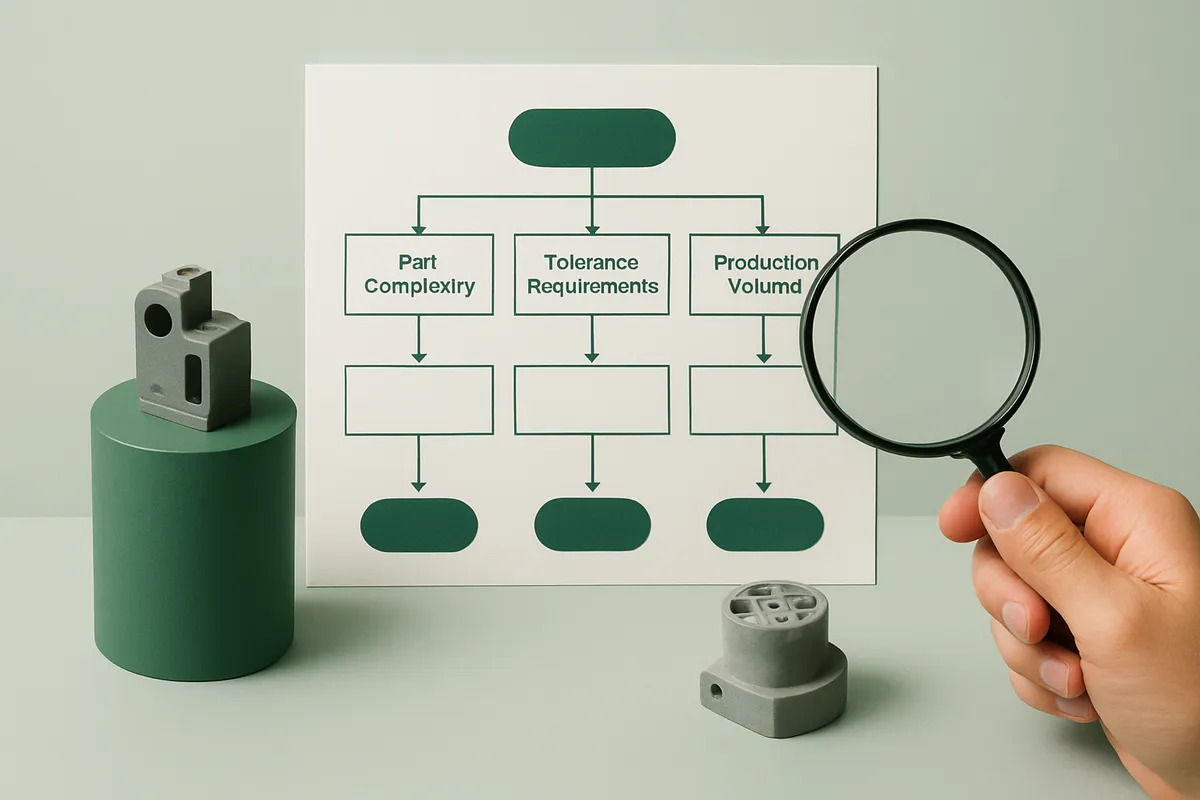
Match the prototyping approach to what the part must prove, its material and tolerance requirements, and your actual production volume, in that order.
Start with purpose: is the prototype proving form, fit, or function under production load? Then match material to final production spec wherever possible, since a prototype in a substitute material won’t validate tolerance behavior under real cutting or forging conditions. Confirm tolerance requirements before selecting a process, not after, because not every rapid prototyping manufacturing method holds the same precision.
Before committing to a rapid prototyping manufacturing approach, work through this sequence:
- Define what the prototype must prove: form, fit, or functional performance under load
- Match the prototype material to the final production spec wherever feasible
- Confirm tolerance requirements before selecting a prototyping process
- Decide whether to build in-house or outsource, based on expected volume and frequency
- Schedule a pilot production run before committing to full-volume manufacturing
What are the limitations and failure rates of rapid prototyping for precision parts?
Rapid prototyping is not the right call for very small, ultra-tight-tolerance parts where prototype-grade processes can’t replicate production accuracy. A part under a few millimeters with single-digit-micron tolerances needs production tooling and process control from the first article, not a faster but looser approximation.
When is rapid prototyping unsuitable or counterproductive for our customer applications?
Weigh in-house versus outsourced prototyping using the volume and utilization cue from earlier: low, sporadic volume favors a partner like MFG SOLUTION, which quotes within 8 hours and ships within 3 days under ISO 9001:2015, ISO 13485:2016, and IATF 16949 process control. Before starting your next program, confirm: the prototype’s purpose is defined, material matches production spec, tolerances are set before process selection, and a pilot run is scheduled before full volume.
Frequently Asked Questions
What enterprise tools and systems do we need to manage rapid prototyping workflows alongside standard production?
Most procurement teams get by with their existing PLM/ERP system plus a quoting portal that tracks revisions separately from production orders.
The bigger requirement is process discipline, not software: a documented change-log between prototype and production specs, and a supplier whose quality system (ISO 9001:2015, IATF 16949) already tracks revisions for you.
How do we compare the total cost of ownership between rapid prototyping and traditional methods?
Compare the cost of a design error caught early against one caught at tooling or launch, not just the per-part prototype price.
A prototype costing a few thousand dollars can prevent a tooling mistake running into the tens of thousands. Factor in supplier lead time too, a 3-day ship window compresses iteration cycles enough to change the total project timeline, not just unit cost.
What actual time-to-market advantage does rapid prototyping offer for precision-machined parts?
Rapid prototyping compresses design validation from weeks to days by letting teams test physical parts instead of waiting on full tooling.
Fresh Consulting frames this as “speed to validation”, converting CAD data into a physical part fast enough to catch issues before they cascade into production costs. With an 8-hour quote and 3-day shipment, MFG SOLUTION keeps that compression intact through batch production, not just the first prototype run.
How do we avoid losing precision when scaling from a prototype run to full production?
Lock tolerances and material specs before scaling, and use a supplier who manufactures both stages under the same documented process controls.
Switching vendors between prototype and production is where tolerance drift usually starts. A single certified partner spanning CNC turning, Swiss lathe, and cold forging removes that handoff risk entirely.
How do we select a rapid prototyping manufacturing partner for ongoing programs rather than one-off builds?
Look for a supplier that documents process controls consistently across both prototype and production runs, not just one that quotes fast on a single job.
Ask about quote turnaround, shipping lead time, and which quality certifications apply to both stages. A partner who treats rapid prototyping manufacturing and production runs under the same documented system reduces the handoff risk that causes most late-stage rework.
Conclusion
Rapid prototyping mistakes rarely come from the technology, they come from vague tolerances, late DFM review, and vendor handoffs between prototype and production. Fix those three and most cost and schedule overruns disappear before they start.
The practical fix is consolidation: one certified partner who can quote fast, hold tolerance across both prototype and production runs, and document every process step for audit. MFG SOLUTION’s 8-hour quote and 3-day ship window exist for exactly this handoff point.
Next step: pull your current prototype-to-production spec sheet and check whether tolerances, materials, and surface finish are locked identically across both stages, that single audit catches most scaling failures before they cost you a production run.
Recommended Articles
Explore more from our content library: