
2026-10-28
How to Improve Manufacturing Efficiency on the Shop Floor
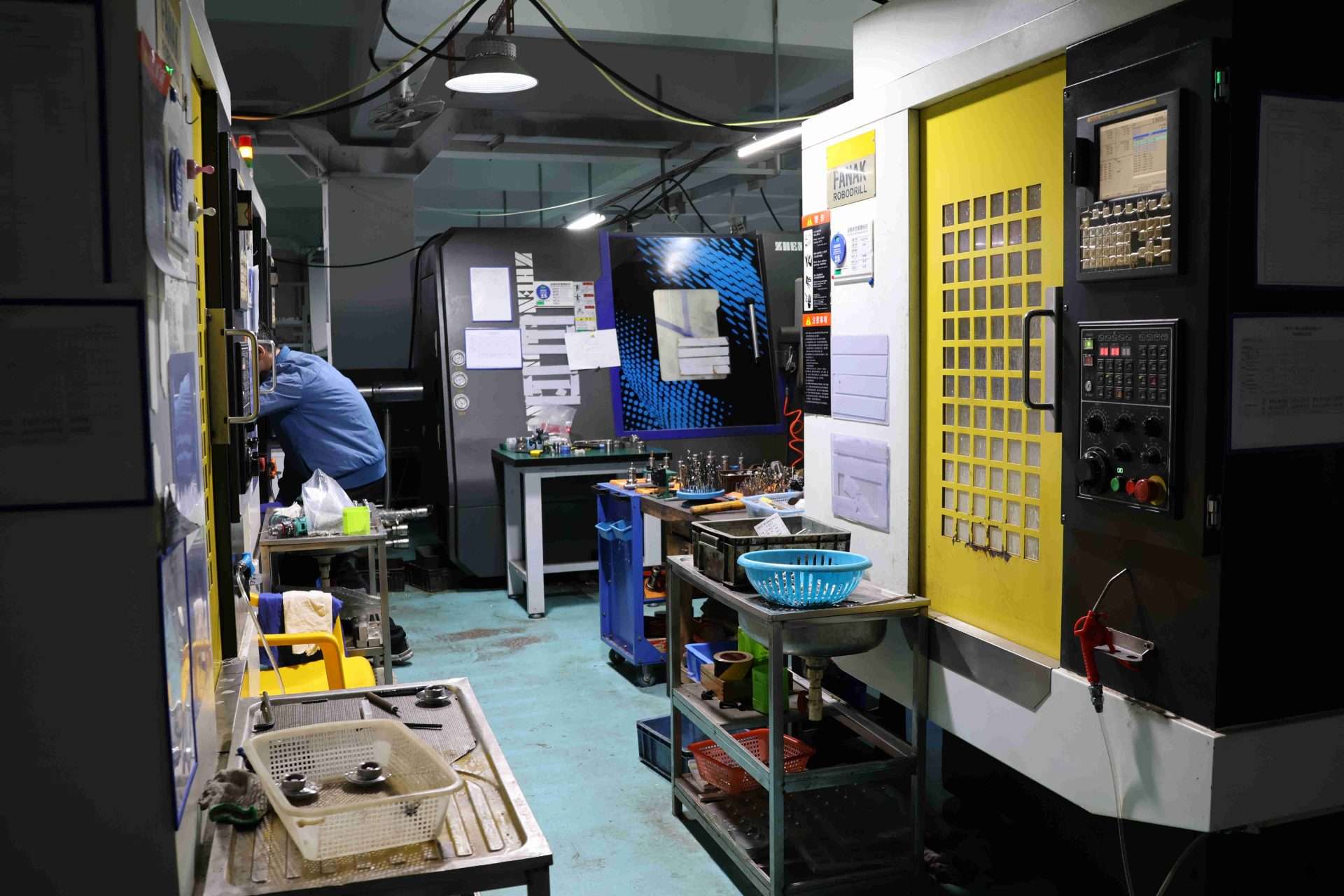
Understanding how to improve manufacturing efficiency is essential. Manufacturing efficiency improves when you cut non-value-added time (changeovers, waiting on materials, rework) while holding throughput and quality steady, it is not just running machines faster. For precision machining and CNC shops, that means tracking cycle time, first-pass yield, and OEE together, then fixing the step causing the biggest drag: usually workflow sequencing, tooling changeovers, or unplanned maintenance downtime. Shops that improve efficiency the right way reduce cost per part without loosening tolerances or missing ship dates.

Define What Manufacturing Efficiency Means on Your Shop Floor
Before changing anything on the floor, write down what efficiency means for your specific parts, output per resource consumed, not just output per hour. Skipping this step is why many efforts to figure out how to improve manufacturing efficiency stall after a few weeks: nobody agreed on what “better” looked like in the first place.
How Efficiency Differs from Productivity in Precision Machining
Productivity counts parts; efficiency counts parts that count. A Swiss lathe running 500 pieces per shift instead of 400 looks like a win until you check the scrap bin and find rework climbed from 2% to 9%, you made more parts and more waste, which is a productivity gain and an efficiency loss.
True efficiency factors in material consumed, machine time, labor hours, and scrap together against usable output. For a shop producing parts up to 38mm in diameter under tight tolerance callouts, that distinction matters more than raw volume, because a fast cycle that drifts out of spec costs more to fix than it saved.
Why Cost, Throughput, and Quality Must Be Balanced Together
Precision customers in electronics, automotive, and medical device manufacturing don’t buy on speed alone, they buy on parts that pass inspection the first time, every time. A part machined 10% faster but rejected at incoming inspection costs the customer far more in downtime, returns, and lost trust than one shipped a day later at full compliance.
That’s why efficiency has to be measured as a relationship between three variables, not optimized one at a time: cost per part, throughput, and first-pass quality. Chasing cost reduction alone tends to erode tolerance control; chasing speed alone tends to increase scrap. Shops operating under ISO 9001:2015, ISO 13485:2016, or IATF 16949 don’t get to trade quality for speed, the standards assume both hold simultaneously.
Efficiency typically leaks in three places on a machining floor: changeover time between job runs, machines sitting idle while waiting on raw material or inspection sign-off, and rework generated by avoidable scrap. Each of these is measurable before you touch a single process change, and measuring them first is what separates a real efficiency program from guesswork.
Measure the KPIs That Reveal How to Improve Manufacturing Efficiency
Five metrics tell you whether a precision shop is actually improving: overall equipment effectiveness (OEE), cycle time per part, first-pass yield, scrap/rework rate, and on-time delivery rate. Track all five before you change anything, because each one points to a different failure mode on the floor.
The 5 KPIs That Matter Most for Precision CNC Operations
OEE combines three factors, availability, performance, and quality, into a single number that shows how much of your planned production time actually turns into good parts. A low availability score points to unplanned downtime: tool changes that run long, machine faults, or waiting on material. A low performance rate usually means the machine is running slower than its rated speed, often from micro-stops, chip clearing issues, or an operator compensating for a worn fixture.
- OEE (availability × performance × quality): the composite health check for a machine or cell.
- Cycle time per part: flags programming inefficiencies, tool path issues, or setup drift on Swiss lathe and CNC turning jobs.
- First-pass yield: the percentage of parts that pass inspection without rework, a direct read on process capability.
- Scrap/rework rate: ties quality losses to material cost and labor hours, and usually traces back to tooling wear, fixturing, or program error.
- On-time delivery rate: the customer-facing metric that reflects whether the first four are under control.
A low quality rate inside OEE shows up as scrap and rework, parts cut to the wrong dimension, surface finish failures, or thread defects caught at final inspection instead of in-process. Each KPI isolates a different cause, which is why tracking only one, like output volume, hides where the real losses are.
How to Calculate ROI on an Efficiency Improvement
Before approving a change, a new fixture, an inspection step, a software upgrade, estimate what it costs against what it recovers over a defined period, usually 90 days. Add the labor hours to implement it and any mid-range tooling or software investment, then compare that against the cycle time recovered or the scrap rate reduced across the same production volume.
If a fixture upgrade costs a set number of labor hours plus a mid-range tooling spend, and it cuts scrap on a high-volume part family by a measurable margin, the payback period is the number of batches it takes for recovered material and rework labor to exceed that upfront cost. This only works if you have a real baseline, measure OEE, cycle time, and scrap rate for at least a few weeks before the change, not after. Without that baseline, any improvement is a guess dressed up as a result. At MFG SOLUTION, every production run is tracked against documented process control under ISO 9001:2015, IATF 16949, and ISO 13485:2016, which gives customers auditable before-and-after data rather than a vendor’s word for it.

Prioritize the Operational Changes with the Fastest Payback
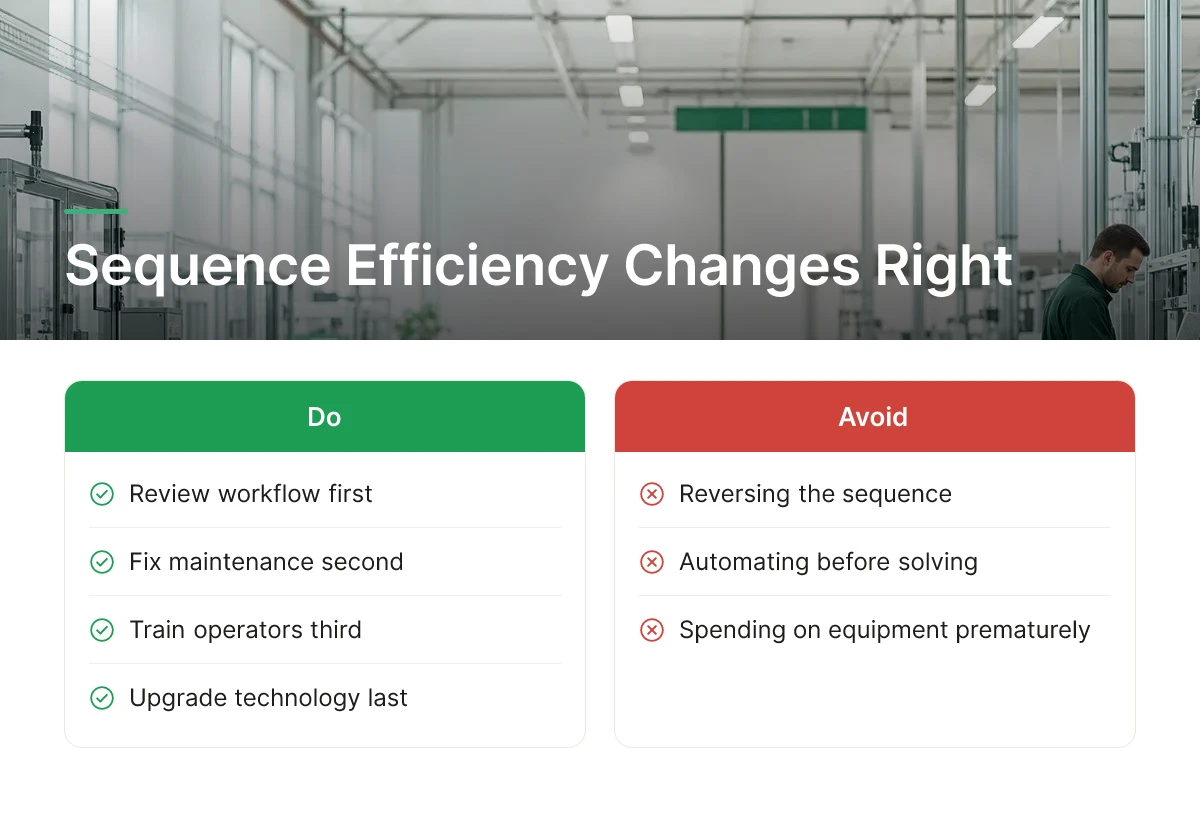
Sequence matters more than the list of tactics itself: review workflow first, fix maintenance second, train operators third, and upgrade technology last. Shops that reverse this order tend to spend on equipment that automates a problem rather than solving it. For more information, see How To Improve Office Efficiency Smart Strategies For 2026.
Should You Prioritize Workflow Review, Maintenance, or Technology First?
Start by walking the floor and mapping how a part actually moves from raw material to shipment, before any purchase order gets signed. A workflow review surfaces bottlenecks, a single Swiss lathe feeding three downstream stations, parts waiting on inspection, operators walking across the shop for tooling, that no new machine can fix on its own. Buying automation to speed up a step that was never the constraint just moves the backlog somewhere else.
Once the workflow is mapped, scheduled maintenance is usually the next-fastest win. Unplanned downtime on a CNC machine costs far more in missed deadlines and rush shipping than the labor hours spent on routine checks. A spindle failure mid-run on a tolerance-critical medical part doesn’t just stop one machine, it can push an entire shipment past a customer’s deadline. Preventive maintenance schedules, tracked against machine hours rather than the calendar, catch wear before it becomes a missed delivery.
Workforce training comes next, and it multiplies the gains from the first two steps. Operators who understand setup reduction and know where to place quality checkpoints cut changeover time and scrap independent of any equipment change. This is also the cheapest lever available, it requires time and documentation, not capital.
Comparing Lean, Six Sigma, and Kaizen for Small Precision Shops
These three frameworks answer different questions, and small shops rarely need all three at once. Lean targets waste in workflow and setup, the same bottlenecks a floor walk reveals. Six Sigma reduces variation in tolerance-critical processes, which matters for parts under 38mm diameter where a few microns separate a pass from a scrap part, but it depends on sustained data collection and statistical analysis that most small shops aren’t staffed to run continuously. Kaizen sits in between: small, operator-driven improvements that don’t require a dedicated data team.
For most precision machine shops asking how to improve manufacturing efficiency without adding headcount, Lean and Kaizen deliver faster returns than Six Sigma, which is better reserved for a specific high-variation process once the basics are under control.
Technology upgrades, 5-axis CNC machines, newer controls, automated material handling, belong after these steps, not before. MFG SOLUTION operates 5-axis CNC equipment and 20 automatic lathes, but that capacity pays off because it sits on top of mapped workflows, maintained equipment, and trained operators, not in place of them.
Organize the Workspace and Inventory to Protect Speed and Precision
A clean, well-ordered shop floor cuts search time and setup error, but the bigger efficiency gain comes from fixing the small number of parts and fixtures that cause most of the disruption. Anyone researching how to improve manufacturing efficiency on the floor should start with that imbalance before touching layout or shelving.
What the 80/20 Rule Reveals About Hidden Efficiency Gains
A small share of part numbers, fixtures, or customer orders typically drives most of the changeover time and expediting pressure on a shop floor. Pull your last quarter of job tickets and sort by changeover minutes and rush-order frequency, in most CNC shops, a handful of recurring part families or problem fixtures account for the bulk of lost time, echoing the broader point that shop floor layout and material flow are recurring root causes of hidden inefficiency.
- Rank part numbers by total changeover minutes consumed over the last 90 days.
- Flag fixtures or tool carts tied to repeated rush orders or late-stage inspection failures.
- Isolate that short list and redesign workflow around it first, reorganizing the entire shop before targeting these offenders wastes effort on areas that were never the bottleneck.
Once the high-impact items are identified, apply 5S-style discipline, sort, set in order, shine, standardize, sustain, to the tooling carts, fixtures, and inspection stations clustered near the machines that handle them. Sort removes unused tooling from the cart. Set in order means every fixture has a marked, fixed location within arm’s reach of the spindle it serves. Shine and standardize keep inspection stations free of chips and coolant residue that slow gauge readings. Sustain is the operator habit that makes the first four stick past week one.
Inventory balance matters just as much as physical layout. Carrying excess raw stock ties up cash and floor space; carrying too little stops the machine mid-run waiting on material. The right stocking level isn’t an arbitrary par count, it’s a function of your supplier’s actual lead time. A Swiss lathe shop with a 2-week bar stock lead time needs a different buffer than one sourcing from a supplier with a 6-week cycle. At MFG SOLUTION, holding parts to 38mm diameter across CNC turning, Swiss lathe, and cold forging methods means matching raw stock levels to each method’s changeover profile, not a single blanket inventory rule.
How IoT Sensors and Predictive Maintenance Support CNC Efficiency
IoT sensors and predictive maintenance are a logical next step once workflow and inventory basics are solid, not a replacement for them. Sensors on spindles and tool holders flag wear patterns before they cause scrap or unplanned downtime, and that data feeds directly back into the KPI tracking a shop should already have in place. Layering sensors onto a disorganized floor just generates more alerts nobody acts on.
Avoid These Common Mistakes When Rolling Out Efficiency Changes
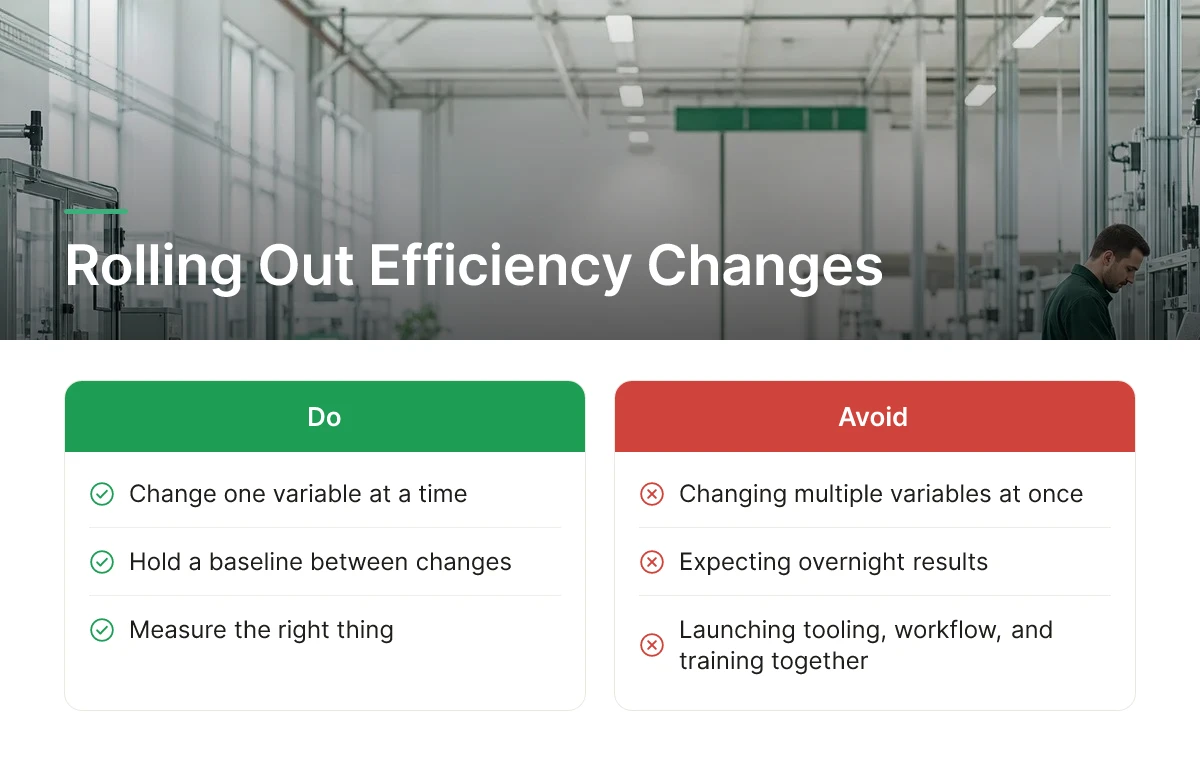
Most efficiency programs fail not from bad ideas but from bad sequencing, changing too much at once, measuring the wrong thing, or expecting shop-floor results overnight. Knowing how to improve manufacturing efficiency also means knowing what derails it.
The most common mistake is changing multiple variables at the same time: new tooling, a revised workflow, and staff retraining launched in the same week. When output shifts, you have no way to tell which change caused it. If scrap rates rise, you cannot isolate whether the new fixture, the new routing, or an undertrained operator is responsible. Change one variable, hold a baseline period of a few weeks, then move to the next.
A second trap is chasing throughput KPIs while ignoring first-pass yield. A line that runs faster but produces more parts needing rework has not gotten more efficient, it has shifted cost from the machine to the inspection bench. Floor efficiency is a catch-all metric that reflects the health of the whole operation, not just how fast spindles turn. Track scrap and rework alongside cycle time, or speed gains will quietly erode margin.
What a Phased Implementation Roadmap Looks Like
Realistic timelines run in months, not weeks, for a small or mid-size shop. A workable sequence:
- Weeks 1-4: Baseline measurement, document current cycle times, scrap rates, and downtime before changing anything, and fix obvious workflow issues like poor part layout or unclear work instructions.
- Months 2-3: Scheduled maintenance and operator training, address machine downtime and skill gaps, since untrained staff and neglected equipment undercut any process redesign.
- Months 4 and beyond: Larger investment, automation, new CNC capacity, or software integration, once the fundamentals are stable enough to show whether the investment actually moved the numbers.
Rushing to the last step before completing the first two usually means buying equipment to compensate for a workflow problem a $0 fix could have solved.
The last mistake is treating efficiency as a project with an end date rather than a recurring review. Gains from a successful rollout erode within a year if KPIs aren’t revisited on a regular cadence, new operators forget training, maintenance schedules slip, and workarounds creep back in. Productivity is a continuous process, not a one-time fix. Build a quarterly review of the same metrics you baselined at the start, and treat each review as the start of the next small, single-variable change.
Frequently Asked Questions
How does efficiency differ from productivity in a precision machining shop?
Productivity measures output volume; efficiency measures how well you use resources, time, material, labor, to get there. A shop can run high productivity (parts per hour) while wasting material or energy, which keeps costs up. Efficiency asks whether the output justifies the input, not just how much got made.
Why do cost, throughput, and quality all matter when defining efficiency for customers?
Because a gain in one that damages another isn’t real efficiency, it’s a trade-off customers eventually pay for. Faster throughput that raises defect rates costs more in rework and scrap. Procurement teams judge suppliers on all three together: sub-1% defect rates, predictable lead times, and competitive unit cost.
What is a realistic timeline for seeing ROI from efficiency improvements in a small shop?
Workflow and layout changes often show measurable gains within 30 to 90 days; equipment or software investments typically take two to six months to pay back. Quick wins, fixing a bottleneck station or reorganizing tool storage, show up fast. Larger changes, like adding monitoring systems or automation, need a full production cycle to validate before judging results.
Can a small precision machining shop run Lean or Kaizen without a dedicated improvement team?
Yes, Lean and Kaizen scale down to small operations when owners assign the review as a recurring task, not a side project. Weekly 30-minute walkthroughs of the shop floor, tracking one metric at a time, deliver most of the benefit without hiring a continuous-improvement staff member.
Do IoT sensors make sense for a small CNC shop, or only larger operations?
Small shops can benefit, but the case depends on machine count and downtime cost, not shop size alone. A handful of sensors on bottleneck machines to track uptime and cycle time often pays off faster than a facility-wide rollout, which rarely fits a small shop’s budget or staffing.
Conclusion
Efficiency gains come from compounding small, measured changes: mapping your actual workflow before investing in new equipment, scheduling preventive maintenance instead of reacting to breakdowns, and tracking a handful of KPIs, scrap rate, cycle time, machine uptime, consistently enough to see trends. None of this requires a large capital outlay to start.
If your current suppliers can’t give you workflow transparency or sub-week quote turnaround, that’s a measurable efficiency gap worth testing. Submit a part specification to MFG SOLUTION this week and compare the 8-hour quote and 3-day shipment window against your existing vendor’s cycle time.
Recommended Articles
Explore more from our content library: