
2026-09-20
How to Streamline Precision Metal Parts Manufacturing

Streamlining precision metal parts manufacturing means aligning CNC process choices, material selection, and quality checks so tight tolerances are met without adding time or cost. The fastest gains come from reducing setup and changeover time, choosing materials that machine efficiently for the required tolerance, and catching quality issues in-process rather than after the fact. Speed and precision aren’t opposing goals, most delays and cost overruns come from unmanaged complexity (excess tolerances, material mismatches, late design changes), not from the machining itself. Fixing those upstream decisions is what actually shortens lead time.

Prerequisites: What to Define Before Streamlining Precision Metal Parts Manufacturing
Before changing any process, lock down four things: critical dimensions, tolerance bands per feature, surface finish requirements, and expected order volume. Skipping this step is the single biggest reason precision metal parts manufacturing projects run over budget or miss deadlines.
These four inputs determine which CNC method fits, which material machines efficiently, and how the part gets quoted. Change any one of them mid-project and the process plan usually has to be rebuilt from scratch.
Set tolerances feature by feature, not part-wide
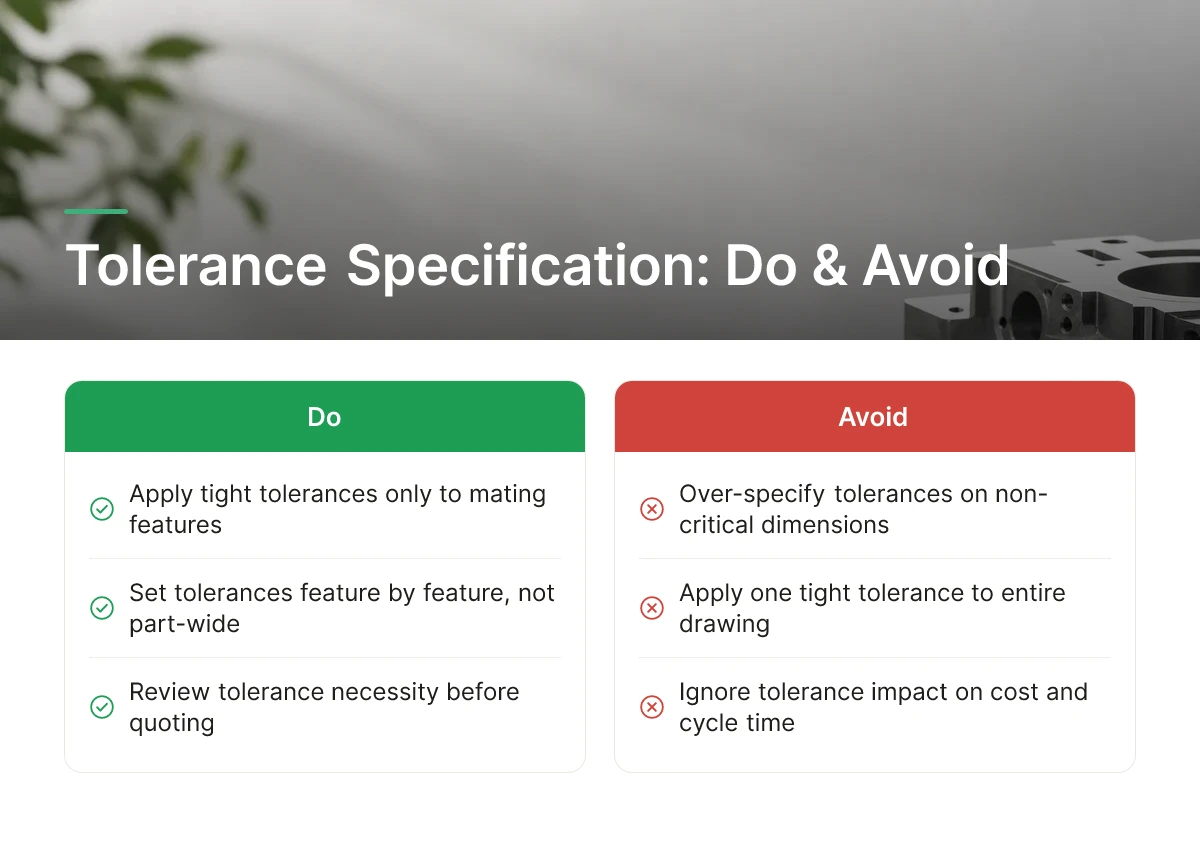
A common mistake is applying one tight tolerance to an entire drawing instead of tightening only the features that need it. A bore that mates with a bearing may need ±0.005 mm, while a non-functional edge on the same part can tolerate ±0.1 mm without any effect on performance. Machining time and inspection time scale with the number of tight-tolerance features, not with the overall size of the part, so over-tolerancing drives up cost without improving function. Reviewing each dimension against its actual functional requirement, fit, seal, load path, before finalizing the drawing keeps the machining process focused on what matters.
Match the run type to the right process decisions
Prototype runs, low-volume batches, and full production runs call for different equipment and different cost logic. A single prototype favors flexible setups like CNC mill-turn, where reprogramming is cheap and tooling investment is minimal. A production run of several thousand identical parts favors automatic lathes or cold forging, where setup cost is spread across volume and cycle time per part matters more than setup flexibility. Committing to a volume estimate early, even a range, lets a shop pick the method that keeps unit cost down at that scale.
Material selection follows the same logic: alloy choice affects machinability, tool wear, and achievable tolerance, so it has to be settled alongside dimensions and finish, not after. At MFG SOLUTION, this upfront data feeds directly into an 8-hour quote covering CNC turning, Swiss lathe, cold forging, automatic lathe, and CNC mill-turn options for parts up to 38 mm in diameter, with the right method already matched to the volume and tolerance profile the customer submits.
Configure CNC Machining for Precision Metal Parts Manufacturing to Hit Tight Tolerances
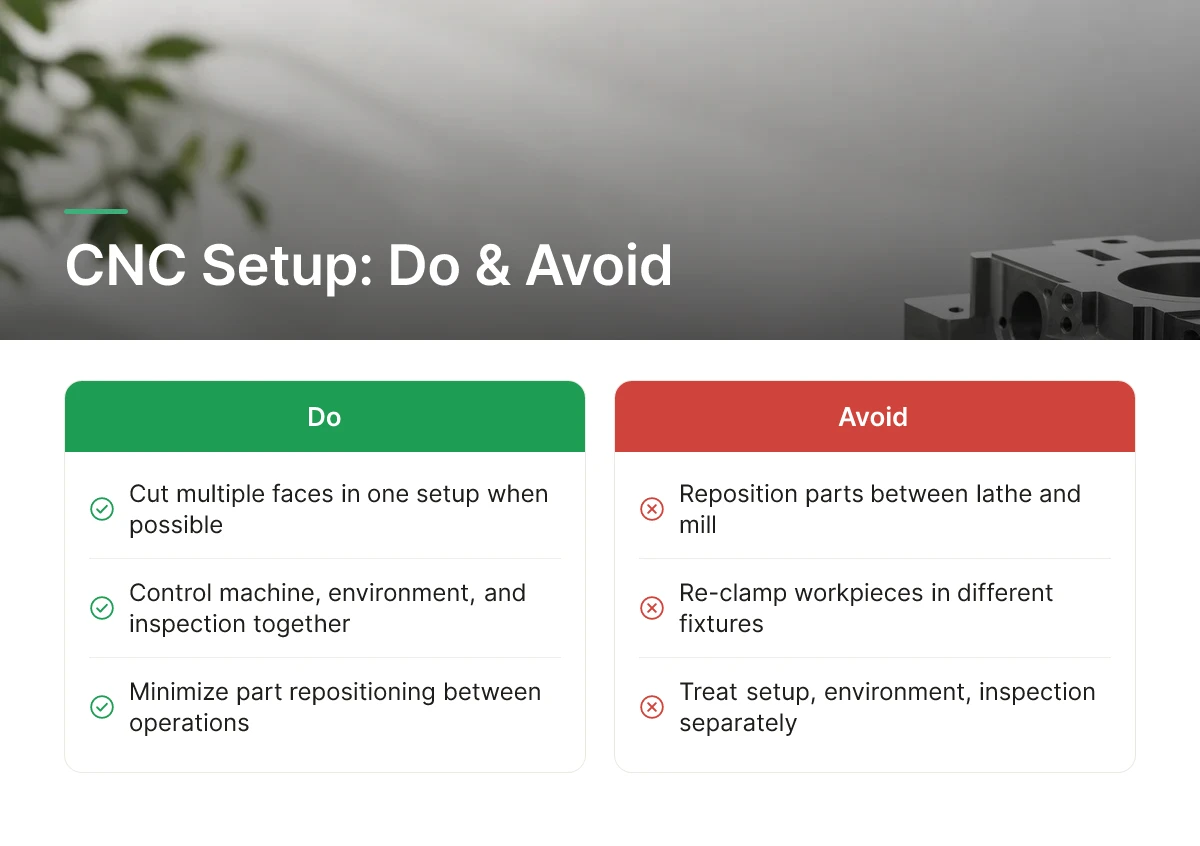
Tight tolerances hold only when the machine setup, shop environment, and inspection process are all controlled together, not treated as separate problems. Precision metal parts manufacturing depends on eliminating the small errors that stack up between operations, not just cutting accurately in a single pass.
Repositioning a part between machines is one of the biggest sources of tolerance drift. Every time a workpiece moves from a lathe to a mill, or gets re-clamped in a new fixture, it introduces a fresh chance for misalignment. A 5-axis CNC machine cuts multiple faces and features in one setup, which removes several of those handoff points entirely. Fewer setups mean fewer opportunities for the part to shift, and that translates directly into tighter, more repeatable tolerances across a production run rather than just on the first article.
What Role Does Temperature Control Play When Machining Precision Parts?
Temperature swings expand and contract both the machine structure and the metal workpiece, and that movement shows up as dimensional drift on tight-tolerance features.
A few degrees of change in shop temperature can shift a spindle’s position enough to matter on a part measured in microns. The workpiece itself heats up during cutting from friction and material removal, then shrinks slightly as it cools, a part that measures in-spec right off the machine can drift out of tolerance an hour later. Shops running precision work control ambient temperature and, where needed, let parts stabilize before final measurement. Skipping this step is a common reason a part passes on the machine but fails inspection later.
How Do Tolerance Management and Quality Control Work in Low-Volume CNC Production?
In-process probing between operations catches dimensional drift while it is still a single part problem, not a batch of scrap.
Checking a feature mid-cycle, before the next operation starts, lets the operator adjust offsets immediately if a tool has worn or the setup has shifted. Waiting until the full run is finished to inspect means any drift that started at part 20 could affect every part made after it. This matters even more in low-volume production, where statistical sampling, checking a percentage of parts and assuming the rest follow, is less reliable simply because there are fewer parts to build a pattern from. Low-volume runs often call for near-100% inspection on critical dimensions instead. MFG SOLUTION’s process control approach, built around ISO 9001:2015 and IATF 16949 requirements, documents each step so drift gets caught and traced rather than discovered after shipment.
Select Materials That Balance Manufacturing Speed and Precision
Material choice sets the ceiling on how fast a part can move through the shop and how tight its tolerances can get, pick wrong and you pay in cycle time, tool wear, or rework.
In precision metal parts manufacturing, the material spec on a drawing determines almost everything downstream: which machine runs the job, how many tool changes the operator schedules, and whether the batch ships on day 3 or day 10. Engineers who treat material selection as a late-stage decision often discover the cost only after the first production run.
Aluminum vs. Stainless Steel vs. Specialty Alloys: What Are the Trade-Offs?
Aluminum cuts fast, generates less heat, and holds tight tolerances with standard tooling, it is the default for parts where weight and speed matter more than surface hardness. Stainless steel machines slower, work-hardens as the tool passes through it, and demands sharper, more frequent tool changes to hold the same tolerance band. Specialty alloys, titanium, Inconel, and similar high-strength metals, push both problems further: low thermal conductivity concentrates heat at the cutting edge, and the material’s resistance to deformation means every pass fights the tool.
None of these trade-offs make one material universally “better.” They make each material suited to a narrower set of applications. A bracket that needs corrosion resistance in a saline environment justifies stainless. A structural housing that never sees corrosive exposure usually does not.
How Does Material Choice Affect Both Lead Time and Final Cost?
Harder alloys require slower cutting speeds and more frequent tool changes, and both of those extend cycle time directly, a part that takes twice as long per unit to cut delays the entire batch, not just one piece. Tool wear compounds the problem: as inserts dull faster against stainless or titanium, shops either accept degraded tolerance or stop mid-run to swap tooling, adding non-cutting time to the job.
- Raw stock availability varies by alloy, common aluminum grades sit in stock at most machine shops, while specialty alloys may require a supplier order that adds days before machining even starts.
- Tooling wear rate on harder materials increases the cost per part through both replacement inserts and slower feed rates.
- Scrap rate tends to climb with harder-to-machine alloys, since tool deflection and heat buildup increase the chance of an out-of-tolerance cut.
The decision rule is simple: reserve specialty alloys for parts where the application genuinely demands their properties, high heat exposure, extreme corrosion, or load conditions aluminum and standard stainless cannot meet. Specifying titanium because it sounds more durable, when the part will never see the stress that justifies it, adds cost and lead time with no functional payoff. Shops running multiple methods, CNC turning, Swiss lathe, cold forging, can match the process to the material once it’s chosen correctly, which is where much of the cost-effectiveness in precision metal parts manufacturing actually comes from.
Optimize CNC Process Design to Reduce Cost Without Sacrificing Precision
Lowering cost in precision metal parts manufacturing comes down to cutting setup time, reducing operations per part, and designing features that machine efficiently the first time.
What Are the Main Cost Drivers in CNC Machining?
Four factors dominate the price of a machined part: setup and changeover time, the number of operations required, tool changes, and material waste. Machining time is often the primary cost driver, especially at high volumes where a small design inefficiency multiplies across every unit. Setup and start-up costs, CAD review, fixturing, process planning, weigh heavily on low-volume runs but shrink as batch size grows.
- Setup and changeover time between jobs, including fixture swaps and program loading.
- Number of distinct operations, turning, milling, drilling, each part requires.
- Tool changes, which add cycle time and wear cost with every swap.
- Material waste from oversized stock or inefficient nesting.
Grouping similar geometries or materials into a single batch reduces changeover time by letting one setup serve multiple orders. A shop running Swiss lathe or automatic lathe production, for example, can sequence parts with matching diameters or shared tooling to cut idle machine hours between jobs. This is one reason batch scheduling, not just machine speed, determines how fast a job shop can turn a quote into shipped parts.
What Design Practices Help Lower Manufacturing Costs for Small Precision Parts?
Design choices made before a part reaches the machine determine most of its final cost.
- Reserve tight tolerances for features that need them. Applying a tight tolerance across an entire part, instead of only the mating surfaces or sealing diameters, adds inspection time and scrap risk without adding function.
- Avoid deep pockets and thin walls. Both require slower feed rates and more tool passes to avoid deflection or chatter, extending cycle time.
- Standardize hole sizes. Using a common set of drill diameters across a part family cuts the number of tool changes per run.
A design-for-manufacturability review catches these issues on the drawing, not mid-run. Reviewing a print before it hits the shop floor lets engineers flag a non-critical tolerance or an unreachable pocket while it costs nothing to fix, discovering the same issue after the first ten parts means scrapped stock and a delayed ship date. At MFG SOLUTION, this review draws on 60+ engineering professionals who evaluate part geometry against the five available processes, CNC turning, Swiss lathe, cold forging, automatic lathe, and CNC mill & turn, before quoting, which is part of why quotes return within 8 hours.
Every added feature, an extra tight tolerance, an unusual thread, a non-standard finish, shifts a part from a budget-friendly production tier toward a premium one. None of this requires guessing; it requires reviewing the print against what the process can do efficiently.
Common Mistakes to Avoid When Streamlining Precision Metal Parts Manufacturing
Most delays and cost overruns in precision metal parts manufacturing come from three repeatable errors: over-tight tolerances, the wrong process choice, and unvetted suppliers.
Each mistake compounds the others. A part with unnecessarily tight tolerances takes longer to quote, longer to machine, and costs more to inspect, and if it’s also assigned to the wrong process or the wrong shop, the delay multiplies.
Over-Specifying Tolerances Where They Don’t Matter
Engineers often apply the tightest tolerance band on a drawing to every dimension, including features that never touch a mating part. Machining time is often the primary cost driver in CNC production, and unnecessarily tight tolerances directly extend cycle time and inspection requirements. Reserve tolerances below ±0.02 mm for the two or three features that actually govern fit or function, and relax the rest to standard commercial tolerances. This single change can cut both quote turnaround and per-part cost without touching part performance.
Picking a Process by Habit Instead of by Fit
Teams default to whatever process their last supplier used, rather than matching volume, geometry, and tolerance to the right method. Sheet metal fabrication suits flat or bent parts at higher volumes; 3D printing suits complex geometries at very low volumes where tooling cost isn’t justified; CNC turning, Swiss lathe, and cold forging suit small, cylindrical, tight-tolerance metal parts run in batches.
When Is Low-Volume CNC Machining the Right Choice Versus Sheet Metal or 3D Printing?
Choose low-volume CNC when parts need tight tolerances, load-bearing metal properties, and moderate batch sizes that don’t justify hard tooling.
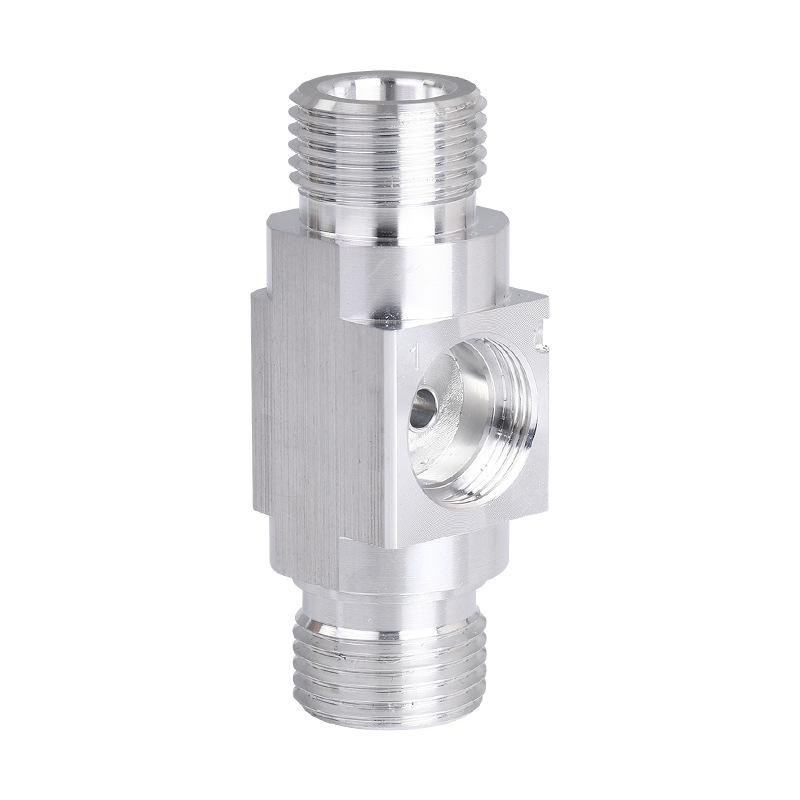
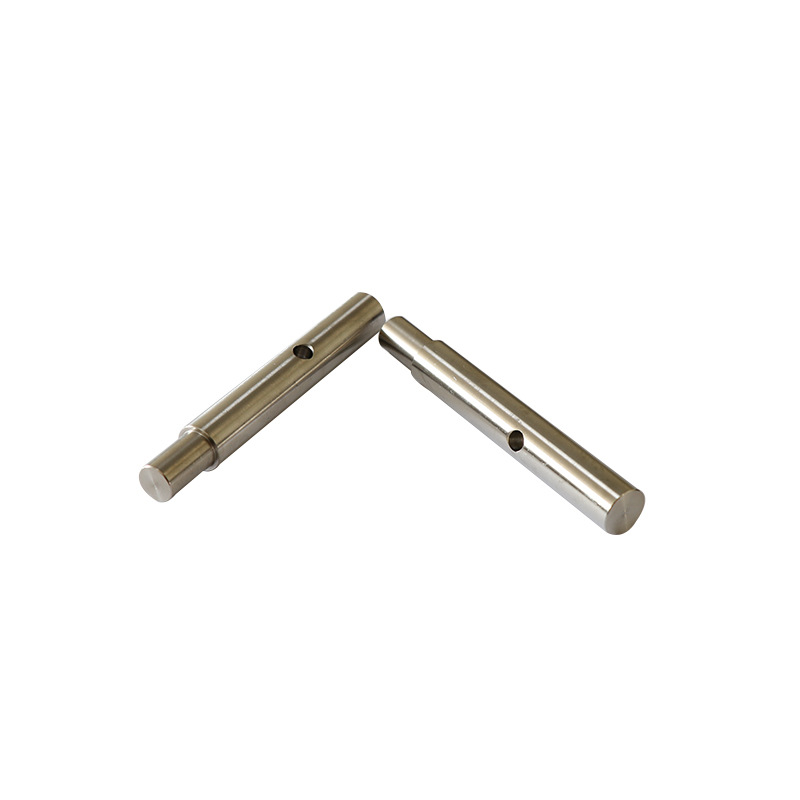
Sheet metal fabrication works better for thin-walled enclosures and brackets where bending and joining dominate the design. 3D printing fits one-off prototypes or highly complex internal geometries where machining access is limited, but it can’t match CNC turning or Swiss lathe machining on dimensional consistency across a production run. For small precision parts under roughly 38 mm in diameter, pins, connectors, fasteners, medical components, CNC and related subtractive methods remain the more predictable, repeatable choice for batch orders.
What Should You Look for When Selecting a Precision Machining Supplier?
Verify certifications, documented quality processes, and clear lead-time communication before committing to any shop.
- Confirm ISO 9001:2015 as a baseline; add ISO 13485:2016 for medical parts and IATF 16949 for automotive components.
- Ask for documented process control: traceable inspection records, not just a verbal quality assurance.
- Test responsiveness before you commit volume, a supplier that quotes within 8 hours signals process discipline, not just speed.
Skipping certification checks is the costliest assumption in precision metal parts manufacturing: not every shop documents traceability the same way, and gaps surface during audits, not during quoting. MFG SOLUTION holds all three certifications and ships within 3 days of approval, which removes that guesswork from the sourcing decision.
Frequently Asked Questions
What certifications matter most for precision metal parts manufacturing?
ISO 9001:2015 for general quality management, ISO 13485:2016 for medical device components, and IATF 16949 for automotive parts are the three that matter most. Each certification requires documented process control, traceability, and regular audits, so a supplier holding all three can serve regulated industries without separate vendor qualification. MFG SOLUTION manufactures to all three standards, which lets electronics, medical, and automotive buyers source from a single certified partner instead of qualifying different shops for each product line.
How do quality assurance processes protect precision in small-batch production?
Full process control tracks every production step, so defects get caught before a full batch ships rather than after a customer complaint. In small-batch runs, tight tolerances are harder to hold consistently because there’s less time to catch drift between setups. Documented inspection at each stage, dimensional checks, material verification, and final audit, keeps defect rates low even at low or mixed-volume production.
Can 3D printing replace CNC machining for small precision parts?
No, not for most production parts, 3D printing suits prototypes and low-stress geometries, while CNC machining holds tighter tolerances and works in a wider range of metals. Machined parts also deliver more consistent mechanical properties across a batch, which matters for load-bearing or regulated components in automotive and medical applications.
How does order volume change which manufacturing method makes sense?
Volume determines whether tooling costs or per-part cycle time drives your total cost, which points toward a different machining method. Low volumes favor CNC turning or mill-turn with minimal setup, while high-volume runs often shift to cold forging or automatic lathe production, where per-part cost drops significantly once tooling is paid off.
Conclusion
Faster, cheaper precision parts come down to three decisions: matching the manufacturing method to your part geometry and volume, verifying certifications before you commit to a supplier, and compressing the quote-to-shipment cycle wherever possible. A supplier running CNC turning, Swiss lathe, cold forging, automatic lathe, and mill-turn under one roof can switch methods as your volume changes without forcing a vendor switch. MFG SOLUTION applies this approach directly, quoting within 8 hours and shipping within 3 days under ISO 9001, ISO 13485, and IATF 16949 certification. Next step: pull your current part drawing and submit it for a quote to see how your existing lead time compares.
Recommended Articles
Explore more from our content library: