
2026-09-18
What Aluminum Machining Services Cost and Why Alloy Matters

Understanding aluminum machining services is essential. Small precision aluminum parts typically fall into budget-friendly territory for simple, low-quantity jobs and climb into mid-range or premium tiers as tolerances tighten, geometry gets more complex, or alloys like 7075 replace 6061. Alloy choice matters because it changes both machinability (cutting speed, tool wear) and final part performance (strength, corrosion resistance, weight). Lead times generally scale with batch size, finish requirements, and inspection needs rather than part size alone. The fastest way to control cost is to match alloy and tolerance to the part’s actual function instead of over-specifying either.

What Aluminum Alloys Work Best for Precision Machining, and How Do They Affect Cost and Performance?
Alloy choice is the single biggest lever on both machining cost and part performance, more so than part size or batch quantity alone. Most precision aluminum parts draw from three alloys, 6061, 7075, and 5052, and each one trades machinability against mechanical performance differently. This is particularly relevant for aluminum machining services.
How Do 6061, 7075, and 5052 Compare in Machinability and Cost?
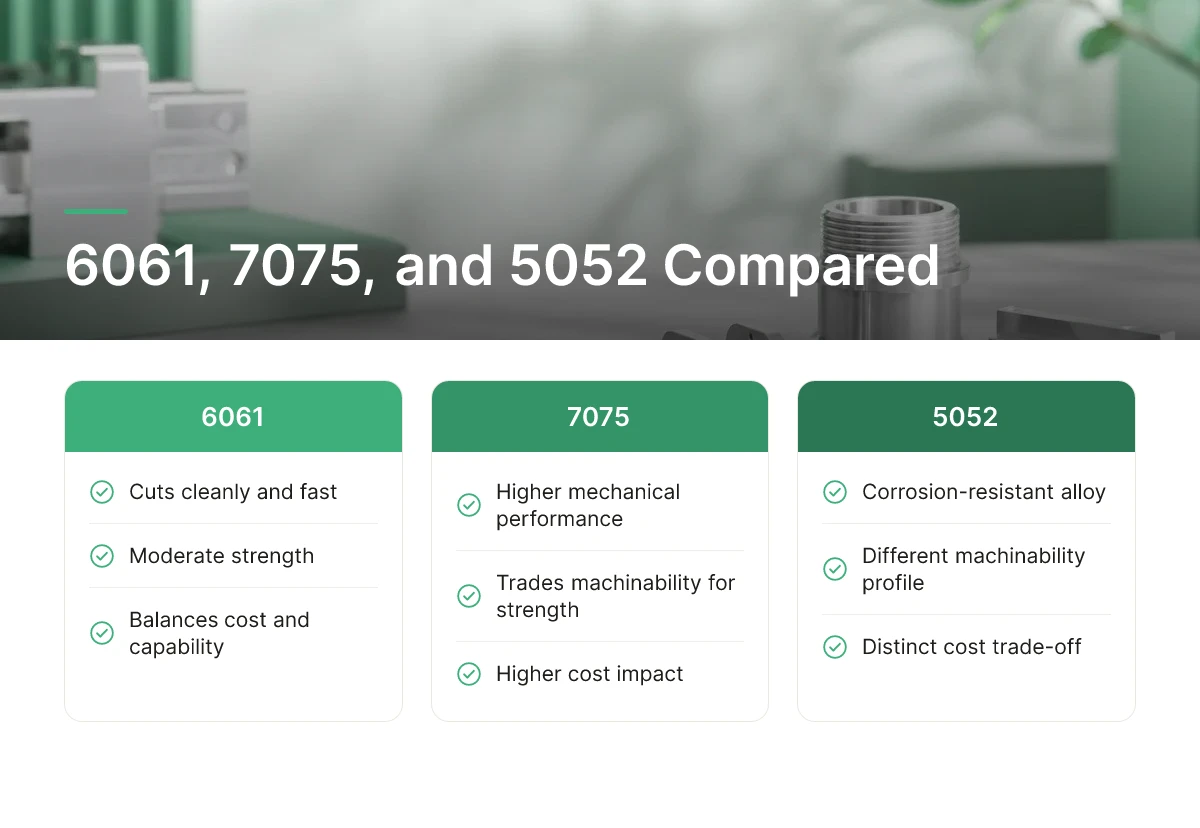
6061 is the default for good reason: it cuts cleanly, holds moderate strength, and machines fast enough to keep cycle times short. It’s the alloy most shops reach for first because it balances cost and capability without extreme trade-offs in either direction.
7075 offers a higher strength-to-weight ratio than 6061, which makes it attractive for load-bearing or weight-sensitive parts. That strength comes at a price: 7075 is harder on cutting tools, generates more heat during cutting, and often needs slower spindle speeds to avoid work-hardening the surface. Expect more tool wear per batch and longer machine time, which pushes 7075 parts toward the mid-range or premium end of any aluminum machining services quote.
5052 sits in a different category. It machines reasonably well but is better known for corrosion resistance and formability, which is why it shows up more often in sheet-formed enclosures or lightly machined brackets than in complex turned parts. If a part needs bending or forming before or after machining, 5052 is often the more practical choice than 6061 or 7075.
Which Alloy Offers the Best Balance of Strength, Corrosion Resistance, and Machining Efficiency?
No single alloy wins across all three factors, the right choice depends on what the part has to survive in service. A bracket exposed to vibration and cyclic loading needs fatigue resistance that 7075 provides better than 6061. A housing exposed to moisture or chemical contact benefits more from 5052’s corrosion resistance than from 7075’s raw strength. A general-purpose structural component rarely needs 7075’s premium at all, since 6061 covers moderate strength requirements at a lower machining cost.
The practical framework: define the part’s mechanical load, its operating environment, and its finish requirements before selecting an alloy, don’t default to whichever material is most common. Aerospace and automotive-style parts that need low weight and high fatigue resistance justify 7075’s added machining cost. Parts that need corrosion resistance or post-machining forming point toward 5052. Everything else generally performs well and machines economically in 6061.
How Much Do Aluminum Machining Services Cost, and What Factors Drive Pricing?
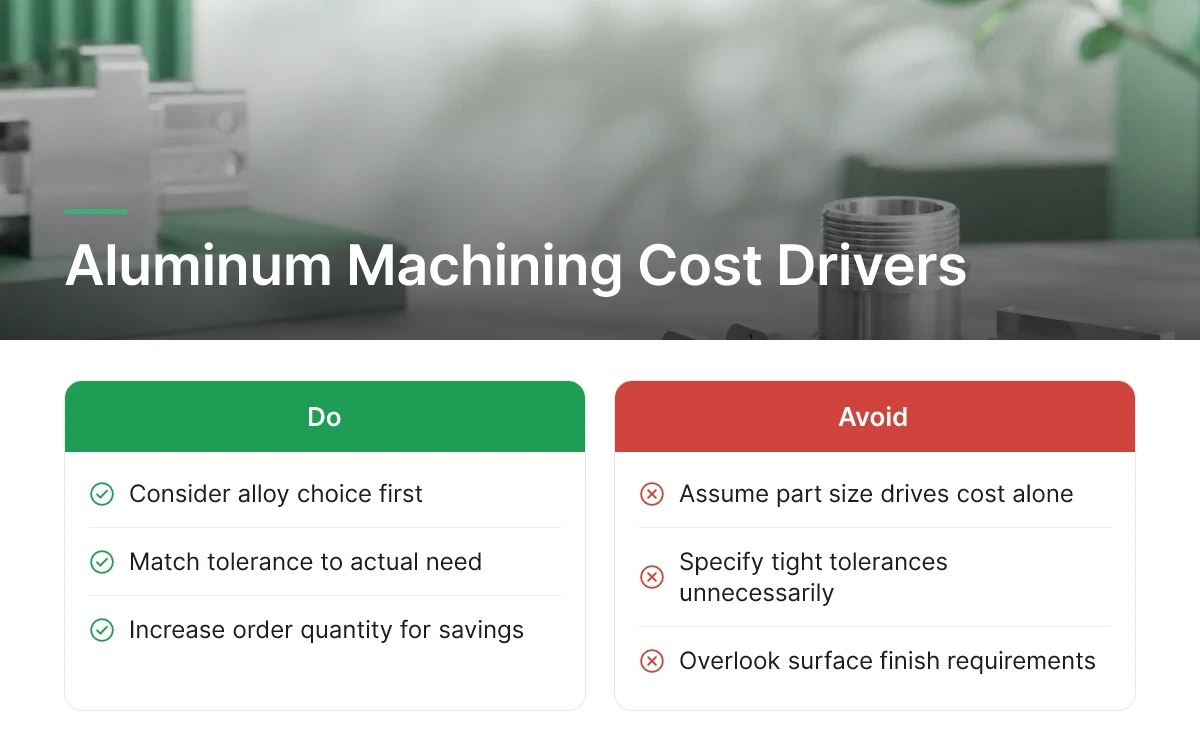
Pricing for aluminum machining services depends on five interacting factors: alloy choice, part complexity, tolerance tightness, surface finish, and order quantity. No single variable sets the price alone, a simple bracket in 6061 with loose tolerances costs far less per part than a tight-tolerance connector housing in 7075 requiring anodizing and a certified inspection report.
What Drives the Cost of Small Precision Aluminum Parts as Order Size and Complexity Change?
Order quantity changes the per-part cost because setup time and CNC programming get spread across more units. A Swiss lathe or CNC mill needs a fixed amount of time to program the toolpath, set fixtures, and run first-piece inspection, regardless of whether the run is 50 parts or 5,000. On small runs, that fixed cost dominates; on larger batches, it shrinks into a rounding error and the price per part drops accordingly. When considering aluminum machining services, this point stands out.
Complexity works differently. Every additional setup, flipping the part to machine a second face, swapping tools for a thread or undercut, adding a secondary operation, adds machine time and handling risk. Parts that can run complete in a single setup, such as many jobs suited to automatic lathe production or Swiss lathe machining, avoid this stacking effect entirely. Feature count matters too: a part with six critical dimensions takes longer to program and inspect than one with two.
How Do Material, Surface Finish, and Tolerance Specs Impact Machining Costs?
Tolerance tightness raises cost through three linked mechanisms: slower feed rates, more inspection time, and higher scrap risk. Holding a dimension to a few thousandths of an inch instead of a standard machine tolerance forces slower cutting speeds to control tool deflection and heat buildup, and every tight-tolerance feature typically needs dimensional verification with calibrated gauges or CMM measurement rather than a quick caliper check. Tighter windows also mean less margin for error, so a single miscut can turn a finished part into scrap rather than a reworkable reject.
Surface finish adds process steps on top of the base machining operation. As-machined parts skip extra finishing and cost the least. Bead blasting or light deburring adds a modest secondary step. Anodizing, common for aluminum parts needing corrosion resistance or a cosmetic finish, requires shipping parts to a plating line, adding both cost and lead time. Alloy choice layers on top of this: standard 6061 machines easily and costs less, while 7075 or 2024 machine harder and cost more in tooling wear and cycle time.
Grouped qualitatively, budget-friendly work covers simple geometries in standard alloys with loose tolerances and as-machined finishes. Mid-range covers moderate feature counts, standard tolerances, and light secondary finishing. Premium-tier pricing applies to tight tolerances, exotic alloys, multi-setup geometries, or certified aerospace and medical work requiring full documentation, the kind of job MFG SOLUTION runs under ISO 13485:2016 and IATF 16949 process controls for parts up to 38mm in diameter.
What Lead Times Can You Expect from Aluminum Machining Services?
Lead times for aluminum machining services generally range from a few days for simple, low-quantity parts to several weeks once finishing and inspection are factored in.
Part complexity is the first variable. A single-setup turned bushing needs one fixture and one tool path, so it can move from quote to shipment fast. A part requiring five-axis milling, multiple fixture changes, and tight positional tolerances needs more programming time and more machine hours before it’s ready to inspect. Some providers, including MFG SOLUTION, quote within 8 hours and ship within 3 days for parts up to 38mm in diameter, a benchmark that only holds when the part geometry doesn’t require extensive fixturing or secondary operations. Treat fast quote-and-ship windows as an achievable pattern for straightforward jobs, not a guarantee for every design. For those exploring aluminum machining services, this matters.
How Do Batch Sizes Affect Production Schedules for Small Aluminum Parts?
Batch size changes the math on both machine time and cost per part, and it directly shapes when your order can be scheduled.
A run of 50 parts ties up a machine for a short window; a run of 5,000 parts occupies that same machine for days. Larger batches take longer to complete in absolute terms, but they spread fixed setup time, programming, tool changes, first-piece inspection, across more units, which lowers the cost and often the average time per part. Smaller prototype batches skip that amortization, so per-part cost runs higher even though total shop time is shorter. If your project moves from prototype to production volume, expect the shop to requote both price and schedule, since the batch profile changes the entire production plan.
How Do Minimum Order Quantities and Capacity Influence Delivery Timelines?
Shop capacity, the number of CNC machines, automatic lathes, and shifts running, determines how quickly your job gets a slot in the queue.
A shop running 20 automatic lathes and 5-axis CNC equipment across multiple shifts can absorb a new order without pushing other customers’ jobs back; a smaller shop with limited machines may need to wait for a current job to finish. Minimum order quantities also matter: some shops set MOQs to keep setup costs proportional to output, which can delay very small orders if they’re batched with other work. Finishing steps add time outside the machining shop’s direct control. Anodizing, passivation, and third-party tight-tolerance inspection typically run through external or separate in-house processes with their own queues, and those steps can add days regardless of how fast the raw machining runs.
Request your quote early, and specify finish and inspection requirements upfront, surface treatment, certification documents, dimensional reports, so the shop can build an accurate schedule instead of revising it mid-order. This directly impacts aluminum machining services outcomes.
What Quality Standards and Certifications Matter for Aluminum Machining Providers?
Certifications tell you whether a provider’s quality process is documented and repeatable, or whether it depends on one experienced machinist catching errors by eye. For aluminum machining services running batch production, that difference determines whether part 500 matches part 1.
Why Do Certifications Like ISO 9001 or AS9100 Matter for Precision Aluminum Machining?
ISO 9001:2015 certifies that a manufacturer has documented, repeatable quality management processes covering everything from incoming material checks to final inspection sign-off. It doesn’t guarantee a part is perfect, it guarantees the provider has a defined system for catching defects and correcting them, and that the system is audited regularly. For a buyer ordering 2,000 aluminum brackets across three batches, that consistency matters more than any single spec sheet.
AS9100 and ISO 13485 raise the bar further, and they matter specifically when the application demands it. AS9100 applies to aerospace components where a single missed tolerance can ground a fleet. ISO 13485:2016 applies to medical device parts, where regulatory bodies require documented traceability from raw material lot to finished part. If you’re sourcing a component for a surgical instrument housing or an automotive fuel system, ask whether the provider holds these certifications rather than assuming general CNC competence covers it. IATF 16949 plays a similar role for automotive suppliers, where warranty claims trace back through the supply chain.
How Do Quality Assurance and Inspection Processes Vary Between Providers?
“Full process control” sounds like marketing language until you break it down: it means every machining step, material verification, tool setup, in-process checks, final inspection, is tracked, documented, and auditable. If a defect shows up in the field, a provider with full process control can trace it back to the exact machine, operator, and batch. A provider without it can only guess.
Inspection intensity should match the tolerance and application. Lower-tolerance decorative or structural brackets often ship with sample inspection, checking a percentage of each batch against the drawing. Tight-tolerance parts, or anything going into a regulated medical or automotive assembly, warrant full dimensional inspection or CMM (coordinate measuring machine) reports covering every critical dimension on every part, or a statistically justified sampling plan tied to the certification standard.
Before committing to a production run, ask any provider for their certification documents and a sample inspection report from a comparable job. MFG SOLUTION operates under ISO 9001:2015, ISO 13485:2016, and IATF 16949 with full process control on parts up to 38mm, meaning every order includes documentation you can audit, not just a pass/fail stamp. This is particularly relevant for aluminum machining services.
What Size and Batch Limitations Apply to CNC Aluminum Machining?
Part size runs from a few millimeters up to several hundred millimeters, while batch size can range from a single prototype to tens of thousands of units, both limits trace directly back to machine capability and cost per part.
What Is the Maximum Part Size Range Precision CNC Aluminum Machining Can Handle?
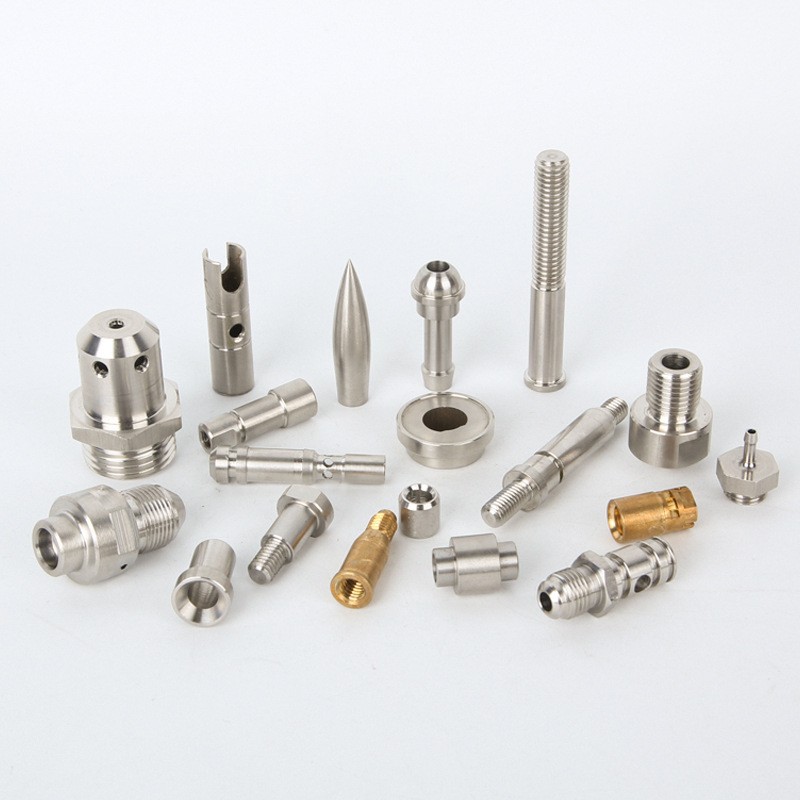
Upper size limits depend on the machine, not the material. A 3-axis mill is bounded by its bed travel and spindle reach, while a 5-axis machine or CNC mill-turn center can reach more surfaces in one setup, which matters more for complex geometries than for raw size . Some aluminum machining services, including MFG SOLUTION, focus deliberately on the small end of that range, parts up to 38mm in diameter, because that’s where Swiss lathes, automatic lathes, and cold forging beat general-purpose 3-axis mills on cycle time and cost.
Small and thin-walled aluminum parts bring their own headaches. Thin walls flex under cutting pressure, which makes workholding and vibration control harder to manage than on a bulky bracket. Aluminum’s low melting point relative to steel also means heat buildup during high-speed cuts can distort tight tolerances if feeds and speeds aren’t tuned correctly . A shop running 5-axis machines alongside 20 automatic lathes and cold heading equipment, as MFG SOLUTION does, can route a delicate small part to the process best suited to hold its tolerance instead of forcing every job through the same mill.
Are There Minimum Order Quantities, and How Do They Affect Pricing and Lead Time?
CNC machining carries no hard minimum order quantity the way casting or forging tooling does, you can order one part or one million, but per-part cost drops as volume rises. Casting and forging require dies or molds that only pay off at higher volumes, while CNC cuts each part from stock, so a single prototype is always technically possible .
That flexibility shapes pricing tier and lead time together. A one-off prototype run typically sits at budget-friendly single-part pricing with setup cost spread across just that unit. A production batch of several thousand shifts toward mid-range or volume-optimized pricing, since setup and programming costs amortize across more parts, this is also where an 8-hour quote and 3-day shipment window matters most, because it compresses the gap between design approval and stocked inventory.
For batch volumes in the hundreds of thousands, a casting or forging partner may eventually undercut CNC on unit cost once tooling is paid off, and for one-off geometric prototypes an additive manufacturing provider can sometimes beat machining on speed. For most small precision aluminum parts under 38mm, though, CNC remains the practical middle ground between those two extremes. When considering aluminum machining services, this point stands out.
Frequently Asked Questions
Is 6061 or 7075 aluminum better for CNC machined parts?
Neither alloy is universally better, 6061 suits general-purpose parts, while 7075 fits high-stress applications. 6061-T6 offers good machinability, corrosion resistance, and lower cost, making it the default choice for brackets, housings, and fixtures. 7075-T6 delivers higher tensile strength closer to some steels, but costs more and machines slightly harder, so it’s reserved for load-bearing or aerospace-grade components.
Does a tighter tolerance always mean a higher price for aluminum parts?
Not always, but tolerances tighter than ±0.05mm typically add cost through slower cutting speeds and extra inspection. Standard tolerances around ±0.1mm rarely affect price. Cost increases when tight tolerances apply to multiple features, small diameters, or thin walls prone to distortion during machining.
Can small aluminum parts be machined in low quantities without high setup costs?
Yes, CNC turning and mill-turn processes handle low-volume aluminum runs without the tooling investment forgings or castings require. Programming and fixturing costs get spread thinner as batch size grows, but a shop running efficient small-parts production can quote and machine short runs economically. MFG SOLUTION, for example, provides quotes within 8 hours and ships within 3 days for parts up to 38mm, which keeps low-quantity orders practical rather than cost-prohibitive.
What surface finishes are common for machined aluminum parts?
As-machined, bead blasted, and anodized finishes are the most common options for CNC aluminum parts. As-machined leaves visible tool marks but costs least. Bead blasting creates a uniform matte look, while anodizing (Type II or Type III hardcoat) adds corrosion resistance and color options, often specified for parts exposed to handling or moisture.
Do I need AS9100 certification for a non-aerospace aluminum part?
No, AS9100 is aerospace-specific and unnecessary for most automotive, electronics, or industrial parts. Non-aerospace buyers should instead look for ISO 9001:2015 for general quality management, IATF 16949 for automotive, or ISO 13485:2016 if the part is destined for a medical device. For those exploring aluminum machining services, this matters.
Conclusion
Getting aluminum parts machined right comes down to three decisions: choosing the alloy that matches the load and environment, setting tolerances only as tight as the assembly actually requires, and picking a supplier whose certifications match your industry rather than paying for credentials you don’t need. Overspecifying any one of these drives up cost without improving the part. Before submitting your next RFQ, pull your drawing and flag every tolerance tighter than ±0.05mm, confirm each one is functionally necessary, then send the specs for a quote and compare turnaround against your current supplier’s timeline.
Recommended Articles
Explore more from our content library: