
2026-10-22
CNC Machining for Agricultural Machinery Components: Shafts, Bushings, Mounting Brackets and Wear-Resistant Parts

Suggested URL Slug: cnc-machining-agricultural-machinery-components
Primary Keyword: CNC Machining for Agricultural Machinery Components
Category: Manufacturing Solutions
Tags: CNC Machining, Agricultural Machinery, Precision Shafts, Custom Bushings, Industrial Equipment, CNC Turning, Material Selection, Wear Resistance, Quality Inspection
Introduction: Precision Manufacturing for Demanding Agricultural Equipment
Agricultural machinery operates in demanding environments. Tractors, seeders, harvesters, irrigation equipment, sprayers and other agricultural machines must handle vibration, shock loads, dust, moisture, temperature changes and repeated mechanical movement. Their components must fit correctly, withstand operating loads and remain serviceable throughout their intended working life.
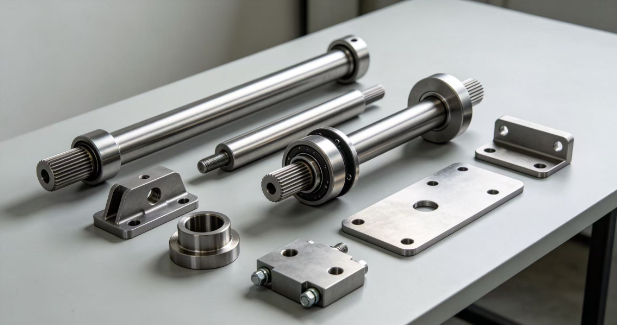
Behind these machines are numerous precision parts: shafts, bushings, spacers, mounting brackets, bearing housings, pivot pins, threaded adapters and custom mechanical connectors. Although many of these components appear simple, their performance depends on details such as bore dimensions, concentricity, surface finish, material properties and the relationship between mating features.
A poorly fitted bushing can create excessive clearance or accelerate wear. An incorrectly machined shaft may cause alignment problems. A mounting bracket with misplaced holes can complicate assembly or transfer unwanted loads to connected parts. These issues can increase maintenance requirements, delay equipment production and create unnecessary costs.
CNC machining for agricultural machinery components gives equipment manufacturers a flexible method for producing custom metal and engineering-plastic parts from prototypes through repeat production. CNC milling, turning and multi-axis machining can support different geometries, while suitable inspection processes help verify the dimensions that matter to assembly and function.
However, reliable manufacturing requires more than selecting a machine. Material selection, operating conditions, design for manufacturability, finishing, quality requirements and production quantity must be considered together.
This guide explains how agricultural equipment manufacturers and procurement teams can specify, manufacture and inspect custom precision components more effectively.
1. Common CNC Machined Components Used in Agricultural Machinery
Agricultural equipment combines moving mechanisms, structural assemblies, rotating parts and adjustable interfaces. Each component category has different manufacturing priorities.
Shafts, pivot pins and rotating components
Shafts and pivot pins transmit motion or support rotating and articulated assemblies. They may include bearing journals, shoulders, grooves, threaded ends, cross-holes and retaining-ring features.
For these components, diameter, straightness, concentricity and runout may influence assembly and operating behavior. The required controls depend on the bearing arrangement, load, speed and intended service conditions.
CNC turning is often suitable for cylindrical parts with multiple diameters and shoulders. Additional milling or drilling can produce keyways, flats and cross-holes when required.
Explore CNC turning services and this practical guide to understanding CNC turning parts to evaluate process options for rotational components.
Bushings, sleeves and spacers
Bushings support motion between mating components, while sleeves and spacers establish separation or positioning. Depending on the application, these parts may be manufactured from steel, stainless steel, bronze or engineering plastics.
Their important features can include internal and external diameters, wall thickness, length, concentricity and surface condition. For a bushing, the clearance or interference between mating parts must be established according to the design and operating conditions.
Where a component is thin-walled, workholding and cutting forces also require attention. Excessive clamping pressure can distort the part and produce dimensional changes after release.
Mounting brackets and structural interfaces
Mounting brackets connect motors, actuators, sensors, guards and other equipment modules. They may contain threaded holes, counterbores, slots, pockets and multiple mounting faces.
CNC milling is useful when these features must be positioned relative to a common datum. For assemblies with several mounting points, the drawing should identify the surfaces and hole patterns that control installation.
Not every bracket requires tight tolerances on every feature. Applying tighter limits only where function requires them can help reduce machining time and inspection costs.
Bearing housings, linkage blocks and custom connectors
Bearing housings and linkage blocks support moving assemblies and establish relationships between shafts, bearings and other mechanical components. Their performance depends on the fit of critical bores, mounting-face geometry and alignment with connected parts.
Custom connectors may combine threads, flats, grooves and cross-holes. For these parts, a complete drawing and an appropriate manufacturing sequence are essential to maintaining feature relationships.
MFG SOLUTION’s manufacturing capability overview provides a starting point for evaluating manufacturing options for different component geometries.
2. Selecting Materials for Load, Corrosion and Wear
Material selection should reflect the component’s function and operating environment rather than relying on a general preference for one metal.
Agricultural machinery may encounter fertilizer, pesticides, mud, water, cleaning chemicals, abrasive particles and repeated mechanical loads. The correct material depends on the actual exposure, temperature, strength requirements, wear conditions and maintenance strategy.
Aluminum alloys for lightweight components
Aluminum alloys can be suitable for lightweight brackets, covers, housings, support blocks and selected non-critical structural components. Their machinability and low density can help reduce part weight.
However, aluminum grades differ in strength, corrosion behavior and machinability. The selected alloy and temper must match the component’s load and environment.
Review available aluminum material options before finalizing the material specification. If anodizing is required, identify functional surfaces, masking areas and the dimensions that must remain within tolerance after treatment.
Carbon and alloy steels for mechanical loads
Carbon and alloy steels may be appropriate for shafts, pins, couplings and other components exposed to mechanical loads or wear. The selected grade, heat-treatment condition and surface requirements affect the manufacturing route.
For example, 1045 steel turned parts illustrate how material choice and turning operations can be considered together.
If a shaft requires hardening, nitriding or another treatment, the drawing should identify the applicable specification and the surfaces affected. Heat treatment can change dimensions, so finishing allowances and the final inspection stage should be planned accordingly.
Stainless steel for corrosion-exposed parts
Stainless steel may be suitable for components exposed to moisture, certain chemicals or outdoor conditions. Nevertheless, corrosion resistance varies by grade and environment.
The presence of fertilizer, cleaning agents or other chemicals may influence material suitability. A material should not be selected solely because it is described as stainless steel.
Consult this guide to stainless steel block types, uses and machining when comparing material options.
Engineering plastics for selected sliding and insulating applications
POM, nylon, PTFE, PEEK and other engineering plastics may be considered for selected bushings, wear pads, spacers or insulating components.
Their suitability depends on load, temperature, moisture exposure, friction and chemical compatibility. Plastics can also expand, creep or absorb moisture, depending on the material grade.
For components with close fits, engineers should consider the operating temperature and environmental conditions rather than evaluating dimensions only at room temperature.
MFG SOLUTION’s material reference resources can help with initial material comparisons. Final selection should be confirmed against the actual application requirements.
3. Controlling Tolerances, Fits and Alignment
Agricultural machinery often contains assemblies with multiple moving interfaces. A component may meet its individual dimensions yet still cause problems if its relationship with neighboring features is not controlled.
Shaft and bushing fits
The fit between a shaft and bushing affects clearance, movement, lubrication and wear. A fit that is too tight may increase friction or prevent assembly; excessive clearance can contribute to movement, noise or accelerated wear.
The appropriate fit depends on the materials, loads, operating temperature, lubrication and intended movement. Drawings should specify the required dimensions and tolerances instead of relying on descriptions such as “close fit.”
Bearing bores and mounting faces
Bearing housings require suitable bore dimensions and relationships between the bore axis and mounting surfaces. Depending on the design, concentricity, perpendicularity, position or other geometric controls may be important.
Datum references should represent how the part is assembled or located. This makes the manufacturing and inspection strategy easier to understand.
Avoid unnecessary precision
Tight tolerances can increase machining time, setup complexity, measurement effort and scrap risk. They should be applied to functional interfaces rather than automatically to every dimension.
Read machining tolerances explained and why CNC machining tolerance drives part price for practical guidance on balancing precision and manufacturing cost.
4. Managing Wear, Surface Finish and Edge Conditions
Agricultural machinery frequently operates in environments where dirt and abrasive particles can affect exposed surfaces. Moving parts may also experience sliding contact, impact or repeated loading.
Surface condition and edge quality should therefore be specified according to the component’s function.
Surface finish on sliding and rotating features
Shaft journals, bushing bores and other mating surfaces may require defined surface roughness to support the intended contact and lubrication conditions.
However, a finer finish is not always necessary. The required roughness should be based on the material pair, operating conditions and design requirements.
The drawing should distinguish functional surfaces from non-critical external surfaces. This prevents unnecessary finishing work and helps the supplier prioritize important features.
For additional guidance, review CNC machining surface finish.
Burr removal and edge treatment
Burrs around cross-holes, slots and machined edges can interfere with assembly, damage adjacent parts or create handling risks. Internal burrs may be particularly difficult to detect on components with intersecting holes.
Where edge treatment matters, specify chamfers, radii or deburring requirements clearly. If an edge must remain sharp for a particular function, identify it rather than relying on a general instruction.
Surface treatments and protective finishes
Anodizing, plating, passivation, painting and other treatments may be used depending on the material and operating environment.
The selected treatment should be compatible with the base material and the intended function. Coating thickness can affect threads, bores, press fits and other dimensions, so critical surfaces may need masking or post-treatment inspection.
For parts requiring heat treatment or protective finishing, agree on the process sequence and final acceptance requirements before production begins.
5. Choosing Between CNC Milling, Turning and Other Processes
The best manufacturing route depends on geometry, material, production quantity, required precision and tooling investment.
CNC milling for brackets and complex blocks
CNC milling is appropriate for brackets, mounting plates, bearing blocks and components with pockets, slots, flat faces and threaded holes.
When multiple faces contain critical features, the process plan should minimize unnecessary repositioning and maintain a consistent datum strategy.
For complex geometry or features on several orientations, 5-axis CNC machining may reduce the number of setups and help maintain relationships between machined surfaces.
CNC turning for shafts, pins and sleeves
Turning is generally suitable for rotational components such as shafts, bushings, sleeves and spacers. It can produce diameters, shoulders, grooves and other cylindrical features efficiently.
For small, slender parts with multiple detailed features, Swiss turning for small precision parts may be worth evaluating.
When alternative processes may be more economical
For repeat components with high production volumes, automatic turning, cold forging, casting or other processes may offer advantages when the geometry and investment requirements are suitable.
Forging may reduce material waste for certain shapes, but secondary machining may still be needed for precision bores, threads and mating surfaces. Casting can suit more complex shapes, although machining allowances and material consistency must be considered.
MFG SOLUTION supports multiple manufacturing approaches. Review the CNC machining service, CNC turning service and capability overview when planning a suitable route.
6. Workholding and Dimensional Stability
Long shafts, thin-walled sleeves and irregular brackets present different workholding challenges. Poor support can cause vibration, deflection or distortion, affecting dimensional accuracy and surface quality.
Support the part according to its geometry
Long shafts may require suitable support to control deflection during turning. Thin-walled components need careful clamping to avoid deformation. Irregular brackets may require dedicated fixtures to locate the part consistently.
The fixture should hold the component securely without introducing excessive stress. Critical features should be machined from an appropriate datum arrangement whenever possible.
See CNC workholding fixtures, types and best practices for additional process-planning considerations.
Plan the machining sequence
A practical sequence may separate roughing from finishing where material stress or distortion could affect the final dimensions. Heat treatment and surface finishing must also be incorporated into the plan when required.
For repeated production, stable fixtures, controlled programs, tool-life management and consistent inspection help reduce variation between batches.
The goal is not simply to achieve a good first part. It is to maintain acceptable quality across the agreed production quantity.
7. Inspection and Quality Control for Agricultural Components
Inspection should focus on the features that determine fit, movement, load transfer and serviceability.
Dimensional verification
Depending on the component, inspection may include shaft diameter, bore size, overall length, hole position, flatness, runout and surface roughness.
Suitable instruments should be selected according to the required tolerance and feature geometry. Complex geometric relationships may require more advanced measurement methods than a standard caliper.
Material and process documentation
Where required, material certificates, heat-treatment records, finishing documentation and inspection reports should be included in the quality plan.
If a part requires a specific material grade or condition, substitutions should not be made without approval. This is particularly important when a change could affect strength, wear behavior, corrosion resistance or fit.
Review quality assurance standards for CNC machining parts and ISO 9001 precision machining guidance when defining project documentation requirements.
First-article and repeat-production checks
For a new component, a first-article inspection can help confirm that the manufacturing process meets the drawing requirements before repeat production proceeds.
The inspection scope should be agreed in advance, including the drawing revision, critical dimensions, acceptance criteria and report format. For recurring orders, the supplier and buyer should also agree on any required sampling or ongoing inspection controls.
8. Reducing Manufacturing Cost Without Sacrificing Reliability
Cost optimization should focus on manufacturing efficiency while preserving the component’s required function.
Several practical decisions can help.
Simplify non-functional geometry. Unnecessary pockets, narrow slots and difficult-to-reach features can increase machining time without improving performance.
Apply tolerances selectively. Tight limits should be reserved for critical fits and interfaces.
Choose a suitable material condition. Material grade, stock size and heat-treatment requirements influence both machining and finishing costs.
Reduce unnecessary setups. A design that allows important features to be machined from a consistent datum may reduce handling and alignment risk.
Specify finishing clearly. Unclear coating or surface-finish instructions can create additional quotation assumptions and rework.
Share production forecasts. Prototype and production quantities may require different manufacturing routes. Providing expected repeat demand helps suppliers evaluate tooling, setup and process economics.
For a deeper evaluation, read CNC machining cost analysis and use MFG SOLUTION’s online quotation service to begin a project discussion.
9. Preparing an RFQ for Custom Agricultural Machinery Components
A clear request for quotation helps engineering teams evaluate manufacturability and allows procurement teams to compare suppliers more consistently.
Include the following information:
- CAD files: Provide a 3D model in a supported format, such as STEP, when available.
- Controlled drawing: Include dimensions, datums, tolerances, thread specifications and revision details.
- Material: Specify the exact grade and condition, plus any heat-treatment or certification requirements.
- Operating conditions: Describe relevant loads, movement, temperature, moisture, dirt or chemical exposure.
- Surface requirements: Identify functional surfaces, roughness, coatings and deburring requirements.
- Quantity: State prototype quantity, initial order size and estimated repeat demand.
- Inspection: Identify critical characteristics, required reports and material traceability expectations.
- Delivery and packaging: Provide the target schedule, destination and any requirements to protect precision surfaces during transport.
If alternative materials or manufacturing methods are acceptable, state the conditions under which a supplier may propose them. This allows engineering review without creating ambiguity around the released specification.
To start a project, use the MFG SOLUTION online quote page or visit the contact page.
Conclusion: Build Agricultural Components Around Real Operating Requirements
Reliable agricultural machinery depends on components that fit correctly, withstand their intended loads and remain suitable for the operating environment. Shafts, bushings, mounting brackets, bearing housings and connectors may be small relative to the complete machine, but their dimensions and material properties can significantly influence assembly and maintenance.
CNC machining offers flexibility for custom components, prototypes and repeat production. The best results come from combining appropriate materials, functional tolerances, well-planned workholding, suitable finishing and a clear inspection strategy.
Before requesting a quotation, define the component’s role, operating conditions, critical interfaces, required documentation and expected quantities. These details allow manufacturing engineers to evaluate the part more effectively and recommend a practical production approach.
Need custom CNC machined parts for agricultural machinery?
Send MFG SOLUTION your CAD files, controlled drawings, material requirements, quantities and inspection expectations for a manufacturing review.
- Request a quote: https://mfg-solution.com/online-quote/
- Contact MFG SOLUTION: https://mfg-solution.com/contact-mfg-solution/
- Explore CNC machining services: https://mfg-solution.com/cnc-machining/
Frequently Asked Questions
1. Which agricultural machinery components can be CNC machined?
Common examples include shafts, pivot pins, bushings, sleeves, spacers, mounting brackets, bearing housings, linkage blocks and custom connectors. The suitable process depends on the part’s geometry, material, quantity and required tolerances.
2. Which materials are suitable for agricultural machinery parts?
Aluminum, carbon steel, alloy steel, stainless steel and engineering plastics may suit different applications. Selection depends on mechanical loads, corrosion exposure, wear, temperature, weight and the intended operating environment.
3. Is CNC turning suitable for agricultural machinery shafts?
CNC turning is commonly suitable for shafts, pins, sleeves and other rotational parts. Additional milling or drilling may be needed for keyways, flats, cross-holes or other non-rotational features.
4. How should shaft and bushing tolerances be specified?
Specify the required diameters and tolerances according to the intended fit, movement, load, lubrication and temperature. The drawing should make clear which features control assembly and function.
5. Can surface treatment affect component dimensions?
Yes. Coating thickness, heat treatment and other finishing operations can affect dimensions or surface conditions. Critical bores, threads and mating surfaces should be reviewed during process planning, with masking or post-treatment inspection specified when necessary.
6. How can I reduce the cost of custom machined agricultural parts?
Use realistic tolerances, simplify non-functional geometry, select a suitable material, minimize unnecessary setups and provide accurate quantities. Clear finishing and inspection requirements also help prevent rework and quotation uncertainty.
7. What information should be included in an agricultural component RFQ?
Provide the 3D model, controlled drawing, material grade, quantity, surface requirements, operating conditions, critical tolerances, inspection expectations and target delivery date.
8. Can CNC machined agricultural parts be supplied for repeat production?
Yes. Repeat production can be supported through controlled drawings and revisions, consistent workholding, stable machining programs, material controls and agreed inspection procedures. The production plan should reflect the required quantity and quality expectations.