
2026-10-03
5 Telecommunications Precision Parts CNC Machines Make Best

CNC machining produces five categories of telecommunications precision parts most reliably: RF connector bodies and pins, waveguide components, antenna mounting hardware, signal shielding enclosures, and small-diameter fasteners or standoffs. Telecom equipment demands tight tolerances for signal integrity, corrosion-resistant materials, and consistent repeatability across thousands of units, conditions where CNC machining outperforms stamping or molding on small-diameter, complex-geometry parts, though stamping still wins on very high-volume flat components once tooling is paid for.
These five categories of telecommunications precision parts share a common requirement: dimensional consistency that stamping dies lose over long production runs. The sections below break down why each category depends on CNC machining specifically, and where stamping or molding remains the better economic choice. For a broader look at how telecom-grade machining fits into communication equipment manufacturing generally, see this overview of telecom parts manufacturing and this guide to CNC machining for the communication industry.

1. RF Connector Bodies and Contact Pins
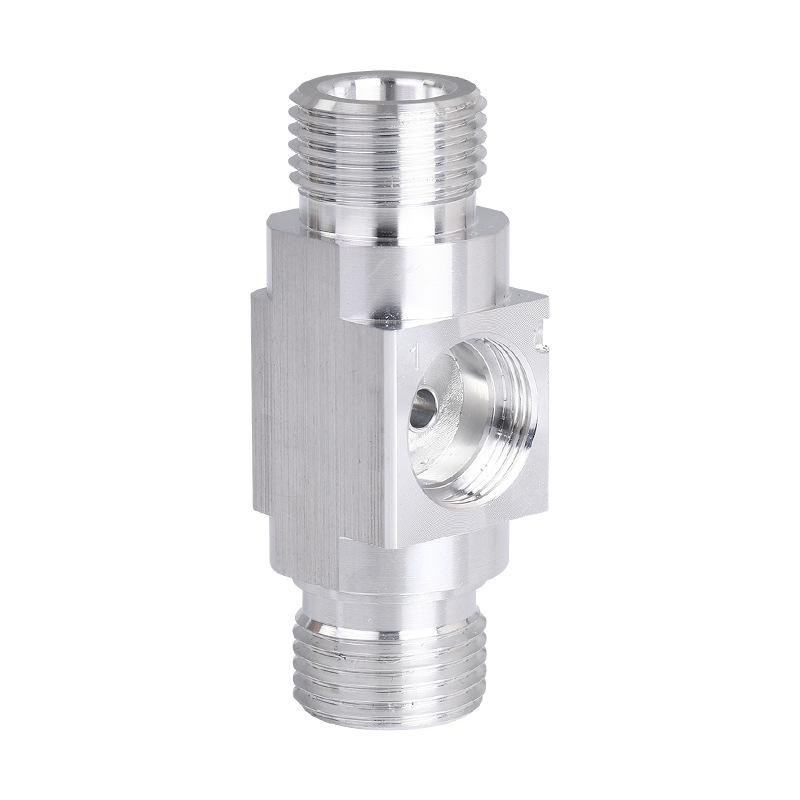
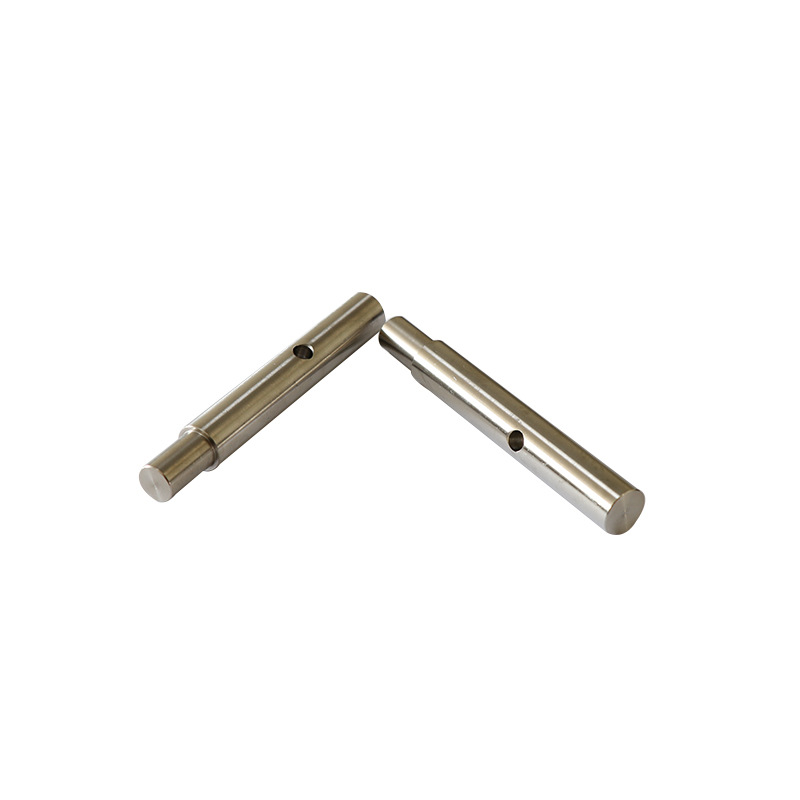
RF connector bodies and contact pins are machined interfaces that set the impedance path for a signal, so dimensional error directly becomes signal loss.
The connector body houses the pin, and both parts depend on concentric, repeatable geometry to maintain a controlled impedance along the mating interface. Any wobble in the bore or inconsistency in the pin diameter creates an impedance mismatch, which shows up as signal reflection and insertion loss at the connector joint.
Tight concentricity and a clean surface finish on the contact pin reduce that reflection, which matters more as frequency climbs into microwave and millimeter-wave bands. This is one category of telecommunications precision parts where a few microns of runout changes measurable RF performance, not just fit.
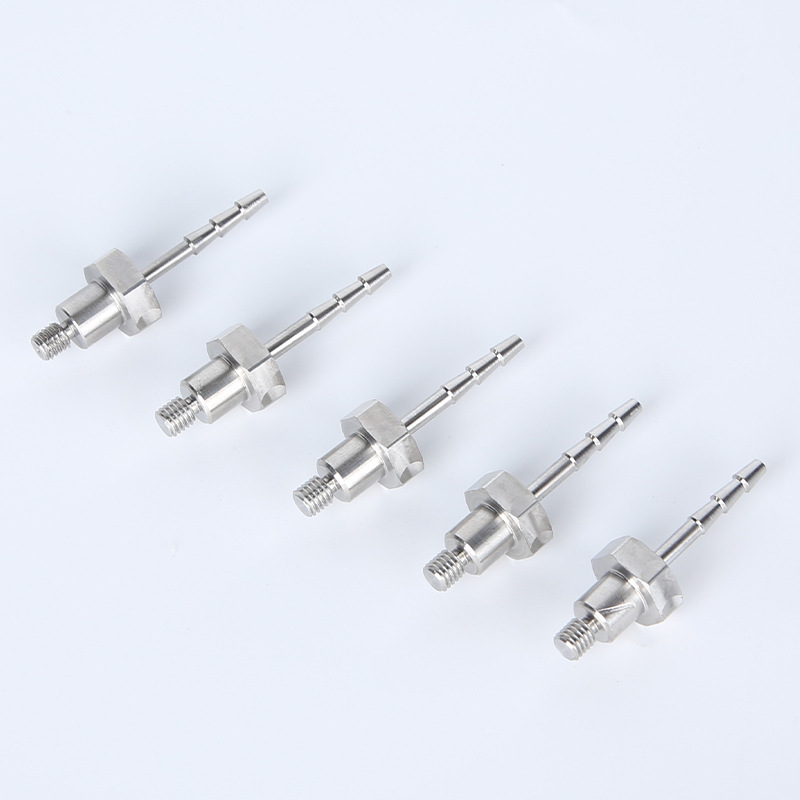
Equipment makers needing small-diameter, high-repeatability parts under 38mm are the best fit here, connector pins and bodies rarely exceed a few millimeters in diameter but demand production volumes in the thousands.
CNC turning avoids a problem stamped pins run into on long jobs: die wear. A stamping die drifts in tolerance as it wears across a production run, so part 1 and part 100,000 are not the same part. CNC holds its tolerance window from the first piece to the last because the cutting program, not a degrading tool, defines the geometry.
2. Waveguide and Microwave Housing Components
Waveguide and microwave housings carry signal through precisely shaped internal cavities, where flatness and dimensional accuracy determine transmission loss.
Internal surface quality controls how a microwave signal propagates through the channel. A rough or uneven wall reflects or absorbs energy it should pass, and at millimeter-wave frequencies, deviations measured in microns start to matter for insertion loss and return loss.
CNC milling reaches internal geometries that stamping and die casting cannot replicate without a secondary machining step. Complex internal profiles, stepped transitions, and tight-radius corners come out of the mill to final spec, which die-cast housings typically cannot match without extra finishing passes. For a closer look at the 5-axis and Swiss CNC processes used on these housings, see this resource on precision 5-axis and Swiss CNC machining for telecommunications parts.
Carrier-grade and backhaul equipment manufacturers running low-volume, high-spec builds are the natural customer for this category, these are not high-volume commodity parts, they are precision telecommunications precision parts built to a performance spec first and a cost target second.
A 5-axis setup cuts complex internal channels in a single operation, which avoids the assembly seams that two-piece stamped or cast housings introduce. Every seam is a potential leak path for signal or a source of mechanical misalignment, so a one-piece machined housing removes that failure mode entirely.
3. Antenna Mounting Brackets and Hardware
Antenna mounting brackets and hardware are the structural parts holding antennas and small-cell units steady against wind, vibration, and temperature swings.
Brackets, clamps, and adjustable mounting hardware position and secure outdoor antenna equipment, often on towers, rooftops, or poles exposed to continuous weather cycling. The hardware has to hold alignment under wind load while still allowing field technicians to adjust angle or position during installation.
Machined parts hold tighter fit tolerances than stamped or cast alternatives, which matters for both field adjustability and vibration resistance over years of service. Loose tolerances in a mounting bracket translate into drift in antenna alignment, which degrades link performance over time.
Outdoor and 5G small-cell deployments are the best-fit application, where equipment faces real thermal cycling and mechanical load that indoor hardware never sees.
CNC machining allows rapid design iteration between prototype and production without cutting new tooling. When antenna specs change mid-rollout, a common occurrence as carriers adjust small-cell designs across a deployment, a machined part updates with a program change, not a new die.
4. Signal Shielding Enclosures and EMI Components
Shielding enclosures and EMI components are machined housings with gasket grooves and seam geometry that control electromagnetic interference leakage.
Enclosure seam tightness and the precision of machined gasket channels determine how much RF energy leaks in or out of a telecom device. A gap of even a few thousandths along a seam can create a leak path that compromises shielding effectiveness at the frequencies telecom equipment operates in.
Consistent wall thickness and flatness from CNC machining support predictable, repeatable shielding effectiveness across every unit built, which stamped sheet metal with variable spring-back cannot guarantee part to part.
Equipment that must pass FCC and RoHS emissions testing is the clearest use case, certification testing exposes inconsistent shielding fast, and a failed test means a redesign cycle no manufacturer wants on a compliance deadline.
CNC machining allows late-stage design changes to shielding geometry without re-tooling. Stamped or die-cast enclosures lock their geometry in at tool build, so a gasket groove revision after a failed EMI test can mean weeks of delay waiting on new tooling, a machined enclosure just needs an updated program. Precision CNC shops that specialize in machined parts for communication equipment typically build this kind of design flexibility into their process from the start.

5. Small-Diameter Fasteners, Standoffs, and Spacers
Standoffs, spacers, and small fasteners hold circuit boards at fixed clearance and provide grounding paths inside network hardware.
These parts maintain board-to-board spacing inside a chassis and often carry a grounding function between a board and its enclosure. Clearance that varies even slightly across a batch can stress connectors, misalign board stacks, or break a grounding contact during vibration.
CNC turning on Swiss lathes holds tight diameter tolerance on parts too small for stamping to run efficiently. Standoffs and spacers often measure a few millimeters across, a size where stamping dies struggle with burr control and consistent wall thickness.
Circuit board assembly in base stations, routers, and network switches is where this hardware lives in volume, small parts, but high counts per unit, and repeated across every unit shipped.
Swiss lathe CNC turning produces the finished part in a single pass, including threading, chamfering, and facing, which cuts the secondary operations small stamped hardware often requires. Fewer operations means fewer chances for a dimension to drift, and MFG SOLUTION runs this process on parts up to 38mm in diameter with quotes delivered within 8 hours of spec submission.
Taken together, these five categories illustrate a pattern worth summarizing. Telecommunications precision parts tend to share these traits regardless of which category they fall into:
- Small diameters or thin wall sections that stamping dies struggle to hold consistently over long runs
- Tight dimensional tolerances tied directly to signal integrity rather than just mechanical fit
- Corrosion-resistant or conductive materials such as brass, stainless steel, or plated aluminum
- Mid-volume production runs where tooling costs for stamping or molding are hard to justify
- Frequent design revisions driven by evolving carrier specs or compliance test results
How CNC Machining Compares to Stamping and Molding for Telecommunications Precision Parts
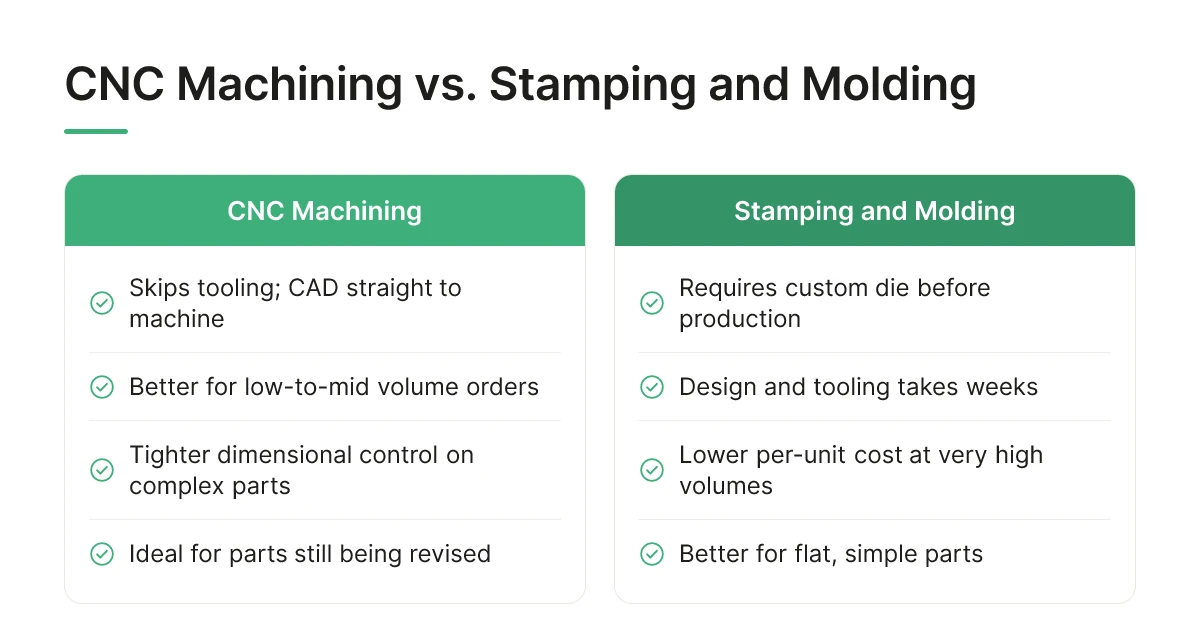
CNC machining wins on flexibility and tolerance for small, complex metal parts, while stamping and molding win on per-unit cost at very high volumes.
Stamping requires a custom die before the first part exists, design and tooling build can take weeks, and that cost gets amortized across the run. CNC machining skips tooling entirely: a CAD file goes straight to the machine, which makes it the better fit for low-to-mid volume orders or parts still being revised.
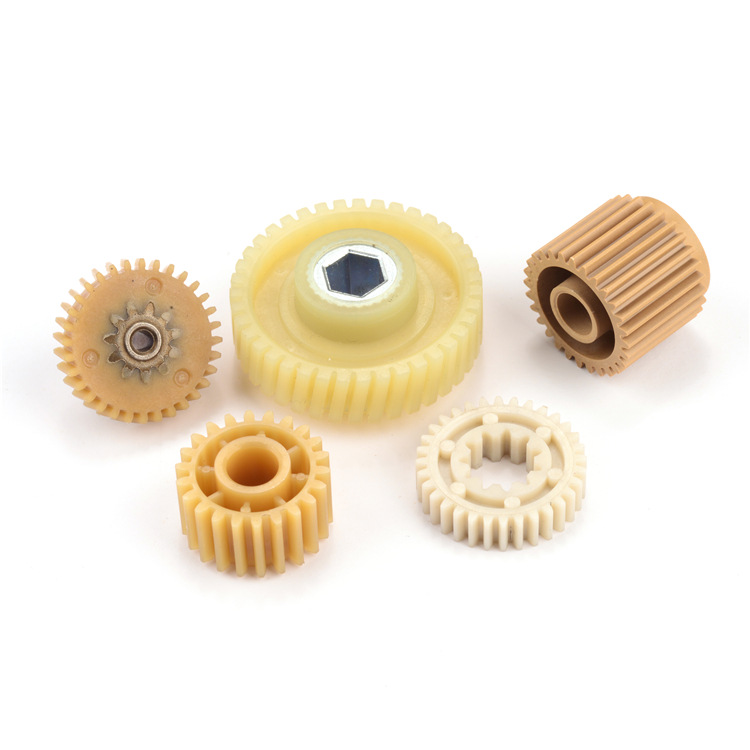
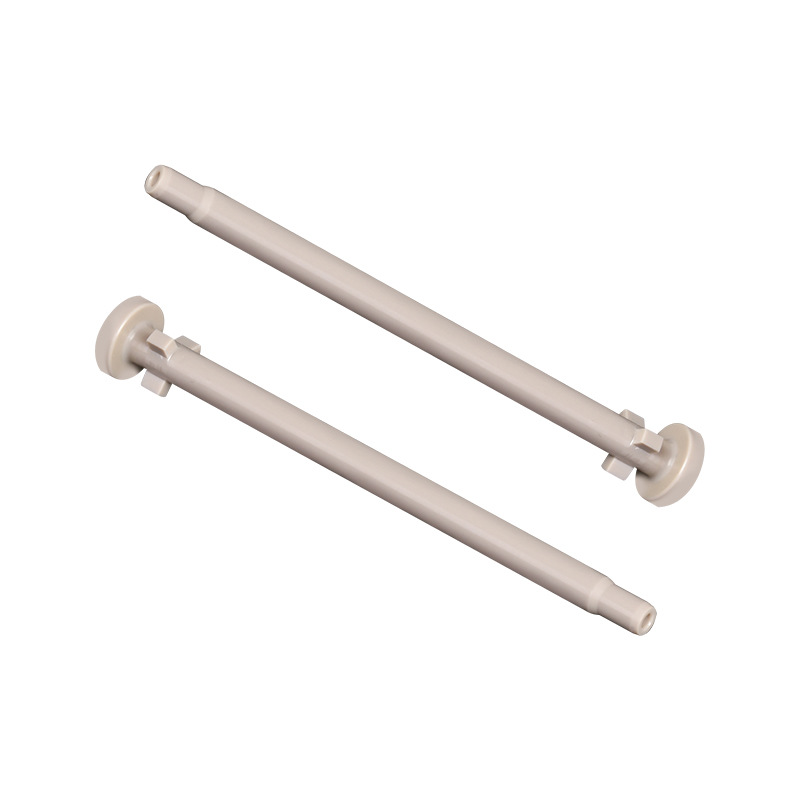
Tolerance capability separates the two methods further. CNC holds tighter dimensional control on small, geometrically complex parts, connector bodies, threaded housings, multi-diameter shafts, while stamping suits flat, simpler geometries produced in high volume, like brackets or shields. Injection molding occupies a different lane altogether: it is the standard for plastic housings and enclosures, while CNC machining handles the metal structural and conductive components inside them, connector pins, waveguide parts, RF shielding.
What Are the Cost Differences Between CNC Machining, Stamping, and Injection Molding?
Stamping and molding carry high upfront tooling cost but low per-unit cost at scale. CNC machining carries no tooling cost, so unit price stays flatter across small and mid-size runs, which is why minimum order quantities differ sharply, stamping vendors push for high MOQs to justify die cost, while CNC shops accept smaller batches economically.
When Is Stamping a Better Choice Than CNC Machining?
Stamping makes sense once volumes climb into the tens of thousands and the geometry is flat and simple enough that a die can produce it repeatably without redesign.
Materials, Tolerances, and Certifications for Telecommunications Precision Parts
Material choice and certification compliance determine whether a part performs electrically and survives audits, not just whether it fits.
Three materials cover most telecommunications precision parts applications, each with its own tradeoffs:
- Stainless steel — strong corrosion resistance and mechanical strength for connector shells and structural hardware, but slower to machine and heavier than aluminum
- Aluminum — lightweight and fast to machine, common for housings and heat-sink structures, though it needs plating for better conductivity
- Brass — the best natural conductivity and machinability of the three, which is why it shows up often in RF connectors and contact pins, at the cost of higher material price and weight
Tolerance matters beyond fit and finish. A connector pin held slightly out of spec can degrade signal integrity or prevent mechanical interchangeability between vendors, a real problem when telecom OEMs multi-source the same part number. CNC machining’s dimensional repeatability is what keeps those parts interchangeable across production lots.
What ISO Standards and Quality Assurance Processes Matter Most?
ISO 9001:2015 governs general process control and documentation; ISO 13485:2016 applies where medical-grade telecom technology overlaps, such as implantable or diagnostic communication devices; IATF 16949 applies to automotive-connected telecom parts, like in-vehicle connectivity modules. MFG SOLUTION manufactures telecommunications precision parts to all three standards, with full process control, meaning every machining step is tracked, documented, and auditable for compliance review.
What FCC, RoHS, and UL Certifications Apply to Telecom Components?
FCC rules govern electromagnetic emissions from telecom housings and shielding, RoHS restricts hazardous materials like lead and cadmium in components, and UL listings certify electrical safety for connectors and enclosures. Documented, traceable machining records make it easier to demonstrate compliance during these reviews rather than reconstructing data after the fact.
How to Choose the Right Manufacturing Method for Your Telecommunications Precision Parts
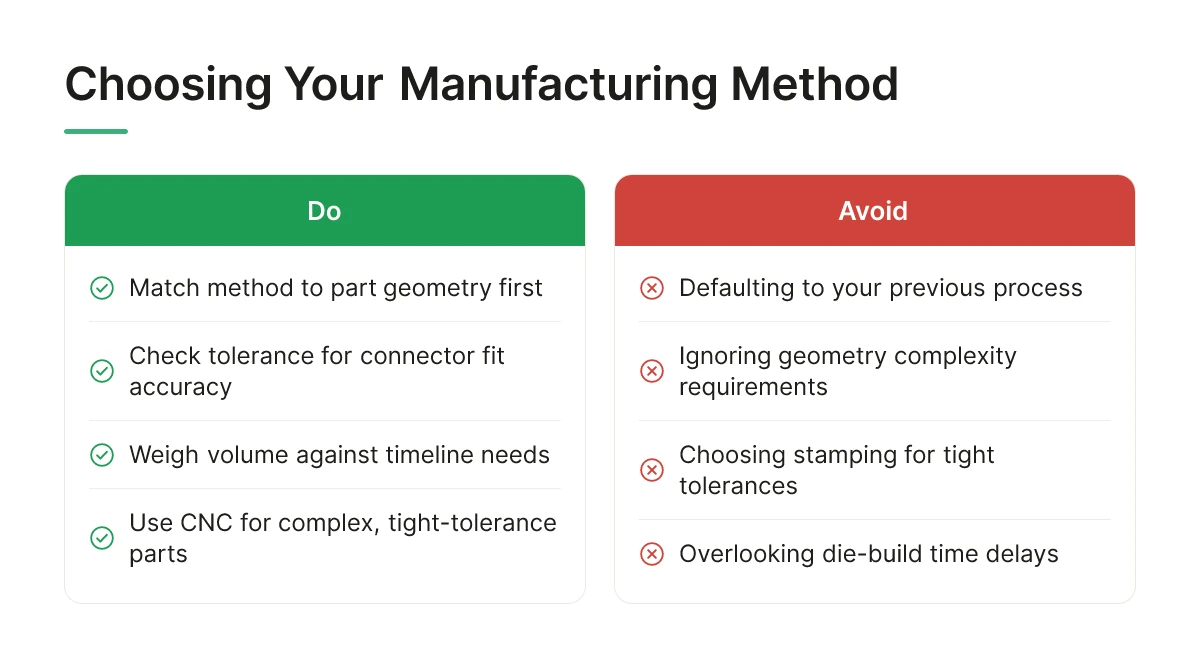
Match the method to part geometry, tolerance, volume, and timeline, in that order, rather than defaulting to whichever process you used last time.
Work through the decision in this order:
- Geometry first — complex, small-diameter parts with internal features point toward CNC machining
- Tolerance second — tight dimensional control for connector fit or signal path accuracy again favors CNC over stamping
- Volume third — small-diameter, tight-tolerance, low-to-mid volume parts favor CNC machining, while flat, simple, very high-volume parts favor stamping
- Timeline last — stamping’s die-build time can add weeks that a near-term launch cannot absorb
Cost works in tiers rather than fixed numbers. Tooling-heavy methods like stamping and molding carry higher upfront investment but lower cost per unit at scale; CNC machining carries no tooling cost but a higher per-unit cost once volumes get very high. Most telecom programs launching a new connector, bracket, or housing sit in the volume range where CNC makes financial sense. Buyers comparing shops for this kind of work can also review this list of leading CNC machining companies in the USA as a starting point for vendor research.
What Factors Should Guide Your Decision for a New Telecom Part?
Bring the manufacturing partner in early with the CAD file instead of guessing the method yourself. A same-day, CAD-based quote, the model MFG SOLUTION uses to return quotes within 8 hours and ship within 3 days, lets engineering teams compare CNC against stamping or molding before committing to tooling, which matters most when a product launch is already on the clock.
Frequently Asked Questions
How tight do tolerances need to be for telecommunications equipment to function reliably?
Most telecom connectors, antennas, and RF housings require tolerances in the ±0.01mm to ±0.05mm range to maintain signal integrity. Thread fit, concentricity, and surface finish matter as much as raw dimensional accuracy, since misalignment in connector pins or waveguide components can cause signal loss or intermittent failures in the field.
Do precision CNC shops have lower minimum order quantities than stamping vendors?
Yes, CNC machining generally supports lower minimum order quantities than stamping, which requires tooling investment that only pays off at high volumes. CNC shops cut directly from bar stock or billet, so prototype runs and mid-volume batches are practical without the upfront die costs stamping demands.
How does rapid turnaround time benefit telecom manufacturers with tight deadlines?
Faster turnaround compresses the sourcing cycle from weeks to days, letting telecom OEMs hit product launch windows without stockpiling inventory. MFG SOLUTION quotes within 8 hours and ships within 3 days, which helps procurement teams respond to late design changes or urgent repair part needs without restarting a multi-week vendor cycle.
Why is CNC machining cost-effective for parts under 38mm in diameter?
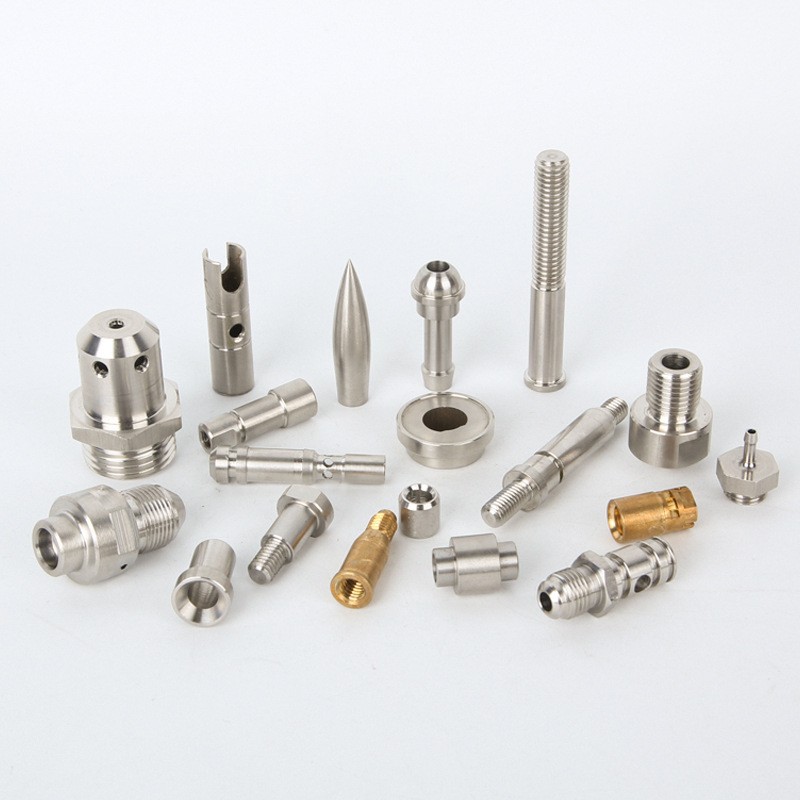
Small parts under 38mm run efficiently on Swiss lathes and automatic lathes, which minimize material waste and cycle time per unit. MFG SOLUTION matches each part to the most economical of five methods, CNC turning, Swiss lathe, cold forging, automatic lathe, or CNC mill & turn, rather than forcing every job through one process.
How do compliance requirements differ between consumer telecom equipment and carrier-grade systems?
Carrier-grade systems typically demand stricter documentation, traceability, and environmental testing than consumer devices, reflecting uptime and safety obligations across public networks. Suppliers serving both segments often standardize on IATF 16949 or ISO 9001:2015 process controls so the same production line can satisfy either requirement set without separate qualification runs.

Conclusion
Telecommunications hardware depends on parts that hold tight tolerances across connectors, housings, antennas, and RF components, and the manufacturing method you choose determines whether you get those tolerances at a workable cost and lead time. Match part geometry to process: Swiss lathe for small high-precision turned parts, cold forging for strength-critical components, CNC mill & turn for complex geometries under 38mm. Verify your supplier’s certifications (ISO 9001:2015, ISO 13485:2016, IATF 16949) before the first production run, not after a failed audit. Next step: pull your current telecom part drawings and submit them for an 8-hour quote comparison against your existing vendor’s lead time.
Recommended Articles
Explore more from our content library: