
2026-09-28
8 Standards Aerospace Precision Machining Shops Must Meet
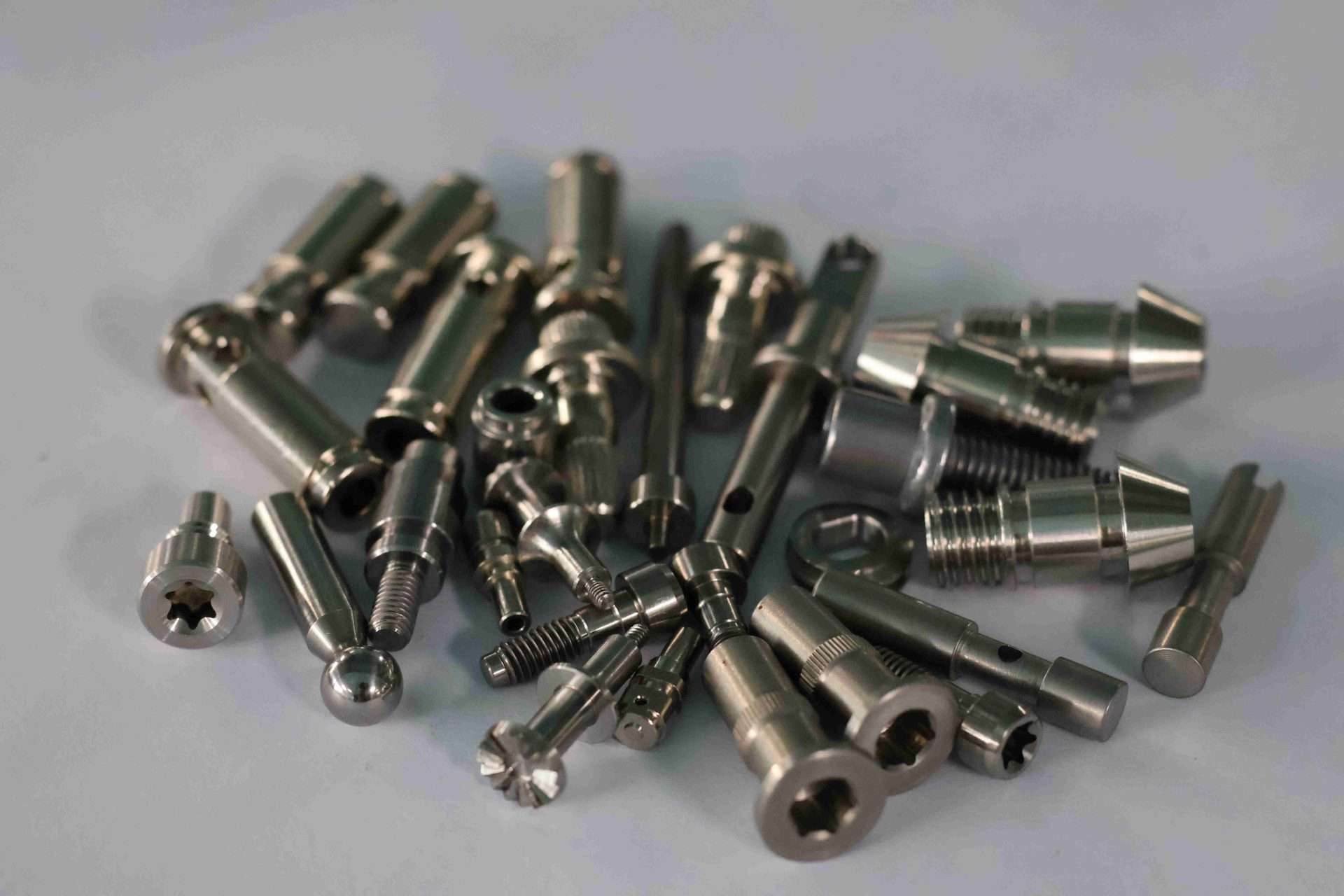
Understanding aerospace precision machining is essential. Aerospace customers require machining shops to combine certified quality systems, documented traceability, and proven process control with the equipment and capacity to hold tight tolerances repeatably. At minimum this means AS9100 certification (often alongside ISO 9001), material certifications and full lot traceability, first-article inspection on every new part, and CNC capabilities, 5-axis, mill-turn, or Swiss, matched to the part’s geometry and volume. Shops that treat these as one integrated system, not separate checkboxes, win and keep aerospace contracts.

1. AS9100 Certification and Quality Management Systems
AS9100 certification is the entry requirement for aerospace precision machining because it adds risk management, configuration control, and counterfeit-parts prevention on top of ISO 9001.
Which Certifications Are Mandatory Versus Preferred
ISO 9001 establishes a general quality management system, but AS9100 builds aerospace-specific layers on top of it: risk-based thinking tied to flight safety, configuration management for design changes, and documented controls against counterfeit or suspect parts entering the supply chain. Prime contractors like Boeing and Lockheed require AS9100 certification from their direct suppliers, and most tier-1 subcontractors won’t win aerospace work without it. Tier-3 and tier-4 shops doing lower-criticality or commercial-adjacent components sometimes operate on ISO 9001 alone, though the margin for future aerospace contracts narrows without the aerospace-specific credential. This is particularly relevant for aerospace precision machining.
How Compliance Audits and Documentation Affect Daily Operations
AS9100 compliance is not a document sitting in a binder, it demands internal audits on a fixed schedule, corrective action tracking for every nonconformance, and management review cycles that feed back into process changes. Shops that treat this as a living system, running internal audits monthly instead of scrambling before the annual renewal, catch drift in documentation and process control before an external auditor does. That distinction separates operations built for sustained prime and tier-1 contracts from shops that hold certification but struggle to operationalize it under real production pressure.
2. Full Material and Process Traceability
Aerospace customers require unbroken lot-level traceability from raw material to finished part, not a general summary of where materials came from.
What Traceability and Material Certification Demands Set Aerospace Apart
Material certification has to be captured at receiving and then preserved through every subsequent operation, heat treat, machining, plating, inspection, so a single finished part can be traced back to its specific material lot. The documentation chain includes material certs, process routers that record every operation performed, inspection records at each stage, and a certificate of conformance tied to one traceable part number. This is where aerospace precision machining diverges sharply from general precision work: commercial and industrial parts often carry traceability that’s optional or summarized at the batch level, while flight-critical or structural aerospace components require record-level detail because a single nonconformance can trigger a fleet-wide investigation.
Shops running digital travelers or MES systems reduce the transcription errors that paper-based routers are prone to, a scanned barcode replaces a handwritten lot number, cutting the risk of a mismatch between the physical part and its paperwork. Competitors still relying on paper folders per job carry that risk forward into every audit.
3. Tight Tolerances and Surface Finish Control
Aerospace tolerances are set by function, fit, fatigue life, aerodynamic performance, not machinist convenience, which forces tighter process capability than commercial work.
A bracket that flexes a few microns under load might be irrelevant in a commercial part but critical in a rotating or structural aerospace component, so tolerances get driven by engineering analysis rather than what’s easy to hold. Surface finish follows the same logic: a rougher surface on a sealing face or a fatigue-loaded fillet becomes a crack initiation point or a leak path, so finish specs tie directly to functional performance and require specific finishing operations plus verification methods like profilometry, not just a visual check. When considering aerospace precision machining, this point stands out.
Holding these specs consistently requires statistical process control, Cpk capability studies that prove a process stays within tolerance over a full production run, and climate-controlled inspection areas where temperature swings don’t skew measurements. This level of control matters most for structural, rotating, or sealing-surface components, a simple low-stress bracket or housing doesn’t demand the same rigor. Shops running in-process gauging, checking dimensions between operations rather than only after the final cut, catch tool wear or thermal drift before an entire batch drifts out of spec and gets scrapped.
4. Facility, Equipment, and Supply Chain Readiness
Entering aerospace work requires calibrated inspection equipment, environmental controls, and a supply chain with no unauthorized substitutions.
What Equipment Investments and Facility Standards Are Necessary to Enter the Aerospace Market
Basic CNC capability isn’t enough, aerospace programs expect calibrated coordinate measuring machines (CMMs) for dimensional verification, environmental controls that stabilize temperature and humidity around sensitive inspection equipment, and segregated work areas that keep aerospace lots physically separate from commercial jobs. Supply chain management also changes: material has to come from approved supplier lists, sourcing gets controlled and documented, and no substitution, even an equivalent-grade alloy, happens without customer sign-off.
Inventory and kitting practices matter just as much as machine capability. A shop running aerospace and commercial jobs concurrently needs kitting procedures that prevent a commercial-grade bolt or bracket blank from ending up mixed into an aerospace lot. This level of readiness suits shops formally entering the aerospace supply base as a strategic move, not those picking up occasional aerospace-adjacent jobs. Dedicating physical floor space and tooling exclusively to aerospace lots, rather than sharing fixtures across job types, removes a cross-contamination risk that generalist shops routinely overlook.
5. Aerospace Material Expertise (Titanium, Nickel Alloys, Aluminum)
Aerospace-capable shops machine titanium, nickel superalloys, and aluminum with material-specific tooling and speeds rather than one-size-fits-all settings. For those exploring aerospace precision machining, this matters.
Unique Machining Difficulties With Titanium, Aluminum Alloys, and Other Aerospace Materials
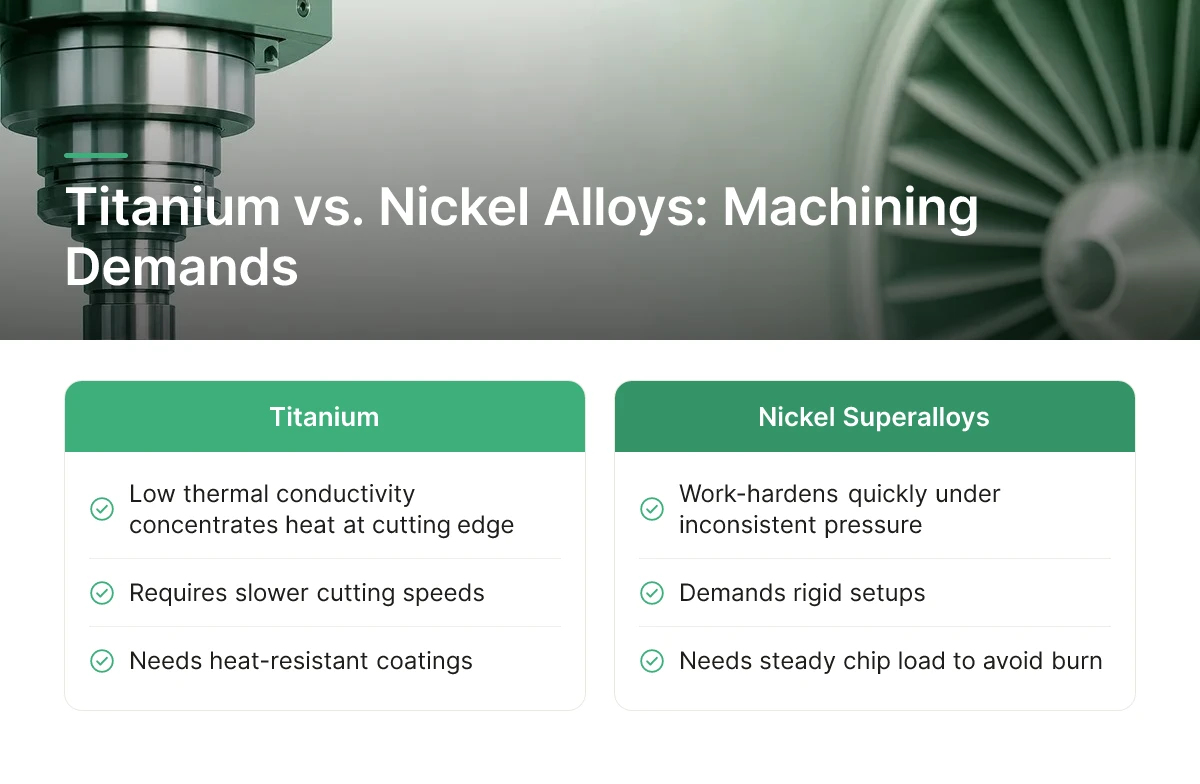
Titanium’s low thermal conductivity concentrates heat at the cutting edge instead of dissipating it through the chip, which demands slower cutting speeds and coatings specifically chosen to resist that heat buildup. Nickel-based superalloys like Inconel work-harden quickly under inconsistent cutting pressure, so machinists need rigid setups and a steady chip load to avoid burnishing the surface instead of cutting it. Aluminum aerospace alloys machine faster than either of those, but thin-wall aerospace geometries make deflection and residual stress the bigger risk, a part can machine within tolerance and still distort afterward if stress relief isn’t built into the process.
How Tool Wear, Heat Management, and Cutting Speeds Vary by Material
Tool wear monitoring and coolant strategy have to be tuned per material family rather than applied uniformly across a shop’s job mix, a coolant concentration and flow rate that works for aluminum will underperform on Inconel. Shops that stock and pre-qualify tooling by material family, rather than swapping tools reactively mid-job, hold tighter consistency across long production runs. MFG SOLUTION applies this material-specific discipline across CNC turning, Swiss lathe, and CNC mill & turn operations for parts up to 38mm in diameter, backed by IATF 16949 and ISO 13485:2016 process controls that document tooling and parameter choices for every material lot.
6. First Article Inspection and Ongoing Quality Documentation
Aerospace customers treat first-article inspection as a gate, not a formality, full dimensional verification against every print characteristic before a single production part ships.
In-Process and Final Inspection Methods Aerospace Customers Mandate
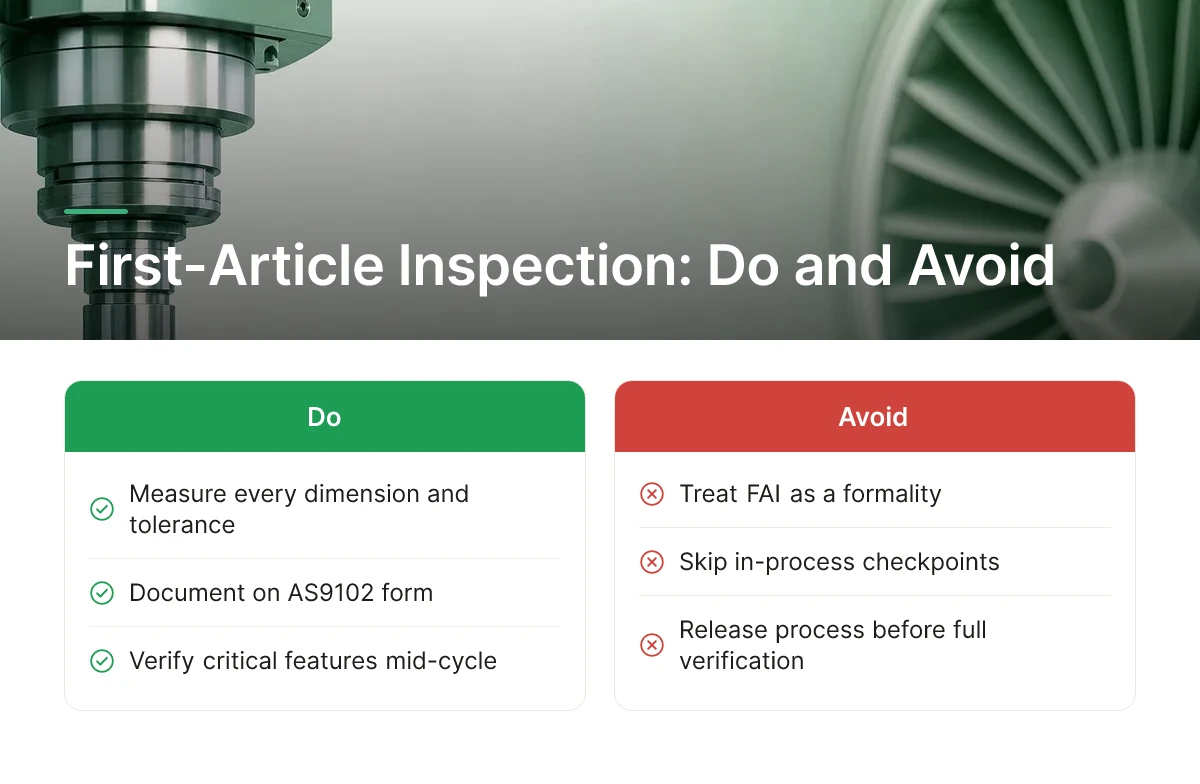
A first-article inspection (FAI) measures every dimension, tolerance, and material callout on the drawing, usually documented on an AS9102 form, before the shop releases the process for volume production. That’s separate from in-process checkpoints, where operators verify critical features mid-cycle, and final inspection, which confirms the finished part before packaging. Aerospace customers require both because a defect caught only at final inspection can mean scrapping an entire batch instead of one part.
How First-Article Inspection and Ongoing Quality Documentation Work in Practice
Documentation obligations don’t end at first-article approval. Shops retain inspection records for the life of the program and must requalify, running a new FAI, after any process, tooling, or material change. This matters most for shops running long-lifecycle aerospace parts, where a supplier substitution or fixture rework five years into a program has to trace back to the original first article. The differentiator: treating FAI as an event triggered by every process change, not a one-time hurdle cleared at launch, is what keeps aerospace precision machining programs free of downstream nonconformances.
7. CNC Capability Matched to Part Complexity (5-Axis, Mill-Turn, Swiss)
The right CNC platform depends on part geometry, 5-axis suits complex contoured structures, while mill-turn or Swiss machining suits small rotational parts. This directly impacts aerospace precision machining outcomes.
When to Choose 5-Axis, Mill-Turn, or Swiss Machining for Aerospace Applications
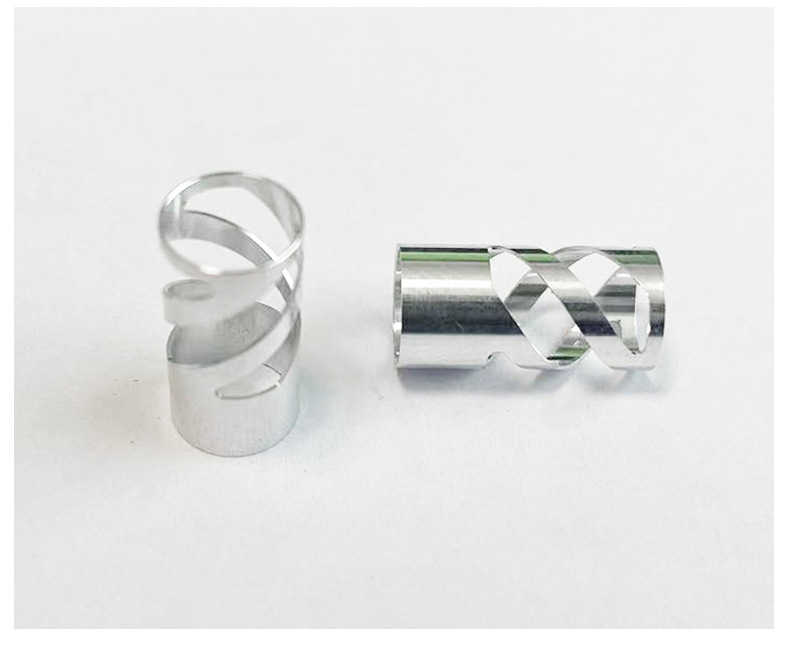
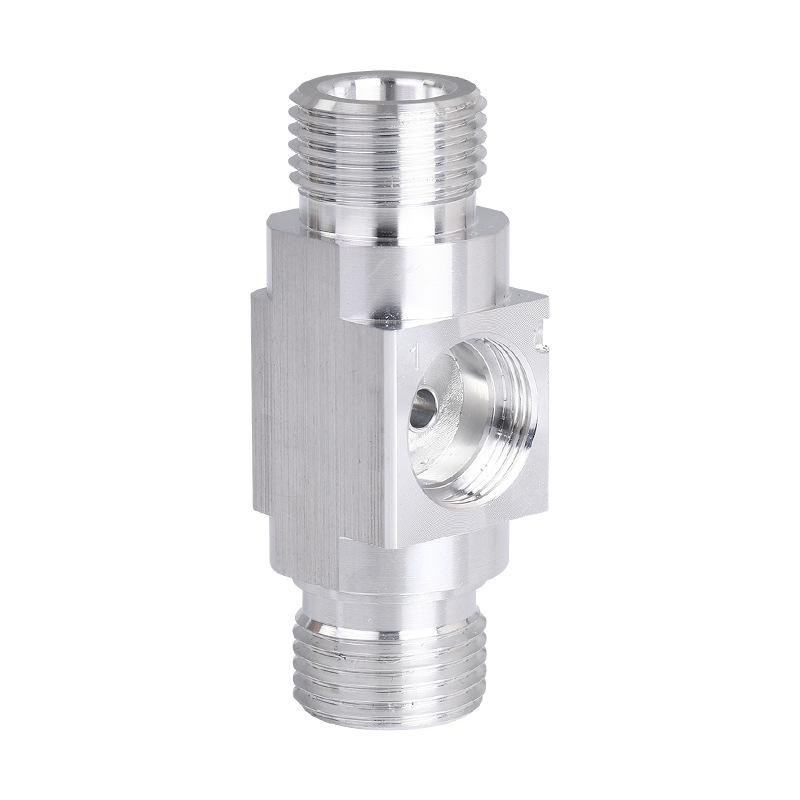
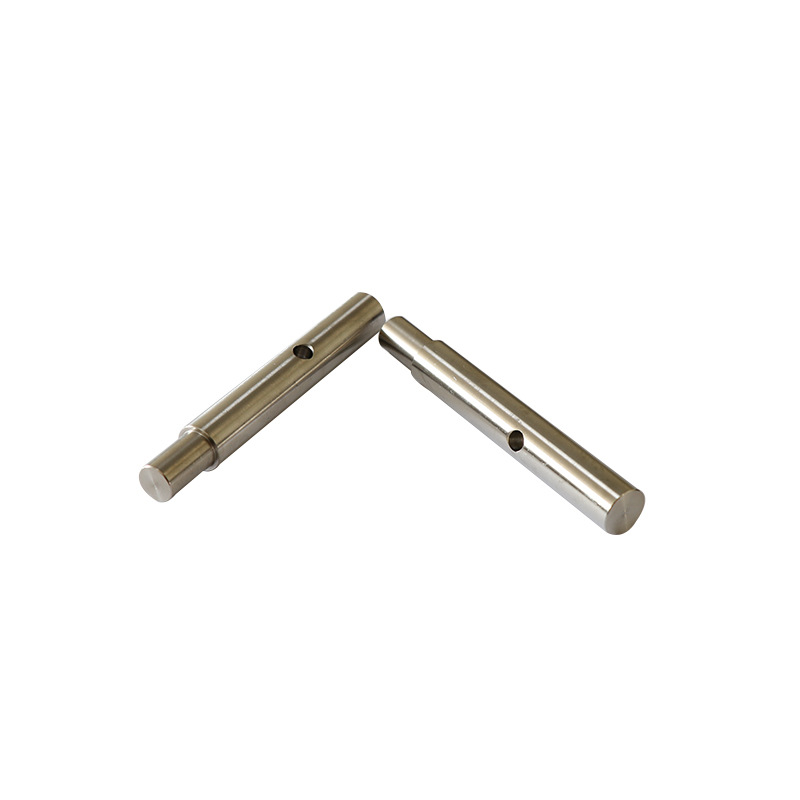
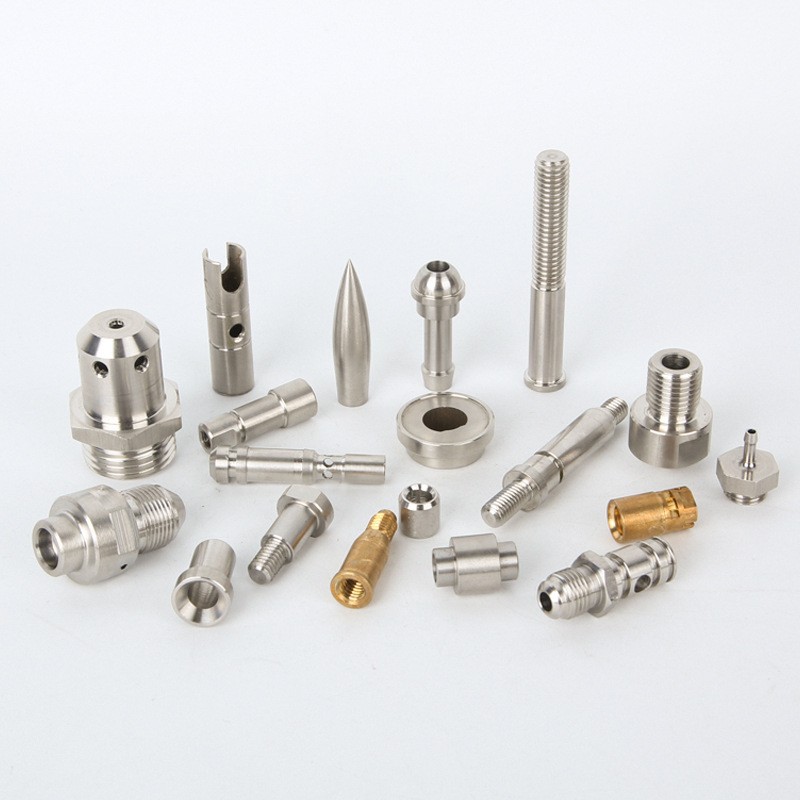
Five-axis machining pays off on contoured structural parts, brackets, housings, manifold bodies, that need multiple angled features held to tight tolerance in a single setup, since each re-fixture introduces stack-up error. Mill-turn and Swiss lathe platforms fit the opposite case: small-diameter, high-volume rotational parts like fittings, pins, and fasteners where speed and repeatability across thousands of cycles matter more than contour complexity. MFG SOLUTION runs both ends of that range, 5-axis CNC machines alongside 20 automatic lathes and Swiss lathe capability, so a customer’s part geometry decides the process, not the shop’s equipment limitations.
How Capability Gaps Affect Pricing and Customer Retention
When a shop lacks the right platform, it outsources secondary operations to a second vendor, adding lead time and a traceability handoff exactly where aerospace documentation is least forgiving. That gap shows up commercially as lost bids or thinner margins, since the prime shop still owns the quality risk for work it didn’t perform. Procurement teams evaluating aerospace precision machining partners should compare equipment lists against actual part drawings, headline machine counts mean little if none of them match the geometry in front of them.
8. Lead Time Reliability and Scalable Production Capacity
Aerospace buyers rate on-time delivery as heavily as unit price, because one late part can idle an entire assembly line.
How Small Shops Compete on Turnaround Time While Maintaining Aerospace Quality
Smaller shops win business by running tighter batch sizes and faster changeovers, without cutting corners on FAI rigor per lot. MFG SOLUTION’s model, quotes within 8 hours and shipment within 3 days, reflects that approach: rapid turnaround built on process discipline rather than skipped verification steps. Volume thresholds still separate customer tiers, though: prototype and low-volume R&D orders get evaluated differently than sustained multi-year production contracts, and a shop needs to be honest with a customer about which tier its floor is built for.
Production Volume Thresholds That Determine Which Aerospace Customer Tier a Shop Can Serve
Shops that segment capacity intentionally, holding machine time in reserve for urgent aerospace orders instead of running strict first-come scheduling, consistently outperform on delivery reliability. That’s the differentiator worth asking about directly: does the shop show real machine availability, or does it quote a date and hope. Transparent capacity planning builds a kind of trust that a generic online quoting portal, optimized for volume rather than program continuity, generally can’t match.
9. Automation and Digital Process Control
Automated monitoring, digital travelers, and predictive tool-wear tracking are becoming baseline expectations for competitive aerospace machining partners. This is particularly relevant for aerospace precision machining.
The Role of CNC Automation and Industry 4.0 in Aerospace Machining Competitiveness
Automated CNC monitoring and lights-out machining cut the variability that manual operator intervention introduces between shifts and operators. Digital work instructions and MES-linked travelers replace paper-based routers, eliminating the transcription errors that occur when data moves by hand between inspection sheets and production records. Predictive tool-wear tracking flags a worn insert before it produces an out-of-tolerance part, which matters more in aerospace precision machining than most industries given the cost of the titanium and nickel alloys involved.
How Shops Can Future-Proof Operations Against Technological Disruption
Automation lets a shop add production volume without adding headcount in the same proportion, keeping quality consistent as a program scales from tens of parts to thousands. This matters most for shops planning multi-year aerospace program commitments, where consistency across repeated cycles counts more than any single order’s turnaround speed. A shop that can show digital process control end to end, not just a quote calculator, signals it’s built for the program, not just the first purchase order.
How to Choose the Right Aerospace Precision Machining Partner
Compare certification, material traceability, CNC platform fit, FAI history, and delivery record together, no single factor decides the fit.
Start with a short checklist:
- Current certification status, ISO 9001:2015 at minimum, AS9100D or IATF 16949 depending on the end application
- Documented material traceability process, from raw stock certification through finished part
- CNC platform that matches the part’s actual geometry, not just an equipment brochure
- A verifiable first-article inspection track record, including requalification history
- Documented on-time delivery performance, not just a stated lead time
Weigh a smaller, agile shop against a larger high-volume supplier based on the part itself. Complex low-volume structural components often fit better with a nimble shop that can turn a design change quickly; high-mix fastener or fitting programs favor a supplier with deep automatic-lathe capacity, like MFG SOLUTION’s 20 automatic lathes and Swiss lathe lines built for parts up to 38mm in diameter.
Verify claims before committing. Ask for a redacted FAI report, current audit certificates, and sample process documentation, a capability list on a website proves nothing on its own. When considering aerospace precision machining, this point stands out.
Cost should be framed qualitatively, not chased to the lowest number. Budget-friendly generalist shops can handle low-criticality, non-flight parts; mid-range and premium aerospace-certified shops are the right fit for flight-critical or high-mix work where a nonconformance carries real downstream cost.

Frequently Asked Questions
Is ISO 9001 enough, or does a shop need AS9100 to work with aerospace customers?
ISO 9001 alone rarely satisfies aerospace prime contractors, most require AS9100D, which adds risk management, configuration control, and traceability requirements built specifically for flight-critical parts. A shop holding only ISO 9001 can still supply non-flight-critical ground support or tooling components, but AS9100D is the baseline for airframe and engine work.
What cost structures let a shop stay competitive while meeting aerospace quality demands?
Shops stay competitive by combining certified process control with manufacturing methods chosen for the part rather than a single default process. MFG SOLUTION, for example, runs CNC turning, Swiss lathe, cold forging, and automatic lathe production side by side, picking whichever method minimizes cycle time and scrap for a given geometry under 38mm, full process documentation without paying for over-processed parts.
What customer segments or component types favor smaller, agile aerospace machining shops?
Smaller shops win work on low-volume, high-mix components: brackets, fittings, fasteners, and small housings where large primes don’t want to tie up capacity. Startups building new airframes or actuation systems, and Tier 2/3 suppliers needing fast prototype-to-production turnaround, also favor agile shops over large-batch specialists.
How do supply chain and inventory management differ for aerospace versus commercial machining work?
Aerospace work demands full material traceability and lot-level documentation that commercial machining rarely requires. Every raw material certificate, heat lot, and process step must be recorded and retrievable for audits, which pushes aerospace suppliers toward tighter inventory controls, approved-source material only, and longer record retention than typical commercial contract manufacturing. For those exploring aerospace precision machining, this matters.
Conclusion
Serving aerospace customers reliably comes down to three decisions: certify to the standard the work actually requires, document every process step so it’s auditable years later, and match manufacturing methods to the part instead of forcing every job through one machine type. Shops that skip any of these compete on price alone against suppliers who can’t sustain zero-defect production.
If you’re evaluating a machining partner for an upcoming component, start by requesting a sample quote with documented process routing, compare the certifications, method options, and turnaround against your current supplier’s 4-6 week baseline.
Recommended Articles
Explore more from our content library: