
2026-10-02
A Buyer’s Guide to Reading Precision Machining Quotes

Understanding precision machining pricing guide is essential. A precision machining quote is fair when its price maps clearly to five drivers: material, part complexity, setup time, production volume, and secondary processes like finishing or inspection. To evaluate one, ask the vendor to break out these components rather than hand you a single lump sum, a transparent quote lets you see exactly what you’re paying for and compare it against other bids on equal terms. If a vendor can’t or won’t explain the breakdown, treat that as a red flag, not just a price signal.

Prerequisites: What to Gather Before Reading Your Precision Machining Pricing Guide
Before you open a single quote, assemble four things: your part drawing with tolerances, your material spec, your volume numbers, and a short list of required secondary processes. Without these on hand, any precision machining pricing guide is just a list of numbers you can’t actually interpret.
Start with the drawing itself. A quote only means something if it’s priced against a finalized print showing dimensions, tolerances, datums, and surface finish callouts, if the drawing is still in flux, you’re comparing quotes for parts that don’t technically exist yet. Tolerances matter especially: tightening a tolerance from ±0.1mm to ±0.01mm can shift the manufacturing route entirely, changing cycle time, inspection load, and sometimes the machine type itself. Have your material spec locked too, alloy, grade, and any certification requirements, since material cost and machinability both move the price independently of geometry.
- Pull the finalized drawing, including GD&T callouts and surface finish requirements.
- Confirm the exact material grade and any required material certifications.
- Write down your volume: a one-off prototype batch, a pilot run, or ongoing production at a set quantity.
- List the secondary processes you actually need, anodizing, heat treat, passivation, or inspection reports like a CMM report or material certs.
Volume changes which cost factors dominate. A prototype order is driven mostly by setup time and programming, while a running production volume spreads those fixed costs across hundreds or thousands of parts, so per-part price should drop significantly between the two. If you don’t know your volume yet, get a range, even a rough one, before requesting quotes.
Finally, don’t evaluate pricing off a single quote. Collect bids from at least two or three vendors, because one number has no benchmark and quotes for an identical drawing can vary by a wide margin depending on each shop’s assumptions about tolerances, inspection, and process. Only with multiple quotes in hand, plus your drawing, material, volume, and secondary process list, can you start comparing fairly.
Identify the Components of a Precision Machining Pricing Guide Breakdown
A quote worth trusting separates six items: material, setup time, programming, machining time, finishing, and inspection or packaging, not one lump figure.
Reading a quote line by line is the fastest way to tell a careful supplier from a rushed one. A precision machining pricing guide only works for you if you can match each dollar to a real production step, not just a total that someone eyeballed.
What Are the Main Components of a Machining Cost Breakdown?
Most CNC quotes include the same core elements, even when the format differs. Quote price generally breaks down into setup time, programming time, run time, material, and secondary processes like finishing or inspection. Here’s what each one represents:
- Material cost, the raw stock price plus any scrap allowance for the geometry.
- Setup time, fixturing the part, loading tools, and dialing in the machine before the first good piece comes off.
- Programming time, writing and verifying the CNC toolpath, heavier for complex geometries or first-time parts.
- Machine/run time, the actual cutting cycle, driven by tolerances, material hardness, and number of operations.
- Finishing, anodizing, plating, bead blasting, or deburring, usually billed separately because it often involves a different vendor.
- Inspection, dimensional checks, CMM reports, or certificates of conformance, especially relevant for medical and automotive parts under ISO 13485 or IATF 16949.
- Packaging and shipping, often overlooked until freight charges show up as a surprise line.
A quote that only separates material, labor, and finishing already tells you more than a single bundled number ever will, you can see where your money goes and negotiate the right line, not the whole quote.
Why Do Quotes Vary So Much Between Vendors for the Same Part?
Two shops quoting the identical drawing can land 100 to 200 percent apart without either one acting in bad faith. Setup time is close to a fixed cost, a shop spends roughly the same hour or two fixturing and programming whether you order 20 parts or 2,000. That means setup dominates the per-part price on small batches and nearly disappears on larger runs, so a quote that looks expensive for a prototype run may be perfectly reasonable at volume.
Differences also come from machine utilization, overhead structure, and batching assumptions. A shop running near capacity may price idle machine time differently than one hungry for work. Quotes are technical judgments about how a part will be made, not fixed price tags attached to a drawing. MFG SOLUTION addresses this by returning itemized quotes within 8 hours, so buyers can compare setup, material, and finishing costs line by line instead of guessing at a single number.

Assess the Cost Factors Driving Your Machined Part’s Price
Four variables explain most of the spread in a machining quote: material, complexity, volume, and tolerance, and a solid precision machining pricing guide treats each as a lever you can question, not a fixed fact.
How Do Material Selection and Part Complexity Affect Your Final Price?
Material cost shows up twice in a quote, once as raw stock price, once as machinability. A free-cutting aluminum alloy cuts fast and keeps tools sharp; a hardened stainless or titanium alloy cuts slower, wears tooling faster, and often needs lower spindle speeds to avoid heat damage. That second cost is easy to miss if you’re only comparing per-kilogram material prices between suppliers.
Part geometry is the other half of the equation. Tight tolerances, deep pockets, thin walls, and multi-axis contours all add machine time and inspection effort beyond what the raw material or part size suggests. A quote that reflects real engineering judgment accounts for how the part will actually be cut, not just its dimensions. Features like a 0.0002-inch tolerance on a single bore, or a wall thin enough to flex under clamping pressure, can force slower feed rates, extra fixturing, or a different machine altogether, each adding cost that a surface-level glance at the drawing won’t reveal.
What Role Do Setup Time and Production Volume Play in Pricing?
Setup, programming the machine, building fixtures, running first-article inspection, is a fixed cost that gets divided across however many parts you order. Quote Price generally breaks down into setup time, programming time, run time, material, and secondary operations combined. Order 50 units and setup might account for a large share of each part’s price. Order 5,000 and that same setup cost barely registers per unit, because it’s spread across so much more output.
This is why comparing quotes across different quantities can mislead you, a low per-part price at high volume says nothing about what you’d pay for a short run. Production methods matter here too: operations like CNC turning, Swiss lathe machining, cold forging, and automatic lathe work each carry different setup profiles, and a supplier like MFG SOLUTION selects among these methods based on which one amortizes cost most efficiently for your specific batch size and part geometry up to 38mm in diameter.
Tolerance tightness deserves a hard look before you accept a price. Specifying ±0.0005 inches on a feature that only needs ±0.005 inches forces slower cycles, more frequent in-process checks, and sometimes a different machine class entirely, all cost with no functional payoff. Asking “does this tolerance match the application” is one of the fastest ways to catch inflated pricing.
Evaluate Whether a Precision Machining Quote Is Fair and Competitive
A fair quote matches scope to price: it names your exact tolerances, finish, and inspection requirements, and every line item traces back to something on your drawing. Any precision machining pricing guide worth using should help you spot quotes that don’t meet that bar before you commit to a supplier.
How Do Domestic US Machining Costs Compare to Offshore Alternatives?
The real difference between domestic and offshore machining usually isn’t the unit price, it’s lead time, communication overhead, and how much quality-control friction you’re willing to absorb. Domestic shops typically offer faster feedback loops and easier in-person audits, which matters when a part is still being designed and changes often. Offshore suppliers can offer strong unit economics on stable, high-volume designs, but shipping adds transit risk and time that a domestic order doesn’t carry.
Communication is the variable buyers underweight most. A supplier working across time zones and a language gap takes longer to resolve a tolerance question, and that delay compounds across a multi-week production run. This is why rapid, standardized quoting matters more for offshore partners than for local ones, MFG SOLUTION addresses this by returning quotes within 8 hours and shipping within 3 days of approval, narrowing the lead-time gap that normally pushes buyers toward domestic-only sourcing for urgent jobs.
What Hidden Costs Should You Watch for in Precision Machining Quotes?
Hidden costs usually show up after the headline price, not inside it. Watch for four recurring ones: rush fees for compressed schedules, minimum order charges that make small batches disproportionately expensive, requoting fees triggered by even minor design revisions, and separate charges for inspection reports or certification documentation. None of these are improper on their own, but a quote that doesn’t disclose them up front is a quote you can’t actually compare to anyone else’s.
Ask every supplier directly whether their number includes first-article inspection, material certificates, and any packaging requirements. If the answer is “that’s extra,” get the extra priced before you decide the quote is competitive.
How Can Design Optimization Lower Your Machining Costs?
Design optimization lowers machining cost by removing unnecessary difficulty, not by cutting corners on the features that matter. Tight tolerances slow cycle time and raise scrap risk, so the highest-use move is restricting them to the features that function actually depends on and relaxing everything else to standard tolerance. Standardizing hole sizes across a part family lets a shop reuse tooling instead of swapping between unique drill or reamer sizes, and designing parts to share fixtures cuts setup time, often the single biggest driver of per-part cost on small batches.
Volume also changes the math directly: setup cost, programming, fixturing, first-article approval, gets spread across more parts as batch size grows, so cost per part drops in tiers rather than a straight line. Before accepting a quoted price break, ask where the minimum order quantity sits, what volume triggers the next tier, and whether that tier assumes a single uninterrupted run.
Once you have multiple quotes in hand, normalize them before comparing totals. Ask each vendor for the same cost breakdown format, the same stated tolerance assumptions, and the same finishing and inspection specs, otherwise you’re comparing different jobs wearing the same part number.
Common Mistakes to Avoid When Comparing Precision Machining Quotes
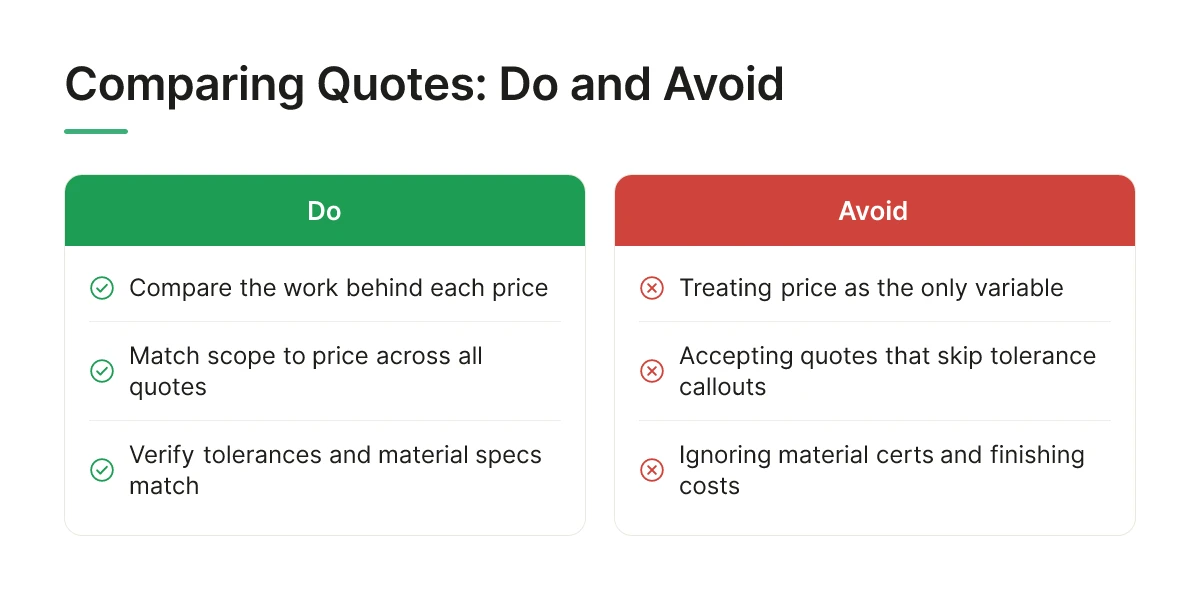
Most costly buying mistakes in a precision machining pricing guide come down to comparing numbers without comparing the work behind them. A low quote that skips a tolerance callout or a material cert isn’t cheaper, it’s a different, riskier part.
The first mistake is treating price as the only variable. If one vendor quotes to a ±0.01mm tolerance and another assumes ±0.05mm because the drawing didn’t specify a critical dimension, you’re not comparing machining cost, you’re comparing two different parts. The same applies to material certs and finishing: mill certs, heat-treat documentation, passivation, or plating add cost, and a quote that omits them isn’t a bargain, it’s incomplete.
The second mistake is picking the lowest number without checking whether the vendor can actually deliver at the volume and quality level you need. Capacity, machine count, and certifications such as ISO 9001, IATF 16949, or ISO 13485 tell you whether a shop can hold tolerance across a production run, not just on a sample part. A vendor without documented process control may quote lower because they’re not budgeting for inspection, traceability, or rework.
The third mistake is ignoring lead time and responsiveness as cost factors. A cheaper part that ships in six weeks with slow email replies can cost more in expedite fees, line-down time, or missed launches than a slightly higher quote with a 3-day shipment window and same-day answers to technical questions.
What Questions Should You Ask Vendors to Make Quotes Comparable?
Ask the same five questions of every vendor so you’re scoring apples against apples, not guessing at what each quote assumes.
- What tolerance did you quote to on each critical dimension, and did you flag any dimensions left ambiguous on the drawing?
- What inspection method will you use, first-article report, in-process checks, CMM, or sampling, and is a report included in the price?
- Can you confirm material traceability, including mill certs and lot tracking?
- What triggers a requote: a tolerance change, a finish change, a quantity change, or a material substitution?
- What is your standard lead time versus your rush lead time, and what does rushing cost?
Put the answers in a simple table next to each vendor’s price. Gaps usually show up fast, one vendor assumed standard tolerance, another priced CMM inspection on every part, and neither mentioned it unprompted.
How Do You Assess Vendor Capabilities Beyond the Quoted Price?
Look at certifications, equipment, and documentation practices, not just the number on the quote sheet. A shop running 5-axis CNC machines and automatic lathes under ISO 9001:2015 and IATF 16949 can usually hold tolerance across a 10,000-piece run more reliably than a shop quoting from a single manual lathe, even if the second quote looks better on paper.
This is also where asking about design-change policy matters. Many buyers never ask how a revision after quoting affects price, then get surprised by a requote mid-order. MFG SOLUTION addresses this by returning quotes within 8 hours and shipping within 3 days under ISO 9001:2015, ISO 13485:2016, and IATF 16949 certification, so procurement teams can compare documented process control alongside price instead of guessing at what’s included.
Frequently Asked Questions
Why did two machine shops quote wildly different prices for the same drawing?
Different shops price different assumptions about how your part gets made, not just different hourly rates. Gaps of 100 to 200 percent are common when one quote assumes a simple 3-axis run and another accounts for tight tolerances, secondary operations, or inspection documentation the drawing implies but doesn’t state outright. Always ask each supplier to confirm the exact scope behind their number before comparing them side by side.
Should I always choose the lowest precision machining quote?
No, the lowest number often means the supplier assumed less work, not that they’re more efficient. A quote that skips inspection reports, assumes looser tolerances, or omits secondary finishing will look cheaper until the parts fail incoming QC. Compare scope first, then price.
Can I negotiate a machining quote after it’s been submitted?
Yes, but negotiate scope, not just the number. Ask what changes if you adjust tolerances, batch size, or finish requirements, a supplier who explains the cost drivers behind their price is one you can negotiate with in good faith. One who just lowers the number without changing scope is a red flag.
What certifications should I check for before trusting a quote?
Match the certification to your industry: ISO 9001:2015 for general quality management, ISO 13485:2016 for medical devices, and IATF 16949 for automotive components. MFG SOLUTION holds all three, which means quotes come with documented process control rather than informal promises. Ask any supplier to confirm current certification status and scope before you commit a production order.
Does requesting a tighter tolerance than needed change the price?
Yes, tolerances that exceed what the application requires can shift the entire manufacturing route and raise cost without adding value. Tighter specs may force a shop into slower cycle times, additional setups, or a different machine class entirely. Review your drawing against actual functional requirements before sending it out for quotes.
Conclusion
A fair precision machining quote is a technical judgment, not just a number on a page. Before you compare offers, normalize scope: confirm tolerances, finish, material certs, and inspection requirements are identical across every supplier’s quote. Watch for vague language around quality documentation, it usually signals assumptions that will surface as costs later.
Next step: pull your last three quotes for a similar part, line up their scope assumptions side by side, and flag any line item that isn’t explicitly stated. If you find gaps, submit that same drawing to MFG SOLUTION for an 8-hour quote and compare the documented scope directly against what you have on file.
Recommended Articles
Explore more from our content library: