
2026-11-04
10 CNC Machining Best Practices Every Shop Should Follow
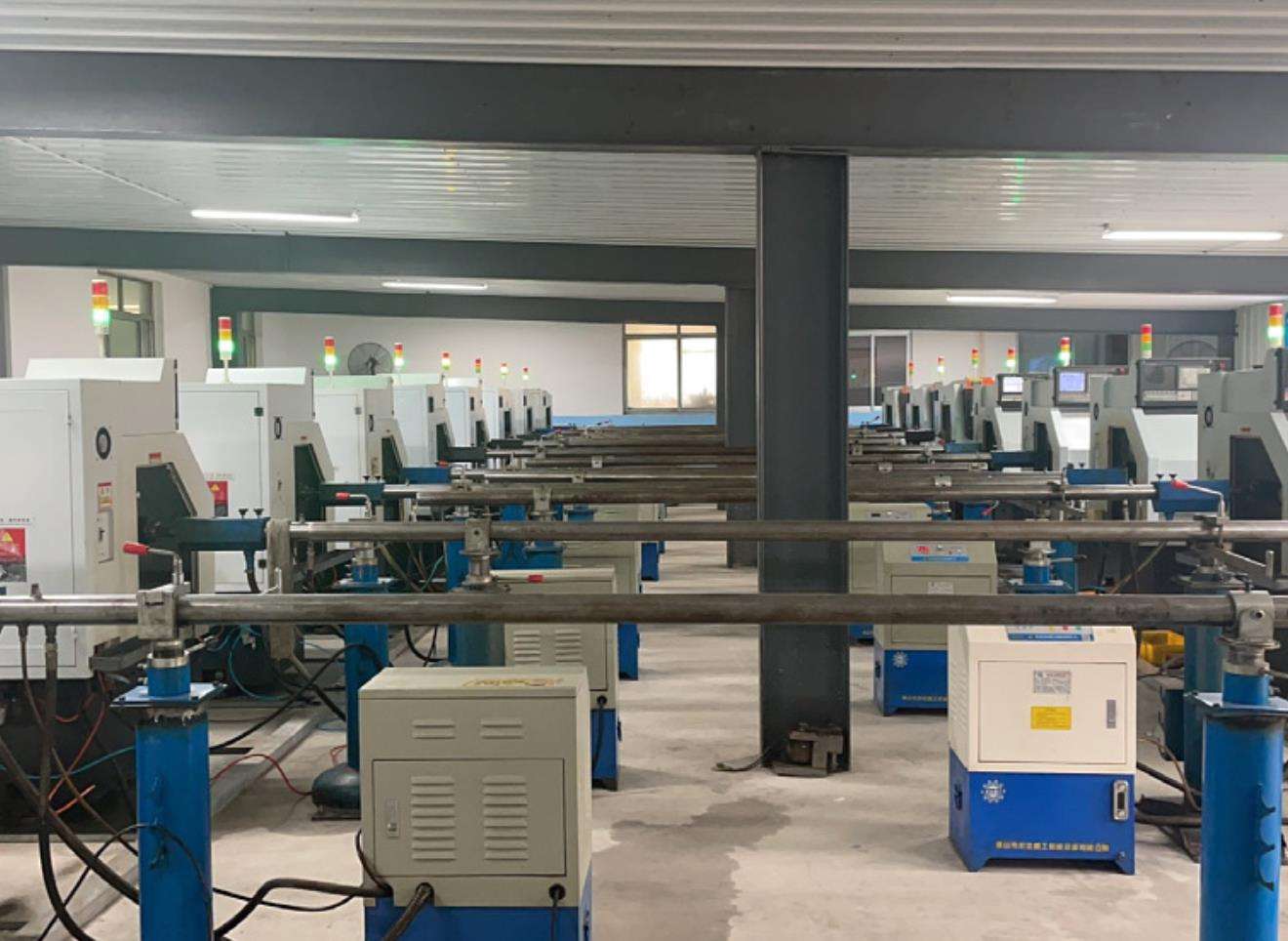
Understanding cnc machining best practices is essential. Shops cut costs and hit tight deadlines in CNC machining by combining disciplined process control, tool management, fixturing, and workflow structure, with upfront planning that prevents rework before it happens. The biggest gains come from reducing variability: consistent tool rotation, verified feeds and speeds per material, and a quote-to-part workflow that catches design issues before the machine starts cutting. For high-volume small-part production, the compounding savings come from minimizing changeovers and scrap, not from running spindles faster.

1. Standardize a CNC Machining Best Practices Checklist Before Every Run
A written pre-run checklist covering fixturing, offsets, and program verification cuts changeover time and prevents the scrap that unstandardized setups cause in small-batch work. This is particularly relevant for cnc machining best practices.
Most cost and deadline problems in high-volume small-part production don’t start on the machine floor, they start before the spindle turns. Inconsistent fixturing, unverified tool offsets, and skipped program checks are the most common source of scrap and missed deadlines when a shop runs frequent changeovers rather than one long job. Each new setup introduces a chance for operator variation, and without a standard sequence, that variation compounds across shifts.
A solid checklist includes four non-negotiable items: material certification check against the print, fixture repeatability verification, first-article inspection against tolerance before the batch runs, and a program dry-run to catch collision or offset errors before cutting chips. This differs from generic quality-control advice because the goal isn’t just defect prevention, it’s reducing the minutes lost between jobs. A shop that treats changeover as a timed, standardized event rather than an improvised one recovers machine hours that otherwise disappear into rework.
This matters most for shops running short, frequent batches of small parts, exactly the production model MFG SOLUTION uses across CNC turning, Swiss lathe, and automatic lathe lines to hit 8-hour quotes and 3-day shipping without sacrificing first-pass yield. Long single-part production runs benefit less, since setup cost amortizes over thousands of cycles instead of dozens. Applying these cnc machining best practices as a fixed checklist, not a loose guideline, is what makes the rest of a shop’s process improvements actually hold up under deadline pressure.
2. Optimize Feeds, Speeds, and Parameters for Precision CNC Machining
Feeds and speeds set the balance between tolerance, surface finish, and cycle time, the wrong combination on small parts causes tool wear or dimensional drift fast.
What RPM and Feed Rates Work Best for Aluminum and Other Common Materials?
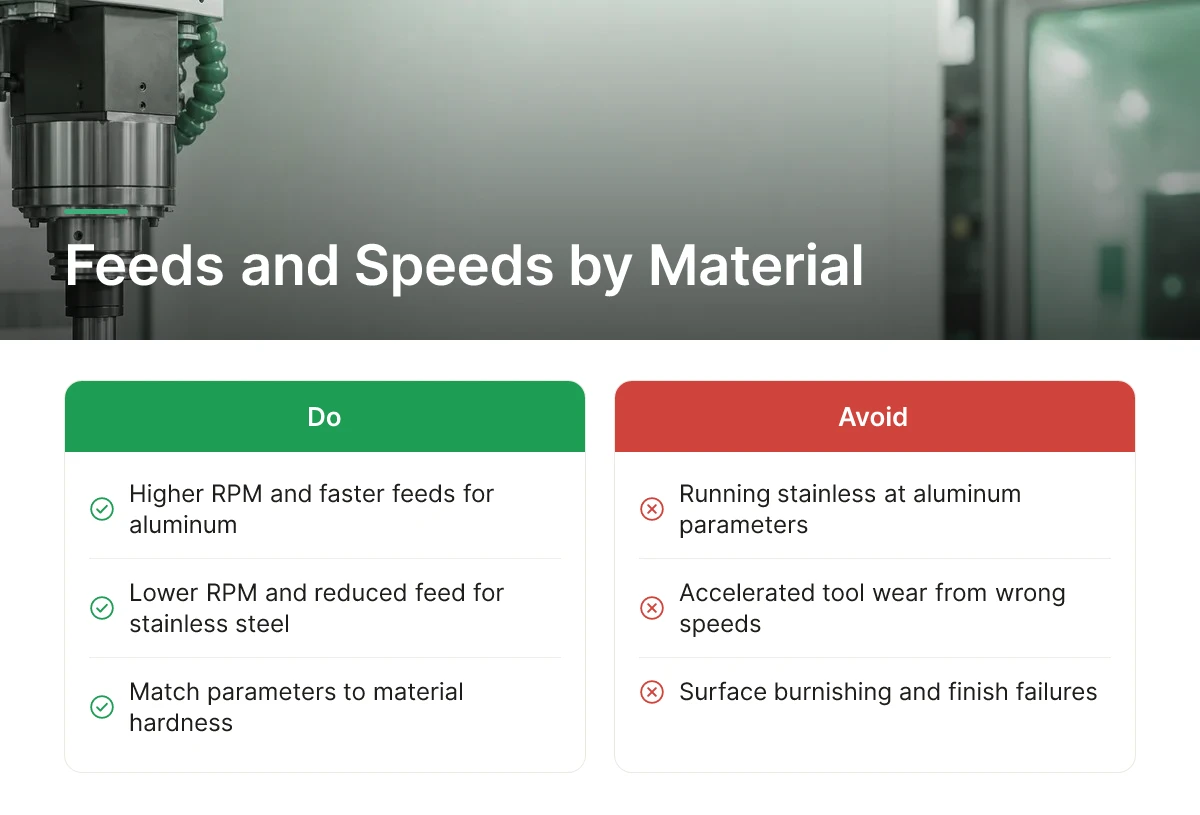
RPM and feed rate scale inversely with material hardness: aluminum tolerates higher spindle speeds and faster feeds because it cuts cooler and generates less tool-edge stress, while stainless steel demands lower RPM and reduced feed to manage heat and work-hardening. Running stainless at aluminum-style parameters accelerates tool wear and risks surface burnishing that fails a finish spec. Matching parameters to the specific alloy, not a generic “metal” setting, is the baseline every machinist should verify before a batch starts.
How Do Tool Diameter and Geometry Affect Tolerance and Surface Finish?
Tool diameter and flute count determine how much material each cutting edge removes per pass, which directly sets achievable tolerance and surface roughness, not just how fast the job runs. A smaller diameter tool with more flutes produces finer finishes but at lower stock removal rates, while fewer flutes with more chip clearance favor speed over finish.
Small parts amplify every parameter error because they carry lower thermal mass: heat builds up faster relative to part volume, and tolerance bands are often tighter in absolute terms even when the percentage tolerance looks similar to a larger part. A 0.05mm deviation that’s negligible on a 150mm part can exceed spec on a 10mm one. This is the core tradeoff under deadline pressure, defaulting to “run faster” instead of recalculating parameters for the specific material and geometry is how shops trade a schedule problem for a quality problem. The right approach matches speed to the tightest tolerance in the print, then looks for cycle-time gains elsewhere.
3. Match Material Selection and Prep to the Part’s End Use
Choosing the right raw material and prepping it correctly prevents warping, tool wear, and tolerance failures that show up only after machining is complete.
What Material Properties Should You Evaluate Before Committing to Production?
Four properties matter most before committing stock to a production run: machinability rating, hardness consistency across the batch, residual stress from prior forming, and stock tolerance from the mill. Skipping this evaluation doesn’t fail obviously, it fails downstream, as excess tool wear or a part that drifts out of tolerance after machining relieves internal stress the operator never saw.
Material prep steps like annealing, stress relief, and requiring certified stock tolerance from the supplier prevent that drift during high-volume runs, where even small per-part deviation compounds across thousands of units. A bar stock lot with inconsistent hardness will cut fine on the first few parts and then produce tool wear patterns that shift dimensions by part 200, a problem that looks like a machine issue but traces back to the raw material. When considering cnc machining best practices, this point stands out.
This matters most for parts with tight tolerance stacks or a secondary heat-treat step, where any residual stress in the raw material gets locked in or released unpredictably during hardening. Shops supplying medical or automotive components, where IATF 16949 and ISO 13485 documentation require traceable material certification, cannot treat this step as optional.
4. Build a Tool Selection and Rotation Strategy for Consistent Quality
Replace tools based on measured wear curves and batch position, not a fixed calendar schedule, to keep tolerance consistent across an entire production run.
How Often Should You Replace or Rotate Cutting Tools to Maintain Precision?
Wear curves, not time intervals, should drive the replacement decision. A tool can look fine after eight hours of light aluminum cuts and be near failure after two hours in stainless; tracking actual cutting distance or part count against expected tool life catches the drift that a weekly swap schedule misses.
High-mix shops running many small-batch jobs benefit from a tool library with automatic offset compensation, which adjusts for gradual wear between inspections, versus a single-tool setup where any wear shows up directly as dimensional error on the part. Coating choice changes the math too: TiAlN-coated carbide holds up significantly longer in stainless and high-heat cuts than uncoated carbide, which lowers cost per part over a long run even though the tool itself costs more upfront.
The differentiator most shop guides miss: track tool life against batch size, not calendar time. A tool rated for 5,000 parts that sits idle for three weeks hasn’t lost capacity, but one run continuously through a 10,000-part order needs a mid-batch swap regardless of how many days have passed. Shops that measure tool life this way catch mid-run drift before it produces a cluster of out-of-tolerance parts near the end of a batch, one of the more overlooked cnc machining best practices in high-volume small-part work.
5. Eliminate Chatter and Runout Before They Become Scrap
Chatter comes from resonance and insufficient rigidity, while runout comes from spindle or tool holder misalignment, both are preventable with setup checks, not corrected after scrap piles up.
What Machine Damping Techniques and Tool Setup Practices Eliminate Vibration?
Chatter happens when cutting forces excite a natural frequency in the machine-tool-workpiece system, producing a visible wave pattern on the surface finish and accelerated tool wear. Runout happens when the tool or spindle doesn’t rotate on a true center axis, causing inconsistent chip load across the cutting edge and oversized or out-of-round features. The two look similar in a finished defect but need different fixes.
For chatter, adjusting spindle speed to shift away from the harmonic frequency of the setup, sometimes a few hundred RPM up or down, breaks the resonance loop without changing the tool. For runout, verifying tool holder runout with a dial indicator before the run starts catches misalignment that no amount of parameter tuning will fix. Improving workholding rigidity, through better fixture contact or reduced part overhang, addresses both problems at once.
Preventive setup practices matter more than reactive fixes: balanced tooling, shorter tool overhang, and vibration-dampening tool holders reduce the chance of either issue appearing mid-run. Small parts are especially vulnerable because their limited clamping surface area gives the fixture less grip to resist vibration, so a setup that works fine on a larger part can chatter badly on a 10mm version of a similar geometry.
6. Structure a Clean Workflow from Quote to Finished Part
A clean workflow turns quoting into a cost and deadline lever, not paperwork, the handoff between design and production decides whether a job ships on time. For those exploring cnc machining best practices, this matters.
A structured job moves through six stages: drawing review, a design-for-manufacturability (DFM) feedback loop, quoting, program verification, first article inspection, and the full production run. Skipping or rushing any one of these steps is where most schedule slippage starts, not on the machine floor.
How Should You Prepare Technical Drawings and Specifications to Avoid Rework?
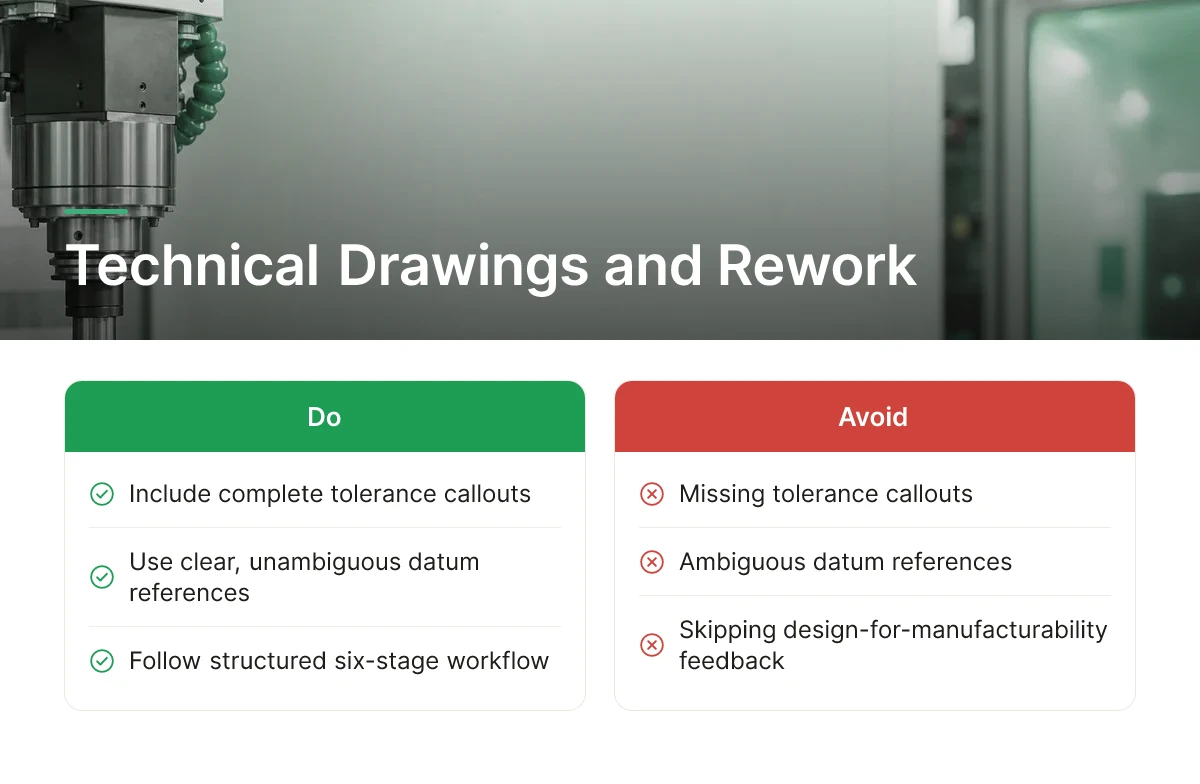
Missing tolerance callouts and ambiguous datum references are the most common causes of rework loops. When a machinist has to guess at design intent, the part gets made, inspected, rejected, and requoted, a cycle that can add days to a timeline that should have taken hours.
Complete drawings with clear GD&T, material callouts, and surface finish requirements let a shop move straight from review to quoting without a round trip back to engineering. This is one of the cnc machining best practices that pays off before a single chip is cut: a fast quote-to-production handoff only compresses lead time if verification steps aren’t skipped to get there.
The differentiator worth building into your process is a feedback checkpoint between design and production planning, rather than treating the quote as a one-way document. MFG SOLUTION applies this by returning quotes within 8 hours and flagging drawing issues during that same review window, so corrections happen before tooling and scheduling commitments are made, not after.
7. Know When CNC Machining Beats 3D Printing or Stamping
CNC machining is the right call for small-to-mid batches needing tight tolerances and production-grade materials without the upfront tooling cost stamping demands.
Each method trades differently on tolerance, material range, and tooling investment. CNC machining holds tight tolerances across metals and engineering plastics with no part-specific tooling required. Stamping achieves excellent repeatability and low per-part cost, but only after a die is cut, an investment that only pays off at very large production volumes. 3D printing needs no tooling at all and can turn around a single prototype fastest, but it generally trails CNC on surface finish and consistency of mechanical properties, especially where load-bearing performance matters.
When Should You Recommend CNC Machining Over Other Manufacturing Methods?
Recommend CNC machining when a customer needs functional, production-representative parts in small-to-mid batches, tight tolerances, or a mix of materials across a single order. Recommend stamping instead when volumes are high enough to amortize die costs and the part geometry is simple and stable. Recommend 3D printing when the job is a one-off form-check prototype where finish and material properties are secondary to speed.
MFG SOLUTION covers this exact middle ground: parts up to 38mm in diameter, CNC turning, Swiss lathe, and CNC mill & turn methods chosen per part geometry, with no tooling investment required to start a batch run. This directly impacts cnc machining best practices outcomes.
8. Train Operators to Execute Best Practices Consistently
Operator skill determines whether documented procedures actually hold up on the floor, especially when part designs or machines change.
Baseline competence includes blueprint reading, G-code troubleshooting, offset adjustment, and in-process inspection. Shops that cross-train operators across multiple machine types, Swiss lathes, automatic lathes, mill-turn centers, reduce the bottlenecks that appear when one machine’s specialist is out or a high-volume job spikes demand on a single cell.
How Do You Train Operators to Troubleshoot Errors and Adapt to New Part Designs?
The most effective training teaches diagnosis from symptoms, not just fixed checklists. An operator who can trace chatter, runout, or dimensional drift back to its likely cause, tool wear, fixture looseness, spindle imbalance, fixes problems in minutes instead of escalating every deviation and stopping the line.
This investment matters most when part designs change frequently. Steady-state production tolerates rigid procedures; a shop running varied small-batch work for electronics, automotive, and medical customers needs operators who adapt setups and catch deviations without a new procedure document for every job. That adaptability is a core piece of cnc machining best practices for any shop running mixed, high-mix production rather than long single-part runs.
9. Use Emerging Technology to Push Efficiency Further
AI-assisted tool paths and predictive maintenance sensors cut cycle time and prevent scrapped batches, but they build on the fundamentals rather than replace them.
AI-assisted tool path software simulates cutting forces before the program runs, eliminating unnecessary air moves and the overly conservative feed rates programmers default to when working from experience alone. The result is a shorter cycle time on the same machine, same tooling, same material. Predictive maintenance works on a parallel track: vibration and spindle-load sensors flag tool wear or bearing degradation before it causes a failure mid-run that scraps an entire batch.
What Does AI-Assisted Tool Path Optimization or Predictive Maintenance Offer Your Shop?
Neither technology substitutes for the workflow structure, operator training, or design review covered earlier, they amplify a shop that already has those fundamentals right, and expose their absence faster in one that doesn’t. A shop with no first-article process won’t fix its scrap rate by adding sensors.
The realistic path in is a pilot: one machine, or one high-volume job, running the software or sensor package alongside the existing process before a shop-wide rollout. That limits risk and gives a shop real cycle-time and downtime data before committing capital across the floor. This is particularly relevant for cnc machining best practices.
How to Choose the Right CNC Machining Partner for Your Project
Choose a partner by checking certifications, quoting speed, and tool management discipline against your part’s tolerance and volume requirements.
Start with a checklist: does the shop hold ISO 9001:2015 for general quality management, ISO 13485:2016 if the part is medical, or IATF 16949 if it’s automotive? How fast do they turn a quote around, hours or weeks? Do they document tool rotation and wear tracking, or rely on operator memory?
Weighing in-house capability against outsourcing comes down to volume and specialization. Building internal capacity makes sense for parts central to your core product line running at steady, predictable volume. Outsourcing fits overflow capacity, prototype runs, or small precision parts under 38mm where the tooling and engineering overhead of standing up an in-house line doesn’t pencil out.
When vetting a partner, ask directly about first-article inspection practices, chatter and runout prevention on their equipment, and how they document process control for audits, the same practices covered earlier in this list. Cost tiers vary by capability: budget-friendly shops may skip formal certifications and rapid quoting, while premium partners bundle certified quality systems with fast turnaround. MFG SOLUTION occupies that premium tier without the long lead times usually attached to it, ISO 9001:2015, ISO 13485:2016, and IATF 16949 certification, quotes within 8 hours, and shipment within 3 days for parts up to 38mm in diameter.

Frequently Asked Questions
What specific cost-reduction strategies work best for small-part, high-volume runs?
Matching the manufacturing method to the part geometry cuts cost faster than any single machining tweak. Swiss lathe and automatic lathe setups reduce cycle time on small-diameter, high-volume parts by minimizing tool changes, while cold forging eliminates material waste on parts that don’t need full machining. MFG SOLUTION evaluates five methods, CNC turning, Swiss lathe, cold forging, automatic lathe, and CNC mill & turn, per job to pick the lowest-cost process without sacrificing tolerance.
How do you balance speed with precision when deadlines are tight?
Speed and precision stay compatible when quality checks are built into the process instead of bolted on at the end. Full process control, tracking every step from raw material to final inspection, catches deviations before they become scrapped batches. That documentation is also what lets a shop quote in 8 hours and ship in 3 days without gambling on rework.
Can you walk through a before-and-after example of a design change that reduced production time?
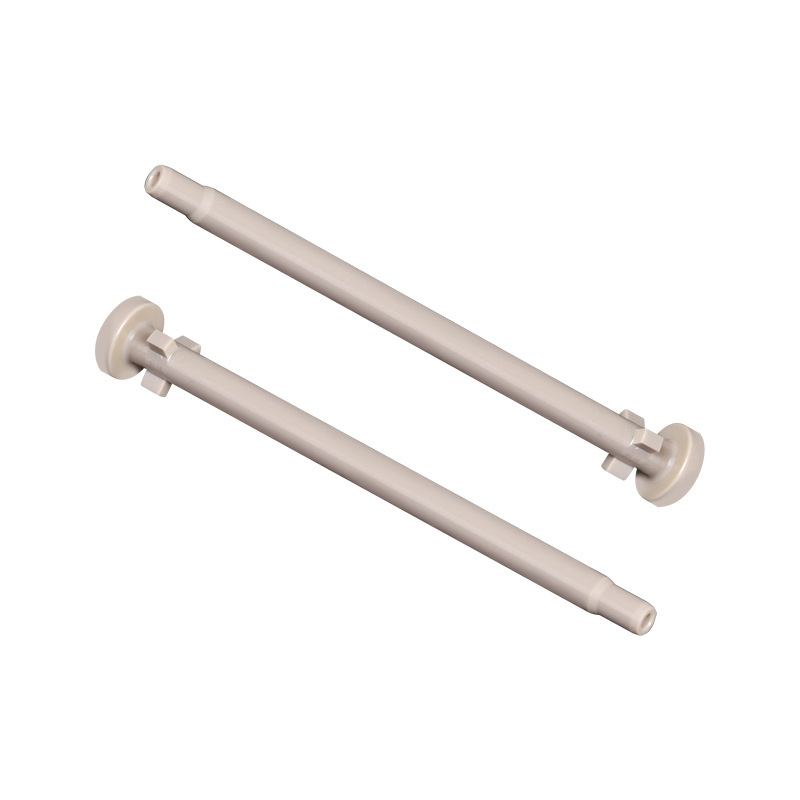
A hypothetical: a connector pin with a sharp internal corner required a smaller tool and slower feed rate to avoid tool breakage. Rounding that corner to match a standard tool radius let the shop run a larger, faster cutter. Standard tooling also skips custom tool procurement, which is often the hidden delay behind quotes that take days instead of hours. When considering cnc machining best practices, this point stands out.
Do small parts require different best practices than large parts?
Yes, small parts (under 38mm) favor high-volume, repeatable processes like Swiss lathe and automatic lathe machining over general-purpose milling. Tolerances are tighter relative to part size, so tool wear and thermal drift matter more. Shops built around small-part production, rather than scaled-down large-part workflows, typically hold tolerance more consistently across long runs.
Conclusion
Cutting cost and lead time on small precision parts comes down to three decisions: choosing the right manufacturing method for the geometry, building quality checks into the process instead of inspecting after the fact, and designing parts around standard tooling rather than custom setups. Each shaves days off a sourcing cycle that often runs four to six weeks with generalist vendors.
Next step: pull the drawing for your next high-volume small part and submit it for a quote. MFG SOLUTION returns a detailed quote within 8 hours, so you can compare the real cost and timeline against your current supplier before committing to a production run.
Recommended Articles
Explore more from our content library: