
2026-11-01
Why Titanium Parts Manufacturing Costs More Than Steel

Understanding titanium parts manufacturing is essential. Titanium parts cost more to manufacture than steel parts mainly because titanium is harder to cut, machines slower, and wastes more material. Low thermal conductivity traps heat at the cutting edge, accelerating tool wear, so shops run lower speeds and replace tooling more often. Titanium also work-hardens quickly, requiring rigid setups and specific tool geometries, and its high strength-to-weight ratio means more material is often removed from an expensive billet to reach final part dimensions. Together, slower cycle times, higher tooling costs, and material waste drive the price gap versus steel.

What Makes Titanium Parts Manufacturing More Expensive Than Steel?
Titanium costs more because four mechanisms compound at once: heat buildup at the cutting edge, work hardening during the cut, expensive raw billet stock, and higher scrap volume per finished part. None of these problems is severe in isolation. Together, they stretch cycle times and shorten tool life in ways that steel machining rarely experiences.
What Are the Specific Cost Drivers That Increase Titanium Machining Complexity Compared to Other Metals?
Titanium conducts heat at roughly one-seventh the rate of steel, so instead of dissipating into the chip and workpiece, heat concentrates right at the cutting edge. That concentrated heat softens the tool tip and accelerates wear, which forces machinists to run slower feeds and speeds than they would on steel or aluminum. Fewer parts per hour means higher labor and machine-time cost allocated to each unit.
Titanium also work-hardens as the tool engages the surface, meaning each pass can leave the material harder than before the cut. That demands rigid tooling, sharp cutting edges, and consistent engagement, any hesitation or tool deflection work-hardens the surface further and risks premature tool failure. Shops running titanium parts manufacturing programs typically dedicate tooling setups and fixturing specifically to manage this behavior, something a generic steel-oriented setup can’t handle without modification.
Raw material pricing adds another layer. Titanium billet and bar stock cost substantially more per pound than steel, driven by titanium’s reactivity during melting and refining, which requires vacuum arc remelting or similarly controlled processes to keep oxygen and other contaminants out of the alloy. That refining complexity keeps base material pricing improved well before a single cut is made.
How Does Material Waste and Tool Wear Impact the Total Cost of Titanium CNC Machining?
Buy-to-fly ratio, the weight of material purchased versus the weight of the finished part, tends to run higher on titanium components, especially in aerospace-style geometries where most of the billet gets machined away. On steel, scrap value partially offsets that waste; titanium scrap is worth less relative to its original purchase price, so every gram removed represents a larger net loss.
Tool wear economics close the gap. Specialized carbide and coated tooling designed for titanium wears faster than tooling used on steel, and those tools cost more to begin with. Add up slower cycles, higher material waste, and faster tool consumption, and the cost difference between titanium parts manufacturing and equivalent steel production is driven by process economics, not just the metal’s sticker price.
Which CNC Machining Methods Work Best for Cost-Effective Titanium Part Production?
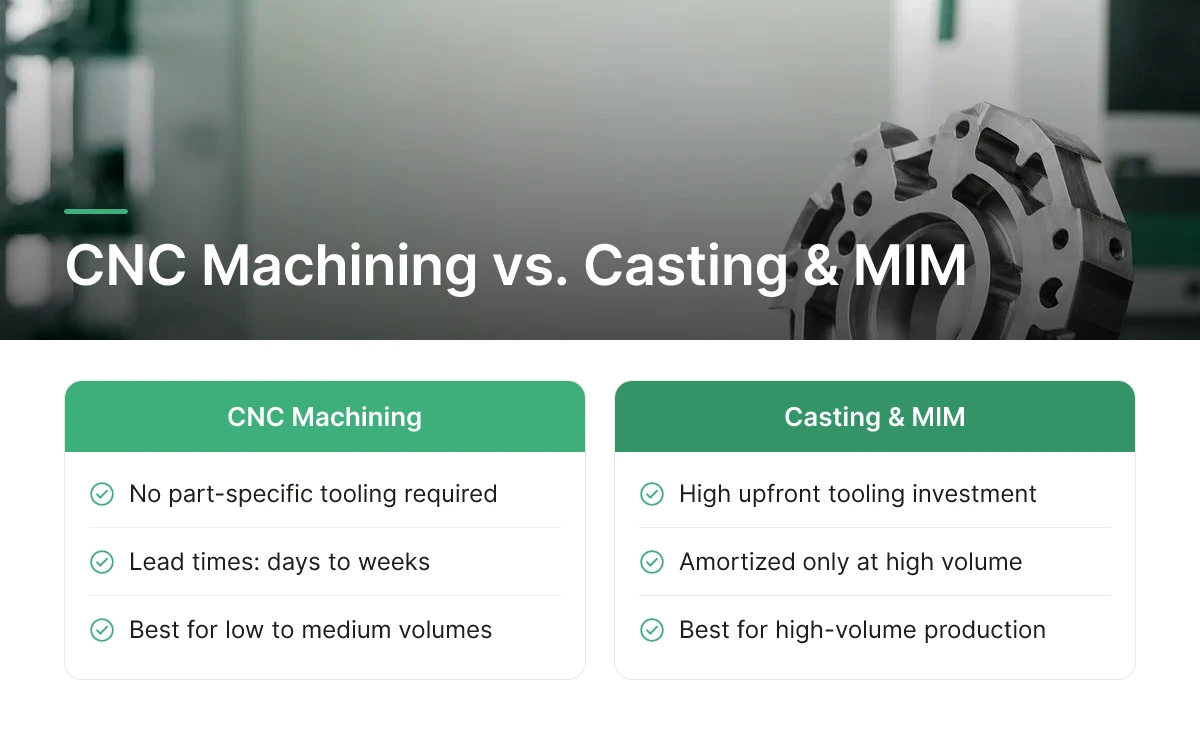
CNC machining wins on tooling-free flexibility and fast changeover, while casting and MIM only pay off once volume is high enough to amortize fixed tooling costs.
Titanium parts manufacturing involves a tradeoff between upfront tooling investment and per-part flexibility. No single method is cheapest across every volume range, and the right choice depends as much on part geometry and tolerance as on order quantity.
How Do CNC Machining, Investment Casting, MIM, and 3D Printing Compare in Cost and Lead Time for Titanium Parts?
CNC machining requires no part-specific tooling, so lead times run days to weeks and low-to-mid volume orders stay cost-competitive. Investment casting and metal injection molding (MIM) both require dedicated molds or dies, which push upfront cost higher and stretch initial lead time to weeks or months before the first part ships.
That tooling cost only makes sense when spread across thousands of repeat parts. For a one-off prototype or a production run in the hundreds, CNC machining typically beats casting or MIM on total cost because there is no mold to pay off. Metal 3D printing sits at a different point on the curve: it eliminates tooling entirely like CNC does, but build times and powder handling costs keep it competitive mainly for complex geometries that machining or casting cannot produce economically, rather than for simple turned or milled shapes.
Design complexity and tolerance requirements shift this calculus further. Investment casting struggles with tight tolerances and thin walls, often requiring secondary machining anyway to hit finish dimensions, which erodes its cost advantage. CNC machining and additive methods handle tight tolerances and intricate internal features more directly, which is why precision parts under 38mm with demanding tolerances usually route to machining rather than casting, regardless of volume.
What Finishing Processes Are Required for Titanium Parts, and How Do They Affect Final Cost?
Titanium parts almost always need passivation, and many also require anodizing, bead blasting, or deburring to meet corrosion-resistance and surface-finish specifications. Titanium’s natural reactivity forms a protective oxide layer, but machining can disrupt that layer at cut edges and tool-contact surfaces, so passivation restores consistent corrosion resistance rather than being an optional cosmetic step.
Medical and aerospace-grade titanium parts in particular treat these finishing steps as non-negotiable, since surface contamination or inconsistent oxide layers can compromise biocompatibility or fatigue life.
Each finishing step adds cycle time, handling, and inspection, costs that scale independently of raw material price. A part requiring bead blasting plus anodizing plus final passivation will sit in queue longer and pass through more hands than one needing only deburring, which pushes it into a higher cost tier even when the machining time itself is identical. Engineers evaluating titanium parts manufacturing quotes should treat finishing scope as a primary cost lever, not an afterthought, since two visually similar parts can land in very different pricing tiers depending on what their surface-finish callouts actually require.
How Do Material Grades and Alloys Affect Cost and Performance in Titanium Machining?
Grade selection changes both machinability and part cost more than almost any other decision in titanium parts manufacturing, because strength and ductility move in opposite directions from cutting ease.
What Are the Performance Trade-Offs Between Grade 1, Grade 2, and Grade 5 Titanium for Different Applications?
Grade 1 and Grade 2 are commercially pure titanium, soft, ductile, and comparatively forgiving to cut. They respond well to forming operations and resist deformation-related tool chatter better than alloyed grades, which is why they machine at faster feed rates with less tool wear per part.
Grade 5, known as Ti-6Al-4V, is an alloy strengthened with aluminum and vanadium. It delivers roughly twice the tensile strength of commercially pure titanium, but that strength comes from a microstructure that resists the shear deformation a cutting tool relies on. The result is slower cycle times, more heat at the cutting edge, and faster tool degradation, all of which raise machining cost even when the raw bar stock price is close to that of Grade 2.
Application fit follows directly from these mechanical differences. Grade 1/2 suits parts where corrosion resistance and formability matter more than peak strength, chemical processing fittings, marine hardware, and plates exposed to seawater or acidic media. Grade 5 fits structural and strength-critical parts: aerospace fasteners, airframe brackets, and load-bearing medical implants where strength-to-weight ratio directly affects part performance.
Which Titanium Grades Offer the Best Cost-to-Performance Ratio for Aerospace, Medical, and Automotive Use?
The right grade is the one that meets the load, corrosion, and certification requirements at the lowest achievable machining cost, not automatically the strongest alloy available. Machining time, not material price, is usually the larger driver of total part cost, so paying for Grade 5’s strength on a part that never sees structural load is money spent on tool wear and cycle time with no functional return.
A practical framework: define the actual load case and environment first, then work backward to the lowest-grade material that satisfies it. Chemical processing and marine components rarely need Grade 5’s tensile strength, making Grade 2 the better cost-to-performance choice. Aerospace structural parts and load-bearing implants justify the Grade 5 premium because failure risk outweighs the machining cost delta.
Grade choice also interacts with what happens after the part leaves the machine. Medical-grade alloys like Grade 5 ELI often require additional surface finishing, passivation, and documentation to meet traceability standards, while industrial Grade 2 parts may need only basic deburring. Factoring finishing and certification scope into the grade decision early, rather than after quoting, avoids cost surprises downstream in titanium parts manufacturing.
What Quality Standards and Certifications Do Titanium Parts Need?
The certification a titanium part needs depends on its end use, aerospace calls for AS9100, medical devices require ISO 13485, and automotive components typically need IATF 16949. Each standard adds its own documentation and inspection burden, and that burden is a direct cost and timeline driver in titanium parts manufacturing, not just a compliance checkbox.
What Compliance Requirements Like AS9100 and ISO 13485 Apply to Titanium Parts for Aerospace and Medical Devices?
AS9100 governs aerospace titanium components and requires full material traceability back to the mill certificate, documented first-article inspection, and configuration control over every process change. ISO 13485 applies to medical-grade titanium, implants, surgical instruments, orthopedic hardware, and requires risk management documentation, validated cleaning and sterilization-compatible processes, and design history records that regulators can audit years later.
Both standards share a common demand: nothing moves through the shop without a paper trail. A titanium hip component or a turbine fastener can’t just pass inspection, the shop has to prove, with records, that every operation happened the way the spec said it would.
How Do Quality Certifications and Regulatory Standards Impact Manufacturing Cost and Timeline?
Full process control means every operation, material receipt, each machining pass, in-process inspection, final dimensional check, is tracked, documented, and auditable. That adds administrative steps and inspection cycles the part itself doesn’t technically need, but those steps are what prevent an out-of-spec titanium part from reaching an aircraft or a patient. The tradeoff is longer lead time and higher per-part overhead in exchange for lower downstream risk, a scrapped titanium forging after final inspection is far more expensive than an extra documentation step earlier in the process.
Certification requirements also narrow the supplier pool before cost even enters the conversation. Not every machine shop carries AS9100 or ISO 13485 accreditation, and a buyer sourcing medical or aerospace titanium parts can’t simply default to the lowest quote, the shop has to hold the right certification for the part’s end market, or the order doesn’t qualify for audit purposes regardless of price.
For buyers outside those two regulated sectors, ISO 9001:2015 and IATF 16949 are the baseline credentials worth asking about when evaluating any titanium supplier. MFG SOLUTION holds ISO 9001:2015, ISO 13485:2016, and IATF 16949 certification with full process control across its CNC turning, Swiss lathe, and CNC mill & turn operations, covering electronics, automotive, and medical-grade titanium parts up to 38mm in diameter without forcing buyers to qualify a separate vendor for each certification tier.
What Lead Times Should You Expect for CNC-Machined Titanium Parts?
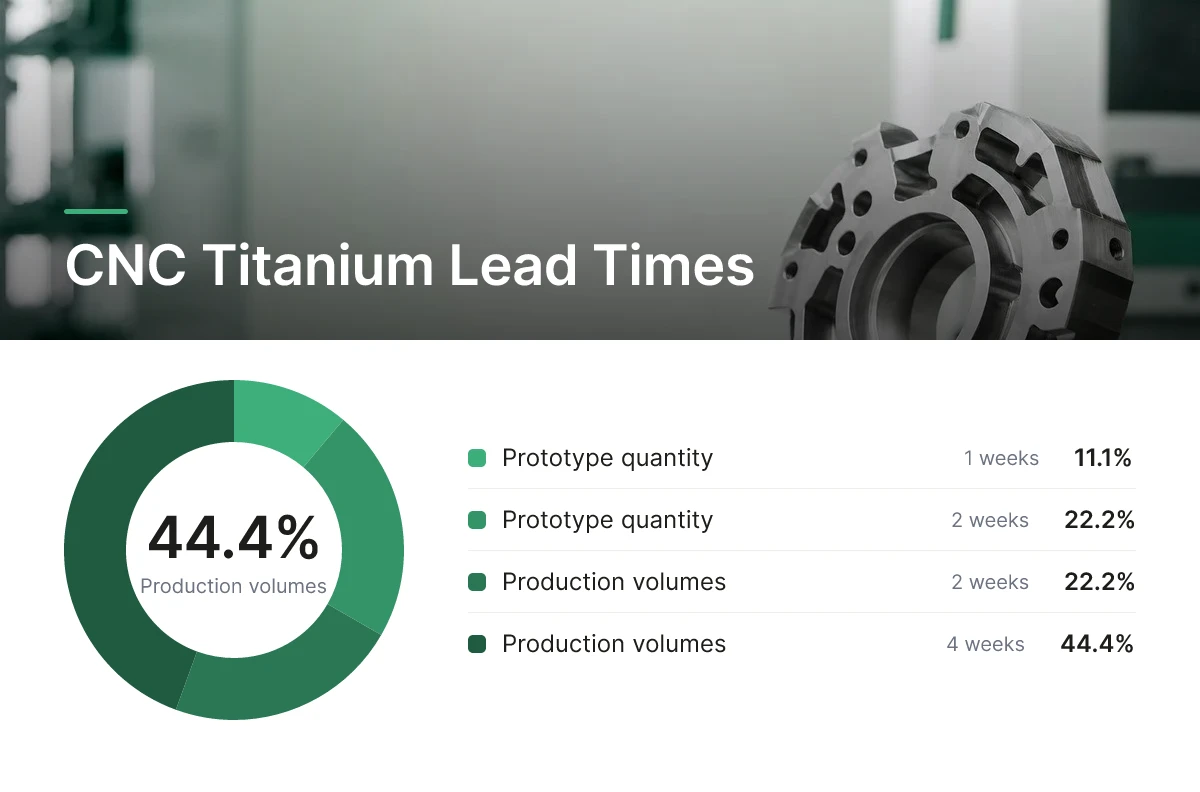
Expect one to two weeks for prototype-quantity titanium parts and two to four weeks for production volumes, with complexity and inspection requirements pushing either end longer.
Titanium’s slow cycle times affect more than machining cost, they compress the schedule flexibility a shop has to work with. Because titanium removes metal slower than aluminum or steel at the same tolerance target, every added operation or inspection step has an outsized effect on the calendar, not just the invoice.
What Factors Determine Turnaround Time for Rapid Prototyping Versus Production-Volume Titanium Machining?
Five variables set the clock: part complexity, tolerance tightness, titanium grade, finishing steps, and certification or inspection demands. A simple Grade 2 bushing with loose tolerances clears a shop floor fast. A Grade 5 (Ti-6Al-4V) bracket with tight positional tolerances, a passivation step, and full dimensional reporting takes considerably longer, the alloy itself is harder to machine, and each added process is a queue a part has to wait in.
Rapid prototyping and production-volume runs follow different logic. A single part or small batch for design validation gets scheduled quickly because setup and fixturing are minimal, you’re paying for speed, not efficiency. Production volumes flip that: fixture and setup time get amortized across hundreds or thousands of parts, so per-part cost drops even though the total job may sit on the schedule longer. Batching is where titanium parts manufacturing earns back the premium baked into Grade 5 stock and slow cycle times.
How Can You Balance Cost Reduction With Delivery Speed When Manufacturing Titanium Parts?
Lock the design and grade before cutting starts, mid-project changes on titanium cost more in rework than they would on aluminum, because machine time already invested is harder to recover. Choosing the correct grade upfront, rather than discovering partway through that Grade 5 was overspecified for a Grade 2 application, avoids resetting a schedule that’s already tight.
Quoting speed matters as much as machining speed. A supplier that returns a detailed quote within 8 hours and ships within 3 days of approval removes days of dead time from the front and back of a project, even when the machining itself runs on titanium’s slower clock, this is the model MFG SOLUTION applies across CNC turning, Swiss lathe, and CNC mill-turn work for parts up to 38mm. Capacity signals, 5-axis CNC machines, 20 automatic lathes, and a 60-plus-person engineering team, are a better predictor of whether a shop can actually hit a tight date than a quoted number on its own.
Frequently Asked Questions
Is titanium always more expensive to machine than steel, regardless of part design?
No, the gap narrows considerably on simple geometries and widens on complex, thin-walled parts. Raw titanium stock already costs more than steel, but machining time is often the larger variable. A simple bushing in titanium may cost twice as much as steel; a thin-walled bracket with tight tolerances can cost far more.
Can simplifying part design reduce titanium machining costs?
Yes, reducing wall thickness variation, tolerance stack-ups, and deep pockets cuts cycle time directly. Titanium’s low thermal conductivity and tendency to work-harden mean every extra pass multiplies tool wear and machining time. Design reviews that flag unnecessary tight tolerances before quoting often produce the biggest savings.
Does machining titanium require different cutting tools than steel?
Yes, titanium demands different tooling, lower cutting speeds, and more frequent tool changes than steel. Its poor heat dissipation concentrates temperature at the cutting edge, accelerating tool wear. Shops typically run carbide or specialized coated tools at reduced spindle speeds with higher coolant volume to manage heat buildup.
How does order volume affect the per-part cost of titanium machining?
Higher volumes spread fixed costs, tooling setup, programming, fixturing, across more parts, lowering the per-unit price. Material and cycle-time costs stay roughly constant per part, but setup amortization and process tuning improve with batch size, which is why consolidating orders with one supplier often beats splitting small runs across vendors.
Conclusion
Titanium’s cost premium comes from compounding factors, material price, slow cycle times, tool wear, and coolant demands, not a single line item you can negotiate away. The real savings come from reviewing part design for unnecessary tolerances, consolidating order volume with one supplier, and choosing the machining method suited to the geometry rather than defaulting to the most familiar process.
Before your next RFQ, send your titanium drawings to MFG SOLUTION for an 8-hour quote that flags design changes that could lower cost without touching function or tolerance.
Recommended Articles
Explore more from our content library: