
2026-10-31
Manufacturing Lead Time Reduction in Precision Machining

Manufacturing lead time reduction means shortening the time between a customer placing an order and receiving finished parts, without cutting corners on quality or driving up cost. In precision machining, that gap is driven by factors like quoting speed, material availability, machine scheduling, setup/changeover time, and inspection steps. Shops cut lead time by tightening these handoffs, faster quoting, better demand forecasting, reduced changeover, and automated order processing, rather than by rushing the cut itself. The result is faster delivery that holds the same tolerances and documentation customers already expect.

What Is Manufacturing Lead Time and Why Does It Matter for Precision Machining?
Manufacturing lead time is the full span from the moment a customer submits a quote request to the moment finished parts ship, not just the time a machine spends cutting metal.
For a precision machine shop, that span covers several distinct stages: quoting and design review, material sourcing, production scheduling, machining itself, secondary finishing, final inspection, and packaging for shipment. Each stage adds days if left unmanaged. A shop that quotes in 8 hours but takes three weeks to source bar stock hasn’t solved its lead time problem, it has just moved the bottleneck downstream. This is why manufacturing lead time reduction has to look at the entire order-to-ship sequence, not a single step in isolation. As research on lead time’s role in manufacturing success points out, focusing solely on efficiency and cost without addressing lead time can leave real competitive gains on the table.
How Is Manufacturing Lead Time Different From Cycle Time in a Precision Shop?
Cycle time is the machining-only duration to produce one part; lead time includes everything around it, queueing, setup, changeover, and inspection.
A Swiss lathe might run a 38mm component in under two minutes of actual cycle time. But if that job sits in a queue behind five other orders, waits on a fixture changeover, or gets held up for a CMM inspection slot, the lead time the customer experiences could stretch to days or weeks. Shortening cycle time through faster spindle speeds or optimized toolpaths helps, but it rarely moves the needle on lead time by itself. The bigger gains come from cutting the non-machining time: faster scheduling decisions, quicker material staging, and less setup between jobs.
What Role Does Lead Time Play in Customer Satisfaction and Competitive Advantage?
When quality and tolerances are comparable across suppliers, buyers frequently award the job to whoever delivers faster.
Procurement teams juggling new product launches or supply disruptions don’t have the luxury of waiting four to six weeks for a vendor that can’t commit to a date. Lead time has become a measure of how responsive a supplier can be when specifications change or timelines compress, a factor that often outweighs marginal efficiency gains on the shop floor. That’s part of why MFG SOLUTION anchors its process around an 8-hour quote and 3-day shipment window for parts up to 38mm in diameter: speed is a competitive signal, not just an operational metric.
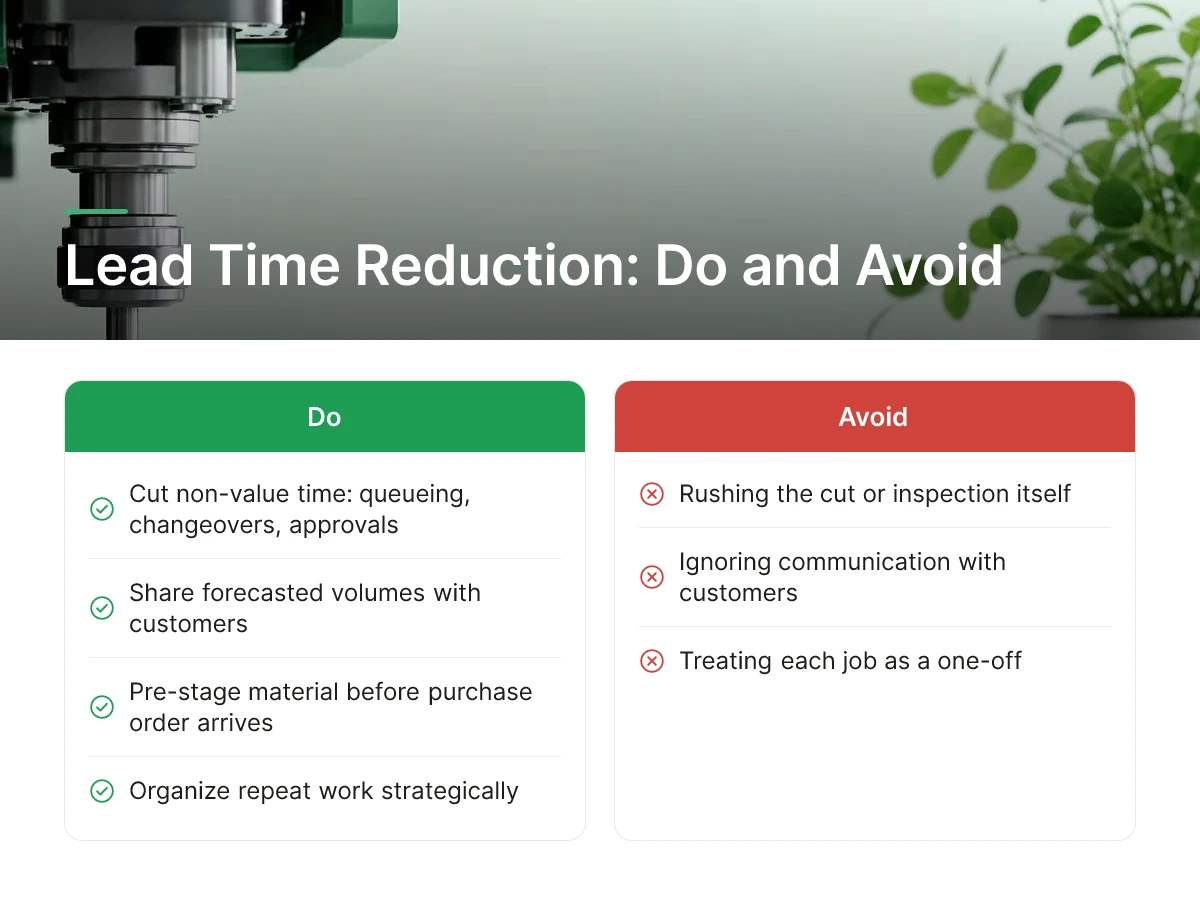
The risk is that lead time pressure tempts shops to skip verification steps to hit a date. The actual target of manufacturing lead time reduction is compressing non-value time, excess queueing, redundant approvals, slow material handoffs, never cutting inspection or setup checks that protect tolerance and traceability.
What Bottlenecks Slow Down Machining Turnaround Times?
Five chokepoints routinely stretch precision machining schedules: setup changeovers, fragmented material procurement, rework loops, poor job sequencing, and delays sitting outside the shop’s control.
- Machine changeover and setup time between different part geometries
- Fragmented material procurement across multiple vendors with mismatched lead times
- Rework loops caused by untracked root-cause failures
- Poor job sequencing and unclear queue priority
- External delays such as customer approvals or outsourced finishing processes
Most shops don’t lose weeks to one dramatic failure. They lose days in small increments across every job, and those increments compound until a 10-day part turns into a 5-week part. Spotting where the time actually goes is the first real step toward manufacturing lead time reduction, guessing at causes just moves the bottleneck somewhere else.
How Do We Identify Inefficiencies and Rework in Our Production Process?
Rework and failed inspections don’t just cost the hours spent re-cutting a part, they send the job back to the end of the queue, behind every job that arrived after it.
Machine changeover and setup time is the quiet killer in small-batch, high-mix production. Every time a machine switches from one part geometry to another, it needs new fixturing, new tooling offsets, and a first-article check before full production resumes. On a job shop running dozens of different parts per week, those setup minutes stack into hours, and the hours stack into missed ship dates.
When a part fails inspection, the instinct is to re-cut it and move on. That fixes the symptom, not the cause. Shops that track failures back to their root, a worn tool, a drawing tolerance that’s tighter than the process can hold, an operator misreading a spec, stop the same defect from resurfacing on the next run. Without that tracking, rework becomes a recurring tax on every future batch of that part.
What Internal and External Factors Most Commonly Delay Small Parts Delivery?
Material shortages, unclear job priority, and factors outside the shop’s walls, customer approvals, outsourced plating, delay small parts as often as anything happening on the shop floor. For more information, see Shift Lead M F D 00MRKEO2i7BgaYesc4FEOa.
Procurement is a common external drag. Sourcing raw stock from multiple vendors means juggling different minimum order quantities, different lead times, and the risk that one material shows up late and holds the whole job hostage. Prioritizing fewer, more reliable material suppliers and keeping safety stock on common alloys cuts this risk significantly. For a broader look at this issue, guidance on reducing lead time in supply chains outlines similar supplier consolidation tactics.
Scheduling adds another layer. A job that’s ready to run can still sit idle behind higher-priority work or get stuck because sequencing wasn’t planned with changeovers in mind. Clear job prioritization and tighter queue visibility are strategies for reducing lead time that cost nothing to implement beyond discipline.
Finally, some delays never touch the machine at all: a customer revises a spec mid-run, a purchase order approval sits in someone’s inbox, or a part needs outsourced plating or heat treating that adds its own transit time. These are harder to control, but flagging them early and building buffer into the quote keeps them from becoming surprises.
What Practical Strategies Reduce Machining Lead Time Without Sacrificing Quality?
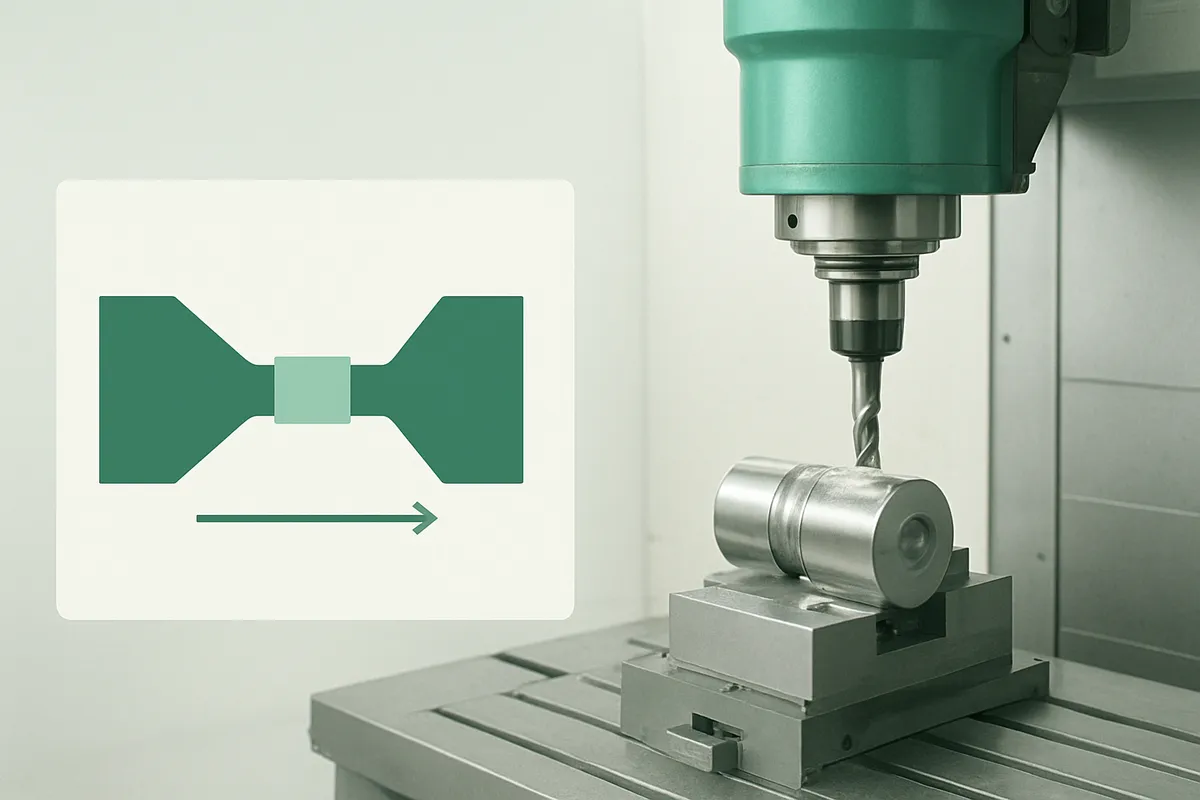
Manufacturing lead time reduction comes mostly from cutting non-value time, queueing, changeovers, approvals, not from rushing the cut or the inspection itself. The biggest wins come from what happens before the spindle starts turning: forecasting, communication, and how a shop organizes repeat work. For a deeper dive into these tactics, this overview of lead time reduction strategies breaks down several complementary approaches.
How Can Better Demand Forecasting and Communication With Customers Reduce Our Lead Times?
Sharing forecasted volumes and firmer order commitments lets a machine shop pre-stage material and block machine time before the purchase order even lands.
A shop that knows a 5,000-unit order is coming in six weeks can buy bar stock early, schedule a Swiss lathe slot, and avoid the material lead time and queue delay that hit customers who place orders cold. Including suppliers in demand forecasting is a documented lever for shrinking lead time because it removes the guesswork that drives safety-stock delays and rush premiums.
The same logic applies to technical information. Submitting complete drawings, tolerance callouts, surface finish requirements, and material certifications upfront prevents the back-and-forth that stalls a job mid-run. A missing finish spec discovered after first-article inspection can cost days, not because the machining is hard, but because the part sits waiting for a clarifying email. Shops that quote fast, like MFG SOLUTION’s 8-hour turnaround on specs for parts up to 38mm in diameter, depend on customers supplying complete, unambiguous files the first time; incomplete packages erase that speed advantage immediately.
What Lean or Continuous Improvement Approaches Work Best for Reducing Machining Lead Time?
SMED-style changeover reduction, standardized work instructions, and batching jobs by tolerance or material are the lean practices with the most direct payoff in a machine shop.
Single-Minute Exchange of Die (SMED) techniques shrink the time a machine sits idle between jobs by prepping fixtures, tooling, and programs offline before the changeover starts. Standardized work for repeat parts, documented setup sheets, fixed tool lists, repeatable CNC programs, means the second and tenth run of a part take less setup time than the first. Batching similar tolerances and materials together reduces the number of tooling and inspection switches across a shift, which cuts queue time without touching the actual cycle time on the machine. The lean practices with the most consistent impact include:
- SMED-style changeover reduction to shrink idle machine time between jobs
- Standardized work instructions and setup sheets for repeat parts
- Batching jobs by tolerance or material to reduce tooling switches
- Root-cause tracking on recurring delays instead of repeated expediting
- Buffer insulation against unplanned equipment or supplier disruptions
Continuous improvement compounds these gains over time. Tracking recurring delay causes, a tooling supplier that’s consistently late, a drawing format that repeatedly triggers clarification requests, and fixing the root process rather than expediting around the symptom each time is what separates a shop improving lead time job after job from one that just scrambles every order. Insulating production from unplanned disruptions, whether equipment downtime or supplier gaps, protects the schedule gains these practices create. For additional detail on applying these methods, this breakdown of lead time reduction strategies covers similar continuous improvement angles.
How Do You Measure and Track Lead Time Reduction Results?
Track four numbers by job type, compare scrap rate against speed gains, and separate capacity spending from process improvement before calling any result a win. Measuring manufacturing lead time reduction accurately requires consistent segmentation rather than a single blended average.
What Metrics Should We Monitor to Quantify Lead Time Reduction Success?
Four metrics give a shop an honest read on whether lead time is actually improving:
- Quote-to-order time: how long a customer waits between submitting specs and getting a workable price
- Order-to-ship time: the manufacturing side, covering setup, machining, inspection, and packaging
- On-time delivery rate: the percentage of jobs that ship on or before the promised date
- Queue time per job stage: how long a part sits waiting between operations rather than being worked
Averaging these numbers across all jobs hides more than it shows. A simple turned part finished on a single automatic lathe might run order-to-ship in a day or two, while a complex 5-axis multi-op part with tight tolerances and secondary inspection could reasonably take longer. Blending both into one “average lead time” makes a shop’s performance look worse on simple jobs and dangerously optimistic on complex ones. Segmenting metrics by job type, by process (Swiss lathe, cold forging, CNC mill & turn), part complexity, or operation count, gives a baseline that’s actually comparable month over month.
How Do We Balance Lead Time Reduction Against Cost and Quality Trade-offs?
Not all lead time reduction is the same kind of win, and shops that don’t distinguish the types end up making bad investment calls. Adding a second shift, buying another machine, or expediting freight shortens lead time but adds ongoing capacity cost, it’s a lever, not a structural fix. Cutting changeover time, fixing a bottleneck stage, or eliminating a redundant inspection step shortens lead time by removing waste, and that gain holds without added spend. Research on quick response manufacturing argues that lead time reduction, pursued correctly, improves cost and quality simultaneously rather than trading against them, but that only holds when the gain comes from eliminating waste, not from brute-force capacity additions.
Speed gains that aren’t checked against quality data can mask a real problem. Scrap rate and first-pass yield need to move alongside lead time on the same dashboard, a shop that cuts order-to-ship time by rushing through inspection will see delivery numbers improve right up until rework and returns start eating the gain back.
What Technology and Automation Tools Help Precision Shops Cut Turnaround Time?
Software that gives real-time visibility into orders and machine status, paired with automation on the shop floor, removes administrative delay before and between cuts. Most manufacturing lead time reduction gains in this category come from eliminating waiting, not from cutting faster. The practical approach to reducing manufacturing lead time echoes this: visibility and process discipline matter more than raw machine speed.
How Can MES, ERP, or Order Automation Platforms Accelerate Our Machining Workflow?
A manufacturing execution system (MES) tied to an ERP gives planners a live view of which machines are running, which are idle, and which jobs are next in queue. Without that visibility, a finished job can sit for hours, sometimes a full shift, waiting for someone to notice a machine is free and manually assign the next work order. Automating that handoff closes the gap between “part is done” and “next part starts.”
The same logic applies before a job ever touches a machine. Manual RFQ processes, emailing drawings, waiting for a reply, clarifying tolerances over a phone call, routinely add days to a quote cycle. Automated quoting and order-entry platforms parse specifications, flag issues up front, and return pricing without a human sitting in the loop for every step. That is part of how MFG SOLUTION returns quotes within 8 hours: the administrative front end is compressed so the shop floor gets the job sooner.
What Role Does Process Automation Play in Maintaining Quality While Reducing Lead Time?
In-process automation, bar feeders, robotic load/unload, multi-axis mill-turn centers, reduces the dead time between operations rather than the cutting time itself. A bar feeder keeps a lathe running through unattended cycles overnight instead of stopping every time a bar is consumed. A mill-turn machine that finishes a part in one setup removes the wait for a second machine and a second fixture. None of this changes what gets inspected or how often; it changes how much idle time sits around the cut.
That distinction matters for any shop weighing automation investment. Options range from budget-friendly upgrades, better fixturing, simple bar stock automation, to mid-range scheduling and quoting software, up to premium, enterprise-grade robotic cells and 5-axis CNC platforms. None of these tiers should touch inspection protocol. Full process control means every step is still tracked and documented regardless of how fast the machine moves between operations, which is why shops pursuing ISO 9001:2015, ISO 13485:2016, or IATF 16949 certification can automate aggressively without creating compliance risk.

Frequently Asked Questions
What is replenishment lead time and how does it apply to machined parts?
Replenishment lead time is the span between placing a reorder for a part and having it back in stock and usable. For machined components, that includes quoting, material sourcing, setup, machining, inspection, and shipping. Shortening any one of those steps, faster quoting, pre-qualified materials, less setup changeover, shrinks the total replenishment window and reduces how much safety stock you need to carry.
How does lead time differ across part complexity, like a simple turned part versus a multi-axis machined component?
Simple turned parts typically move faster because they need fewer setups, tool changes, and inspection steps than multi-axis components. A basic Swiss-lathe part might run through production in a single setup, while a part requiring 5-axis milling needs more programming, fixturing, and in-process checks. Complexity doesn’t have to mean weeks of delay if the shop has the right equipment already in place.
Can reducing lead time increase the risk of quality issues?
It can, but only if speed comes from skipping steps rather than removing waste. Rushing through inspection or cutting corners on documentation raises defect risk. Sustainable lead time reduction instead comes from parallel processing, pre-approved processes, and standardized quality checks built into the workflow, not from shortcuts. Shops certified to ISO 9001:2015 or IATF 16949 maintain process control even as cycle times shrink, so speed and quality aren’t a tradeoff.
How quickly should a precision machine shop be able to turn around a quote?
A responsive precision machine shop should return a detailed quote within one business day, ideally faster. MFG SOLUTION, for example, delivers quotes within 8 hours for parts up to 38mm in diameter, which lets procurement teams compare options and start production the same week instead of waiting on back-and-forth emails.
What is the fastest way to get started with manufacturing lead time reduction at a small job shop?
Start by mapping the full order-to-ship sequence and timing each stage, quoting, material sourcing, scheduling, machining, inspection, shipping, to find where time actually accumulates. Most shops discover the biggest gains sit in queueing and handoffs rather than the cut itself. Fixing one bottleneck at a time, rather than attempting a full overhaul, produces measurable manufacturing lead time reduction without disrupting ongoing production commitments.
Conclusion
Cutting manufacturing lead time comes down to three levers: faster quoting, fewer handoffs between process steps, and a supplier whose quality system is strong enough that speed doesn’t introduce rework. Vendor consolidation and parallel processing tend to matter more than squeezing machine cycle times. If your current sourcing cycle runs four to six weeks because of slow quotes or fragmented vendors, start by auditing where the delays actually sit, quoting, material lead time, or shipping, before changing suppliers. Then test a supplier against that baseline: submit a real part spec to MFG SOLUTION and compare the 8-hour quote and 3-day ship window against what your current vendor delivers.
Recommended Articles
Explore more from our content library: