
2026-10-30
6 Habits That Make Fast Turnaround CNC Machining Possible

Fast turnaround CNC machining happens when a shop combines standardized processes, smart material selection, and parallel quality checks so small parts move from quote to shipment in days rather than weeks. Speed comes from habits, not shortcuts: pre-qualified materials, DFM feedback built into quoting, and inspection steps that run alongside production instead of after it. Shops that deliver consistently fast lead times typically quote within hours, flag design issues before cutting starts, and keep a fixed roster of machines and materials ready to run—so quality standards never get traded away for speed.
Several of the habits below show up consistently across shops that treat fast turnaround CNC machining as a repeatable process rather than a one-time promise:
- Standardized, pre-qualified material stock that skips procurement delays
- Design-for-manufacturability feedback delivered at the quote stage
- File preparation standards that prevent clarification back-and-forth
- Complexity-based routing that matches parts to the right machine setup
- In-process inspection instead of end-of-line-only checks
- Parallel processing across multiple machines and methods
1. Standardized Material Stock for Fast Turnaround CNC Machining
Keeping a fixed library of pre-qualified materials on hand removes the single biggest delay in fast turnaround CNC machining: waiting on procurement.
Sourcing a one-off exotic alloy means placing a purchase order, waiting for delivery, and verifying certification before a machine ever starts cutting, that can add days to a timeline before any chips fly. Stocked aluminum and common engineering plastics skip that step entirely; a job can often start the same day a quote is approved.
Why Do Aluminum and Plastic Parts Have Different Lead Times Than Steel?
Aluminum and plastics are forgiving to machine, widely stocked, and cut at faster speeds with less tool wear. Steel and specialty alloys are slower to source, harder on tooling, and typically run at longer cycle times because they demand lower feed rates and more frequent tool changes.
This option suits buyers who can flex on exact grade, accepting 6061 instead of a specific aerospace-grade aluminum, for example, and who prioritize speed over a niche material spec.
What most shops miss is that material standardization speeds up the quote itself, not just the machining. Fewer material unknowns mean fewer lookups and verifications on the quoting side, which is part of how MFG SOLUTION returns quotes within 8 hours rather than days. For comparison, platforms like Xometry’s CNC machining service and Protolabs’ online CNC machining service also lean on standardized material catalogs to keep instant quoting systems accurate.
2. Design-for-Manufacturability Feedback Before the Quote
Catching manufacturability problems during quoting, before a part enters the production queue, prevents the rework cycles that add days or weeks to delivery.
A thin wall prone to warping, a pocket too deep for a standard tool, or a feature a cutter physically can’t reach: flagged at the quote stage, these get resolved with a quick design tweak. Caught after the job is already scheduled, they stall the machine and force a re-cut, pushing the whole order back.
In practice, design-for-manufacturability (DFM) feedback looks like specific call-outs:
- Tolerance notes that exceed standard machine capability
- Tool-access warnings on internal features
- Flags on deep pockets or walls thinner than the material can reliably hold during cutting
This matters most for engineers submitting first-run prototypes, where geometry hasn’t yet been tested against real machining constraints.
The differentiator is timing: DFM feedback delivered alongside the quote, not as a separate engineering review scheduled after order approval, is what actually saves calendar days. A separate review step means waiting for an engineer’s availability; bundling it into the quote means the fix happens before the clock on production even starts.
3. File Preparation Standards That Avoid Queue Delays
Clean, complete CAD files let a part move straight into programming instead of sitting in a clarification queue waiting on the buyer to respond.
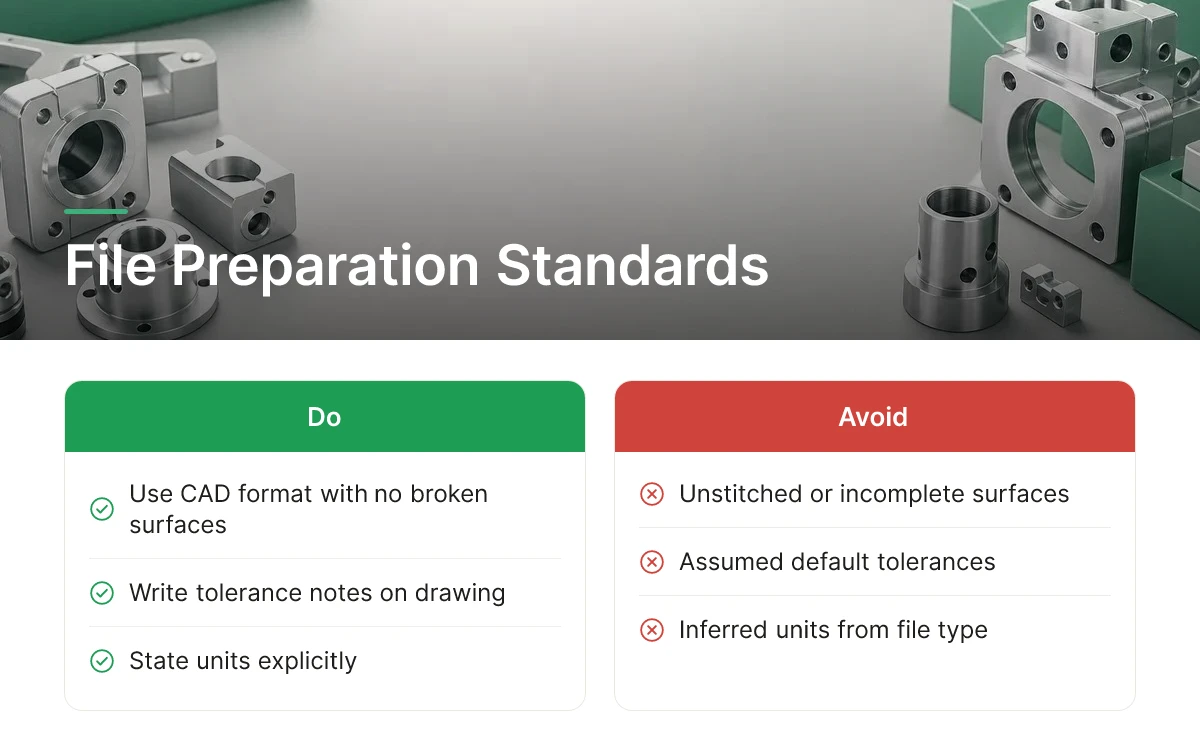
The habits that matter are specific: a CAD format with no broken or unstitched surfaces, tolerance notes written directly on the drawing rather than assumed as default, and units stated explicitly rather than inferred from file type.
How Should You Format Your CAD Files to Avoid Delays in the Machining Queue?
A missing GD&T callout forces a shop to stop and ask a question, and that single question can add a full communication cycle to the timeline, especially across time zones. Multiply that across several parts in one order and the delay compounds fast.
This discipline matters most for repeat buyers submitting multiple parts per order who want every submission handled the same consistent way, without re-explaining intent each time.
The habit that saves the most time: export a STEP file paired with a matching PDF print. The STEP file gives programmers exact geometry; the PDF print gives them the tolerances, finish notes, and design intent that geometry alone can’t communicate. Without the PDF, programmers have to guess, and guessing means a clarification email instead of a cut part. Instant-quoting platforms such as SendCutSend’s CNC machining service are built around this same expectation: clean, complete files move through automated quoting without manual clarification.
4. Matching Part Complexity to the Right Machine Setup
Shops that sort incoming parts by complexity before scheduling avoid unnecessary operations, and that triage step is what actually controls speed in fast turnaround CNC machining.
What Makes a Part ‘Simple’ or ‘Complex’ from a Turnaround Perspective?
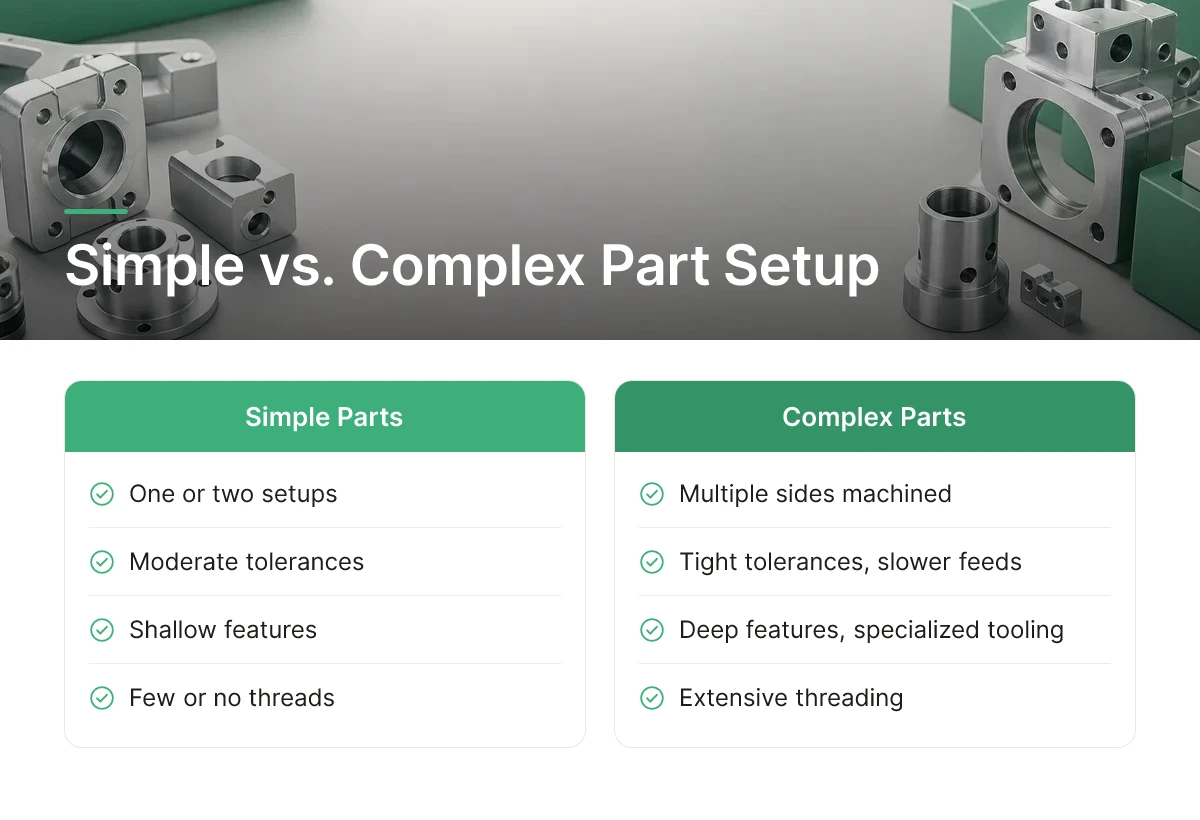
Simple parts need one or two setups, moderate tolerances, shallow features, and few or no threads. Complex parts share a different set of traits:
- Multiple sides that need to be machined
- Tight tolerances that demand slower feed rates
- Deep features that require specialized tooling
- Extensive threading, each adding time independent of the part’s size
The mechanism is straightforward: every additional work-holding setup means stopping the machine, repositioning the part, re-zeroing, and verifying alignment. On a single part that’s minutes; across a batch of 500, that changeover time compounds into hours or days.
This matters most to buyers ordering small batches with mixed geometry, who often notice that some parts in the same order ship faster than others. That’s not inconsistency, it’s complexity-based routing at work.
The differentiator: grouping similar-complexity parts into the same production run reduces total changeovers compared to processing each part in isolation. A shop running five simple turned parts back-to-back on one setup finishes faster than running those same five parts interspersed with complex multi-axis jobs, even if the total machining time is identical.
5. In-Process Inspection Instead of End-of-Line Inspection
Checking quality during the machining run, not only after it finishes, catches defects while there’s still time to fix the process instead of scrapping finished parts.
The mechanism is simple: if an operator spots an out-of-tolerance feature mid-run, they adjust the offset for the next part. If that same defect is caught only at final inspection, the entire batch may already be cut wrong, meaning a full re-queue and a scrapped run.
A fast timeline can still include real checks:
- First-article inspection to confirm the first part off the line meets spec
- In-process dimensional spot checks at intervals through the run
- A final CMM or gauge verification before shipment
What Quality Trade-Offs Should You Know About When Choosing the Fastest Turnaround Option?
Skipping in-process checks to save time on the front end usually costs more time later, once rejected parts are discovered after shipment and the whole order has to be re-cut and re-shipped. The apparent speed gain disappears the moment a batch fails inspection downstream.
This approach matters most to buyers in regulated or tight-tolerance industries, medical device and automotive component makers, for example, who can’t treat speed and inspection as a trade-off. MFG SOLUTION builds this in by manufacturing under ISO 9001:2015, ISO 13485:2016, and IATF 16949 process control, meaning every step is tracked and documented rather than checked only once at the end.
6. Parallel Processing Across Multiple Machines
Running turning and milling operations on separate machines at the same time cuts total production time compared to routing every part through one machine in sequence.
In a sequential setup, a single machine performs every operation on a part before moving to the next piece, turning, drilling, and finishing all queue behind each other on the same spindle. Splitting those operations across dedicated setups means a Swiss lathe can be turning one feature while a mill cuts another on a different part number, both finishing closer to the same time instead of one after the other. This is one reason parallel scheduling is central to fast turnaround CNC machining strategies at shops running multiple machine types side by side.
This approach pays off most on orders with several part numbers or batch quantities where machine availability, not raw cutting speed, is the real constraint. A shop with one CNC lathe and one mill can’t parallelize anything; it needs enough equipment variety and trained operators on-site to run multiple setups at once. For a closer look at how turning operations specifically factor into overall shop efficiency, see this guide to maximizing efficiency with CNC turning.
That’s the differentiator worth checking for: more of the same machine doesn’t help if there’s nobody qualified to run a second, different process simultaneously.
7. Transparent, Rapid Quoting Built Into the Workflow
A quote that takes days to produce delays the entire job before machining ever starts, so quoting speed is as much a lead-time factor as the cut itself.
Fast turnaround CNC machining depends on compressing every stage of the order, not just the cutting time. If a shop needs three or four business days just to review a drawing and respond with pricing, that delay eats into whatever time savings the machining process offers downstream. A fast, transparent quote confirms the per-part cost tier, a realistic lead-time estimate, and material and finish specifications up front, not a rough estimate that gets revised after the job is already queued.
MFG SOLUTION returns quotes within 8 hours of spec submission, which keeps the production clock starting the same day a buyer submits a design rather than the same week.
How Do You Balance Speed and Cost When Ordering Small Machined Parts?
Expect fast turnaround to sit at mid-range to premium pricing compared to standard lead times, expedited scheduling and dedicated review time cost more than batching a job into a routine queue. Buyers comparing multiple shops side by side should weigh that premium against the cost of a delayed product launch before deciding which matters more for a given order.
8. Dedicated Capacity Reserved for Rush and Prototype Work
Reserving specific machine hours for small or urgent jobs keeps a one-off prototype from waiting behind a large production run in the same queue.
When prototype orders and high-volume batches share one scheduling queue, the small job loses every time, a 5,000-piece run ties up a machine for days before a single-digit prototype order gets its turn. Shops built for speed address this by setting aside a portion of machine hours, or specific machines entirely, exclusively for low-volume and rush work.
Which Fast-Turnaround Approach Fits Prototyping, Low-Volume, or Full Production Runs?
Reserved capacity suits prototyping and low-volume buyers who need a handful of parts quickly, not customers placing full production orders, which run on different scheduling logic entirely and benefit more from batch efficiency than queue priority.
This differs from a shop simply advertising fast turnaround as a general promise. Capacity reservation is a scheduling commitment, specific hours or machines blocked off in advance, rather than a marketing line that evaporates the moment a big order comes in and claims priority.
How to Choose a Fast Turnaround CNC Machining Partner
Match the shop’s model to four factors: part complexity, required certifications, order volume, and how much timeline flexibility the project actually has.
Start with a short checklist:
- Complex, multi-feature parts need multi-method capability, CNC turning, Swiss lathe, cold forging, or mill-turn, rather than a single-process shop
- Regulated industries need to confirm certifications up front: ISO 13485:2016 for medical devices, IATF 16949 for automotive, ISO 9001:2015 as a baseline
- Volume determines whether reserved rush capacity or standard batch scheduling fits better
- Timeline flexibility determines whether paying a premium for speed is worth it at all
Weigh a factory model against a broker or network model qualitatively. A factory gives in-house control over quality checks and process consistency because the same team handles the part from stock to shipment. A network model spreads jobs across many third-party shops, which widens material and process options but adds coordination layers between the buyer and whoever actually cuts the part.
What’s the Difference Between a Factory and a Network Model for Fast Turnaround Delivery?
A factory, like MFG SOLUTION’s in-house operation with 5-axis CNC machines and 20 automatic lathes, controls inspection and scheduling directly, quotes in 8 hours, shipment in 3 days, under one documented process. A network model outsources to whichever partner shop has availability, which can widen capability but makes turnaround and quality control harder to guarantee consistently.
Before placing an order, ask directly about quoting speed, in-process inspection practices, and whether rush capacity is actually reserved or just promised. For large production runs where unit cost matters more than days saved, standard lead time is usually the smarter choice over paying for rush scheduling.

Frequently Asked Questions
How has rapid turnaround become a competitive advantage in precision machining?
Speed now determines who wins contracts, not just who passes quality audits. Buyers facing 4-6 week lead times from legacy suppliers increasingly consolidate sourcing with shops that quote in hours and ship in days. This shift rewards suppliers who pair digital quoting with certified process control, letting procurement teams cut sourcing cycles without adding vendor risk or sacrificing compliance documentation.
What’s the difference between ‘fast’ and ‘reliable’ in CNC machining lead times?
Fast means a short quoted lead time; reliable means that time holds up order after order, batch after batch. A shop can promise 3-day shipping once and miss it under volume. Reliability comes from documented process control and repeatable capacity, not a one-time rush job dressed up as a standard offering.
Which materials can be machined fastest without compromising precision?
Free-machining aluminum alloys, brass, and certain stainless grades cut fastest because they chip cleanly and allow higher spindle speeds without tool wear spikes. Exotic alloys, titanium, and hardened steels slow cycle times regardless of equipment quality. Matching material choice to the application early in design review avoids forcing a shop to trade speed for tolerance later in production.
Can you maintain quality standards while cutting turnaround time?
Yes, but only when speed comes from process efficiency, not from skipping inspection steps. Shops certified to ISO 9001:2015, ISO 13485:2016, or IATF 16949 document every stage, so faster cycle times don’t mean fewer checks. MFG SOLUTION applies this model directly: quotes within 8 hours and shipment within 3 days run under full process control, not around it.
What capabilities should you look for in a fast-turnaround CNC shop?
Look for multiple machining methods under one roof, documented certifications, and engineering support that catches design issues before production starts. A shop offering CNC turning, Swiss lathe, cold forging, automatic lathe, and mill-turn capacity can match the process to the part instead of forcing one method on every job. Also confirm equipment depth, 5-axis machines and dozens of automatic lathes signal capacity to hold fast turnaround under real order volume, not just on a sample run.
Conclusion
Fast turnaround only matters if it holds under real order volume and real tolerance requirements. The shops that deliver consistently combine certified process control, equipment depth across multiple machining methods, and engineering review upfront, not just a quick quote. Before committing to a supplier, test the claim: submit a real part spec and measure the actual quote time and ship date against what’s promised.
MFG SOLUTION quotes within 8 hours and ships within 3 days on parts up to 38mm, backed by ISO 9001:2015, ISO 13485:2016, and IATF 16949 certification. Send a current part drawing through for quoting and compare the response time against your existing supplier’s last three orders.
Recommended Articles
Explore more from our content library: