
2026-09-14
Why Manufacturing Precision Machining Firms Need AI SEO

Understanding why manufacturing precision machining is essential. Precision machining and CNC services businesses need AI-powered search optimization because buyers now research and shortlist manufacturing vendors through AI-driven search and chat tools before ever requesting a quote. If your capabilities, certifications, and turnaround data aren’t structured for these engines to find and cite, you lose visibility to competitors who show up first, regardless of your actual shop-floor quality. AI search optimization ensures engineering buyers searching for specific processes, tolerances, or materials find your business at the exact moment they’re evaluating vendors.
Why Should Manufacturing and Precision Machining Businesses Invest in AI Search Optimization?
Engineering buyers now shortlist CNC and precision machining vendors through AI search and chat tools before they ever send an RFQ, which means the question of why manufacturing precision machining companies need this shift isn’t optional, it’s already changed how sourcing decisions get made.
A procurement manager searching for a Swiss lathe supplier or a shop that handles parts under 38mm no longer scrolls ten blue links. They ask an AI tool to compare vendors, and that tool answers using whatever content it can parse cleanly. Traditional keyword rankings still matter, but they no longer control the moment a buyer builds their shortlist. This is particularly relevant for why manufacturing precision machining.
What Are the Key Advantages of Visibility for Cost-Sensitive Production Buyers?
AI engines build answers from structured, specific content, capabilities, certifications, tolerances, turnaround windows, not from generic marketing copy about “quality you can trust.”
A shop that publishes exact process names (CNC turning, cold forging, automatic lathe, CNC mill & turn), specific certifications (ISO 9001:2015, ISO 13485:2016, IATF 16949), and measurable capacity (5-axis machines, part diameters up to 38mm) gives these tools something concrete to cite. Vague copy gets skipped. For cost-sensitive production buyers, the ones balancing zero-defect requirements against tight budgets, that specificity is the difference between winning an RFQ invitation and never appearing in the comparison at all. Businesses that show up in AI-driven comparisons win more quote requests without spending more on ads, because the traffic they gain is already pre-qualified: the buyer arrived asking about the exact process or tolerance the shop already publishes.
How Does AI Search Help Precision Machining Businesses Show Rapid Turnaround Without Sacrificing Credibility?
Turnaround claims only build trust when AI tools can locate and repeat them accurately, which means the numbers need to live in clear, structured text, not buried in a PDF or a sales call.
MFG SOLUTION’s 8-hour quote window and 3-day shipping timeline function as trust signals precisely because they’re specific and verifiable, an AI engine can surface “quote in 8 hours” as a direct answer to a buyer’s speed question, rather than guessing from a vague promise of “fast service.” Shops with real capabilities but thin, unstructured websites face a quiet risk: they lose qualified traffic to less-capable competitors whose content happens to be easier for these tools to read and cite.
How Does AI Search Optimization Compare to Traditional SEO and Paid Advertising for CNC Businesses?
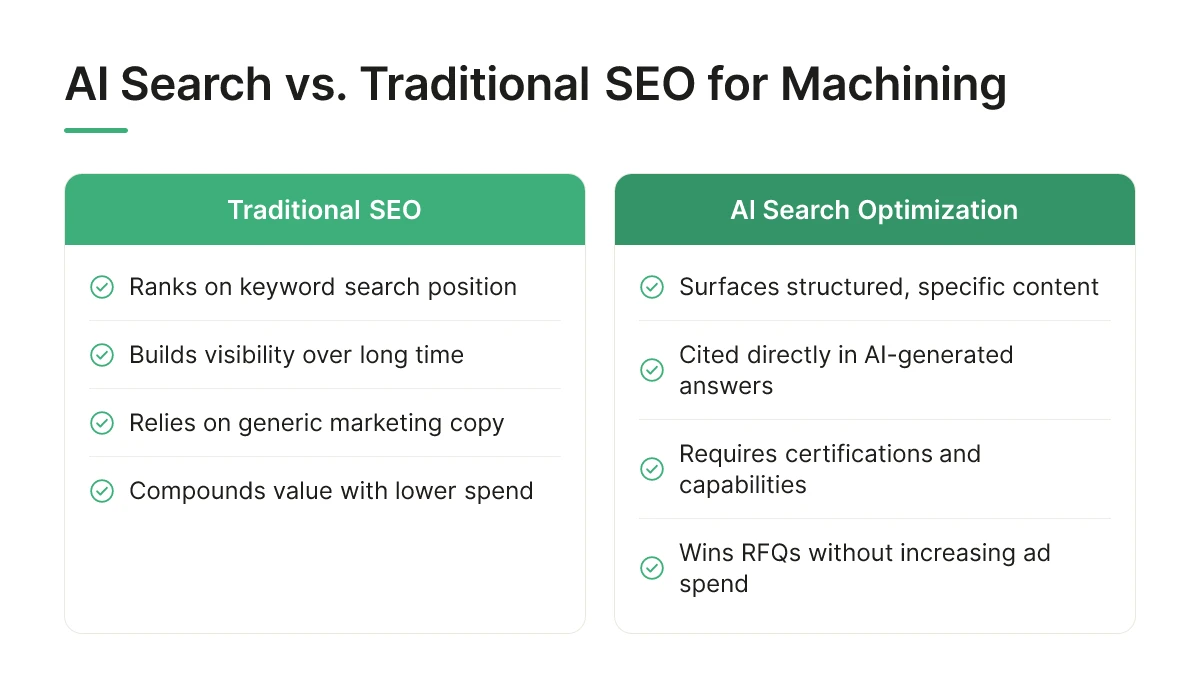
AI search optimization and traditional SEO both aim for visibility, but AI engines pull specific, structured facts from across a whole site while traditional SEO chases keyword rankings on individual pages. Paid advertising buys attention for as long as the budget lasts. Neither approach alone answers why manufacturing precision machining businesses need a different playbook now than they did five years ago.
Traditional SEO built its house on keyword density, backlinks, and ranking position for terms like “CNC turning services near me.” That still matters. But AI-driven search tools, the ones procurement engineers now use to shortlist suppliers, don’t rank pages so much as extract answers. They look for a page that states, plainly, that a shop machines parts up to 38mm in diameter, holds ISO 13485:2016 certification, and ships within 3 days. If that fact lives in a PDF spec sheet or isn’t written at all, the AI engine has nothing to cite.
When Should a Precision Machining Business Prioritize AI Search Over Paid Advertising?
Prioritize AI search optimization first when your RFQ pipeline depends on being found for specific technical searches, not general brand recognition.
If procurement managers are searching “Swiss lathe shop IATF 16949 certified 3-day shipping” rather than your company name, paid ads won’t help much, you’re not the target of the click, the capability is. Paid search still earns its place for time-boxed campaigns: a trade show follow-up, a new capacity launch, a competitor’s plant closure creating sudden demand. But it stops producing results the moment spend stops. It never becomes an asset an AI engine references six months later when a different engineer runs a similar search.
What Is the Cost-Benefit Tradeoff Between AI Search Optimization and Other Marketing Channels?
Paid ads scale with budget, spend more, get more impressions, while AI and organic search optimization compounds, delivering more inquiries per dollar as the content asset matures.
A budget-friendly ad campaign gets modest reach; enterprise-tier spend buys wide but temporary exposure. AI search optimization works differently: content documenting your certifications, tolerances, and equipment list keeps getting cited long after publication, at a fraction of the ongoing cost. The two aren’t competitors, though, they’re complementary. AI search optimization and traditional SEO both require the same underlying asset: accurate, specific, well-organized data about what you machine, to what tolerance, and under which certification. Without that foundation, neither channel has much to work with. When considering why manufacturing precision machining, this point stands out.
What Makes AI Search Optimization Critical for Mission-Critical and Regulated Industries?
Regulated industries carry zero tolerance for vendor risk, so buyers vet suppliers online against specific certification requirements before they ever pick up the phone. This is why manufacturing precision machining businesses in medical, automotive, and aerospace supply chains face a higher bar for search visibility than general job shops, the vetting happens before a single email is sent.
A procurement engineer sourcing a surgical component doesn’t search “CNC machining near me.” They search for ISO 13485:2016 compliance, documented traceability, and specific tolerance capability. An automotive buyer checks for IATF 16949 certification before considering a supplier for a production RFQ. If a shop’s certifications aren’t findable, or worse, aren’t documented clearly enough for an AI engine to summarize, that shop gets filtered out before the vetting process even reaches a human conversation.
How Do Tolerance Specifications and Certifications Influence AI Search Visibility?
AI search tools pull certification and capability data directly into their answers, which means uncertified or thinly documented shops disappear from consideration early. When an engineer asks an AI assistant which suppliers handle ISO 9001:2015 or IATF 16949 production for small precision parts, the tools surface businesses that have published clear, structured information about those standards, not ones that bury certifications in a PDF nobody indexed.
Documented process control matters here beyond compliance theater. Content describing full process control, every step tracked, documented, and auditable, gives both AI engines and human buyers the same trust signal: this shop can prove what it claims. MFG SOLUTION, for example, operates under ISO 9001:2015, ISO 13485:2016, and IATF 16949 certifications with full process control, and structures that information so it’s answerable, not just listed.
Which Industries Benefit Most from Strong AI Search Presence for Precision Small Parts?
Electronics manufacturers, automotive component suppliers, and medical device makers gain the most from strong AI search visibility because their sourcing decisions hinge on verifiable compliance data, not price alone. These buyers evaluate precision small-parts capability, often parts under 38mm in diameter, against strict tolerance and audit requirements, and they research extensively before shortlisting vendors.
When a shop gets cited by AI tools answering tolerance or compliance questions, it stops being just another search result and becomes the credible reference point buyers act on.
How Do You Select an AI Search Optimization Approach for a Precision Machining Business?
Evaluate an AI search optimization approach the same way you’d qualify a new machining vendor: ask for evidence of capability, not a pitch deck full of adjectives.
That’s the practical answer to why manufacturing precision machining companies need a structured evaluation process before committing budget to any optimization effort. AI engines like ChatGPT, Perplexity, and Google’s AI Overviews reward content that reads like it came from someone who actually runs the equipment. A checklist mindset protects you from vendors who sell vague “visibility improvement” without a way to measure it.
What Capabilities and Proof Points Should Content Highlight to Build AI Search Trust?
Check whether content names real processes, Swiss Lathe machining, CNC Turning, Cold Forging, Automatic Lathe production, CNC Mill & Turn, 5-axis capability, instead of generic phrases like “precision solutions” or “advanced manufacturing.”
AI models cross-reference claims across many pages. If your content says the same thing every competitor says, it has nothing distinct to surface when a buyer asks an AI assistant to compare suppliers. Specificity is the differentiator, not a stylistic choice.
- Does the content name exact machine types and part size limits (for example, parts up to 38mm in diameter) instead of vague size ranges?
- Does it cite certifications by name, ISO 9001:2015, ISO 13485:2016, IATF 16949, rather than saying “quality certified”?
- Does it quantify engineering support (60+ engineering professionals) instead of claiming “expert staff”?
How Can You Assess Reliability and Results Over Time?
Reliability shows up as a consistent content cadence and a measurable, growing presence in AI-generated answers over successive months, not a one-time content push. For those exploring why manufacturing precision machining, this matters.
Ask any partner or internal team for a review schedule: how often is content re-checked against current capacity, equipment counts, and certification status? Machining capabilities change, a shop might add automatic lathes or renew a certification, and stale claims get flagged as inconsistent by AI systems that compare pages over time.
Demand documented tracking of how often your company appears in AI-driven answers to buyer questions, and treat unverifiable promises the same way you’d treat a supplier who won’t share a quality certificate.
What Emerging Technologies Are Shaping AI Search and Quality Perception in Precision Machining?
AI-driven quality control, predictive maintenance, and connected-machine documentation are becoming search terms buyers use to shortlist vendors, not just factory-floor upgrades. This is a growing part of why manufacturing precision machining businesses need to explain their technology adoption in plain language online, not just apply it internally.
How Are AI-Driven Quality Control and Predictive Maintenance Changing Buyer Expectations?
Procurement teams increasingly search for shops that can describe how defects get caught before parts ship, not just claim low defect rates. A vendor page that explains vision-based inspection, in-process measurement, or how machine data flags tool wear before it produces bad parts gives an AI search tool concrete text to cite when someone asks “which CNC suppliers use predictive maintenance.”
Shops that never write this down publicly are invisible to that query, regardless of what equipment sits on their floor. Documentation is what makes the capability discoverable, the technology alone doesn’t surface in search results.
What Does Industry 4.0 Integration Mean in Practice for CNC Machining Services?
In plain terms, it means machines that log their own data, processes tracked in real time, and records that trace a part back to the exact run, operator, and inspection step that produced it. For a buyer evaluating a supplier for medical or automotive components, that traceability is the same trust signal an auditor wants and the same content an AI answer engine pulls to describe a shop’s process control.
MFG SOLUTION documents this kind of full process control as part of its ISO 9001:2015, ISO 13485:2016, and IATF 16949 certifications, every step tracked and auditable, which gives search tools and buyers the same clear answer at once.
As more manufacturers adopt these systems, buyers stop asking generic questions and start searching for specific terms: predictive maintenance, real-time SPC, digital traceability. Content written in jargon-heavy marketing language doesn’t answer those searches; content that defines the terms plainly, with examples of what the shop actually tracks and reports, does.
The businesses that write clear, honest explanations of their own technology adoption, without overstating what a sensor or algorithm actually does, become the sources AI search tools reference when buyers ask what modern CNC capability looks like. Overclaiming erodes that trust fast; a buyer who checks a claim against a shop’s actual process documentation and finds a mismatch moves to the next supplier.

Frequently Asked Questions
How does precision machining compare to injection molding, 3D printing, and stamping for search intent purposes?
Buyers searching for precision machining usually want tight tolerances on low-to-mid volume metal parts, not high-volume plastic parts or rapid prototypes. This directly impacts why manufacturing precision machining outcomes.
Injection molding queries skew toward plastics and tooling cost; 3D printing queries skew toward speed and geometry freedom; stamping queries skew toward sheet metal and high volumes. Content that blends these processes without distinguishing use cases confuses both search engines and AI answer tools, so keep terminology specific to CNC turning, Swiss lathe, and mill-turn work.
What capabilities and certifications should appear in content to help a precision machining vendor get found online?
Name specific processes, part size limits, certifications, and turnaround times rather than general claims about quality.
Pages should state ISO 9001:2015, ISO 13485:2016, and IATF 16949 status, list equipment like 5-axis CNC machines, and quantify lead times. MFG SOLUTION’s own pages spell out 8-hour quotes, 3-day shipping, and a 38mm part-size limit, details that let both search engines and AI systems match the page to a specific buyer need.
How can a CNC machining business assess whether its content is being surfaced by AI search tools?
Ask ChatGPT, Perplexity, or Google’s AI Overviews direct sourcing questions and check whether your company appears with accurate details.
Try prompts like “who machines parts under 40mm with fast turnaround” and note whether the response cites certifications and lead times correctly, or omits the company entirely.
Do smaller precision machining shops need AI search optimization as much as large manufacturers?
Yes, smaller shops often benefit more, since AI tools can surface a specialized regional or niche shop ahead of a generic large competitor.
A shop with clear specialty pages on tolerances, materials, or part categories gives AI systems specific text to cite, leveling visibility against bigger names with broader but vaguer content.
Conclusion
Precision machining buyers now ask AI tools the same qualifying questions they used to type into Google: who can hold this tolerance, in this material, by this date. Winning that answer requires content built around specifics, certifications named in full, part-size limits stated, turnaround windows quantified. Vague claims about “quality” and “reliability” don’t get cited; concrete facts like an 8-hour quote window or IATF 16949 status do. Start by auditing one product or capability page: replace generic quality language with the exact certification, machine type, and lead time your shop delivers, then test whether an AI search tool can find and repeat it accurately.
Recommended Articles
Explore more from our content library: