
2026-10-09
What Electronics Manufacturing Services Actually Deliver
Electronics manufacturing services (EMS) let a precision machining business hand off PCB assembly, component sourcing, and electronics production to a specialized partner instead of building that capability internally. The arrangement works best when your core value is machining tolerances and material expertise, not electronics assembly lines, test fixtures, and component procurement. A good EMS partner absorbs the equipment investment, certifications, and supply chain complexity for the electronics side, while you stay focused on the precision parts you’re built to produce. The right choice depends on your volume, product mix, and how much control you need over the assembly process.
Should You Outsource Electronics Assembly to an Electronics Manufacturing Services Partner?
Outsourcing makes sense once electronics assembly starts competing for the same engineering time and capital your precision machining work needs to grow. The decision isn’t philosophical, it’s a resource allocation problem with a clear tipping point.
What Electronics Assembly Tasks Can You Realistically Outsource?
PCB assembly, component sourcing, box build, and functional testing are the tasks most precision machining shops hand to an electronics manufacturing services partner. These require dedicated pick-and-place lines, reflow ovens, test fixtures, and component procurement relationships that have nothing to do with holding a tolerance on a turned part. Keeping machining as the core competency while routing electronics work to a specialist is a common split, not a compromise, it lets each side of the build run on equipment actually suited to it.
Some manufacturers go further and outsource the full assembly lifecycle, from engineering support through sustaining production, when the electronics content of their product grows large enough to justify a dedicated manufacturing partner rather than a vendor relationship. The same logic applies to precision machining work handed to a precision machining partner: the decision to outsource tends to follow the point where specialized equipment and qualified labor outpace what’s practical to keep in-house.
What Challenges Come With Transitioning to an EMS Partner?
Qualifying a new partner is the slowest part of the transition, not the fastest. You need to transfer documentation, bills of materials, and inspection criteria accurately, then re-establish quality sign-off procedures so the new partner’s acceptance standards match what your engineering team expects. Evaluation should go beyond a capability checklist, planning process, inspection systems, and how a partner communicates when something changes on the line matter as much as equipment lists.
Skipping these steps is how programs end up with mismatched documentation or a quality escape nobody catches until a customer does.
The clearest signal that outsourcing makes sense: your electronics volume or complexity is growing faster than you can justify dedicated equipment, trained operators, and test engineering in-house. If you’re machining 38mm precision components at MFG SOLUTION and the same program now needs a PCB-driven sensor housing, building an SMT line from scratch rarely pencils out against partnering with an electronics manufacturing services specialist.
Outsourcing doesn’t have to be all-or-nothing. Many manufacturers send high-mix, low-volume electronics work to an outside partner while keeping simple or highly proprietary builds in-house, where control over IP or process knowledge outweighs the convenience of outsourcing. This mirrors the broader tension between full vertical integration and selective outsourcing that many manufacturers weigh when standardized production models don’t fit a unique product.
EMS Provider vs In-House Production: What’s the Real Difference?
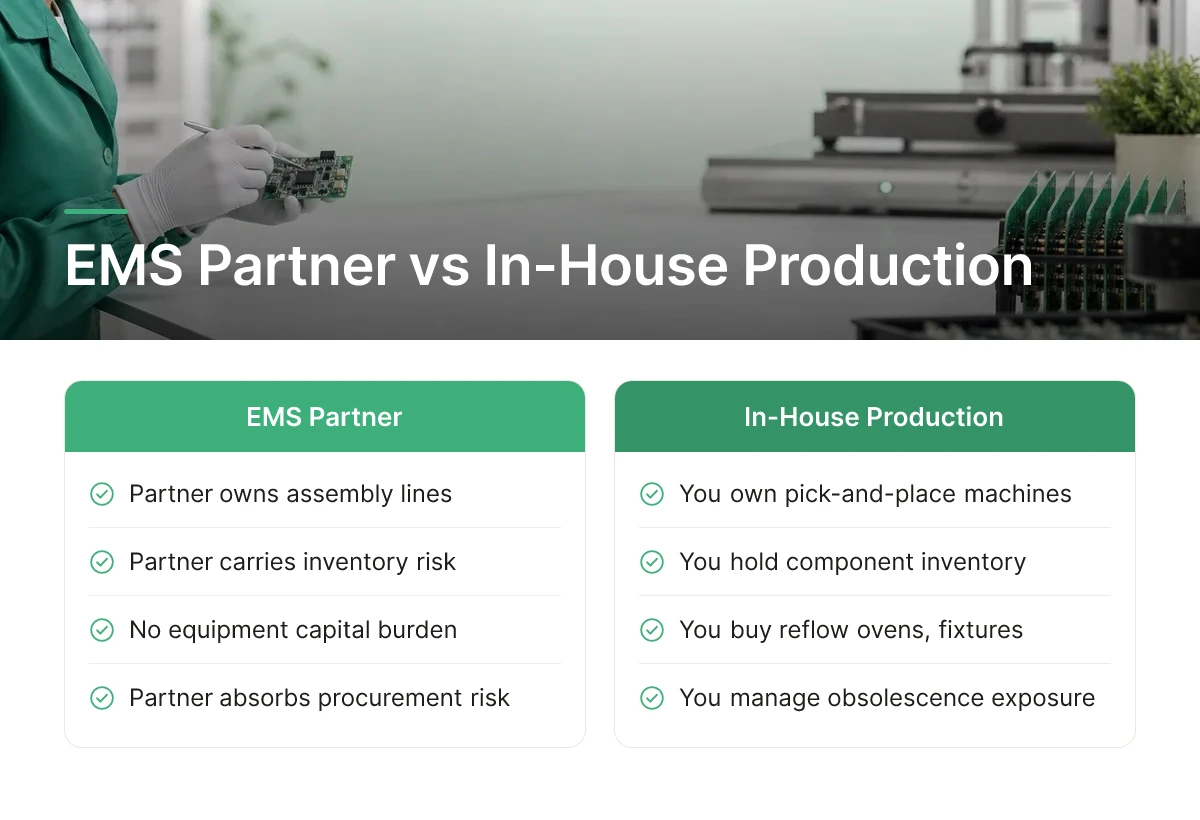
The core difference is who carries the capital risk: an electronics manufacturing services provider owns the assembly lines and inventory exposure, while in-house production puts that burden on your balance sheet.
Running electronics assembly internally means buying pick-and-place machines, reflow ovens, test fixtures, and hiring line staff to run them. It also means holding component inventory on your books, including the exposure to price swings and obsolescence on parts that may sit for months before a build runs. An EMS partner absorbs that equipment cost and staffing load, and usually the component procurement risk too, spreading it across multiple customers’ volume instead of concentrating it on one program.
That difference in who owns the assets is also what separates an EMS provider from an original equipment manufacturer (OEM) relationship, even though the two terms get confused.
How Does an EMS Provider’s Capability Differ From an OEM?
An OEM designs the product and owns the brand, the intellectual property, and the end customer relationship; an EMS provider builds to that design without claiming ownership of any of it.
Think of it as a division of labor rather than a hierarchy. The OEM decides what the product does and how it looks. The EMS provider decides how best to assemble it reliably at the volume required, feeding back manufacturability concerns but not altering the product’s identity. This separation is what makes outsourcing viable for companies that need to protect design ownership while still accessing production capacity they don’t want to build themselves.
The trade-off runs in both directions. Keeping assembly in-house gives you tighter control over schedule changes and lets you guard proprietary processes without exposing them to a third party. Working with an EMS provider gives you access to specialized equipment, qualified line staff, and scale economics without the ownership burden, but it means adapting to someone else’s production calendar and quality systems. The same checklist applies broadly to any custom manufacturing partner, regardless of whether the output is a machined component or a fully assembled electronic product.
For a precision machining business, the right call usually depends on how central electronics is to what you sell. If electronics assembly supports a mechanical product rather than being the product itself, outsourcing to an EMS provider frees up capital and engineering attention for the machining work that actually differentiates the business, which is the reasoning behind MFG SOLUTION’s focus on precision-machined components rather than full electronics assembly.
How Do You Evaluate and Select the Right Electronics Manufacturing Services Partner?
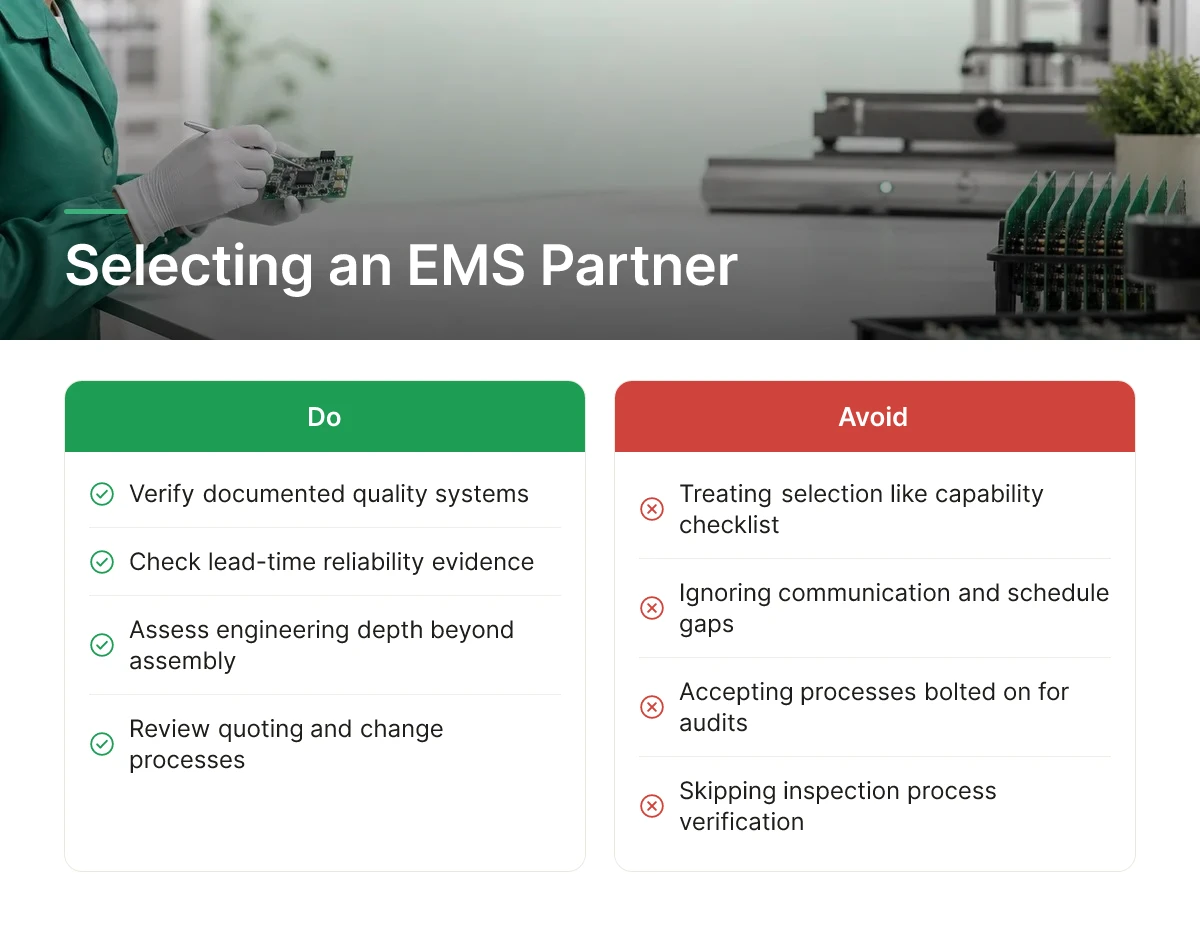
Evaluate electronics manufacturing services partners against three criteria: documented quality systems, verifiable lead-time reliability, and evidence of engineering depth beyond basic assembly.
Buyers who treat the selection process like a capability checklist tend to get burned later by communication gaps and schedule slips. A shop can hold tight tolerances and still create friction if its quoting, inspection, and change-management processes aren’t built into daily operations rather than bolted on for audits.
What Should You Look for in Quality Assurance, Lead Times, and Service Differentiation?
Start with certifications that match your industry’s actual compliance burden, not just a logo on a website. For electronics, automotive, or medical-adjacent components, ask to see current ISO 9001:2015 certificates at minimum, and ISO 13485:2016 or IATF 16949 if your end product falls under those regulatory umbrellas. Then ask how those certifications translate into daily practice: documented inspection routines, lot traceability from raw material to shipped part, and a formal first-article approval step before any production run begins. A partner who can’t produce an inspection report on request is telling you something about how they’ll handle a quality escape later.
Lead time claims deserve scrutiny too. Ask for typical quote turnaround under normal conditions, not best-case marketing numbers, MFG SOLUTION, for example, commits to quotes within 8 hours and shipment within 3 days of order approval, which gives buyers a concrete benchmark to compare against. Also ask how a shop handles scheduling flexibility when order volumes change, and what their actual process looks like when a key component runs short. Vague answers on shortages usually mean the plan is improvisation. The same diligence applies when outsourcing precision machining work, where schedule reliability and transparent communication matter as much as unit price.
Differentiation shows up in willingness to do design-for-manufacturability review before committing to a production run, prototype smaller batches without penalty pricing, and take on mixed-volume orders rather than pushing you toward a minimum they find convenient. Shops with meaningful engineering staff, MFG SOLUTION runs 60+ engineering professionals across design optimization and production planning, tend to catch tolerance or geometry problems before they become scrapped parts.
What Implementation Timeline Should You Expect When Switching to an EMS Provider?
Expect four phases: documentation transfer, a pilot run, ramp-up, and steady-state production. Documentation transfer, drawings, material specs, inspection criteria, is where miscommunication most often starts, so insist on a written confirmation step before tooling begins. The pilot run validates the process at low volume and is the cheapest place to catch a problem. Ramp-up is where lead-time promises get tested against real scheduling pressure, and where shortage handling and flexibility either prove out or don’t.
What Are the Real Costs and ROI of Outsourcing Electronics Manufacturing?
The real cost comparison isn’t quote price versus hourly shop rate, it’s fixed capital against variable per-unit spending, measured over the equipment’s working life.
Most procurement teams compare an EMS partner’s per-unit quote to an internal estimate built mostly from labor and materials. That’s an incomplete model. A credible comparison has to account for every category of spend a part touches, whether it’s machined in-house or sent to an outside electronics manufacturing services provider.
How Do You Build a Cost-Benefit Analysis for Outsourcing vs In-House Production?
Start by laying out four cost categories side by side for both models: equipment and tooling investment, labor and training, component inventory carrying cost, and quality or rework cost.
- Equipment and tooling: In-house production requires buying and maintaining CNC equipment, fixtures, and calibration tools, capital that sits on the balance sheet whether the machine runs at 30% or 90% utilization. Outsourcing converts that into a per-order cost with no ownership burden.
- Labor and training: Skilled machinists and quality technicians need ongoing training as part geometries and materials change. An EMS partner spreads that training cost across many customers instead of one production line.
- Inventory carrying cost: Holding raw stock and components in-house ties up working capital and warehouse space. Batch production through an outside partner shifts that holding risk to the supplier’s schedule.
- Quality and rework: Scrap and rework costs compound quietly in-house without a documented process control system. A partner operating under ISO 9001:2015, ISO 13485:2016, or IATF 16949 builds inspection into the process rather than catching defects after the fact.
The core shift is from fixed to variable cost. Equipment purchased in-house has to be paid for regardless of order volume, which means the breakeven point moves with every slowdown in demand. Outsourcing ties spend directly to units produced, so a drop in volume doesn’t leave a five-axis machine depreciating in an empty bay.
ROI from outsourcing shows up less in the line-item price and more in what it frees up. Faster time-to-market matters when a product launch is waiting on tooling, MFG SOLUTION’s 8-hour quote turnaround and 3-day shipment window, for example, compress a sourcing cycle that otherwise stretches into weeks. Capital that would’ve bought a lathe can go toward product development instead, and engineers can spend their time on core machining problems rather than managing a production line. This is the same calculation outlined in end-to-end manufacturing solution models, where consolidating sourcing and assembly under one partner reduces coordination overhead across the supply chain.
The costs easiest to miss in-house are the ones that don’t show up on a quarterly budget: downtime from equipment obsolescence, retraining teams when new component technologies arrive, and the audit overhead of maintaining certifications internally. Those costs tend to surface only after a quality escape or a missed launch date forces the review.
What Supply Chain and Operational Risks Come With Switching to an EMS Partner?
Handing assembly work to electronics manufacturing services exposes your schedule to someone else’s supplier network, their shipping lanes, and their quality discipline, risks you need to price in before signing anything.
Component Sourcing Risk Passes Through to Your Schedule
When you outsource assembly, you inherit your EMS partner’s bill-of-materials exposure. If their distributor allocates a connector or microcontroller during a shortage, your production date moves whether or not your own machined parts are sitting ready. This is the same dependency risk procurement teams already manage with any single-source vendor, but it compounds when two separate operations, your machining line and their assembly line, have to stay synchronized against one component delay.
How Do Geographic Factors and Lead Time Variability Affect EMS Partner Selection?
Partner location directly shapes how fast you can react when a design changes or a shipment stalls, so distance and time zone overlap deserve as much weight as unit cost. Offshore EMS providers often offer lower per-unit pricing but add shipping transit time and time-zone lag to every engineering change order. Nearshore or domestic partners shorten that feedback loop but may carry higher labor costs. The right choice depends on how often your product changes post-launch, high-change-rate programs tolerate distance poorly, stable mature products tolerate it better.
Dual-Sourcing Complexity Between Machining and Assembly
Running precision-machined components into a separate EMS partner’s assembly line creates hand-off points where quality gaps can hide. A part that passes incoming inspection at the EMS dock but fails in final assembly creates a finger-pointing problem between two vendors who don’t share a quality system. Avoiding this requires aligned inspection criteria and traceability documentation that travels with the part, not just a packing slip.
Practical Steps to Reduce the Risk
- Dual-source critical, long-lead components rather than relying on one distributor relationship inside the EMS partner’s network.
- Negotiate contractual lead time commitments with penalties or escalation paths tied to specific milestones, not vague “best effort” language.
- Audit the EMS partner’s upstream suppliers periodically, not just at onboarding, supplier bases shift as partners chase cost.
- Keep certified documentation, like ISO 9001:2015 or IATF 16949 process records, traveling with machined parts so quality history survives the hand-off between vendors.
MFG SOLUTION’s own model, ISO 9001:2015, ISO 13485:2016, and IATF 16949 certification with full process control on parts up to 38mm, is built to reduce exactly this kind of hand-off risk, since every batch carries documented traceability before it ever reaches an assembly partner.
Frequently Asked Questions
Can we outsource only part of our electronics assembly and keep the rest in-house?
Yes, partial outsourcing is common and often the right starting point. Many manufacturers keep final assembly or testing in-house while sending precision-machined components, enclosures, or connectors to a specialized partner. This hybrid model lets you validate a new partner’s quality and reliability before shifting more volume, while still controlling the processes you consider core to your product.
What is high-mix, low-volume manufacturing and does it affect our EMS decision?
High-mix, low-volume means producing many different part types in smaller batches, and it changes what you should look for in a partner. Shops built for long, repetitive runs often struggle with frequent changeovers and tight tolerances across varied geometries. If your product line fits this pattern, prioritize a partner with multiple machining methods and flexible quoting over one optimized purely for massive single-part volumes.
How long does it typically take to transition from in-house to an EMS partner?
Expect anywhere from a few weeks to a few months, depending on part complexity and how many SKUs you’re moving. Simple components with clear specs transition faster; parts requiring new tooling, DFM review, or certification documentation take longer. Partners offering quotes within hours and short production turnarounds, rather than weeks, can meaningfully shorten this ramp-up period.
Do we lose control over quality when we outsource electronics assembly?
Not if the partner operates under documented, auditable quality systems. Certifications like ISO 9001:2015, ISO 13485:2016, and IATF 16949 mean every process step is tracked and traceable, which often gives you more visibility than loosely managed in-house runs. Control comes from process discipline, not from physically owning the equipment.
How many electronics manufacturing services providers should we evaluate before choosing one?
Most procurement teams benchmark at least two to three electronics manufacturing services providers before committing, since a single quote offers no basis for comparison on lead time, documentation practices, or engineering support. Request parallel quotes on the same part, compare certification coverage, and weigh responsiveness during the quoting process itself, since it often predicts how a partner communicates once production starts.
Conclusion
Deciding what to outsource comes down to three questions: which parts are commodity versus core IP, how much lead-time risk your current suppliers carry, and whether your quality documentation would survive an audit today. Parts under 38mm with repeatable geometries are usually the easiest to hand off first, especially when a partner can quote within 8 hours and ship within 3 days under ISO 9001:2015, ISO 13485:2016, and IATF 16949 process control.
Start small: pick one high-friction part number from your current vendor list and request a parallel quote from MFG SOLUTION to compare lead time, documentation, and cost before moving full volume.
Recommended Articles
Explore more from our content library: