
2026-09-21
How to Estimate CNC Machining Cost Per Part Before You Order
You can estimate CNC machining cost per part by breaking the quote into four components: material cost (stock volume plus waste), machine time (cycle time multiplied by hourly rate), setup and tooling costs (amortized across your batch size), and finishing or inspection work. Complex geometry, tight tolerances, and small batch sizes push per-part cost up because setup and programming time get spread over fewer parts. Before ordering, ask any provider for a line-item breakdown of these four components rather than a single lump figure, that lets you compare quotes accurately and spot where design changes could lower cost.
Identify What Drives CNC Machining Cost Per Part
Every quote for a machined part breaks down into four buckets: material, machine time, setup and tooling, and finishing or inspection. Understanding how each one moves is what lets you predict CNC machining cost per part instead of just reacting to a number on a PDF.
Material cost isn’t just the price of raw stock per pound or bar, it’s stock volume plus waste, and waste depends on how much material gets cut away to reach final geometry. A part machined from bar stock with a 70% material removal rate costs more in scrap and cycle time than one closer to net shape. Machine time is cycle time multiplied by an hourly shop rate, and that rate itself varies by machine type: a 5-axis mill running a complex profile costs more per hour than a simple 3-axis operation or a Swiss lathe running a turned part.
How Material Choice, Complexity, and Batch Size Interact
Material choice affects cost twice, once in raw stock price, once in cycle time, because harder alloys cut slower and wear tools faster.
Titanium and hardened stainless steel demand lower spindle speeds and feed rates than aluminum or brass, which stretches machine time even when the part geometry is identical. Geometric complexity compounds this: tight tolerances (say, ±0.01mm instead of ±0.1mm) require slower finishing passes, more in-process measurement, and sometimes a second setup on a different axis. Deep pockets, thin walls, and internal features often force secondary operations, EDM, grinding, or a dedicated finishing pass, that a simple profile would never need.
Batch size is the lever that dilutes all of this. Setup, programming, and fixture-building are fixed costs regardless of whether you order 10 parts or 10,000, spread across a larger run, that fixed cost per unit drops sharply, which is why per-part quotes for prototype quantities often look disproportionately high.
Hidden Costs: Tooling, Fixturing, and Inspection
A simple hourly rate hides costs that only show up once you’re deep into a production run: tool wear, custom fixturing, and inspection.
Cutting tools degrade with every pass, and harder materials or tighter tolerances accelerate that wear, shops factor tool replacement into pricing even when it’s not itemized. Custom fixturing for oddly shaped or thin-walled parts adds nonrecurring engineering cost, and it’s often bundled into a setup fee rather than shown separately. Inspection and certification, especially for medical or automotive parts requiring documented process control, add labor that a rough per-hour estimate won’t capture. Deburring and surface finishing, if not called out in the design, can turn into a manual, per-part cost.
MFG SOLUTION addresses this by quoting all four cost buckets explicitly within 8 hours, drawing on five manufacturing methods, CNC turning, Swiss lathe, cold forging, automatic lathe, and CNC mill & turn, so the most economical process gets matched to your part’s material, complexity, and batch size before you commit.
Calculate Your Estimated CNC Machining Cost Per Part
Build a rough CNC machining cost per part estimate with one formula: (machine hourly rate × cycle time) + (setup cost ÷ batch quantity) + material cost + finishing. Each variable is knowable before you request a quote.
This isn’t a precision forecast, it’s a sanity check. You use it to spot an inflated quote, compare two providers on equal terms, or decide whether a redesign is worth the engineering time. Run the math on a spreadsheet with your own numbers rather than trusting a vendor’s single lump-sum figure.
Turning Machine Time and Setup Costs Into a Per-Part Number
Cycle time is the hardest variable to estimate without CAM software, but you can approximate it from three inputs: material volume removed, number of distinct features, and number of separate operations (turning, milling, drilling, tapping). A simple turned part with two diameters and a chamfer might run 45-90 seconds per piece on a Swiss lathe. A part needing five operations across mill and lathe stations, with tight tolerances that force slower feed rates, can push cycle time past 3-4 minutes. If you don’t have a print yet, ask your provider for a comparable part’s cycle time as a benchmark.
Setup cost behaves differently. It’s a fixed charge, covering programming, fixturing, and first-article inspection, that gets divided across your entire batch quantity. On a 50-piece order, a setup charge lands hard on the per-part number. Spread that same charge across 5,000 pieces and it becomes nearly invisible. The curve is steep at first and then flattens: most of the savings from raising batch size happen in the first few multiples, and after a certain volume, machine time and material cost dominate instead of setup. Where exactly it flattens depends on the part’s complexity and the provider’s setup time, so calculate it for your own quantities rather than assuming a universal breakpoint.
Questions to Ask a CNC Provider for an Accurate Breakdown
Request these five figures as separate line items, not a bundled total:
- Machine hourly rate for the specific process (CNC turning, Swiss lathe, mill-turn) used on your part
- Estimated cycle time per part, including all operations
- Setup or programming charge as a flat fee, independent of quantity
- Minimum order quantity and how per-part price changes at higher volumes
- Finishing costs, plating, anodizing, deburring, or secondary inspection, priced separately from machining
A quote delivered as one number tells you nothing about where your money goes or how it will shift if you change batch size or material. An 8-hour turnaround is only useful for comparison once it’s itemized this way, speed means little if you can’t see what’s driving the price. MFG SOLUTION structures its 8-hour quotes around these line items so procurement teams can compare machine time, setup, and material costs directly against other bids rather than negotiating blind.
Compare In-House and Outsourced CNC Machining Costs
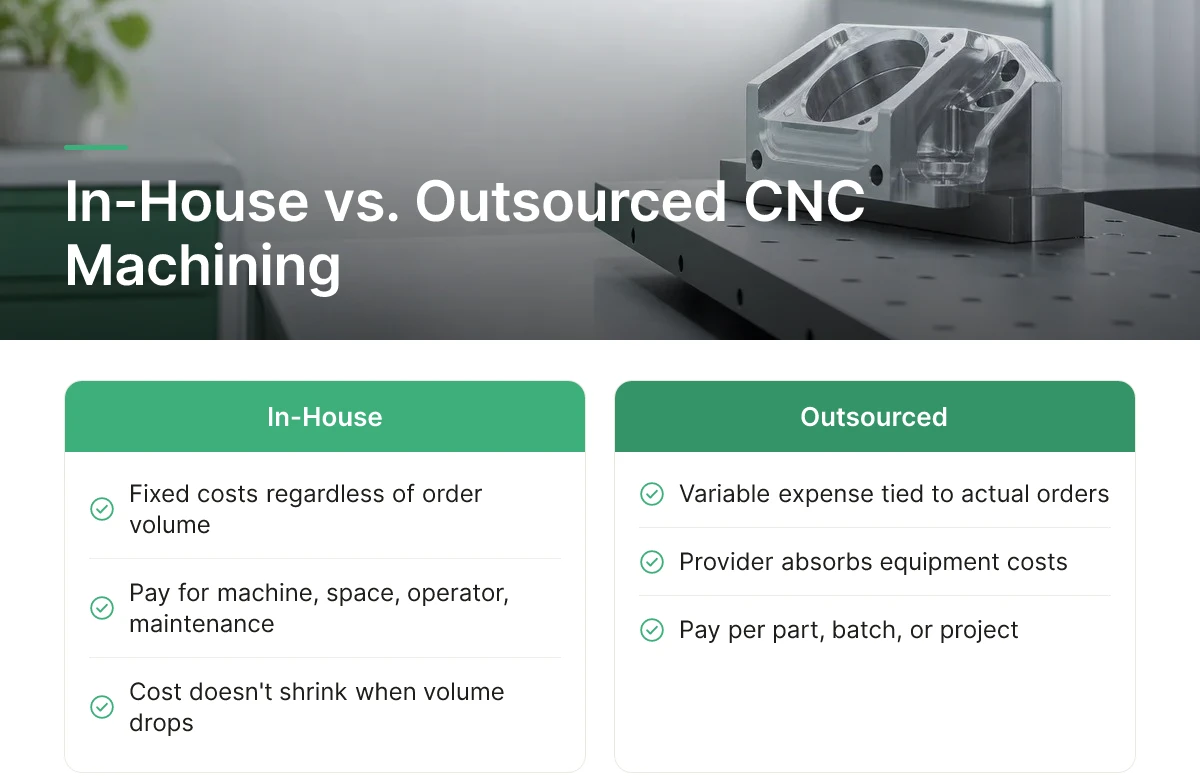
In-house machining locks you into fixed costs regardless of order volume, while outsourcing converts CNC machining cost per part into a variable expense tied directly to what you actually order.
Buying a CNC lathe or mill means paying for the machine, the floor space it sits on, a trained operator, and ongoing maintenance, whether that machine runs one shift a week or three. A single 5-axis CNC machine, tooling, and a qualified machinist represent a fixed monthly cost that doesn’t shrink when order volume drops. Outsourcing shifts that structure entirely: you pay per part, per batch, or per project, and the provider absorbs the equipment and labor overhead across many customers.
Utilization rate is what makes or breaks the in-house math. A machine running at 30% capacity still accrues depreciation, insurance, and maintenance costs every month, those costs just get spread over fewer parts, driving the effective per-unit cost higher than most buyers expect. Idle capacity is a real cost even though no invoice shows up for it, which is why shops with unpredictable order patterns rarely see in-house equipment pay for itself.
The break-even logic follows from utilization. Low or irregular volume favors outsourcing because you’re not carrying fixed costs between orders. High, steady volume on a narrow set of part geometries can eventually justify in-house investment, since utilization stays high enough to offset the fixed overhead. Between those extremes sits most mid-market manufacturing, volume that’s real but not constant enough to keep a dedicated machine busy.
Quality systems add a cost layer that’s easy to miss when comparing quotes. Building an internal quality management system to ISO 9001:2015 standards, or IATF 16949 for automotive work, requires documentation, audits, and dedicated staff, expenses that don’t show up on a machine’s price tag. Outsourcing to a provider that already holds ISO 9001:2015, ISO 13485:2016, or IATF 16949 certification means that cost is already built into the quoted price, not bolted on afterward.
When Outsourcing Makes Financial Sense
Outsourcing tends to win financially when volume is under continuous full-shift levels, part designs change frequently, or the parts require certifications you haven’t built yet. MFG SOLUTION’s model reflects this: quotes within 8 hours and shipment within 3 days let procurement teams treat outsourced capacity almost like an on-demand extension of their own shop, without carrying the fixed cost of equipment that sits idle between design changes. For parts up to 38mm across CNC turning, Swiss lathe, cold forging, automatic lathe, and mill-turn processes, that means the provider, not the buyer, absorbs the equipment risk.
Reduce Per-Part Costs Without Sacrificing Quality
Lowering CNC machining cost per part comes down to five levers you control before you submit a quote request: tolerances, setups, material grade, batch size, and machine selection.
Design Changes With the Biggest Cost Impact
Tolerances drive machine time more than almost any other spec on the print. A ±0.1mm tolerance on a non-critical bore can machine in a single pass, while a ±0.01mm callout on the same feature may require slower feeds, multiple finishing passes, and in-process inspection. Reserve tight tolerances for mating surfaces and functional fits, loosen everything else to the machine’s standard capability.
- Standardize hole diameters to match common drill sizes instead of specifying odd, one-off dimensions that force a tool change.
- Avoid deep pockets and thin walls where possible. Deep cavities need slower plunge rates and smaller-diameter tools that flex and chatter, adding cycle time and scrap risk.
- Round internal corners to match standard end-mill radii rather than calling out sharp corners that require EDM or specialty tooling.
None of these changes touch the part’s function. They just remove machining steps that add time without adding value.
How Multi-Axis Machining Can Lower Total Setup Cost
Every time a part comes off the machine to be flipped and re-fixtured, you pay for it, in labor, in alignment risk, and in queue time. Consolidating features so they can be cut in one or two setups, instead of four or five, is often the single biggest lever available on complex geometries. A part that needs machining on three faces plus a cross-drilled hole might take four separate setups on a basic 3-axis mill, but far fewer on equipment built for multi-face access.
This is where choosing a provider with 5-axis CNC capability matters, even if its hourly rate runs higher than a bare-bones shop. A 5-axis machine can reach multiple faces of a part in a single fixturing, cutting setup count and eliminating the accumulated positioning error that comes from repeated re-clamping. MFG SOLUTION runs 5-axis CNC machines alongside 20 automatic lathes specifically to match part geometry to the process that needs the fewest setups, reducing total machine time even when the per-hour rate isn’t the cheapest on paper.
Material selection adds another lever: a free-machining aluminum or leaded brass grade cuts cycle time and tool wear compared to a harder alloy, provided your application doesn’t require the mechanical properties of the tougher grade. Finally, batch size still matters, ordering a slightly larger run, or combining several part numbers into one production release, spreads fixed setup cost across more units and lowers the average per-part price.
Common Mistakes to Avoid When Estimating Cost Per Part
Most miscalculations of CNC machining cost per part trace back to five recurring errors: opaque quotes, ignored minimums, over-tolerancing, hidden secondary operations, and rate-based machine selection.
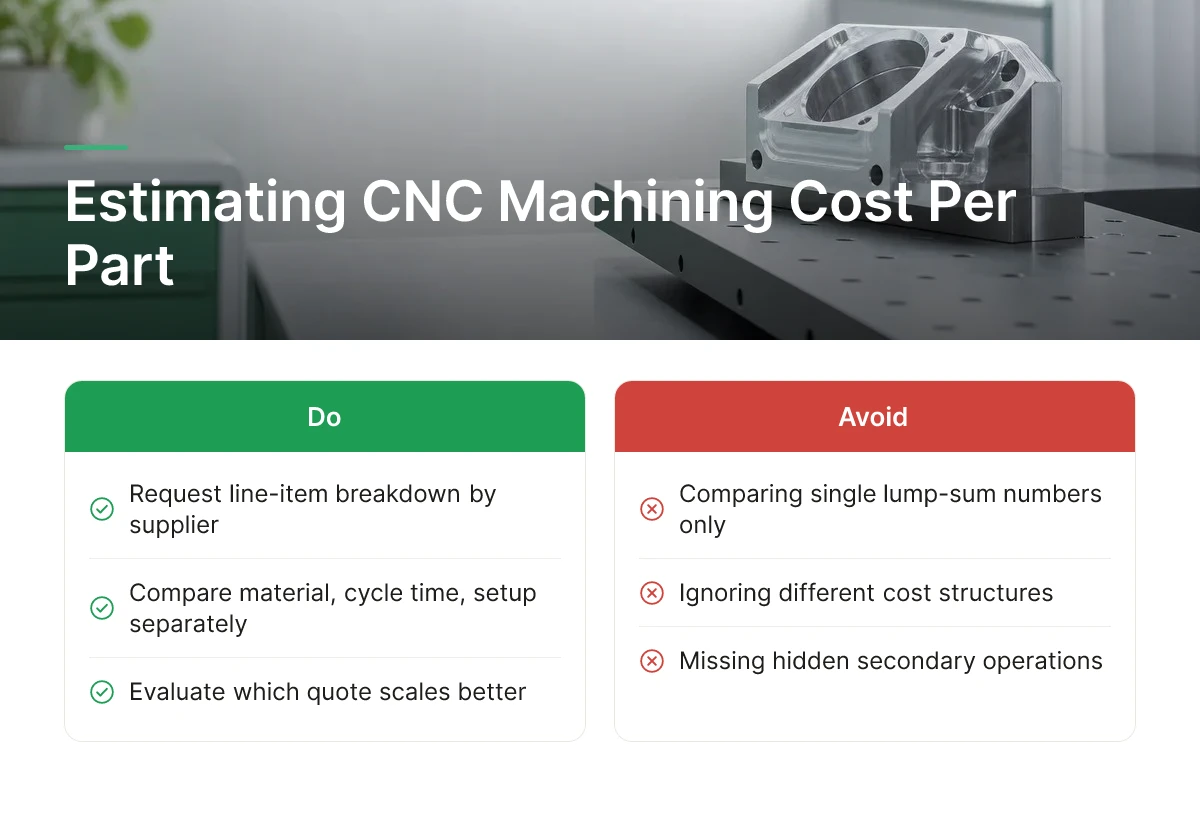
The first mistake is comparing a single lump-sum number across suppliers instead of the line-item breakdown. Two quotes at the same total can hide very different cost structures, one supplier might load the price into setup because they expect a reorder, another into machine time because they run older equipment. Without material, cycle time, setup, and finishing broken out separately, you can’t tell which quote actually scales better at higher volumes.
The second is ignoring minimum order quantities. A quote that looks competitive at 500 units can look very different at 50, because fixed setup costs spread across fewer parts. Buyers who request pricing at only one volume tier often commit to a batch size that inflates their real per-part cost without realizing it.
The third is overspecifying tolerances or surface finishes that the application doesn’t require. A tolerance tightened from ±0.1mm to ±0.02mm “to be safe” can add several passes and inspection steps that don’t change how the part performs, the machine time increases, but the extra precision buys nothing functional.
Overlooked cost lines and machine mismatches
- Assuming secondary operations are bundled into machining cost. Anodizing, heat treat, and plating are typically priced and scheduled as separate steps, not automatic inclusions, leaving them out of an estimate produces a quote that looks lower than the finished part will actually cost.
- Picking a machine type based on hourly rate alone. A cheaper hourly rate on the wrong machine can mean more setups and a longer cycle for a specific geometry, which erases the apparent savings. This is one reason MFG SOLUTION evaluates CNC turning, Swiss lathe, cold forging, automatic lathe, and CNC mill & turn side by side for each part rather than defaulting to one process, the goal is the lowest total cost for that geometry, not the lowest rate on paper.
Avoiding these five errors won’t guarantee the lowest possible quote, but it will make the number you receive comparable, predictable, and tied to the part in front of you rather than a generic average.
Frequently Asked Questions
How do 3-axis mills, lathes, and multi-axis machines compare on per-part economics?
Each platform carries a different cost curve depending on part geometry and volume. A CNC lathe or Swiss lathe machines round, rotationally symmetric parts fast, with low cycle time and low cost per unit for small-diameter components. A 3-axis mill handles flat or prismatic features but needs more setups for complex geometry, adding cost. Multi-axis mill-turn centers cost more per hour but cut cycle time and eliminate re-fixturing, often lowering total cost per part on complex small components.
What emerging technologies like 5-axis and hybrid machines change the cost equation?
5-axis and mill-turn platforms raise the hourly rate but often lower the total cost per part by cutting setups and handling. A 5-axis CNC machine can finish a complex part in one operation instead of three, removing fixturing time and scrap risk from repositioning. For small precision parts under 38mm, this consolidation typically outweighs the higher machine rate on anything beyond simple geometry.
Does a lower hourly machine rate always mean a lower cost per part?
No, a lower hourly rate can still produce a higher cost per part if cycle time or setup time is longer. A cheaper machine that takes twice as long per part, or needs extra manual repositioning, often costs more overall. Compare total cycle time and scrap rate, not just the quoted rate.
How much does batch size need to increase before setup cost per part becomes negligible?
Setup cost per part usually flattens out once batch size reaches several hundred to a few thousand units, depending on part complexity. Below that range, setup and programming time still make up a visible share of unit cost. Above it, machine time, material, and tooling wear dominate the price instead.
Conclusion
Controlling cost per part comes down to three levers: matching the process to the geometry, sizing the batch to dilute setup cost, and choosing a supplier with certified, repeatable process control so scrap and rework don’t erase your savings. Material choice and tolerance requirements set the floor; batch size and machine selection determine how close you get to it.
Before committing to a production order, submit your part specifications for a written quote and compare the cost breakdown against at least one alternative process. MFG SOLUTION returns quotes within 8 hours across five machining methods, so you can see the cost impact of process choice before you commit to tooling.
Recommended Articles
Explore more from our content library: