
2026-09-23
5 Titanium Precision Machining Mistakes That Ruin Parts
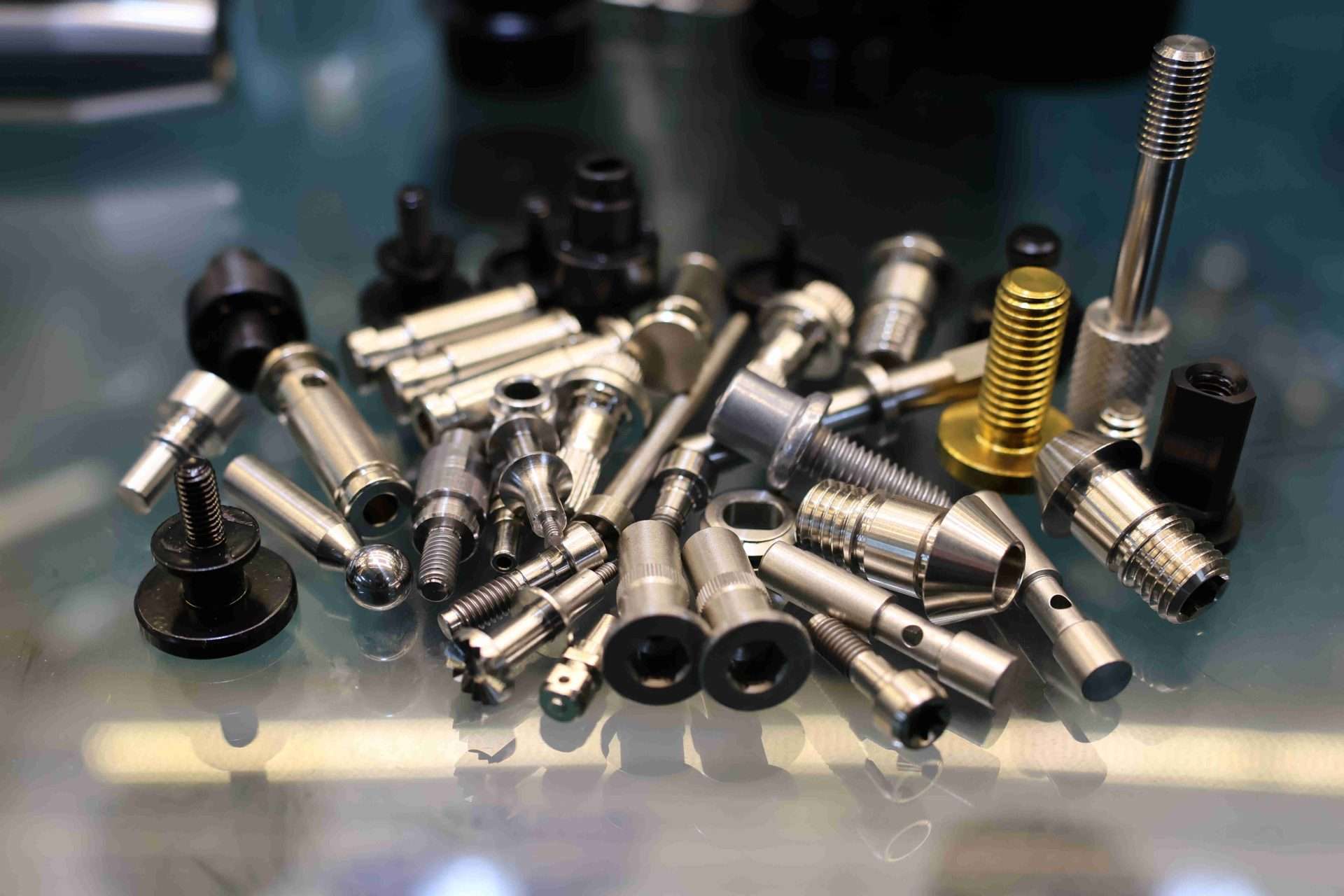
Titanium precision machining goes wrong most often at five points: ignoring titanium’s low thermal conductivity (which concentrates heat at the cutting edge), using tool geometry and speeds borrowed from steel or aluminum jobs, under-designing fixtures for a springy material, skipping grade-specific parameter adjustments, and treating post-machining finishing as an afterthought. Each mistake compounds tool wear, work-hardening, and dimensional drift, turning a straightforward part into scrap or costly rework. Avoiding them starts with matching cutting parameters, tooling, and fixturing to titanium’s specific behavior rather than generic metal-cutting defaults.
1. Using the Wrong Cutting Parameters for Titanium Precision Machining
Carrying over steel or aluminum speeds and feeds into a titanium job is the single most common cause of scrapped parts and short tool life. Titanium precision machining demands parameters built for the material’s specific thermal and mechanical behavior, not a generic setting pulled from a different metal’s program.
What Spindle Speeds, Feed Rates, and Cutting Fluids Work Best for Titanium?
Titanium conducts heat poorly, so instead of flowing into the chip and away from the cut, heat stays concentrated at the cutting edge. That trapped heat accelerates tool wear and can push edge temperatures high enough to soften the coating on a standard insert within a handful of passes. This is particularly relevant for titanium precision machining.
Shops used to steel or aluminum often default to higher spindle speeds and lower feed-per-tooth values. Titanium needs the opposite: slower cutting speeds paired with higher feed per tooth to keep the tool cutting rather than rubbing. Rubbing and light cuts generate friction without removing material efficiently, and that friction work-hardens the surface layer. Once hardened, the next pass meets a tougher surface, tool pressure climbs, and dimensions drift out of tolerance mid-run.
Avoiding this starts with programming parameters for each titanium grade rather than applying one universal “titanium setting” across a job list. The differentiator that separates a controlled run from a guessing game is real-time adjustment: tracking tool wear signals during the cut and modifying feed or speed before drift shows up in inspection, instead of relying only on a static speeds-and-feeds chart.
2. Choosing the Wrong Tooling and Tool Maintenance Schedule
Tool material, coating, and replacement timing decide whether titanium parts hold tolerance across a full production run or drift halfway through it.
How Do You Select and Maintain Cutting Tools to Avoid Premature Wear?
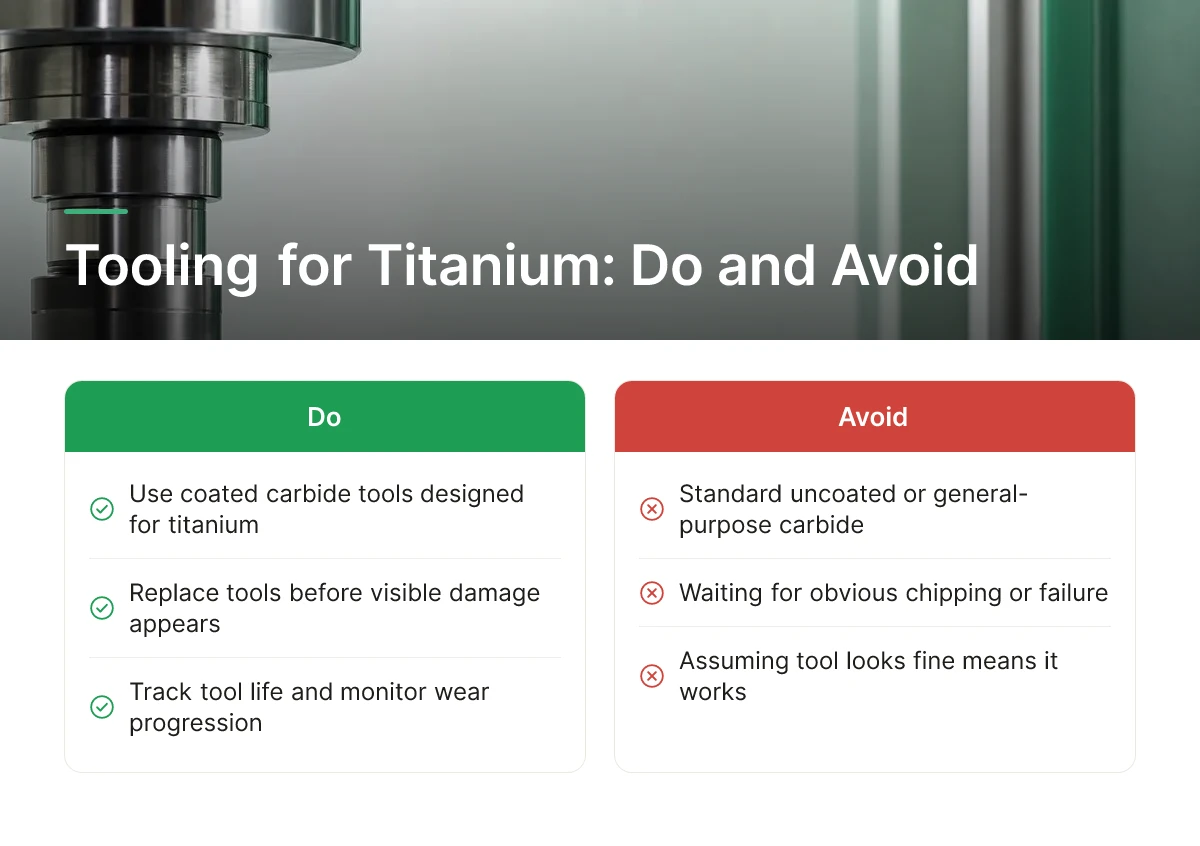
Standard uncoated or general-purpose carbide tools dull fast against titanium because the metal tends to gall and adhere to the cutting edge rather than shear cleanly away. That adhesion builds up material on the tool, changes the effective geometry of the cut, and speeds up wear well before a tool looks visibly damaged.
Waiting for obvious tool failure is the mistake. By the time an insert shows chipping or discoloration, tolerances have often already drifted for several parts back in the batch. A documented replacement schedule based on cut count or measured wear, not visual inspection alone, catches the problem before it reaches the part. When considering titanium precision machining, this point stands out.
Coating selection matters alongside the insert itself, coatings suited to titanium reduce adhesion and heat transfer into the tool, and a rigid tool holder limits deflection that a sharp edge alone can’t compensate for. This approach fits shops running repeat titanium production, where a documented tool-life schedule prevents batch-to-batch inconsistency. The differentiator worth building into that schedule: track wear against specific part features, since deflection and edge breakdown show up first on thin walls or deep pockets, not on the overall run-time counter.
3. Underestimating Fixture and Setup Requirements
Titanium’s lower stiffness relative to steel means inadequate workholding introduces deflection and chatter that generic fixture setups won’t catch.
What Fixture and Jig Design Strategies Prevent Deflection and Chatter?
Titanium has a lower modulus of elasticity than steel, so thin sections flex under cutting force instead of resisting it. That flex shows up as chatter marks, uneven wall thickness, or dimensions that measure fine at the start of a cut and drift by the end. A fixture designed for a stiffer material simply doesn’t account for that springback.
The fix is fixturing that supports the part near the actual cutting zone, not just clamping at the edges. Edge-only clamping leaves the middle of a thin wall or a deep pocket unsupported exactly where cutting force is highest.
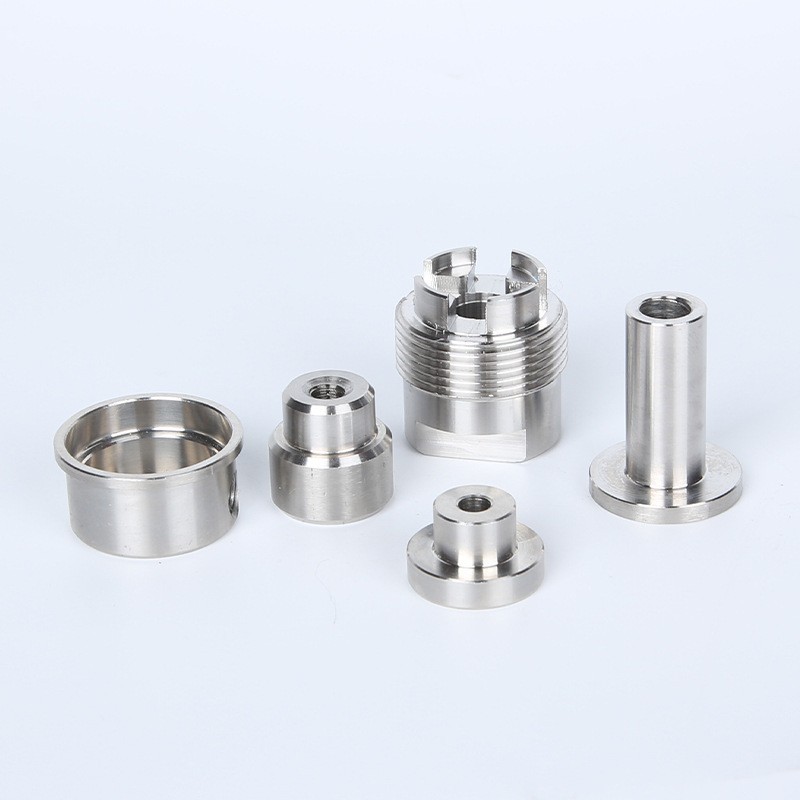
For small precision parts, the kind under roughly 38mm in diameter that make up most titanium precision machining work in electronics and medical applications, fixturing needs a lighter touch than large aerospace structures. Over-clamping a small part can distort it as much as under-clamping, since there’s less material to absorb clamping force without deforming. This matters most on complex geometries: thin walls, deep pockets, or asymmetric shapes where a standard vise can’t hold consistent contact.
The step many shops skip is iterative fixture validation, running test cuts and checking results before releasing a fixture design to full production, rather than discovering a deflection problem after a batch is already machined. For those exploring titanium precision machining, this matters.
4. Ignoring Grade-Specific Machining Differences
Treating all titanium as one material leads to mismatched tooling, longer cycle times, or parts that cost more than the application requires.
Which Titanium Grade Offers the Best Balance of Machinability and Cost?
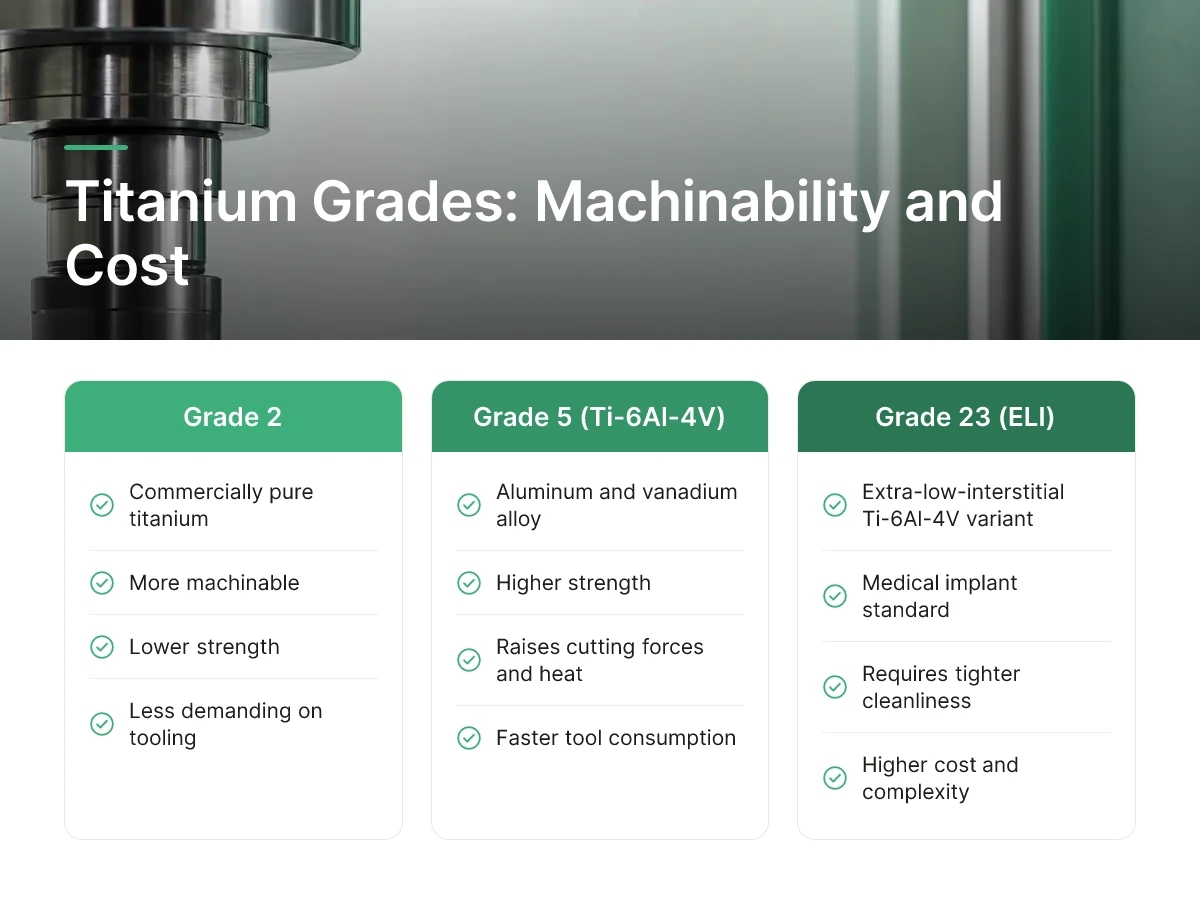
Grade 2 is commercially pure titanium, more machinable, lower strength, and less demanding on tooling. Grade 5 (Ti-6Al-4V) adds aluminum and vanadium for higher strength, but that alloy content raises cutting forces and heat generation, which extends cycle time and consumes tools faster than Grade 2. Grade 23, an extra-low-interstitial (ELI) variant of Ti-6Al-4V, is common in medical implants and requires tighter cleanliness and chemistry control during production.
The mechanism is straightforward: more alloying content means harder material to cut, more heat concentrated at the edge, and shorter tool life per part, all of which push cost up for Grade 5 relative to Grade 2. Specifying a grade with more strength than the application needs adds machining cost without adding usable part performance. A bracket that only needs to resist moderate load doesn’t benefit from Grade 5’s aerospace-level strength margin.
Grade selection should match the actual requirement, load-bearing capacity, corrosion resistance, or biocompatibility, instead of defaulting to the strongest available option. Grade 23’s tighter chemistry control also demands additional documentation and traceability during production, a requirement not every shop is set up to maintain consistently across batches.
5. Skipping or Mismatching Post-Machining Finishing
Skipping finishing or picking the wrong process undoes the corrosion resistance that makes titanium worth machining in the first place.
What Finishing Methods Are Required for Aerospace and Medical-Grade Titanium Components?
Machining alone leaves a stressed and sometimes contaminated surface layer on titanium, and that layer reduces the material’s natural corrosion resistance until it’s removed or passivated. A part that measures perfectly to print can still underperform in service if this step gets skipped. This directly impacts titanium precision machining outcomes.
Anodizing adds an oxide layer and enables color coding for part identification. Polishing improves surface finish for medical components or visible assemblies where surface roughness affects function or appearance. Coating options add wear or corrosion protection beyond what the base material provides on its own. Which one applies depends entirely on where the part is going into service.
Aerospace and medical-grade parts typically require finishing and cleaning steps tied directly to certification requirements, not a cosmetic pass added at the end of a job. This matters most for parts entering corrosive, biological, or high-visibility environments, where an untreated machined surface will degrade faster than the design intended.
Finishing choice ties directly back to grade: a Grade 5 aerospace bracket and a Grade 23 implant carry different finishing and cleanliness requirements even though both start as titanium precision machining jobs. MFG SOLUTION manufactures parts up to 38mm to ISO 9001:2015, ISO 13485:2016, and IATF 16949 standards, matching finishing and documentation requirements to the certification each part actually needs rather than applying one finishing process across every order.
6. Overlooking Certification and Documentation Requirements
Skipping compliance and traceability steps turns a dimensionally correct titanium part into a rejected one the moment a regulated customer audits your paperwork.
How Do AS9100 and ISO 13485 Certifications Impact Titanium Machining Processes?
AS9100 for aerospace and ISO 13485 for medical devices layer documentation, material traceability, and process control requirements on top of the ISO 9001 baseline most shops already meet. That means certified material heat lot numbers, recorded inspection results, and signed-off process routings, not just a part that measures correctly on a CMM.
The mechanism buyers miss: without full process control, where every step is tracked, documented, and auditable, a titanium part can hit every print dimension and still fail a customer’s compliance audit. A missing certificate of conformance or an untracked tool change at the wrong operation is enough to trigger a rejection late in the program, after the part has already shipped. This is particularly relevant for titanium precision machining.
Certification requirements reach further than the finished part, they govern fixture validation, inspection frequency, and record retention throughout the job. Buyers sourcing for aerospace, medical, or defense programs should treat certification as a production control requirement, not a paperwork formality, since non-conformance at this level carries downstream regulatory consequences. MFG SOLUTION runs titanium precision machining under ISO 9001:2015, ISO 13485:2016, and IATF 16949 with full process control, so traceability is built into the routing rather than reconstructed after the fact.
7. Misjudging When Titanium Is the Right Material Choice
Defaulting to titanium, or ruling it out, without weighing performance requirements against cost and machining complexity wastes budget either way.
What Performance Requirements Justify the Higher Cost and Machining Complexity of Titanium?
Titanium earns its added cost and cycle time when a part actually needs its strength-to-weight ratio, corrosion resistance, biocompatibility, or stability at high temperature. Aerospace brackets, medical implants, and high-temperature aerospace and defense components are common fits; a bracket that only needs to survive room temperature and light load is usually over-specified in titanium.
Scrap and rework hit titanium harder than cheaper metals because a mis-cut part throws away more value per piece, the raw material, the machine time already invested, and the tooling wear accumulated getting there. A scrapped aluminum part costs a fraction of a scrapped titanium one for the same cycle time, so error tolerance in process planning matters more here than on easier materials.
Production volume shifts the calculation. Low-volume prototyping can absorb higher per-part cost and slower iteration; higher-volume runs justify investing in validated fixtures, tool-life data, and repeatable parameter sets that bring cost down over the run. This decision belongs at the design stage, before tooling and fixtures are committed, reversing course mid-job is expensive. Compare total cost across scrap, rework, and finishing, not just the raw material price tag, before locking in titanium.
8. Neglecting Chip Handling and Machining Safety Controls
Ignoring titanium’s fire risk during chip removal creates a safety hazard that also degrades part quality when chips recut or pile up near the cutting zone. When considering titanium precision machining, this point stands out.
Why Is Titanium Chip Handling a Fire Hazard, and What Controls Are Needed?
Fine titanium chips and dust ignite at a lower threshold than most metals, and because titanium conducts heat poorly, heat concentrates near the cutting edge instead of dissipating through the workpiece. Poor chip evacuation lets that heat build further, raising ignition risk exactly where chips accumulate.
Controls that address this include dedicated metal chip containers kept clear of ignition sources, procedures that prevent chip pileup near heat-generating operations, and coolant strategies chosen for both temperature control and safety, since high-pressure coolant also flushes chips away from the tool. These aren’t separate from machining strategy, they’re the same decisions.
Poor chip evacuation causes recutting, where chips pass back through the cut, damaging surface finish and accelerating tool wear. That links safety directly to part quality rather than treating it as an independent compliance checkbox. Shops running titanium at production volume see far higher chip loads and heat buildup than a one-off prototype job, making these controls a daily operating requirement, not an occasional precaution.
How to Choose the Right Approach to Titanium Precision Machining
Evaluate a partner or internal process against a short checklist covering material grade, process documentation, fixture validation, and certification match to your industry.
Start with the fundamentals: grade selection matched to the actual application, documented cutting parameter sets per grade, a fixture validation process, tool-life tracking, and a finishing plan tied to the part’s end-use environment. A provider who can produce evidence of each, not just a verbal assurance, has a mature titanium precision machining process.
Weigh certifications against your compliance needs before awarding a job. ISO 9001 covers general quality management; AS9100 and ISO 13485 add the traceability and documentation layers aerospace and medical programs require. Sourcing a medical or aerospace part from a shop without the matching certification creates audit risk regardless of how the part measures. For those exploring titanium precision machining, this matters.
Quote and turnaround transparency signals process maturity. A shop that gives a clear quoting timeline and a defined shipping window has its process control organized enough to commit to dates, MFG SOLUTION quotes within 8 hours and ships within 3 days under ISO 9001:2015, ISO 13485:2016, and IATF 16949 certification, backed by 5-axis CNC machines and 60+ engineering professionals for parts up to 38mm in diameter.
Match part complexity, thin walls, tight tolerances, small size, to demonstrated fixture and tooling capability rather than general capacity claims. Before committing a titanium job to production, request a documented process plan covering grade, parameters, fixturing, and inspection points.
Frequently Asked Questions
What material properties of titanium create the biggest machining challenges?
Low thermal conductivity and high strength at improved temperatures cause heat to concentrate at the cutting edge instead of dissipating through the workpiece. This accelerates tool wear, promotes work hardening on the surface being cut, and raises cutting forces compared to aluminum or steel. Combined with titanium’s tendency to spring back elastically, these properties make dimensional drift and premature tool failure the two most common failure modes in production runs.
How does titanium’s heat generation during machining affect tool life and part quality?
Trapped heat at the cutting zone shortens tool life and can shift dimensions mid-run, producing parts that pass first-piece inspection but drift out of tolerance later. Left uncontrolled, that heat also work-hardens the surface layer, forcing higher cutting forces on the next pass and compounding tool wear. Rigid setups and high-pressure coolant reduce this effect but never fully eliminate it.
What surface finish defects commonly occur when machining titanium, and how do you prevent them?
Feed marks, micro-tearing, and discoloration from heat buildup are the most frequent defects, along with a hardened surface skin left by a dull or wrong-grade insert. Sharp, properly coated tooling and controlled feeds and speeds limit tearing and heat discoloration. Matching the tool geometry and coating to the specific titanium grade being cut, rather than defaulting to a general-purpose insert, prevents most of these defects before they reach inspection.
How do scrap rates and rework costs affect the true cost of titanium precision parts?
Scrap and rework, not raw material, usually drive the real cost gap between a well-run titanium job and a troubled one. Because titanium costs more per pound and machines slower than steel or aluminum, a scrapped part represents lost material, lost spindle time, and a missed delivery window all at once. Over-tolerancing surfaces that don’t need tight control adds inspection time and rework risk without improving function. Catching tolerance and tooling mismatches at the design stage avoids most of this cost before the first cut.
How do anodizing, polishing, and coating processes affect titanium part performance?
These finishing steps affect corrosion resistance, wear behavior, and cosmetic appearance without changing the base machining tolerances. Anodizing builds a protective oxide layer useful in medical and aerospace applications, while polishing removes minor surface defects left from cutting. Choosing a finish should follow the part’s functional requirement, not just appearance, since some coatings add measurable thickness that must be accounted for in final tolerance stack-up.
Conclusion
Titanium quality problems trace back to a short list of causes: uncontrolled heat at the cutting edge, tooling mismatched to the grade being cut, and tolerances specified tighter than the part actually needs. Fixing the first two prevents scrap and premature tool failure; fixing the third cuts inspection time and cost without touching function. Before your next production run, flag which surfaces on the drawing actually require tight tolerance and which don’t, then confirm your supplier’s tooling and coolant strategy matches your specific titanium grade, not a generic setup. MFG SOLUTION applies this process control under ISO 9001:2015, ISO 13485:2016, and IATF 16949 certification, with quotes back within 8 hours.
Recommended Articles
Explore more from our content library: