
2026-10-11
5 Signs You Need Contract Manufacturing Services Now

You need contract manufacturing services when at least two or three of these show up at once: your in-house machines are booked solid and quoting new work pushes lead times past what customers accept, you’re turning down orders because capacity or precision requirements exceed what your shop can hold, or capital you’d spend on new CNC equipment would earn a better return elsewhere. Other triggers include rising scrap/rework rates signaling your process is maxed out, a sudden volume spike or new program that doesn’t justify permanent headcount, and needing certifications (ISO 13485, IATF 16949) you don’t currently hold. If two or more apply, it’s time to get quotes.
Here’s a quick summary of the five signs covered in this article:
- Backlog and capacity ceiling: Lead times are stretching and quoting new work means delaying existing orders.
- Capital allocation: A new CNC machine purchase wouldn’t earn a better return than outsourcing the work.
- Tolerance and quality limits: You’re declining bids because your process control can’t hold the required spec.
- Temporary volume spikes: A program ramp doesn’t justify hiring and training permanent operators.
- Certification gaps: Your industry now requires ISO 13485 or IATF 16949 credentials you don’t hold in-house.
1. Your Backlog Signals It’s Time for Contract Manufacturing Services
Rising lead times and repeat scheduling conflicts are the clearest sign your shop has hit a capacity ceiling that contract manufacturing services can resolve.
The mechanism is straightforward: when spindle utilization stays near maximum, every new job queues behind work already on the schedule. A single large order with a long fixture changeover can push every other delivery date out by days or weeks, and the delay compounds as more orders stack up behind it.
What Are the Warning Signs That In-House Capacity Is No Longer Sufficient?
Quoting becomes the real problem before output does. Once you can’t confidently promise a delivery date without checking three other jobs on the floor, you’re either padding lead times to protect yourself or losing bids to competitors who can commit faster. Both outcomes cost you revenue.
This sign fits shops fielding repeat lead-time complaints from existing customers or losing new bids specifically because of scheduling conflicts, not pricing. The detail most guidance misses: this isn’t about generic “manufacturing capacity”, it’s about precision CNC-specific constraints like spindle hours, tooling changeover time between part families, and the setup time Swiss lathes need for small, tight-tolerance geometries. A machine shop can look busy on paper while actually sitting idle during changeovers, which is a different bottleneck than raw output and requires a different fix: shifting overflow work to contract manufacturing services built for fast changeover and batch flexibility. For a deeper breakdown of when this tradeoff tips in favor of outsourcing, see this comparison of in-house versus outsourced CNC machining.
2. Capital You’d Spend on New Machines Could Work Harder Elsewhere
If the next CNC machine or Swiss lathe purchase doesn’t clearly beat the return from outsourcing, that capital probably belongs somewhere else in the business.
Buying equipment ties up capital for years, and that machine only earns its keep if you can keep it running near full utilization. A contract manufacturer spreads that same equipment cost across many clients’ production runs, which is how they offer per-part pricing that often beats what a single company pays to own and run the same capability alone.
How Do We Know If Outsourcing Will Actually Reduce Our Costs and Improve Margins?
Run the comparison past the sticker price. Ownership brings ongoing costs that don’t show up on the equipment quote: preventive maintenance contracts, replacement tooling, coolant and consumables, and the months it takes to train an operator to run a new machine at full speed. A pay-per-part model converts all of that into a variable cost tied directly to output. This guide on in-house versus outsourced production for custom parts walks through the same capital-allocation logic in more detail.
This decision applies most directly to companies standing at a capacity ceiling, weighing a new machine purchase against sending overflow to a partner offering contract manufacturing services. Frame it as opportunity cost, not just cash outlay: the money earmarked for a new CNC mill could instead fund product R&D, a new sales hire, or a second product line, uses with a faster, more direct payback than idle spindle hours.
3. You’re Turning Down Work That Needs Tighter Tolerances Than You Can Hold
Declining bids because your tolerance capability or process control can’t match the spec is a direct signal to move that work to a certified partner.
Tolerance stack-up and equipment age create a hard ceiling. A shop without 5-axis capability or current process-control documentation will eventually hit a part geometry or tolerance band it simply can’t hold consistently, no matter how skilled the machinists are.
What Questions Should We Ask a Potential Contract Manufacturer About Their Capabilities?
Watch your scrap and rework rates before the bid gets rejected outright. A process running near its limit shows rising scrap long before it fails a customer’s incoming inspection, and that trend is often the earliest sign you’ve outgrown your own equipment for a given part family. This overview of the benefits of contract CNC machining covers several of the same capability checks worth asking about upfront.
This applies to shops repeatedly asked to quote tighter-tolerance or more geometrically complex parts than their current fleet supports. Don’t take capability claims at face value, ask any prospective contract manufacturer for process capability (Cpk) data and sample parts matching your actual tolerance requirements, not generic marketing language about precision. MFG SOLUTION, for example, documents process control to ISO 9001:2015, ISO 13485:2016, and IATF 16949 standards across CNC turning, Swiss lathe, and CNC mill-and-turn operations, which gives buyers auditable evidence rather than a claim on a webpage.

4. A Volume Spike or New Program Doesn’t Justify Permanent Headcount
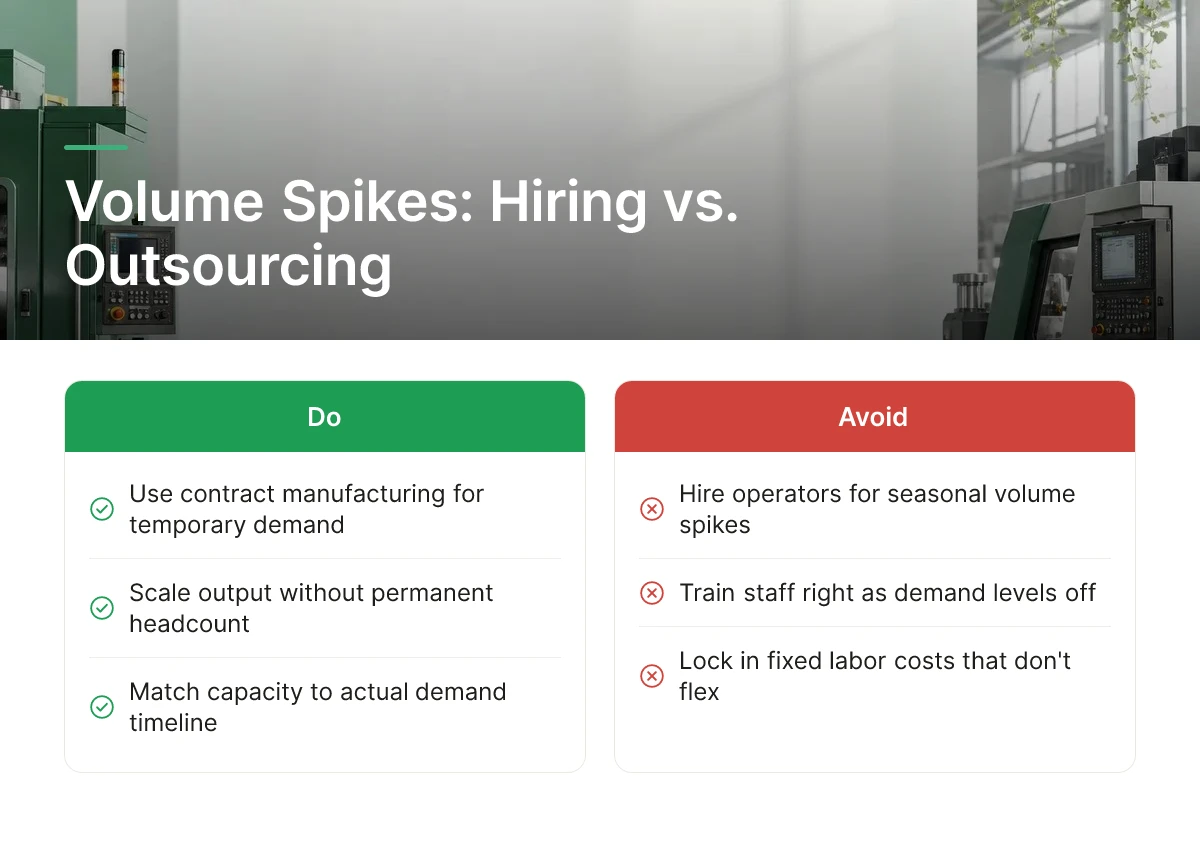
When demand is temporary or still ramping, contract manufacturing services let you scale output without hiring and training operators you may not need in six months.
Hiring, training, and equipping a new CNC operator takes months before that person is producing at full speed. If the volume spike is seasonal, tied to a single program, or still ramping gradually, that lead time works against you, the hire is trained right around the time demand levels off.
How Do Production Timelines and MOQs Affect Our Ability to Serve Customers With Rapid Turnaround?
Fixed labor costs don’t flex with demand the way outsourced capacity does. In-house headcount keeps drawing a paycheck whether the order book is full or thin; a contract manufacturing relationship scales production up or down with the program’s actual run rate.
This fits companies launching a new product line or absorbing a short-term contract without long-term volume certainty. The detail worth checking before you commit: minimum order quantities and lead times vary widely between a small job shop and a high-volume specialist, so match the manufacturer type to your program’s real run rate rather than assuming any partner fits any volume. If you’re still unsure whether this stage warrants outsourcing at all, these five signs you should consider contract manufacturing cover the broader decision point.
5. Your Industry Now Requires Certifications You Don’t Hold
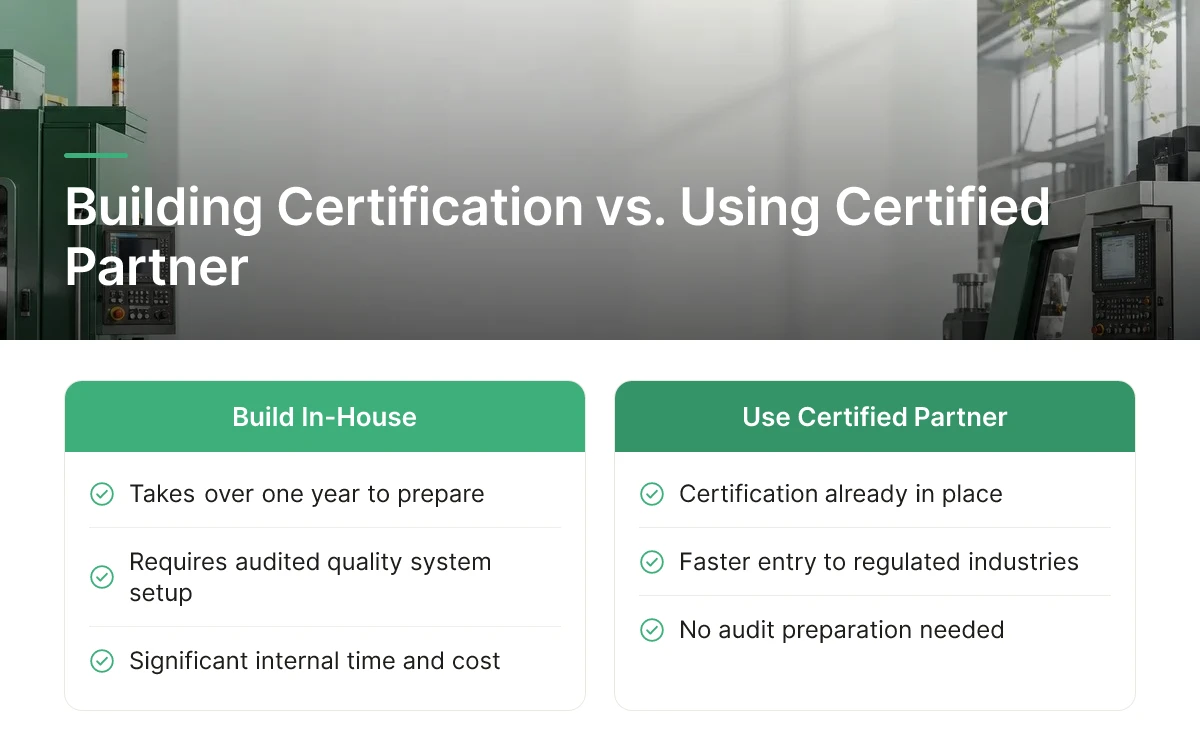
Entering medical, automotive, or aerospace work without the required certification means a contract manufacturer who already holds it is often faster than building one yourself.
Certifications like ISO 13485:2016 for medical devices or IATF 16949 for automotive aren’t a checklist of good habits, they require an audited quality management system with documented process control, traceability, and corrective-action procedures. Earning that internally takes significant time and cost, often more than a year of preparation before an external audit even happens.
Which Certifications Matter Most for Precision Machining Needs?
A certified contract manufacturer gives you a faster path into a regulated market. Instead of building a quality system from scratch, you route qualifying parts to a partner who already operates under the standard your new customer or regulator requires.
This matters most for companies pursuing their first medical device, automotive, or aerospace contract. Verify the claim concretely: ask for the certificate’s scope and issuing registrar, since certifications apply to specific processes and facility locations, not a company in general. MFG SOLUTION holds ISO 9001:2015, ISO 13485:2016, and IATF 16949 certifications with full process control across its production lines, letting customers enter regulated markets without the multi-year internal buildout.
How to Choose the Right Contract Manufacturing Services Partner
Vetting contract manufacturing services comes down to five checks: capability audit, certification verification, sample part review, quoting speed, and onboarding communication.
Run these in order, not in parallel. A supplier can pass a certification check and still fail on responsiveness, and that gap shows up after you’ve committed volume, not before. This decision framework for choosing between in-house and outsourced machining offers a similar structured checklist worth cross-referencing.
- Capability audit: Confirm the shop’s processes match your part, CNC turning, Swiss lathe, cold forging, automatic lathe, or mill-turn, rather than forcing a square peg through whatever machine they happen to run.
- Certification verification: Ask for current ISO 9001:2015, ISO 13485:2016, or IATF 16949 documentation if you’re in medical or automotive, don’t accept a logo on a website as proof.
- Sample part review: Request a pilot run before committing to a production volume. Measure dimensions against your print, not just visual inspection.
- Quoting responsiveness: Track how long a quote takes and how complete it is. A quote within 8 hours, as MFG SOLUTION provides, signals a process built for speed rather than one that scrambles per request.
- Onboarding communication: Watch how questions get answered during setup, slow or vague answers here predict slow answers during a production issue.
What Hidden Costs Should We Factor Into Our Outsourcing Decision?
A fair comparison weighs tooling transfer, shipping, and incoming inspection against your fully loaded in-house cost, not just the quoted unit price.
Build three tiers, budget-friendly, mid-range, and premium, and map each supplier against them based on total landed cost, not sticker price alone. A budget-friendly quote that requires air freight and 100% incoming inspection can land mid-range or worse once those costs are added in.
How Do We Protect Our Intellectual Property When Working With an External Manufacturer?
Protect designs with a signed NDA, documented drawing revision control, and a written agreement on tooling ownership before any file transfer.
Specify who owns custom tooling and fixtures if you later switch suppliers, this single clause prevents the most common dispute in contract manufacturing relationships.
What’s the Typical Timeline for Ramping Up Production With a New Contract Manufacturer?
Plan a phased transition: run a pilot batch alongside your existing production source before shifting full volume to the new partner.
This overlap period protects your supply chain if the new vendor hits early snags. Once the pilot clears inspection, track on-time delivery rate, scrap/rework rate, and total landed cost per part for several production cycles to confirm the switch delivered what the business case promised.

Frequently Asked Questions
What control do we lose when we outsource precision machining, and what do we gain?
You give up direct floor-level oversight of daily production but gain documented process control and specialized capacity you’d otherwise have to build yourself.
In-house teams see every machine cycle; contract manufacturers replace that visibility with certified quality systems, inspection reports, and traceability documents instead. The trade-off works when the partner’s compliance records (ISO 9001:2015, IATF 16949) give you equal or better confidence than watching the machine run.
How do we verify that a contract manufacturer’s quality standards match our own?
Check their certifications against your industry requirements, then request sample inspection reports and first-article documentation before committing to volume.
Medical device programs should confirm ISO 13485:2016 compliance; automotive suppliers need IATF 16949. MFG SOLUTION operates under both plus ISO 9001:2015, with full process control documenting every production step for audit purposes.
How do we build a detailed cost comparison between in-house and outsourced production?
Compare total cost of ownership, not just per-part price: equipment, tooling, labor, scrap, downtime, and opportunity cost of engineering time diverted from product development.
One procurement guide frames this as a capital allocation decision rather than a purchasing one, since every dollar spent on machines is a dollar not spent on R&D or growth. Build a spreadsheet model covering a 2-3 year horizon, factoring in spindle utilization targets and demand variability, not just quoted unit cost.
What metrics should we track to prove outsourcing was the right decision?
Track lead time reduction, defect rate, on-time delivery percentage, and total cost per part against your prior in-house or legacy supplier baseline.
Capacity utilization freed up for core engineering work is also worth tracking as a secondary signal of success.
How many contract manufacturing services providers should we evaluate before choosing one?
Request quotes from at least three contract manufacturing services providers so you can compare lead time, quality documentation, and total landed cost side by side rather than relying on a single data point.
Evaluating multiple providers also reveals how consistent each one is about quoting speed and communication before you commit production volume, which often predicts how they’ll perform once you’re a live customer.
Conclusion
The decision to outsource precision machining comes down to three checks: does your current supplier’s lead time cost you more than it saves, can you verify their quality documentation matches your compliance needs, and does the total-cost math, not just the per-part quote, favor outsourcing over the next production cycle.
If your answers point toward outsourcing, start with one SKU. Submit its specifications to a contract manufacturer with sub-24-hour quoting, like MFG SOLUTION’s 8-hour turnaround, and compare the quoted lead time and documented quality process against your current vendor before shifting full volume. Strong contract manufacturing services providers should welcome this kind of side-by-side comparison rather than asking you to commit on faith.
Recommended Articles
Explore more from our content library: