
2026-09-24
Which Materials Work Best for Medical Device Precision Parts
The best materials for medical device precision parts depend on whether the part is implantable, how it’s sterilized, and what loads it carries in service. Stainless steels like 316L and 17-4 PH suit non-implantable and short-term contact parts needing strength and corrosion resistance, while titanium alloys (Ti-6Al-4V) and cobalt-chrome dominate long-term implants due to biocompatibility and fatigue life. Medical-grade plastics like PEEK and PTFE serve applications requiring chemical resistance, radiolucency, or lighter weight. The right choice balances biocompatibility, sterilization method, corrosion resistance, and how the manufacturing process holds tolerance in that material.

What Materials Work Best for Medical Device Precision Parts?
Material selection for medical device precision parts comes down to three filters: where the part contacts the body, how it gets sterilized, and what mechanical loads it sees over its service life. Get any one of those wrong and the part either fails a biocompatibility test, degrades in the sterilizer, or cracks under repeated use. Treat material choice as a framework with three inputs, not a single default answer.
Which Materials Meet Biocompatibility and Sterilization Requirements for Implantable vs. Non-Implantable Devices?
Implantable and non-implantable devices sit at opposite ends of the material spectrum because the consequences of a bad material choice are completely different. An implant has to survive years inside the body without triggering an immune response or corroding, which is why titanium alloys, cobalt-chrome, and select stainless grades dominate that category. External and reusable devices, surgical handles, diagnostic housings, instrument trays, face lower biological risk and can use a wider range of materials, including 303 and 304 stainless steel and engineering plastics that would never qualify for long-term implantation.
Sterilization method narrows the field further. Autoclave (steam), ethylene oxide (EtO), and gamma radiation each interact differently with a material. Metals generally tolerate all three methods without meaningful change, but some polymers discolor, embrittle, or lose mechanical properties under repeated gamma exposure. A device that will be re-sterilized hundreds of times over its working life needs a material validated for that specific cycle, not just one that passes a single sterilization test.
How Do Corrosion Resistance and Fatigue Strength Affect Component Lifespan?
Corrosion resistance and fatigue strength set the practical lifespan of implants and repeatedly-actuated parts like surgical instrument joints or forceps pivots. An implant sitting in saline-like bodily fluid for years needs a surface that resists pitting and crevice corrosion, which is why 316L stainless and titanium remain standard choices. A hinge or joint that opens and closes thousands of times needs fatigue strength that won’t crack under cyclic stress, which pushes designers toward cobalt-chrome or precipitation-hardened stainless like 17-4 PH.
Comparing Stainless Steel, Titanium, Cobalt-Chrome, and Medical-Grade Plastics
316L stainless offers solid corrosion resistance and machinability at a lower cost than titanium, making it common in non-implantable and short-term contact parts. 17-4 PH adds higher strength through heat treatment, useful for load-bearing components. Titanium alloys like Ti-6Al-4V deliver the biocompatibility and fatigue life implants demand, though they machine slower and generate more tool wear. Cobalt-chrome outperforms both on wear resistance for joint and bearing surfaces. Medical-grade plastics, PEEK, PTFE, UHMWPE, bring chemical resistance and radiolucency where metal would interfere with imaging.
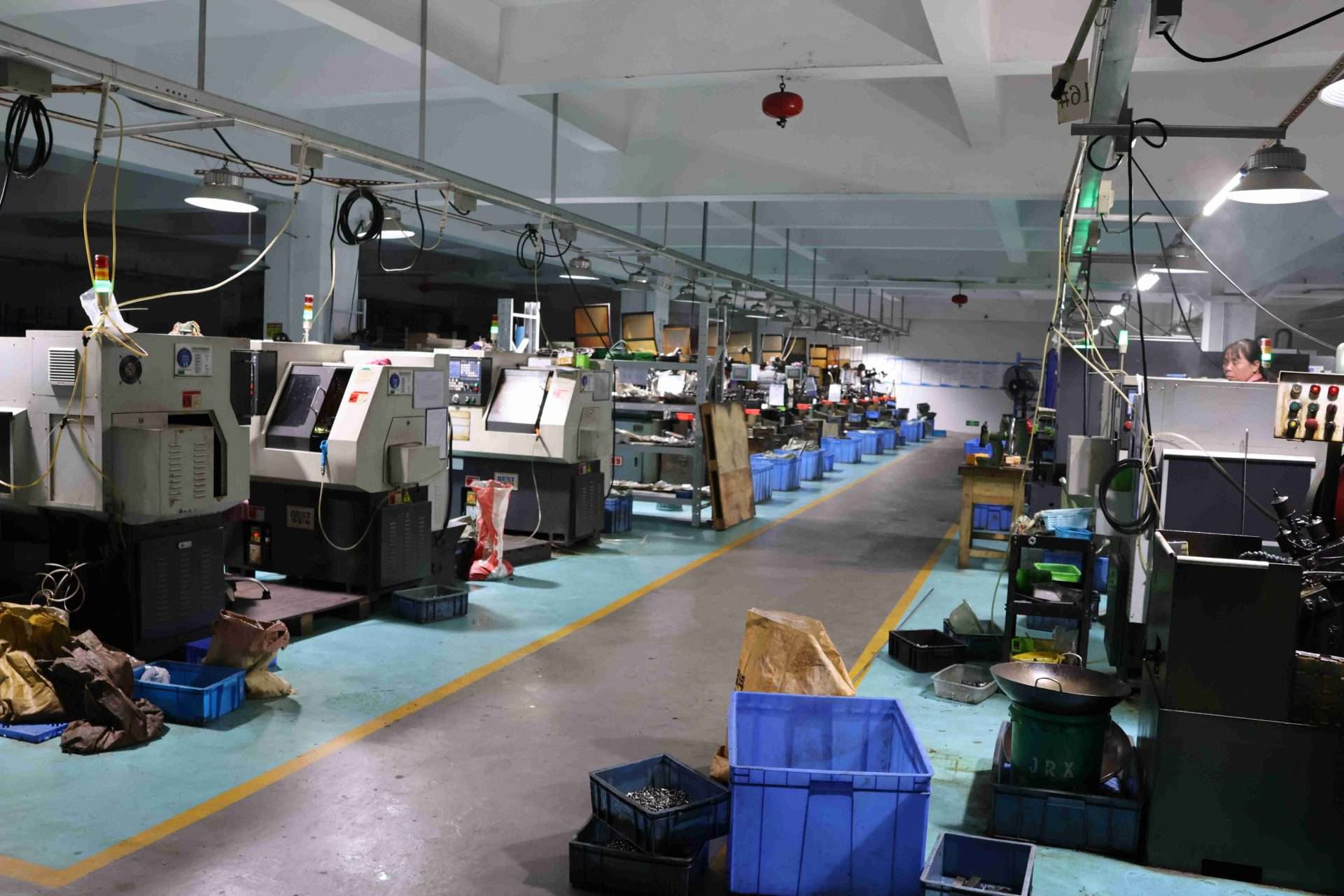
Harder alloys like titanium and cobalt-chrome hold tighter tolerances once machined, but they increase cycle time and tool wear compared to stainless or plastic. MFG SOLUTION machines across this full material range, stainless, titanium, and engineering plastics, under ISO 13485:2016 process control, so the material decision doesn’t force a compromise on tolerance or turnaround.
What Manufacturing Processes Achieve the Tight Tolerances Medical Devices Require?
Tight tolerances on medical device precision parts come from a combination of rigid machine platforms, disciplined tooling choices, and process controls that catch drift before it reaches a full batch.
How Does CNC Machining Maintain Micron-Level Precision for Small Parts Under 38mm Diameter?
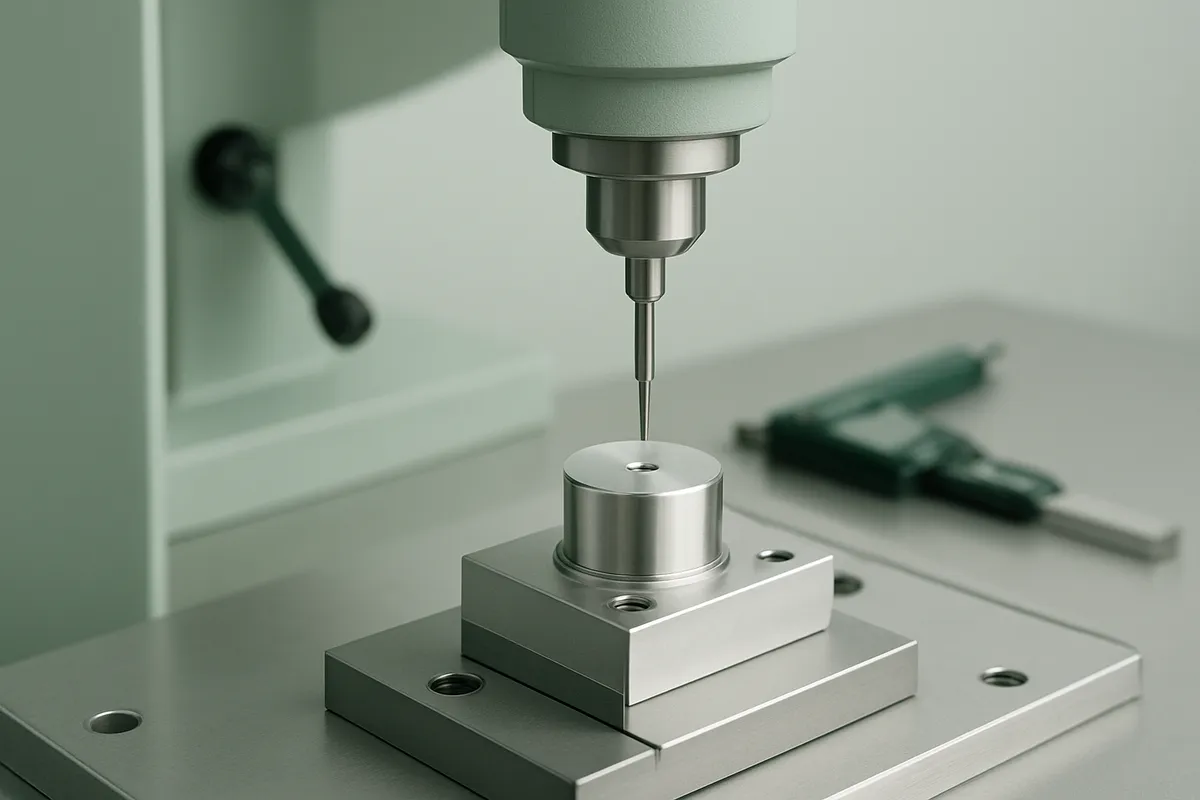
CNC turning and Swiss-style machining hold tight tolerances on small parts by supporting the workpiece close to the cutting zone, which minimizes deflection during the cut. In Swiss-style lathes, the bar stock feeds through a guide bushing positioned near the tool, so the unsupported length stays short even as the part gets thinner toward the finished profile. This matters most on parts under 38mm diameter, where a few microns of flex can push a feature out of spec.
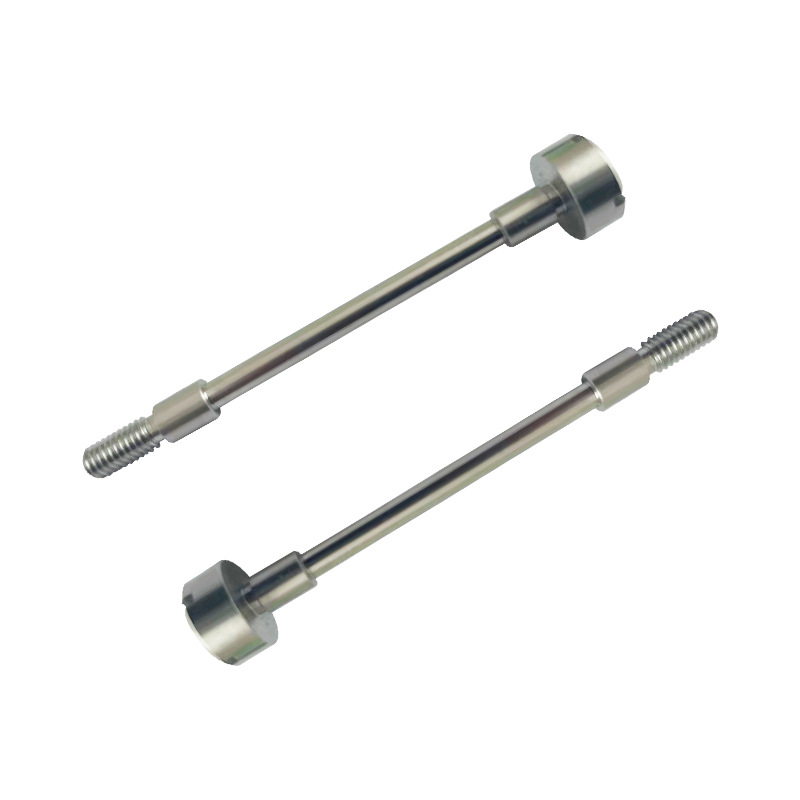
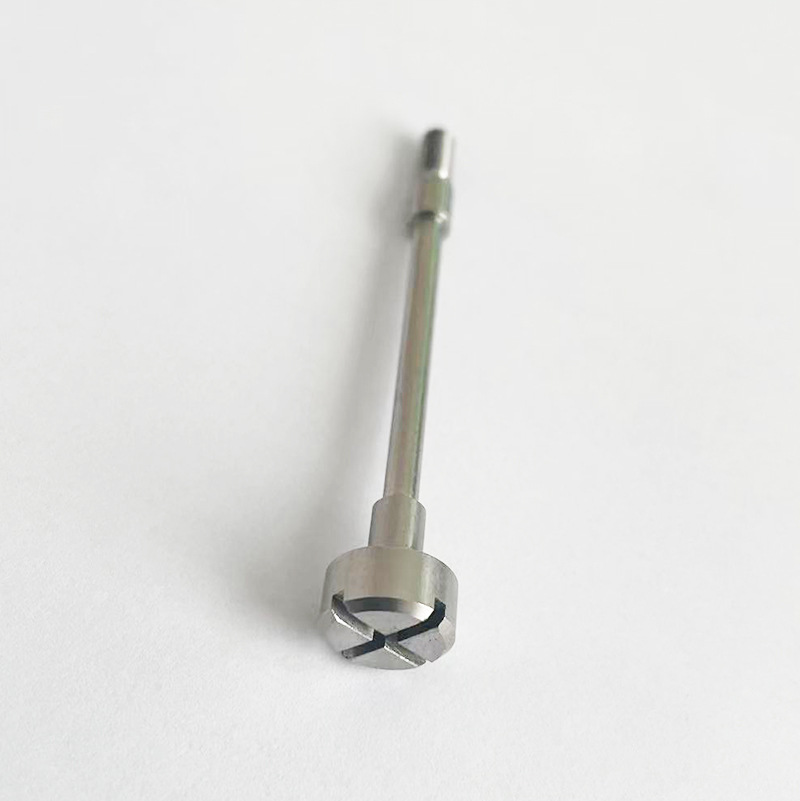
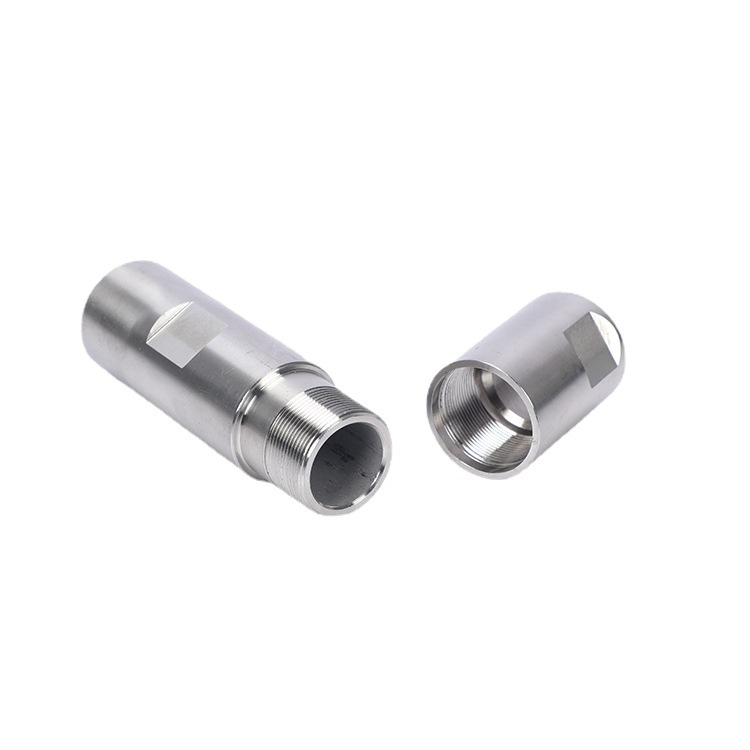
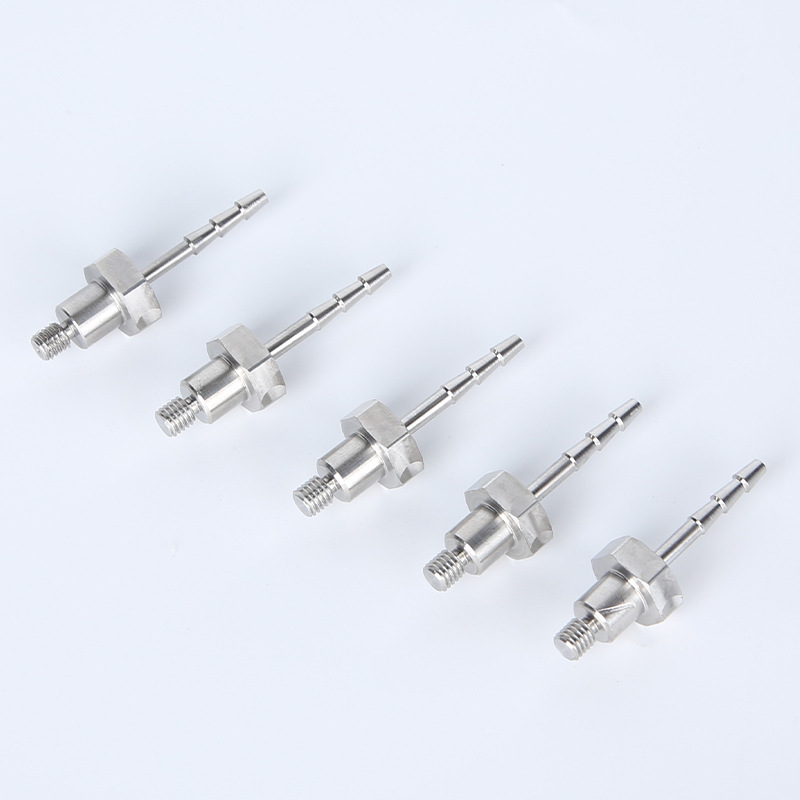
Live tooling adds another advantage: it lets a single setup perform turning, milling, drilling, and cross-tapping without removing the part from the machine. Fewer setups mean fewer chances to reintroduce alignment error. This is especially relevant for medical components like cannulas, bone screws, and small connector housings, where multiple features must stay concentric to each other within a few microns.
What Role Do Tool Selection, Coolant Strategy, and Machine Calibration Play in Holding Tight Tolerances?
Tool material and coolant strategy directly determine whether a small feature comes out clean or burred. Carbide tooling handles most stainless steel and titanium cuts reliably, but diamond-coated tools extend tool life and hold sharper edges on abrasive materials and softer polymers like PEEK, reducing the microscopic burrs that are hard to deburr on parts this small. Coolant delivery also controls thermal expansion, a workpiece that heats unevenly during a cut will shrink out of tolerance once it cools, which is why flood or through-tool coolant is standard on tight-tolerance runs.
Machine calibration and environment matter just as much as the cutting event itself. In-process probing checks critical dimensions between operations, and temperature-controlled shop floors prevent the thermal drift that can shift a machine’s reference points over an eight-hour run. Without climate control, ambient temperature swings alone can move tolerances outside acceptable limits on long batches.
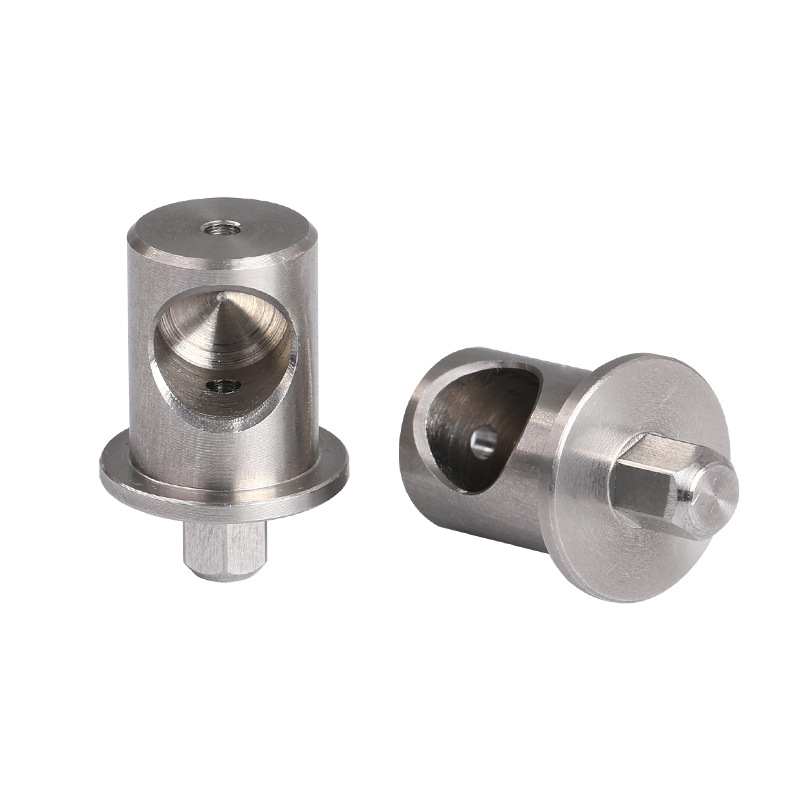
5-axis CNC mill-turn centers reduce another source of error: tolerance stack-up from repeated fixturing. Machining multiple faces and features in one clamping removes the alignment error that accumulates each time a part is unclamped and repositioned. Statistical process control and first-article inspection then verify that the first parts off a run meet print before the shop commits to a full batch, catching drift early rather than after hundreds of parts are already cut.
How Do CNC Machining, Stamping, and Other Methods Compare for Medical Component Production?
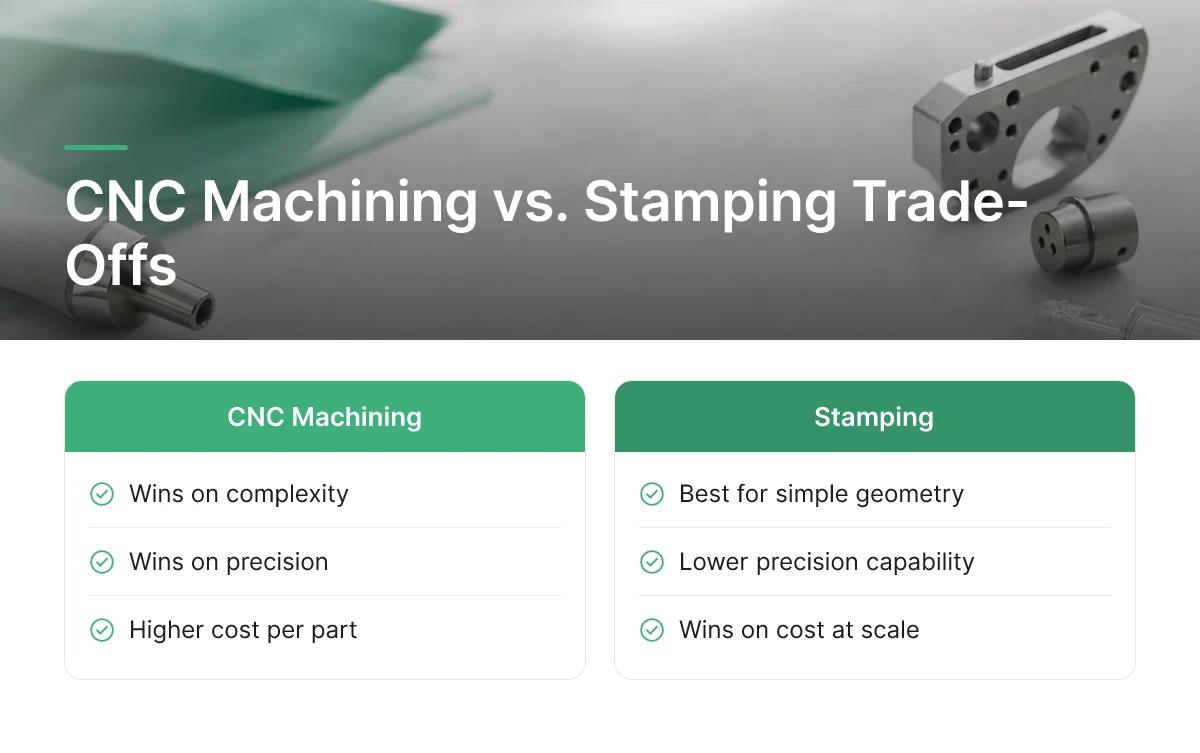
The right process depends on part geometry, order volume, and tolerance requirements, CNC machining wins on complexity and precision, stamping wins on cost at scale.
No single process makes sense for every medical device part. A titanium bone screw, a stainless steel enclosure, and a surgical mesh have almost nothing in common structurally, so the manufacturing method has to match the geometry and the production run, not the other way around.
What Are the Cost and Lead-Time Trade-Offs Between CNC Machining, Deep Drawing, Chemical Etching, and Stamping for Different Part Geometries?
CNC machining removes material from solid stock, which makes it suited to complex geometries, low-to-mid production volumes, and tight tolerances, no tooling required, so you can move from design to finished part quickly. Stamping forms flat or shallow-formed metal parts by pressing sheet stock through a die, and it beats CNC on per-part cost once volumes climb into the tens of thousands, because the cycle time per part drops to seconds.
Deep drawing fits seamless, cup-shaped, or cylindrical components, surgical instrument housings, battery cans, and some implant shells are typical examples. It pulls flat sheet metal into a three-dimensional shape using a punch and die, producing a part with no weld seams. The trade-off is tooling: a deep-drawing die costs more upfront than a CNC setup, but the per-unit cost drops sharply once you’re running production volume.
Chemical etching removes material through a controlled acid bath rather than a cutting tool, which makes it the process of choice for thin, burr-free, stress-free parts, surgical blades, cardiovascular stents, and fine mesh screens are common applications. Because etching works from the surface inward, it can’t hold tight tolerances on thick cross-sections the way CNC machining can; it’s a sheet-metal specialist, not a general-purpose process.
When Should You Choose One Process Over Another Based on Volume, Tolerance, and Material?
Prototype runs and low-volume complex geometries favor CNC machining, no tooling investment, and design changes don’t strand a die. High-volume simple geometries favor stamping or deep drawing, where the upfront tooling cost amortizes across thousands of identical parts. Thin, delicate, or burr-sensitive components favor chemical etching.
Tooling lead time is what shifts the calculation as volume grows. Etching and CNC machining need no hard tooling, so they stay cost-competitive at any volume and remain the default for medical device precision parts still in design iteration. Stamping and deep drawing require a die before the first part ships, so their economics only make sense once volume is committed. MFG SOLUTION runs CNC turning, Swiss lathe, cold forging, automatic lathe, and CNC mill & turn side by side, selecting whichever process fits the part’s geometry and volume rather than forcing every job through one method.
What Regulatory and Quality Standards Must Medical Precision Parts Meet?
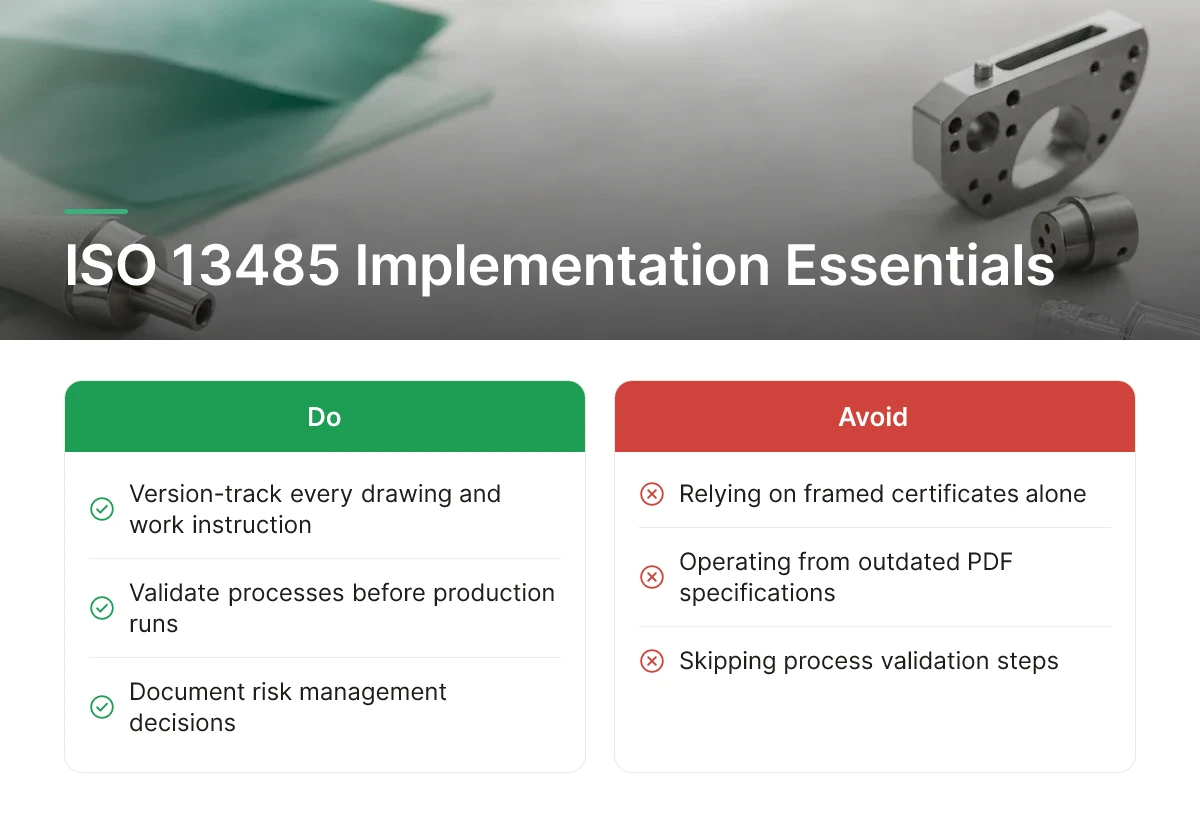
ISO 13485 and FDA traceability rules require a documented system that governs every batch, not a framed certificate a shop can point to and stop thinking about.
What Does ISO 13485 Compliance Require in Your Manufacturing Process, and How Do You Implement It?
ISO 13485:2016 is a quality management system standard built around three ongoing obligations: document control, risk management, and process validation. Document control means every drawing revision, work instruction, and inspection procedure is version-tracked so operators always work from the current spec, not last quarter’s PDF. Risk management means the shop identifies where a process could produce an out-of-spec part and builds controls, fixture checks, tool-wear limits, in-process gauging, before that failure ever reaches a customer.
Process validation is the part buyers underestimate most. A machine shop making medical device precision parts has to prove that a given setup, tool, and program combination reliably produces parts within tolerance across an entire run, not just on the first piece. That proof gets re-established whenever a material lot, tool supplier, or fixture changes. A shop that treats ISO 13485 as a certificate to renew annually, rather than a system that runs daily, will eventually produce a batch nobody can fully explain.
How Do FDA 510(k) Requirements and Traceability Documentation Affect Your Precision Machining Workflow?
FDA 510(k) clearance shifts real documentation burden onto the machining supplier, because the device maker’s submission depends on being able to trace every component back to its source. In practice that means lot tracking on raw material, certifications proving the alloy or polymer matches the spec, and process documentation tied to each part batch, not just the finished device. If a material lot later shows a defect, the manufacturer needs to identify exactly which shipped parts came from it, and only a supplier with full process control can answer that question in hours instead of weeks.
Full process control means every operation is logged, machine, operator, program revision, cycle time, and every inspection result is recorded against the part number and lot. That creates an unbroken chain from raw bar stock to the box that ships. First-article inspection reports and dimensional data, often from a coordinate measuring machine (CMM), are the deliverables that prove a part matches its drawing before the rest of the production run moves forward. MFG SOLUTION documents this chain under ISO 9001:2015, ISO 13485:2016, and IATF 16949 certification, giving buyers a traceable record rather than a claim.
For buyers, this changes what to ask a supplier during qualification. A certificate number confirms registration; it does not confirm the supplier can produce a lot traceability report on request. Ask to see the quality manual, a sample first-article inspection packet, and how they handle a nonconformance, that tells you more than any audit badge.
How Do You Balance Precision, Cost, and Lead Time When Sourcing Medical Device Components?
Balancing precision, cost, and lead time means matching tolerance requirements and order volume to a manufacturing process, then choosing a partner who quotes and schedules against those realities rather than around them.
Tighter tolerances raise cost through three linked mechanisms, not a flat markup. Machines run slower to hold position accuracy on each cut, which extends cycle time per part. Inspection sampling gets stricter, instead of spot-checking a batch, a tight-tolerance run often requires measuring a higher percentage of parts, sometimes every one, adding labor and equipment time. Scrap rates also climb, because parts that would pass at a looser spec get rejected, and that rejected material and machine time gets absorbed into the price of the parts that ship. A feature held to a tight tolerance band, as described in tolerance guides for hard-metal alloys and engineering plastics alike, costs more precisely because it demands slower, more deliberate machining and more verification at every stage.
What Minimum Order Quantities and Lead Times Should You Expect for Custom Medical Precision Parts?
Expectations shift sharply depending on where a project sits between prototyping and full production. Prototype runs typically involve single-digit or low-double-digit quantities, priced and scheduled to support design validation rather than unit economics. Low-volume production, the stage where a device moves toward regulatory submission or initial market release, usually carries higher per-part costs but shorter setup lead times, since tooling investment hasn’t been fully amortized yet. Full-scale runs justify more upfront tooling and process optimization, which lowers per-part cost but requires longer initial setup and a firmer volume commitment. Buyers sourcing medical device precision parts should clarify which stage they’re in before requesting quotes, since the same part specification can carry very different pricing and turnaround depending on the batch size behind it.
How Can You Estimate Costs and Timelines for Different Tolerance Levels and Production Volumes?
A simple framework helps set expectations before specs go out for quotes: tight tolerance combined with low volume tends toward premium pricing, because setup and inspection costs spread across few parts, while looser tolerance combined with higher volume tends toward budget-friendly pricing, because per-part overhead shrinks as batch size grows. Mixed cases, tight tolerance at high volume, or loose tolerance at low volume, usually land in the middle, and the right process (CNC turning, Swiss lathe, cold forging, or CNC mill and turn) shifts depending on which variable matters more for a given part.
A fast, detailed quote removes the guesswork from this trade-off. MFG SOLUTION returns quotes within 8 hours and ships approved orders within 3 days, which lets a procurement team plan a production schedule against a known window instead of estimating supplier capacity blind. Consolidating machining, tooling, and inspection with one accountable partner, certified to ISO 9001:2015, ISO 13485:2016, and IATF 16949, also cuts the coordination overhead of chasing multiple vendors for status updates, inspection reports, and re-quotes when a design revision comes through.

Frequently Asked Questions
Can the same material be used for both implantable and non-implantable medical device parts?
No, the same base alloy or polymer often needs different processing, finishing, or certification depending on implant status. A titanium alloy used in a surgical instrument may skip the passivation and biocompatibility testing required for the same alloy in a load-bearing implant. Specification sheets and supplier quality records must state the intended use, not just the material grade.
Do medical device precision parts always require 5-axis CNC machining?
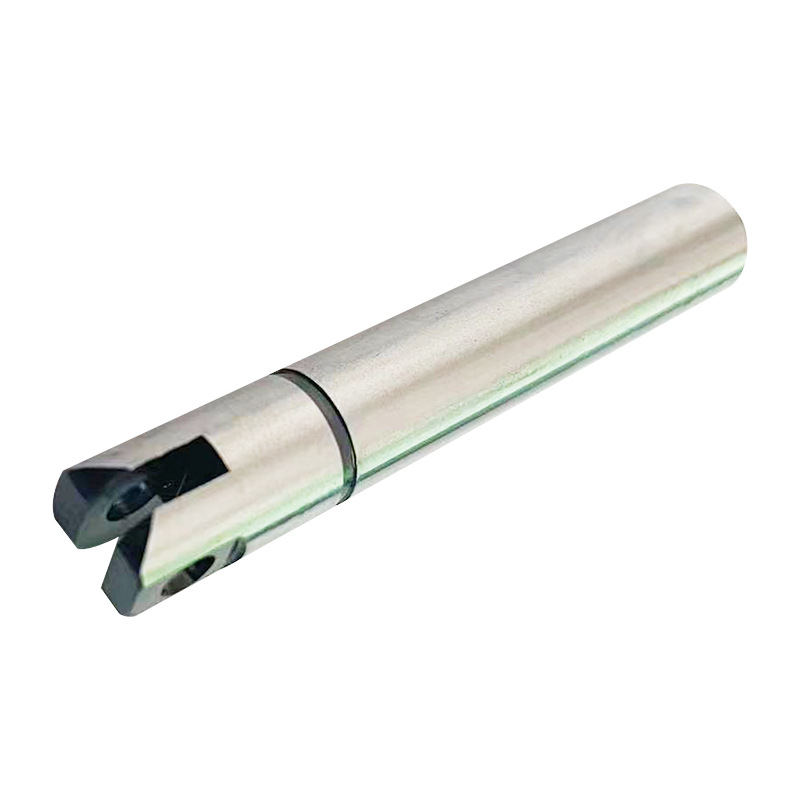
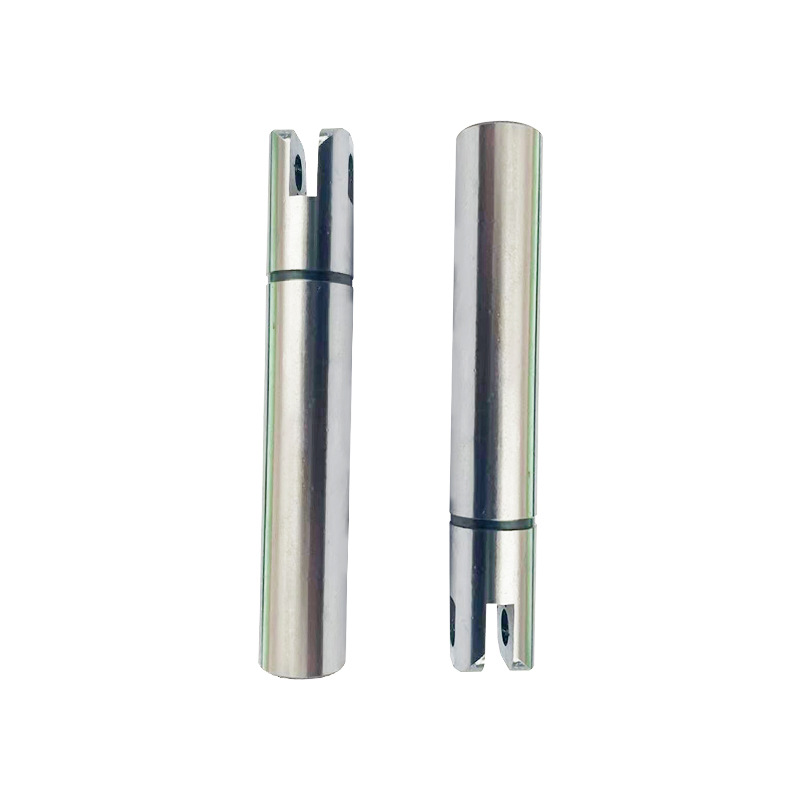
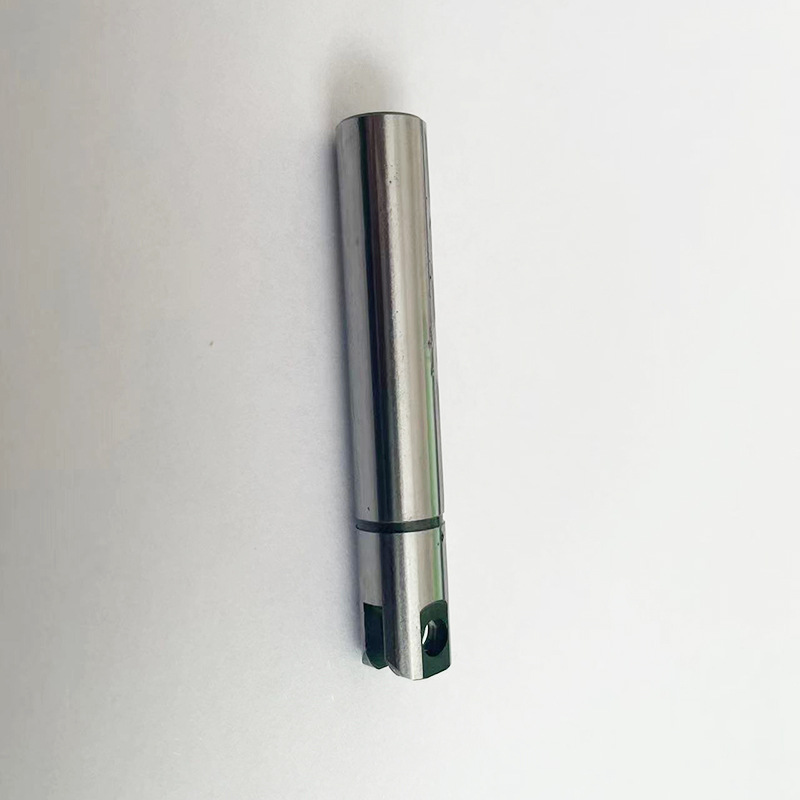
No, 5-axis machining is needed only for complex geometries with multiple angled features or deep cavities that can’t be reached in fewer setups. Simpler rotational parts, like pins, fittings, and connectors, are often produced faster and cheaper on CNC turning or Swiss lathe equipment.
How does part geometry influence whether stamping or CNC machining is more cost-effective?
Simple, flat, high-volume geometries favor stamping, while parts with tight tolerances, internal features, or low-to-mid volumes favor CNC machining. Stamping tooling costs are high upfront but pay off at scale; CNC machining has minimal tooling cost, so it stays economical even when order quantities or design revisions are unpredictable.
What documentation should you request from a supplier to confirm ISO 13485 compliance?
Ask for the current ISO 13485:2016 certificate, the certifying body’s name, and the scope of certification listed on it. Also request the supplier’s material certifications, first-article inspection reports, and process control records, these confirm the certification is backed by real, auditable documentation on the shop floor, not just a wall plaque.
Conclusion
Getting medical device precision parts right comes down to three decisions: matching material to the part’s contact classification, choosing the machining process that fits the geometry and volume, and confirming the tolerance stack-up before cutting any metal. Skipping any of these steps shows up later as failed inspections or field returns, not just line-item cost overruns.
Before your next RFQ, pull your part’s tolerance drawing and confirm whether it actually needs 5-axis machining or can run on CNC turning or Swiss lathe equipment, that single check often changes the quote. MFG SOLUTION reviews specs like these within 8 hours, manufacturing to ISO 13485:2016 and ISO 9001:2015 standards for parts up to 38mm.
Recommended Articles
Explore more from our content library: