
2026-07-31
Forging vs Casting: Differences and Costs

Understanding forging vs casting is essential for any engineer or buyer selecting a manufacturing process. Forging shapes metal under high pressure without melting it, producing parts with superior grain structure and tensile strength; casting pours molten metal into a mold, enabling complex geometries at lower tooling cost. Forged parts typically achieve 20–30% higher strength than cast equivalents, making forging the default for high-stress applications like automotive axles and aerospace fasteners. Casting wins when intricate internal cavities or low per-unit cost on short runs matter more than peak mechanical performance. According to Cornell Forge Co., the choice between these two processes has lasting consequences for part performance and total production cost.
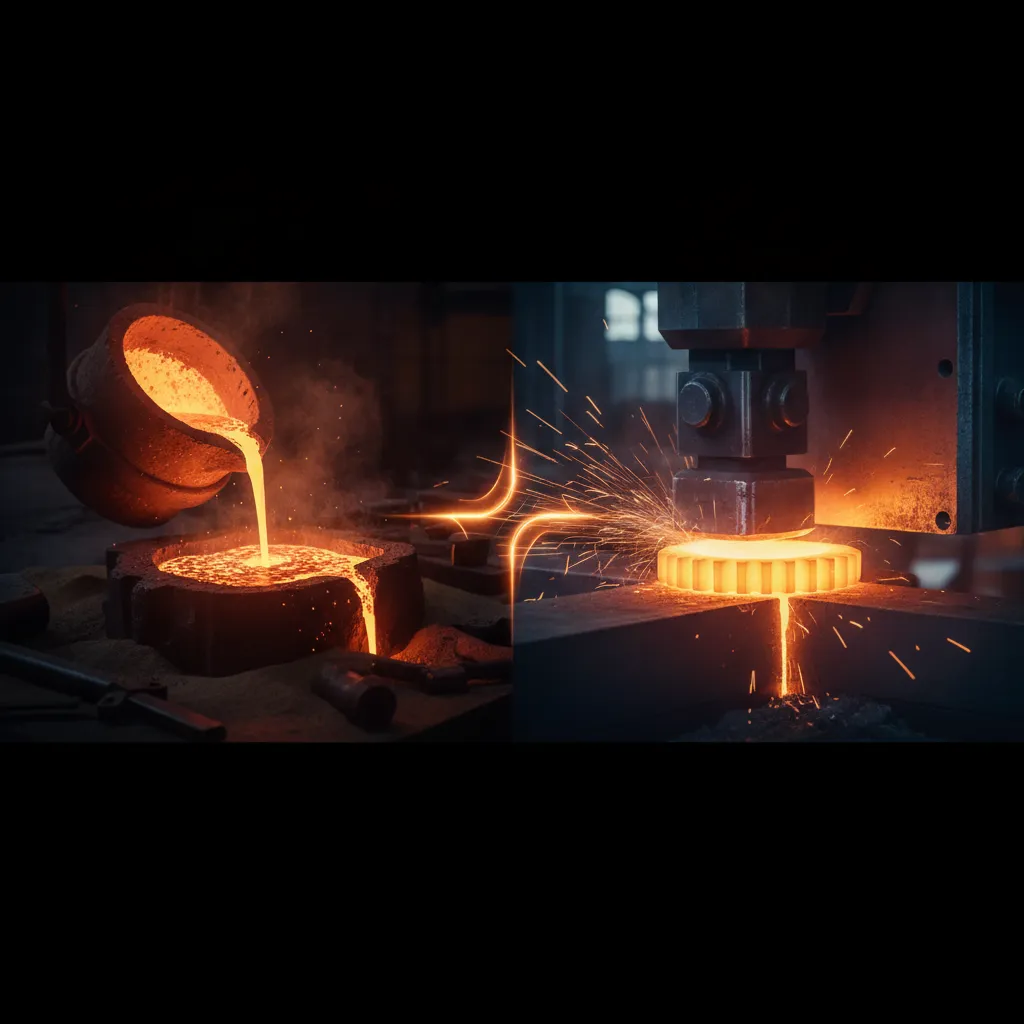
Forging vs Casting: Key Differences Explained
Forging and casting differ fundamentally in one way: forging shapes solid metal under compressive force; casting shapes molten metal by letting it solidify in a mold.
Is Casting the Same as Forging?
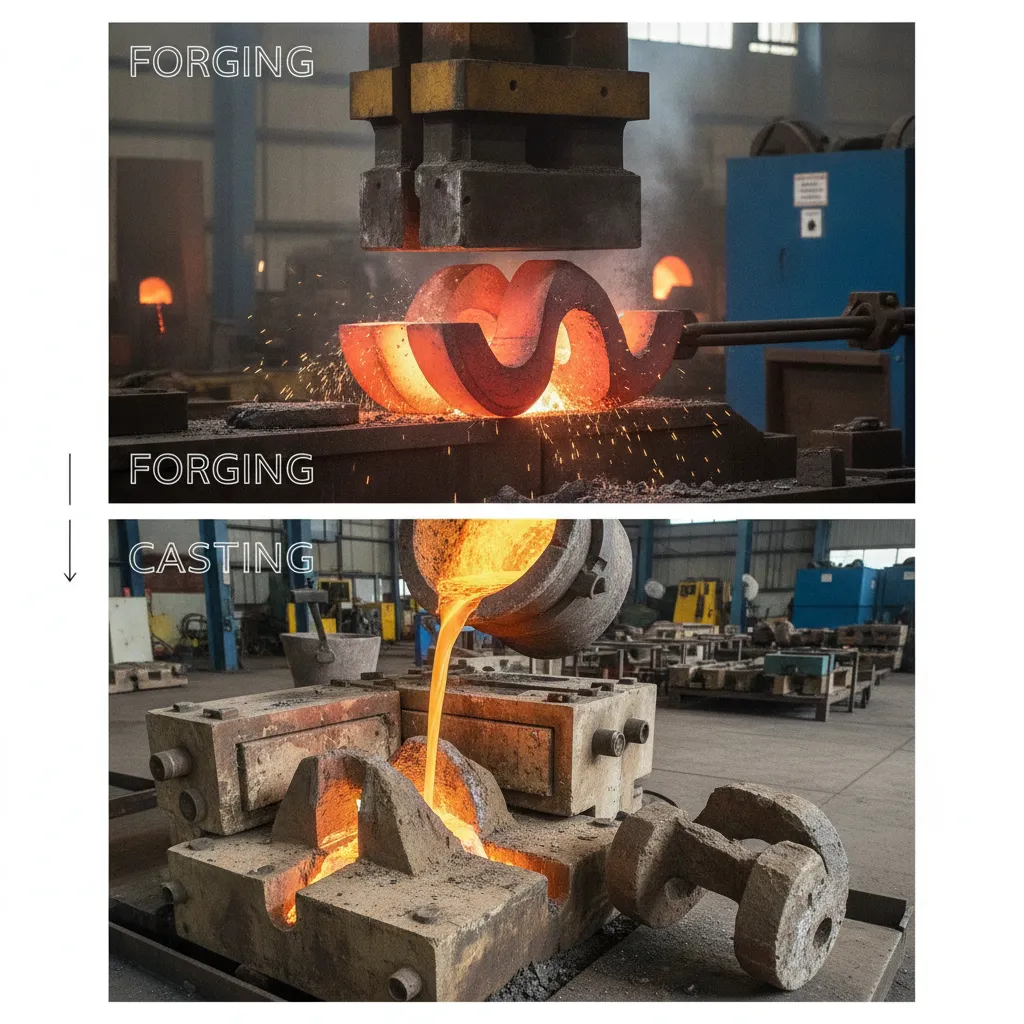
No. In forging, a metal billet is pressed, hammered, or rolled below its melting point. That compressive force aligns the metal’s grain structure along the contours of the finished part, producing a dense, directional microstructure. Casting does the opposite, metal is heated until fully liquid, poured into a mold, then cooled. Solidification is never perfectly uniform, which can leave porosity, shrinkage voids, and randomly oriented grains throughout the part.
The mechanical gap between the two processes is measurable. According to ASM International data, forged parts typically show tensile strength 20–30% higher and fatigue life up to 37% longer than cast parts made from the same alloy. For components that carry cyclic loads, gears, connecting rods, suspension knuckles, that difference is the margin between acceptable and failed.
“Forged components consistently outperform cast parts in fatigue-critical applications because the continuous grain flow achieved during forging eliminates the internal discontinuities that initiate cracks in cast structures.” — Dr. Rajiv Shivpuri, Professor of Industrial and Systems Engineering, The Ohio State University
Casting has a structural advantage of its own: geometric freedom. Internal channels, undercuts, and thin-walled cavities are achievable in a single cast pour. Forging physically cannot replicate those features without secondary machining, which adds cost and cycle time.
Surface finish also separates the two. As-cast surfaces typically measure Ra 3.2–12.5 µm depending on mold type; as-forged surfaces run Ra 1.6–6.3 µm. Neither finish meets precision tolerance requirements without further surface finish CNC machining.
How to Tell a Cast Part from a Forged Part
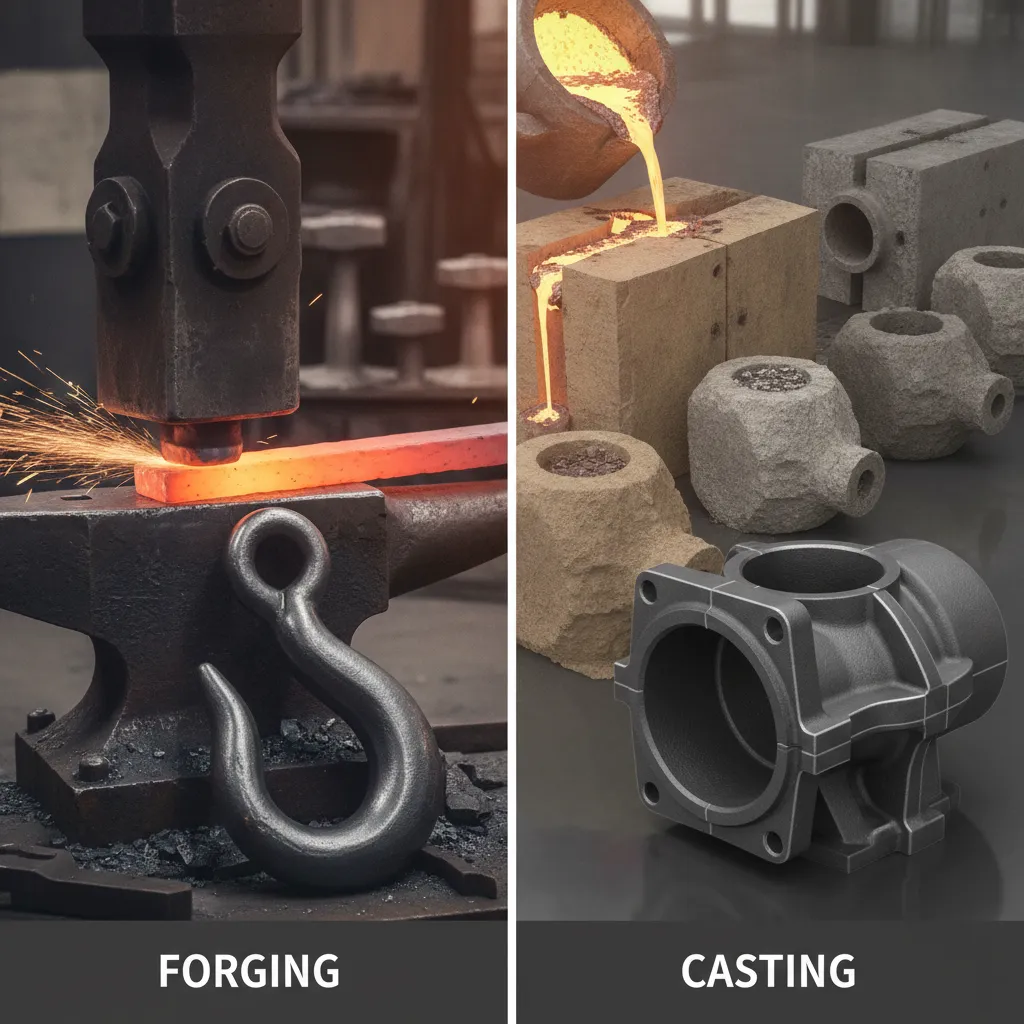
A visual inspection usually reveals the answer quickly. Cast parts carry parting lines, faint seams left where mold halves met, and a matte, slightly porous surface texture. Porosity may show as small pits or a granular appearance under close inspection.
Forged parts look and feel denser. The surface is smoother and more uniform, with no parting lines from a mold. Under metallographic inspection, polished cross-sections of forged components show visible flow lines that curve around the part geometry, a direct result of grain alignment during the forging process. Cast cross-sections show equiaxed, randomly oriented grains with no directional pattern. When evaluating forging vs casting side by side, these microstructural differences are immediately visible to a trained metallurgist.
How Forging and Casting Actually Work
Forging shapes metal under compressive force while it remains solid; casting pours molten metal into a mold and lets it solidify, each method produces fundamentally different internal structures.
Casting splits into three common methods. Sand casting uses expendable sand molds, which keeps tooling cost low but produces a coarser surface finish. Investment casting (also called lost-wax casting) builds ceramic molds around wax patterns, allowing high detail and thin walls at a higher cost per part. Die casting injects molten non-ferrous metals, typically aluminum or zinc, into hardened steel dies at high pressure, enabling fast cycle times suited to high-volume runs. For a detailed breakdown of how these casting methods compare to forging in practice, VPIC Group’s process comparison guide is a useful reference.
The Three Main Types of Forging
Open-die forging works metal between flat or simple dies, making it practical for large, simple shapes where tooling cost must stay low. Closed-die (impression-die) forging presses heated metal into a machined cavity, producing near-net shapes with high repeatability, though the die itself costs significantly more to produce. Cold forging shapes metal at room temperature, which work-hardens the grain structure and delivers tight tolerances and an excellent surface finish without the heat-related distortion common in hot processes. For precision small parts under 38mm, cold forging minimizes material waste and often reduces downstream machining, a reason MFG SOLUTION runs dedicated cold forging equipment alongside its CNC turning and Swiss lathe lines.
The three main forging types compared at a glance:
- Open-die forging: Best for large, simple shapes; lowest tooling cost; limited dimensional precision.
- Closed-die (impression-die) forging: Near-net shape output; high repeatability; die cost $10,000–$80,000+.
- Cold forging: Room-temperature process; work-hardens grain structure; tight tolerances; ideal for small precision parts under 38mm.
Common Defects in Casting vs Forging
Forging defects, laps, cold shuts, and underfill, are largely surface-level. Visual inspection or dye-penetrant testing catches most of them without adding significant cost or lead time.
Casting defects run deeper. Shrinkage porosity, gas porosity, and hot tears form inside the part as metal cools and contracts. Detecting them requires X-ray or ultrasonic testing, which adds both inspection cost and lead time to every production run. When comparing forging vs casting on total part cost, that inspection burden is a line item buyers often underestimate.
“Subsurface porosity in cast components is the leading cause of premature fatigue failure in structural parts. Non-destructive testing adds cost, but skipping it in safety-critical castings is not an option.” — George Vander Voort, Fellow, ASM International
Material Compatibility: Which Metals Work Best with Each Process
Forging suits ductile metals like steel, aluminum, and titanium; casting handles virtually any metal that melts, including brittle alloys no press can shape. For more information, see Thegoodcode.
The forging vs casting decision often comes down to the material itself. Forging requires enough ductility to deform under compressive force without fracturing. Carbon steel, alloy steel, stainless steel, aluminum, titanium, and copper alloys all meet that threshold. Aluminum is the most forged non-ferrous metal globally, forged 6061-T6 aluminum delivers a yield strength of approximately 276 MPa, compared to roughly 124 MPa for sand-cast 356-T6. That 2× strength difference drives aluminum forging adoption in aerospace brackets and automotive suspension components where weight and load capacity both matter.
Stainless steel is forgeable, but it demands higher press tonnage and tighter temperature control than carbon steel, process parameters that require experienced tooling engineers to manage correctly.
Casting faces none of those ductility constraints. Any metal that can be reliably melted is a casting candidate: cast iron, high-silicon aluminum alloys, magnesium, and complex nickel superalloys used in turbine hardware all process well through casting routes.
Which Metals Cannot Be Forged and Why
Cast iron fractures under compressive load because its high carbon content, typically 2–4%, makes it too brittle to deform plastically. Most nickel superalloys above certain temperature thresholds and complex multi-phase alloys with low ductility share the same problem: the material cracks before it flows. For those metals, casting is the only practical shaping route. Engineers specifying parts in these materials should eliminate forging from consideration before the design phase begins, tooling investment and scrapped billets are expensive ways to confirm a material incompatibility.
MFG SOLUTION’s cold forging capability is optimized for ductile metals, carbon steel, stainless steel, and aluminum alloys, where compressive deformation produces the tight tolerances and grain-flow strength that precision components in automotive and electronics applications require.
Cost and Lead Time: What to Expect from Each Process
Casting costs less upfront; forging costs less per part at scale, the crossover point determines which process wins your budget.
Small vs Large Production Run Cost Analysis
Tooling is where the forging vs casting decision starts. Sand casting patterns run $500–$5,000; investment casting tooling climbs to $5,000–$25,000; closed-die forging dies cost $10,000–$80,000 or more depending on part geometry and die steel grade. That gap matters enormously at low volumes.
For orders under 500 steel parts, casting almost always delivers a lower total cost because the tooling investment amortizes faster and per-unit setup is lighter. Above roughly 1,000 units, forging becomes cost-competitive, faster cycle times and less post-processing scrap reduce the per-part cost enough to offset the die investment. At 10,000+ parts per year, automotive and aerospace suppliers consistently favor forging for total cost of ownership.
Small-run buyers under 200 parts are usually better served by casting or CNC machining from billet. Forging’s economics only reward volume.
One factor buyers often miss: forged parts require less downstream CNC machining time. Near-net shape and better surface finish mean fewer passes on the lathe or mill, which directly reduces cost per part when you factor in CNC hole drilling or CNC threading optimization steps. MFG SOLUTION’s cold forging capability, paired with CNC turning and Swiss lathe finishing, is built around exactly this cost model for parts up to 38mm diameter.
How Lead Times Compare Between Forging and Casting
Lead time gaps between the two processes are significant and often underestimated. Sand casting prototypes arrive in 2–4 weeks; investment casting takes 4–8 weeks. Closed-die forging first articles run 6–12 weeks because die machining is the bottleneck, you’re waiting on hardened tool steel, not just raw material.
Cold forging production runs are a different story: once tooling exists, runs typically complete in 2–4 weeks. MFG SOLUTION ships production batches within 3 days of order approval for parts already in tooled programs, a lead time that no sand or investment casting process can match at equivalent volume.
When to Choose Forging or Casting for Your Application
Choose forging for load-bearing, fatigue-critical parts in high volumes; choose casting when geometry is complex, alloys are brittle, or tooling budgets are tight.
The forging vs casting decision starts with the part’s structural role. Forging is the right call when the component carries cyclic or impact loads, axles, connecting rods, crane hooks, and surgical implants all fall here. If annual volume exceeds 1,000 units and the material is a ductile metal like steel or aluminum, forging’s grain refinement and die cost amortize quickly.
Casting wins when geometry makes forging impractical. Pump housings, engine blocks, and valve bodies contain internal cavities that forging dies cannot form. Brittle alloys, cast iron, certain nickel superalloys, also favor casting because they crack under the compressive force forging requires. Short production runs below the tooling break-even point are another clear signal: die sets for closed-die forging typically cost $10,000–$50,000, so low volumes rarely justify that upfront spend.
Real-World Examples: When Companies Switched Processes
Automotive wheel hub manufacturing is the clearest documented process switch. Hub producers moved from sand casting to closed-die forging through the 1990s after fatigue failures in cast hubs caused field recalls. Forged hubs, with their continuous grain flow aligned to load direction, now dominate passenger vehicle production globally. The switch added tooling cost but eliminated the porosity-driven failure mode that sand casting introduced. This real-world shift illustrates why the forging vs casting choice carries long-term consequences beyond initial tooling spend.
MFG SOLUTION’s cold forging capability handles exactly this class of part: high-volume, ductile-metal components where near-net shape production reduces downstream machining. For parts up to 38mm diameter, cold forging combined with CNC turning delivers tighter tolerances than casting alone, with quotes returned within 8 hours.
Environmental and Sustainability Considerations
Forging produces less material waste than casting because the billet is shaped, not poured, scrap rates are lower and the near-net shape requires less post-process CNC coolant and lubricant use during finishing. Casting generates more scrap metal from sprues, risers, and runners, and the additional machining needed to hit final dimensions increases both energy consumption and coolant volume.
Use this checklist before committing to either process:
- Is the part safety-critical or fatigue-loaded? → Forging.
- Does it require internal cavities or undercuts? → Casting.
- Volume over 1,000 units per year? → Forging likely wins on total cost of ownership.
- Tooling budget under $5,000? → Casting or CNC machining from billet.
Frequently Asked Questions
Is forged steel stronger than cast steel?
Yes, forged steel is stronger than cast steel in most structural applications. The forging process aligns the metal’s grain structure along the part’s geometry, which increases tensile strength and fatigue resistance. ASM International data shows forged steel can achieve tensile strength 26% higher than equivalent cast steel grades. Cast steel, however, can match or exceed forged steel in compressive strength for certain geometries, making material selection dependent on the specific load type the part must bear.
What is the cost difference between forging and casting for a 500-unit run?
At 500 units, casting typically costs less per part, but the gap depends on material, geometry, and tooling amortization. Casting dies for aluminum can run $5,000–$15,000; forging dies often start at $10,000–$30,000. At low volumes, that tooling cost dominates unit price. For a simple steel bracket, casting may come in 20–35% cheaper per piece at 500 units. Cold forging, as offered by MFG SOLUTION for small precision parts up to 38mm, can close that gap significantly by reducing secondary machining costs.
Can aluminum be both forged and cast?
Yes, aluminum is one of the most commonly processed metals using both methods. Forged aluminum (typically 6061 or 7075 alloy) delivers higher fatigue strength and is standard in aerospace and automotive suspension components. Cast aluminum (A380, A356) allows more complex shapes and is widely used in engine housings and consumer electronics enclosures. The choice comes down to whether you need structural strength or geometric complexity. When evaluating forging vs casting for aluminum parts specifically, volume and load requirements are the deciding factors.
How do production timelines differ between forging and casting?
Casting generally reaches production faster because die fabrication is quicker and the process accommodates complex shapes without multiple secondary operations. A sand casting run can move from design to first parts in 2–4 weeks. Forging tooling takes longer to machine and validate, typically 4–8 weeks for closed-die setups. Once tooling is ready, forging cycle times per part are often shorter. For small precision parts, cold forging with post-machining can compress total lead time considerably compared to traditional hot forging routes.
Which process is better for high-temperature applications?
For high-temperature environments, the answer depends on the alloy and the mechanical demands. Casting is often preferred for complex nickel superalloy components used in turbine blades and exhaust manifolds, since those alloys are too brittle to forge reliably. However, for high-temperature steel fasteners and structural brackets, forging vs casting comparisons consistently favor forging because the aligned grain structure resists creep and thermal fatigue better than a cast equivalent. Always verify the alloy’s forgeability before committing to either process at elevated service temperatures.
Conclusion
The forging vs casting decision comes down to three variables: the mechanical demands on the part, the complexity of its geometry, and your production volume. Forging wins on strength and fatigue life, casting wins on shape freedom and lower tooling cost at moderate volumes. Neither process is universally superior. For additional technical guidance on making this decision, the Cornell Forge Co. comparison resource and the VPIC Group process guide both offer practical industry perspectives.
For small precision parts under 38mm, cold forging combined with CNC finishing often delivers the best of both: near-net shape efficiency with tight dimensional tolerances. MFG SOLUTION uses exactly this combination, cold forging plus Swiss lathe and CNC mill & turn, certified to ISO 9001:2015 and IATF 16949.
Submit your part drawing at mfg-solution.com and receive a process recommendation with a quote within 8 hours.
Recommended Articles
Explore more from our content library: