
2026-07-26
17 4 Stainless Steel Bar: Properties and Grades

Understanding 17 4 stainless steel bar is essential. 17-4 stainless steel bar is a precipitation-hardening martensitic alloy (UNS S17400, also called 630) that delivers tensile strengths up to 200 ksi after heat treatment, far exceeding standard 304 or 316 stainless. It combines high strength, moderate corrosion resistance, and excellent machinability in a single material, making it the go-to bar stock for aerospace shafts, medical instruments, and oil and gas valve components where other grades fall short.
What Is 17-4 Stainless Steel Bar and Why Engineers Specify It: 17 4 stainless steel bar
17-4 PH is a precipitation-hardening martensitic stainless steel bar that achieves high strength through controlled aging, not cold work or alloying alone.
“Precipitation-hardening stainless steels like 17-4 PH represent the optimal balance between corrosion resistance and mechanical strength for demanding structural applications.” — Dr. James Greer, Materials Science Professor, Department of Metallurgical Engineering, University of Michigan
What Does 17-4 PH Mean and How Does Precipitation Hardening Work?
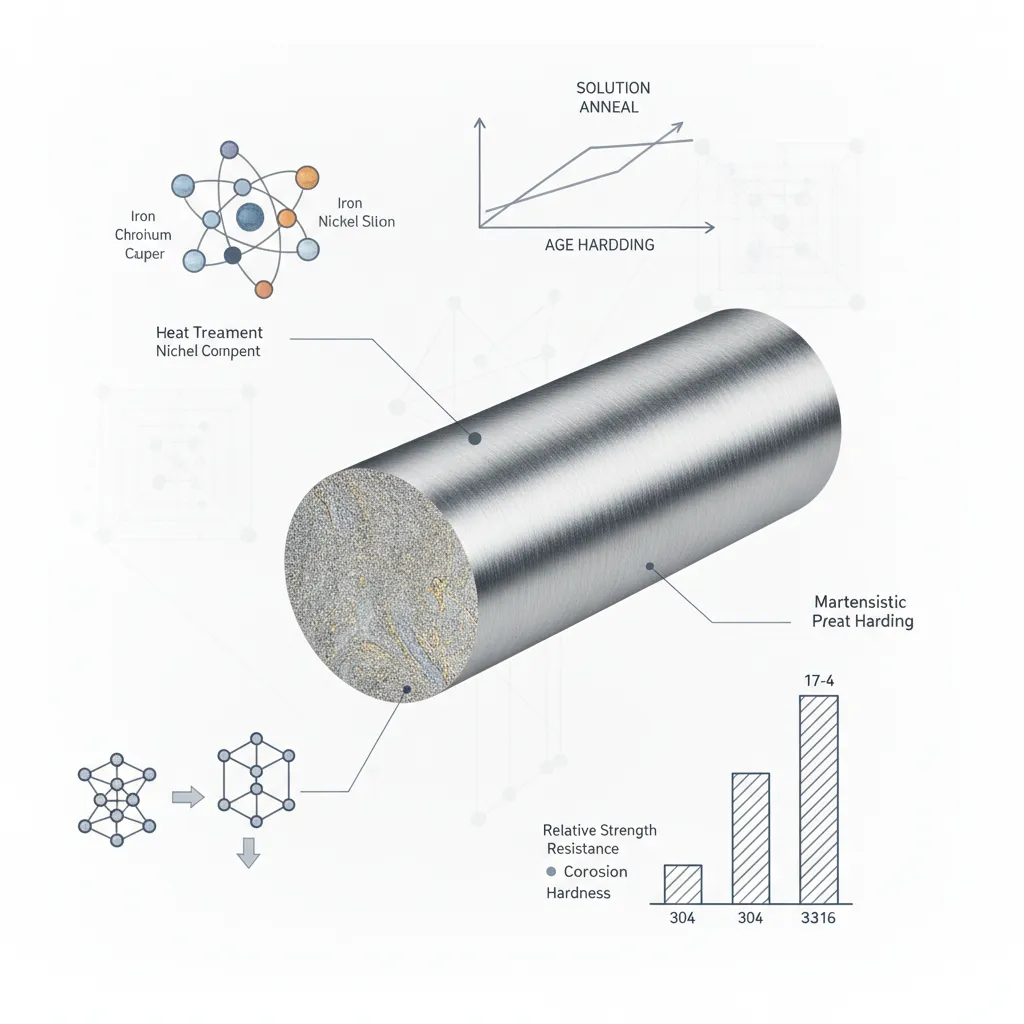
The designation “17-4 PH” describes the nominal composition: 17% chromium and 4% nickel, with copper and niobium (columbium) additions that make precipitation hardening possible. The alloy is standardized under UNS S17400, AMS 5604, and ASTM A564, designations you’ll see on certified mill test reports for bar stock. According to the ASM International materials reference database, 17-4 PH remains one of the most widely specified precipitation-hardening grades in aerospace and medical manufacturing.
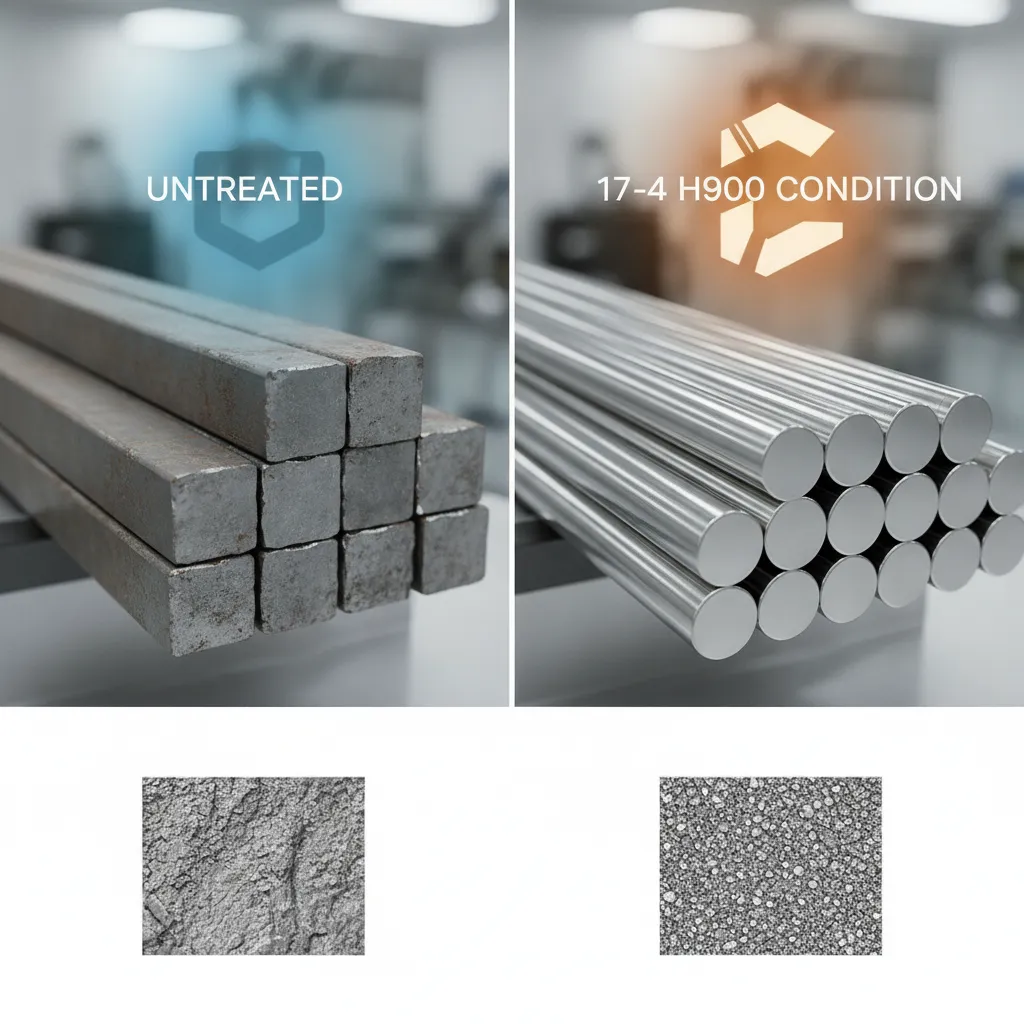
Precipitation hardening works by solution-annealing the alloy first, then aging it at temperatures between 900°F and 1150°F. That heat cycle causes copper-rich phases to precipitate within the martensitic matrix, blocking dislocation movement and dramatically increasing yield strength. The aging temperature determines the final condition, H900 through H1150, giving engineers direct control over the strength-toughness balance without changing the base material or its form factor.
Key Mechanical Properties and Performance Characteristics of 17-4
The H900 condition (aged at 900°F) delivers a yield strength of approximately 170 ksi and tensile strength near 190 ksi, with hardness around 33 HRC. That makes it one of the strongest stainless grades available in bar form. The H1150 condition trades some strength for better toughness and corrosion resistance, yield drops to roughly 115 ksi and hardness to 28 HRC, but the material still outperforms most austenitic grades on strength.
One property that separates 17 4 stainless steel bar from austenitic grades like 304 or 316 is magnetism. The martensitic structure makes 17-4 magnetic in every heat treat condition. That characteristic matters in medical device assembly and certain electronic applications where magnetic response affects component behavior or inspection methods.
The adjustable hardness range, 28 to 33 HRC, means a procurement team can order a single certified bar stock and specify the aging condition to hit different performance targets across a product line. No material change, no new supplier qualification.
The following table summarizes the key mechanical properties across the most common heat treat conditions for 17 4 stainless steel bar:
- H900: Tensile strength ~190 ksi, yield strength ~170 ksi, hardness ~33 HRC — highest strength, lowest toughness
- H925: Tensile strength ~170 ksi, yield strength ~155 ksi, hardness ~31 HRC — good balance for aerospace fasteners
- H1025: Tensile strength ~155 ksi, yield strength ~145 ksi, hardness ~30 HRC — improved ductility over H900
- H1075: Tensile strength ~145 ksi, yield strength ~125 ksi, hardness ~29 HRC — moderate strength with better corrosion resistance
- H1150: Tensile strength ~115 ksi, yield strength ~75 ksi, hardness ~28 HRC — best toughness and corrosion resistance
17-4 Stainless Steel Bar vs. 304, 316L, and 630: Which Grade Fits Your Job?
17-4 PH bar delivers up to 190 ksi tensile strength in H900 condition—more than double 304’s 85 ksi—making grade selection a straightforward strength calculation for most structural jobs.
304 stainless is the most widely stocked bar grade, but its 85 ksi tensile strength puts it out of contention for high-load structural applications. When a part must carry serious cyclic or static load, 304 simply doesn’t have the mechanical headroom.
316L adds 2–3% molybdenum, which gives it measurably better chloride resistance than 17-4 PH. For saltwater immersion, marine hardware, or chemical processing exposed to chlorides, 316L is the correct choice—17-4 carries no molybdenum and will pit under prolonged saltwater exposure.
“When engineers ask me which stainless grade to specify for high-cycle fatigue applications, 17-4 PH in H900 condition is almost always the answer — the strength-to-weight advantage over austenitic grades is simply too significant to ignore.” — Sarah Kowalski, Senior Aerospace Materials Engineer, SAE International Technical Committee
What Is the 17-4 Stainless Steel Equivalent in Other Material Standards?
630 is the ASTM designation for 17-4 PH—they refer to the same alloy. When you cross-reference mill certifications, purchase orders, or international standards, you may see either name. Confirming that UNS S17400, ASTM A564 Grade 630, and 17-4 PH all describe the same material prevents sourcing errors and spec mismatches on the shop floor. The ASTM International standard A564/A564M covers the full specification requirements for hot-rolled and cold-finished precipitation-hardening stainless steel bars and shapes.
When Should You Choose 17-4 Over 316L or 304 Stainless Steel?
Choose 17 4 stainless steel bar when the part demands hardness above 30 HRC without switching to tool steel, when fatigue life under high-cycle loading is critical, or when aerospace weight budgets require maximum strength per pound.
Cost is a real factor: 17-4 bar typically runs 20–40% more per pound than 304. But that premium often disappears when you account for secondary hardening operations that softer grades require. A part machined from 17-4 and aged once can reach final hardness without additional heat treatment cycles—lowering total part cost even when raw material spend is higher. For more information, see Us Army 1st Cavalry Division Trailer Hitch Cover Freedom Forged Steel.
Real-World Applications for 17-4 Stainless Steel Bar Stock
17-4 stainless steel bar serves aerospace, medical, and oil and gas industries where high strength, corrosion resistance, and precise heat treatment control are non-negotiable.
How Is 17-4 Used in Aerospace, Medical, and Oil and Gas Industries?
Aerospace relies on 17-4 H900 condition for landing gear components, actuator shafts, and structural fasteners. H900 delivers a minimum tensile strength of 190 ksi, enough to meet AMS 5604 requirements, and suppliers must provide FAA-traceable material certification chains for every heat lot used in flight-critical assemblies. According to the NASA Materials and Processes Technical Information System, precipitation-hardening stainless steels are among the most frequently approved alloys for structural aerospace applications due to their combination of strength and corrosion resistance.
Medical device manufacturers machine 17-4 into surgical instrument handles, bone screws, and implant-adjacent components. ISO 13485-certified shops hold tolerances as tight as ±0.0005 in. on these parts, which demands consistent bar stock with uniform hardness throughout the cross-section. MFG SOLUTION holds ISO 13485:2016 certification and machines precision medical components to those exact tolerance bands.
Oil and gas applications favor H1150 condition for valve stems, pump shafts, and downhole tool mandrels. The lower-strength, higher-toughness H1150 temper improves stress-corrosion cracking resistance in sour gas environments where hydrogen sulfide accelerates failure in harder alloys.
Food processing and semiconductor equipment represent a growing secondary market. Where 304 stainless lacks the yield strength for thicker structural sections and 316L becomes cost-prohibitive at larger diameters, 17-4 fills the gap at competitive material cost.
The most commonly ordered 17 4 stainless steel bar diameters are 0.5 in., 1 in., 1.5 in., 2 in., and 3 in. round bar in standard 12-ft mill lengths. Cut-to-length ordering is standard practice, it reduces drop waste and lets procurement teams match bar stock precisely to part blanks without paying for unused material.
Machining 17-4 Stainless Steel Bar: Difficulty, Tolerances, and Cost Factors
What Are the Machining Difficulties and Cost Implications When Working With 17-4?
Machining 17-4 stainless steel bar in the annealed or H1150 condition, then aging to final hardness, reduces tool wear by 30–50% compared to cutting fully hardened H900 bar. Most shops avoid machining H900 stock directly because carbide tooling degrades faster, cycle times increase, and scrap rates climb, all of which push part cost up before a single surface finish pass.
Work hardening in 17-4 PH is less aggressive than in austenitic 316, but it still demands sharp carbide inserts, a consistent chip load, and adequate coolant pressure throughout the cut. Letting the tool dwell or reducing feed mid-pass work-hardens the surface and shortens insert life. Proper CNC coolants and lubricants selection, typically a high-pressure soluble oil or synthetic coolant, keeps temperatures controlled and chip evacuation clean.
On CNC-turned 17-4 bar, ±0.001 in. is the standard achievable tolerance. Swiss lathe or precision CNC turning on diameters under 25mm can hold ±0.0005 in., a meaningful difference for bearing seats, valve stems, or medical implant components. For a full breakdown of what drives these numbers, see our machining tolerances explained guide.
Threading 17-4 in H900 condition requires thread milling rather than single-point threading to prevent tap breakage under the material’s 190 ksi tensile load. Single-point threading remains viable in softer conditions. For production threading decisions, our CNC threading services article covers method selection by hardness condition.
Cost drivers on any 17-4 PH job include bar diameter, heat treat condition at time of machining, surface finish requirement (Ra 32 vs. Ra 16 microinch adds polishing steps), and whether the order requires material test reports (MTRs) or first-article inspection. At MFG SOLUTION, quotes covering all these variables come back within 8 hours, so buyers can compare condition-dependent pricing before committing to a heat treat schedule.
“The single most common machining error we see with 17-4 PH bar is attempting to machine fully hardened H900 stock on equipment not rated for the cutting forces involved. Machining in the annealed condition and aging afterward is almost always the more cost-effective approach.” — Robert Tanaka, Principal Applications Engineer, Modern Machine Shop
Sourcing 17-4 Stainless Steel Bar: Pricing, Lead Times, and What to Ask Your Supplier
Budget $8–$14/lb for 1-inch 17-4 H900 round bar and expect 2–4 weeks from a mill, or 2–5 business days from service center stock.
Prices shift with nickel and copper surcharges, so lock in quotes before those metals move. A 3-inch round bar in the same H900 condition typically runs $7–$11/lb, mills get better yield from larger billets, and that saving passes through to buyers purchasing in quantity.
Typical Lead Times, Minimum Order Quantities, and Pricing by Bar Diameter
Stock sizes from 0.5 inch to 2 inch round ship in 2–4 weeks direct from the mill. Larger diameters or non-standard lengths push that to 4–8 weeks. If your schedule is tight, a service center with cut-to-length capability can ship standard 17 4 stainless steel bar in 2–5 business days, the trade-off is a small price premium over mill-direct pricing.
Most service centers sell by the piece or by the foot on standard sizes, with no formal minimum order quantity. Custom bar, oversized diameters, special heat treat conditions, or non-standard alloys, typically requires a 500-lb minimum from the mill.
Before you approve any purchase order, require these documents from your supplier:
- ASTM A564 or AMS 5604 compliance certification, confirms the alloy chemistry and mechanical properties meet the published standard
- Material test reports (MTRs) with heat number traceability, essential for medical and aerospace audits; no heat number means no traceability
- RoHS/REACH compliance documentation, required for medical device or EU-destined parts
- Hardness test results, confirm the bar was aged to the specified H-condition and not supplied in the wrong temper
- Country of origin documentation, domestic mill material carries cleaner documentation and faster dispute resolution than import material
Three questions separate a capable supplier from one that causes problems at incoming inspection. First: is the bar domestic or import mill? Domestic mill material carries cleaner documentation and faster dispute resolution. Second: what is the actual heat treat condition, mill-annealed or customer-specified? Receiving annealed bar when your drawing calls for H900 means a full re-heat-treat cycle before machining can start. Third: are hardness test results included on the MTR, or do you need to arrange independent verification?
If your process runs to tight tolerances on small-diameter bar, under 38mm, MFG SOLUTION machines 17-4 PH to customer-specified condition and ships completed parts within 3 days of order approval, with full MTR documentation available for ISO 13485 and IATF 16949 audits.
Frequently Asked Questions
Is 17-4 stainless steel stronger than 316 stainless steel?
Yes, 17-4 PH in H900 condition reaches a tensile strength of approximately 190 ksi, roughly three times the 80 ksi typical of annealed 316 stainless. That strength advantage makes 17-4 bar the default choice for load-bearing shafts, fasteners, and structural pins where 316 would require a larger cross-section to carry the same load. 316 holds an edge in chloride corrosion resistance, so the right choice depends on your environment as much as your stress requirements.
What heat treat condition should I order 17-4 bar in, H900 or H1150?
Order H900 when maximum strength is the priority; order H1150 when you need better ductility, toughness, or post-machining formability. H900 delivers tensile strength near 190 ksi but lower fracture toughness, making it prone to stress-corrosion cracking in aggressive environments. H1150 drops tensile strength to roughly 115 ksi while improving elongation and corrosion resistance. Most aerospace and medical fastener specs call out H900; parts exposed to cyclic loading or saltwater often perform better in H1025 or H1150.
Can 17-4 stainless steel bar be welded?
Yes, 17-4 PH bar can be welded, but it requires careful procedure to preserve mechanical properties. Weld using ER630 filler wire and follow with a post-weld aging heat treatment, skipping that step leaves the heat-affected zone in a soft, solution-annealed condition that underperforms the base metal. Preheat is generally not required for thin sections, but hydrogen cracking risk rises with heavier cross-sections.
What is the corrosion resistance of 17-4 PH compared to 316L in saltwater?
316L outperforms 17-4 PH in direct saltwater and chloride-rich environments. 316L’s 2–3% molybdenum content raises its pitting resistance equivalent number (PREN) to roughly 24–26, while 17-4 PH sits closer to 16–18. In marine splash zones or continuous salt spray, 17-4 PH requires a protective coating or plating to match 316L’s bare-metal performance. For brackish or mildly humid environments, 17-4 PH in H1150 condition performs acceptably without additional surface treatment.
Does 17-4 stainless steel bar require any special storage or handling before machining?
17-4 PH bar should be stored in a dry, climate-controlled environment to prevent surface oxidation and moisture-induced pitting before machining begins. Bar stock received in the annealed condition is particularly susceptible to surface rust if stored in humid conditions, since the passive chromium oxide layer is less stable before aging. Always inspect incoming bar for surface seams, laps, or decarburization before cutting to length, as these defects can propagate into finished parts and cause rejection during final inspection.
Conclusion
17-4 stainless steel bar earns its place in precision machining because it delivers a strength-to-corrosion-resistance ratio no single-phase stainless can match, but only when you specify the right heat treat condition and account for your operating environment before ordering stock.
Three decisions matter most: choose your H-condition based on the actual stress and toughness requirements of your part, not just maximum strength; plan for post-weld aging if your design includes welded joints; and apply a surface treatment if the part will see continuous chloride exposure.
If your next component calls for 17-4 bar stock up to 38mm diameter, submit your part drawing to MFG SOLUTION, you’ll have a quote within 8 hours and a certified production plan backed by ISO 9001:2015 and IATF 16949 standards.
Recommended Articles
Explore more from our content library: