
2026-07-18
Custom Crankshaft: Materials, Specs, Cost

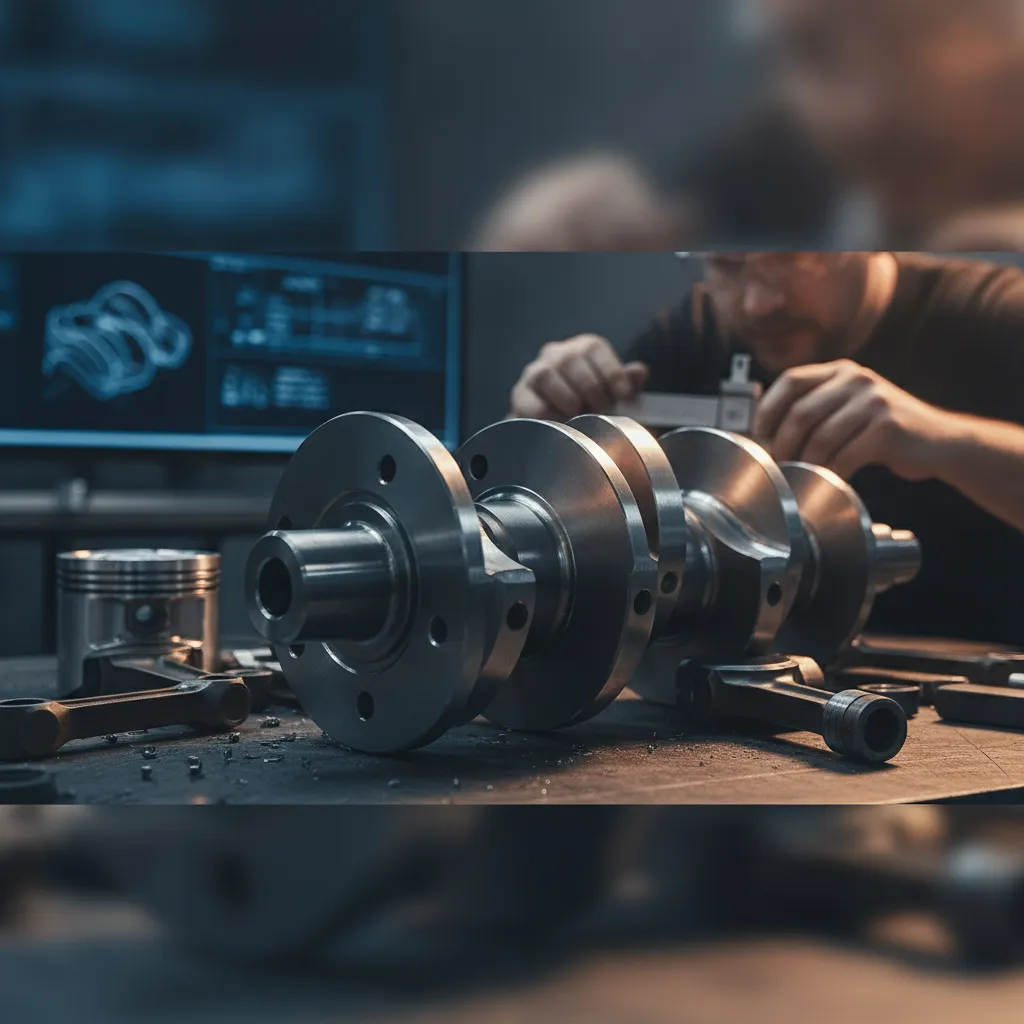
A custom crankshaft is a crankshaft machined or forged to specifications beyond what OEM or off-the-shelf options offer, different stroke lengths, custom journal diameters, specific material grades, or unique balancing requirements. Builders choose them when a stock crank can’t handle target power levels, when an engine displacement change demands a new stroke, or when a specific application (racing, marine, industrial) requires tolerances tighter than production parts deliver.
What a Custom Crankshaft Is and When You Actually Need One
A custom crankshaft is machined or forged to buyer-supplied specs, stroke, journal diameter, counterweight placement, material grade, not selected from a catalog.
OEM crankshafts are engineered for stock displacement and power levels. They hold up fine under normal operating loads, but sustained high-RPM operation or forced induction creates stress concentrations that production cranks aren’t designed to absorb. When those loads exceed what the OEM part was rated for, fatigue cracks typically start at the journal fillets, and that failure is rarely gradual.
“A production crankshaft is designed to meet a cost target and a warranty period — not to survive 1,000 horsepower for a decade. When builders push beyond those boundaries, a custom crankshaft isn’t an upgrade, it’s an engineering necessity.” — Senior Engine Builder, Professional Racing Division
Which Engine Types and Vehicles Benefit Most
Stroker builds are the most common application. A 383 Chevy or 408 Ford stroker requires a longer stroke than the factory block was designed around, which means a new crank is mandatory, not optional. Competition engines in NHRA and NASCAR programs demand custom forgings because catalog parts can’t meet the combination of stroke, journal size, and material spec those applications require. Marine diesels and industrial equipment with non-standard bore/stroke ratios fall into the same category: no catalog part exists, so a custom crankshaft is the only path.
The following engine types and applications most commonly require a custom crankshaft:
- Stroker builds requiring displacement increases beyond factory stroke (e.g., 383 Chevy, 408 Ford, 427 LS)
- NHRA and NASCAR competition engines with non-catalog stroke and journal combinations
- Marine diesel engines with non-standard bore-to-stroke ratios
- Industrial power units where no OEM replacement exists
- Forced-induction builds exceeding 400 HP where OEM crank failures are documented
- Agricultural and heavy equipment engines requiring custom material grades
Why Builders Choose Custom Over OEM
A practical threshold: builders running naturally aspirated setups past 600 HP, or forced-induction builds past 400 HP where OEM crank failures are documented, should treat a custom crank as a requirement rather than an upgrade. At those power levels, journal tolerances measured in tenths of a thousandth of an inch determine whether the engine survives a full run, a point covered in detail in our precision tolerance stackup guide.
The material choice matters as much as the geometry. Billet steel, typically 4340 chromoly, offers a fatigue strength advantage over cast iron OEM cranks that becomes decisive under repeated high-load cycles. SCAT Crankshafts and Bryant Racing both build competition cranks from billet or forged steel specifically because cast production cranks can’t match the grain structure or surface finish those applications demand.
Billet vs. Forged Custom Crankshaft: Material, Cost, and Performance Compared
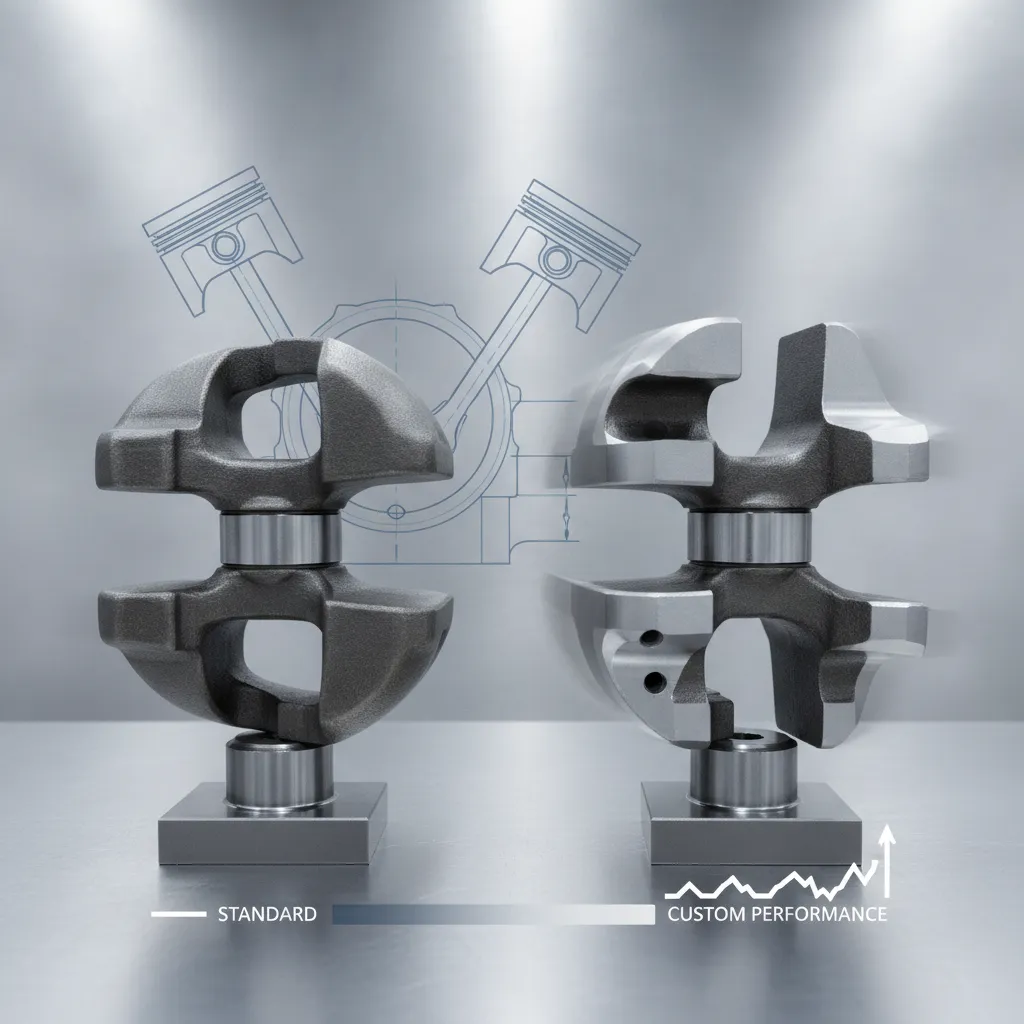
Forged cranks suit most high-performance street and strip builds; billet cranks are the right call when non-standard geometry rules out existing forging dies.
A forged crankshaft is shaped under extreme pressure, typically 2,000–10,000 tons, then finish-machined to final dimensions. That process aligns the steel’s grain structure along the part’s stress lines, which improves fatigue resistance under repeated load cycles. A billet crank, by contrast, is CNC-machined from a solid bar of steel, giving engineers complete geometric freedom: unusual stroke lengths, custom snout dimensions, or asymmetric counterweight placement that no forging die can produce.
“The grain flow in a properly forged crankshaft follows the contour of the part — that’s what gives it superior fatigue life compared to a billet piece machined across the grain. For most high-performance builds, forging is the right starting point.” — Metallurgical Engineer, Automotive Forgings Industry
How Material Grade Affects Durability and Fatigue Life
4340 chromoly steel is the standard material for performance forged cranks, it delivers a tensile strength above 220,000 psi and handles the fatigue cycles typical of street/strip builds without exotic processing. Billet cranks for top-tier racing applications step up to 300M steel, a modified 4340 with vanadium added to increase fracture toughness. According to Bryant Racing, Top Fuel and Pro Stock teams rely on 300M precisely because journal diameters are finish-machined to within ±0.0001″, tolerances that demand both premium material and controlled CNC processes. (For a closer look at how those tolerances are held in production, see our article on CNC machining tolerances explained.)
Forged cranks handle fatigue better in builds where geometry stays close to OEM specs. When a custom crankshaft requires a stroke or snout length that falls outside standard die dimensions, billet is the only practical path.
Price Ranges for Billet vs. Forged Options
Forged custom cranks from specialty shops typically run $800–$2,500, depending on steel grade, journal count, and finish operations. Billet cranks occupy a different tier entirely: expect $2,000–$6,000+ for racing-spec pieces from established suppliers. The gap reflects longer CNC cycle times, higher material cost for 300M bar stock, and the engineering hours required to program non-standard geometry from scratch.
Neither option is universally better, the right choice depends on your power target, stroke requirement, and production volume. The table below summarizes the key differences:
- Forged 4340 steel: Best for street/strip builds up to ~1,000 HP; $800–$2,500; 6–10 week lead time
- Billet 4340 steel: Ideal for non-standard geometry; $2,000–$4,000; 4–8 week lead time
- Billet 300M steel: Top-tier racing applications; $4,000–$6,000+; 6–12 week lead time
Technical Specifications to Nail Before You Order
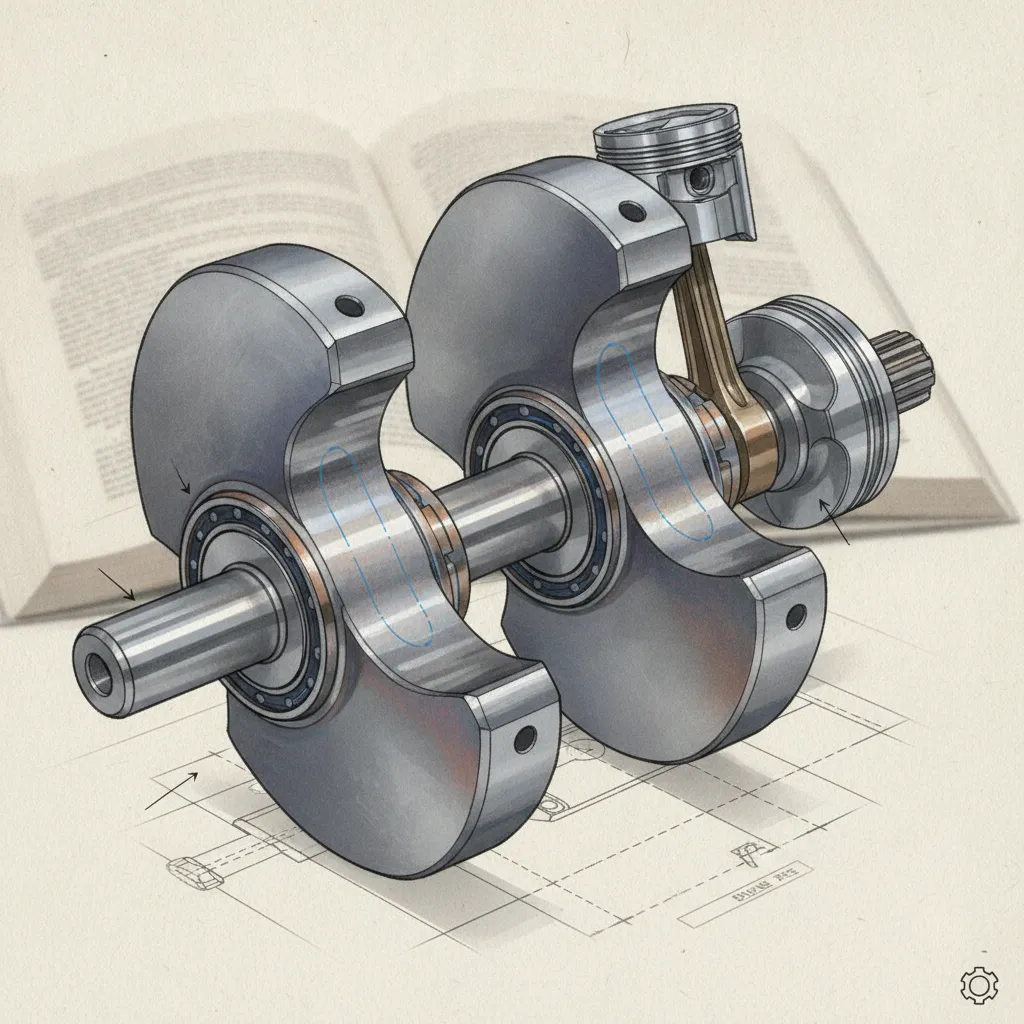
A custom crankshaft order requires stroke length, journal diameters, balancing method, surface finish, snout dimensions, and flange bolt pattern before production starts.
Stroke, Journal Diameter, and Balancing Methods Explained
Stroke length is your primary spec. It equals twice the crank throw offset, a 4.000″ stroke on a small-block Chevy, paired with a 4.030″ bore, produces a 383 cubic inch displacement. Get this number wrong and the entire build is compromised.
Main and rod journal diameters must match your block and connecting rod specs exactly. For each journal, specify diameter, width, and surface finish. Most performance applications call for Ra 8–16 microinch on journal surfaces, tighter than that adds cost; looser risks bearing failure under load.
Balancing method is the third critical input. Internal balance uses counterweights machined directly into the crank. External balance relies on a weighted harmonic damper and flexplate to offset rotating mass, common on stock small-block Ford and big-block Chevy applications. Specify which your block requires before you order; swapping balance types after manufacture is not a minor fix.
How to Match Specs to Your Specific Engine Build
Beyond the core three, confirm snout diameter and length, flange bolt pattern, keyway location, and oil hole drilling pattern. Missing any one of these inputs causes costly rework, machining a new oil passage or re-cutting a keyway after heat treatment is avoidable with a complete spec sheet up front.
Threaded snout ends and flange bolt patterns also require precise thread form and pitch. If your build uses non-standard thread configurations, review your machining partner’s CNC threading capabilities before finalizing drawings, thread errors on a crankshaft snout are not field-serviceable.
MFG SOLUTION’s engineering team reviews submitted specs against block and rod dimensions before quoting, catching conflicts before they reach the shop floor. Quotes come back within 8 hours of specification submission. For more information, see Custom Freedom Forged Hitch Covers.
Lead Times, Pricing, and What Drives Both
Custom crankshaft orders typically take 4–12 weeks, with cost ranging from a few hundred to several thousand dollars depending on material, geometry, and finishing requirements.
Material grade is the first major cost lever. Billet 4340 steel is the baseline for most performance builds; 300M (a higher-silicon variant with greater tensile strength) costs more per bar and requires tighter machining parameters. Non-standard stroke lengths add further cost because the shop must program custom toolpaths from scratch rather than pulling an existing file.
Surface treatments are a real line item. Nitriding—a heat-based process that diffuses nitrogen into the journal surface to harden it—adds $150–$400 per crankshaft but measurably extends journal life under high-load conditions. Most performance builders treat it as standard, not optional. Shot-peening, which compresses the surface grain to resist fatigue cracking, carries a similar add-on cost.
Lead time varies by shop type. Large-volume producers like SCAT Crankshafts and Bryant Racing typically quote 6–10 weeks due to order backlog. Boutique CNC shops handling simpler billet designs can often deliver in 3–5 weeks. Rush orders at premium facilities can compress timelines to 2–3 weeks, but expect a surcharge.
Incomplete specs are the most avoidable delay. Shops report that orders requiring back-and-forth clarification on journal diameters, stroke, or keyway dimensions add 1–3 weeks to production. Submit complete, verified drawings on day one and your build schedule stays intact.
Real-World Performance, Durability Testing, and Warranty Coverage
A well-documented custom crankshaft from a reputable manufacturer will survive 50+ dyno pulls without measurable journal wear—if it’s correctly spec’d, inspected, and warranted in writing.
One documented example: a 632 cubic inch big-block Chevy running 1,200 HP on a billet 4340 steel crank with a 4.750″ stroke completed more than 50 dyno pulls without detectable journal wear when clearances were set to spec. That result depends on the entire manufacturing chain—material grade, fillet radii, balance, and surface finish—not just raw steel quality.
Two failure modes account for most field failures. Fillet radius cracking occurs when the transition radius at journal edges is too tight, concentrating stress under load. Torsional vibration failures happen when a crank is improperly balanced, sending destructive harmonic energy through the rotating assembly. Both are preventable with correct specifications and controlled manufacturing—ask your supplier directly how they spec fillet radii and what balancing method they use.
“We see fillet radius failures almost exclusively in cranks where the radius was tightened to save weight without a corresponding increase in material strength. The geometry and the metallurgy have to work together — you can’t optimize one in isolation.” — Quality Control Director, Precision Crankshaft Manufacturing
What Warranty Coverage and Durability Testing Should Include
Reputable manufacturers perform magnetic particle inspection (MPI) on every finished crank to detect surface cracks before shipment. Request the MPI report as part of your documentation package—if a shop can’t provide it, treat that as a disqualifying gap. According to the Society of Automotive Engineers (SAE), documented non-destructive testing is a baseline quality requirement for safety-critical rotating components.
The same principle applies across tight-tolerance CNC work: documented quality control is non-negotiable. CNC machining for medical devices, for instance, requires full traceability at every process step—crankshaft journals demand the same discipline because the consequences of an undetected defect are equally severe.
Warranty terms vary sharply across suppliers. Some shops offer a lifetime warranty against manufacturing defects; others cap coverage at one year; some offer nothing at all. Get the warranty terms in writing before placing your order—verbal assurances carry no weight when a journal fails at 7,000 RPM.
Frequently Asked Questions
Can a custom crankshaft be made for a diesel or industrial engine, not just automotive performance builds?
Yes, custom crankshafts are regularly produced for diesel, marine, agricultural, and industrial power units, not only racing or performance automotive applications. Material selection shifts toward higher-grade alloy steels to handle the improved torque loads typical of diesel cycles. Journals, stroke dimensions, and counterweight geometry are all specified to the engine’s design requirements, so the machining process is fundamentally the same regardless of application.
What is the difference between a stroker crankshaft and a standard custom crankshaft?
A stroker crankshaft increases engine displacement by extending the piston stroke beyond the factory specification, achieved by moving the rod journals farther from the crankshaft centerline. A standard custom crankshaft replicates or replaces an OEM design with tighter tolerances or better material, without changing stroke length. Both are custom-machined parts, but a stroker specifically targets displacement and power output increases rather than direct replacement.
How do I verify that a custom crankshaft was machined to my exact specifications before I install it?
Request a dimensional inspection report, ideally a CMM (coordinate measuring machine) report, that documents journal diameters, stroke length, runout, and surface finish against your drawing tolerances before accepting the part. Reputable manufacturers operating under ISO 9001:2015 maintain documented process control records for every production run. At MFG SOLUTION, every precision machined part ships with full traceability, so you can audit the measurement data before the crankshaft ever reaches your engine assembly line.
Is nitriding or shot-peening worth the added cost on a custom crankshaft?
Both treatments are worth the cost for high-load or high-cycle applications. Nitriding increases surface hardness and wear resistance on journal surfaces without distorting the part geometry. Shot-peening introduces compressive stress into the fillet radii, which directly reduces the risk of fatigue cracking under cyclic bending loads. For street or light-duty use, standard heat treatment may be sufficient, but for racing, diesel, or industrial duty cycles, both processes extend service life measurably.
How long does a custom crankshaft last compared to an OEM crankshaft?
A properly specified and manufactured custom crankshaft will typically outlast an OEM unit in high-performance applications by a significant margin. OEM cranks are designed for stock power levels and standard duty cycles; a custom crankshaft built from 4340 or 300M steel with nitrided journals and correct fillet radii can sustain hundreds of high-load cycles without measurable wear. Service life depends heavily on correct installation clearances, oil quality, and operating conditions — but a well-built custom crank in a properly assembled engine routinely exceeds 100,000 miles or thousands of race passes.
Conclusion
A custom crankshaft delivers real performance or reliability gains only when material selection, journal geometry, and surface treatment are all specified correctly from the start. The three decisions that matter most: choose the right steel grade for your load cycle, confirm dimensional accuracy with a CMM report before installation, and add nitriding or shot-peening if the application runs high RPM or improved torque.
If your project requires precision-machined crankshaft components with documented quality control, submit your part drawings to MFG SOLUTION, you’ll receive a detailed quote within 8 hours and can expect shipment within 3 days of approval, backed by IATF 16949 certification for automotive-grade compliance.
Recommended Articles
Explore more from our content library: