
2026-07-14
Medical Device Machining Compliance Guide

Medical device machining compliance means meeting FDA 21 CFR 820 and ISO 13485:2016 requirements at every stage of CNC production, from material selection and tolerance control to documentation, traceability, and post-market surveillance. Non-compliance risks FDA warning letters, product recalls, and loss of market access. Manufacturers targeting U.S. markets must align with 21 CFR 820; those selling in the EU need ISO 13485 and CE marking. Both frameworks demand documented quality management systems, validated processes, and full audit trails.
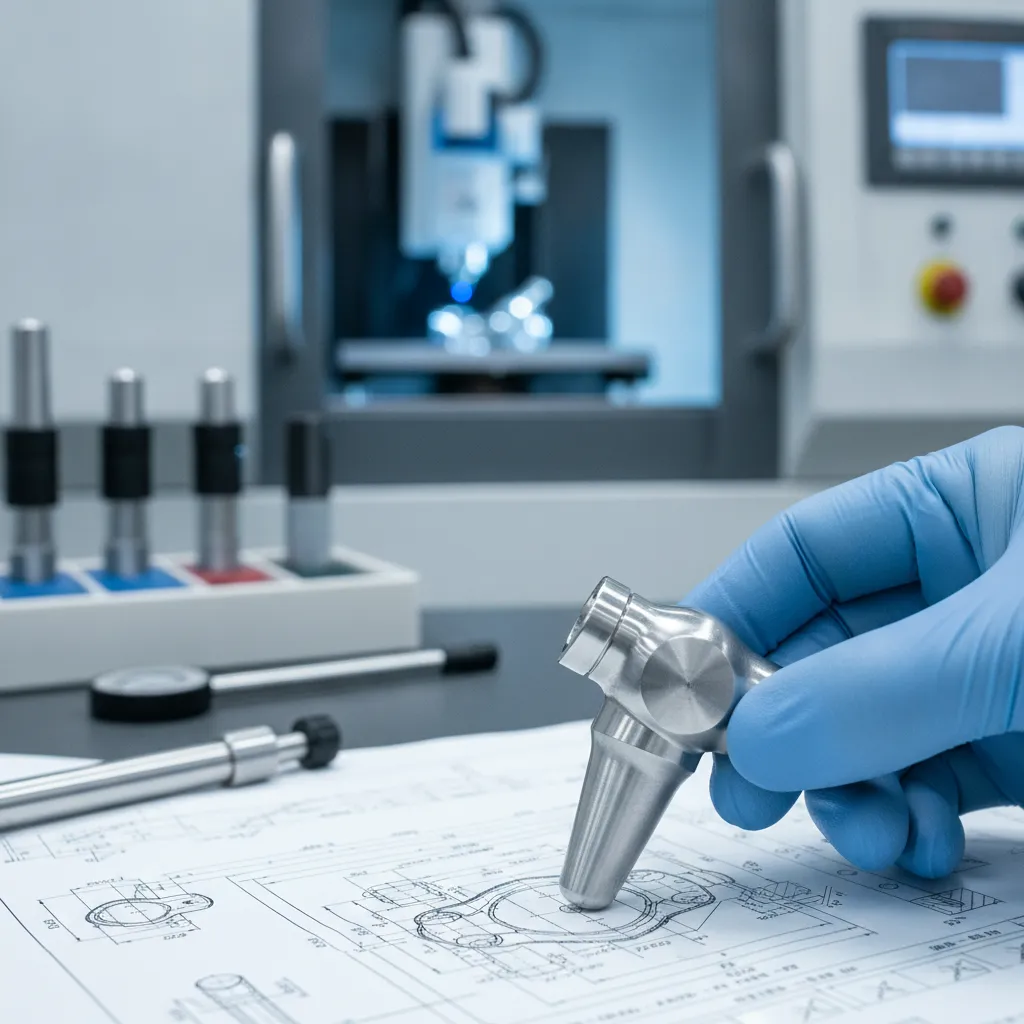
Understand Medical Device Machining Compliance Requirements
Medical device machining compliance spans four overlapping frameworks, FDA, ISO, EU MDR, and device classification rules, each with distinct documentation and validation demands.
In the U.S., FDA 21 CFR 820 (Quality System Regulation) sets the baseline. It requires documented design controls, process validation records, and corrective and preventive action (CAPA) procedures for every production step. CNC manufacturers supplying U.S. medical OEMs must treat these requirements as non-negotiable, not as optional best practices.
ISO 13485:2016 operates as the international counterpart. CE marking in the EU mandates it, but U.S.-based suppliers increasingly face it as an OEM contract requirement regardless of their target market. Customers buying precision machined components for implants or surgical instruments want a certified quality management system on file before they sign a purchase order.
Two newer obligations are reshaping the compliance picture. The FDA’s 2023 Consolidated Appropriations Act introduced cybersecurity requirements for connected and software-enabled devices, relevant to any machined housing or enclosure that integrates electronics. EU Regulation 2017/745 (EU MDR) added structured post-market surveillance obligations that trace back to every component supplier in the chain.
According to the U.S. Food and Drug Administration, quality system regulations under 21 CFR Part 820 are designed to ensure that finished devices are safe, effective, and otherwise in compliance with the Federal Food, Drug, and Cosmetic Act. The International Organization for Standardization (ISO) similarly notes that ISO 13485:2016 specifies requirements for a quality management system where an organization needs to demonstrate its ability to provide medical devices and related services that consistently meet customer and applicable regulatory requirements.
“Compliance is not a destination — it is a continuous process of documentation, validation, and improvement that must be embedded into every machining operation from day one.” — Dr. Susan Alpert, Former Director of the Office of Device Evaluation, U.S. FDA
Which Device Classes Trigger the Strictest Machining Controls
Device classification sets the compliance burden directly. Class I devices (tongue depressors, bandages) carry minimal controls. Class II devices, surgical drills, diagnostic catheters, typically clear the market via the FDA’s 510(k) pathway, which requires demonstrated substantial equivalence to a predicate device. Class III implants, such as spinal fusion cages or cardiac valves, require Premarket Approval (PMA), the most demanding review path, with full clinical evidence and exhaustive manufacturing documentation.
For CNC manufacturers, Class III parts demand the tightest process controls. The key requirements include:
- Validated toolpaths with documented acceptance criteria
- Material traceability to the heat lot for every raw stock batch
- Dimensional inspection records tied to individual part serial numbers
- Corrective and preventive action (CAPA) records for any nonconformance
- Process validation protocols (IQ/OQ/PQ) for all critical operations
For application context on which machining methods apply to each device type, see our CNC machining medical devices overview — this section covers the regulatory angle only.
FDA vs. ISO 13485: Which Framework Applies to Your Market
The short answer: both frameworks likely apply, even if you sell only in one market. FDA 21 CFR 820 governs U.S. device manufacturing; ISO 13485:2016 governs EU market access and is the standard OEM customers worldwide use to qualify suppliers. The two systems overlap significantly — both require documented procedures, internal audits, and corrective action records — but they differ on specifics like design history file structure and post-market surveillance scope.
MFG SOLUTION holds ISO 13485:2016 certification alongside ISO 9001:2015 and IATF 16949, which means its quality management system is already structured to satisfy the documentation and process control requirements that medical OEMs audit before awarding contracts. Manufacturers sourcing precision machined parts up to 38mm diameter can verify supplier certification status before submitting specifications, a step that eliminates a common audit gap.
“The convergence of FDA QSR and ISO 13485 requirements means that a well-structured quality management system can satisfy both regulators simultaneously — but only if it is built with that dual purpose from the start.” — Mark Swanson, Principal Consultant, Medical Device Quality Systems
Compare Compliance Certification Costs: ISO 13485, FDA 510(k), and CE Marking
ISO 13485 offers the lowest entry cost and broadest market access; FDA 510(k) and CE marking add device-level or regional approval at significantly higher expense.
What ISO 13485 Certification Actually Costs a Small Shop
For a small precision machining operation, the initial gap assessment and certification audit for ISO 13485:2016 typically runs $15,000–$40,000, with annual surveillance audits adding another $5,000–$10,000 per year. Implementation, covering documented procedures, process controls, and staff training, takes 9–18 months from kickoff to certificate.
The ROI case is concrete: ISO 13485 certification typically enables OEM supply contracts worth 3–5x the certification cost within 24 months. Shops without it are disqualified from most Tier 1 medical OEM supplier lists before a single quote is reviewed. MFG SOLUTION holds ISO 13485:2016 certification alongside ISO 9001:2015 and IATF 16949, a combination that satisfies supplier qualification requirements across medical, automotive, and electronics customers simultaneously.
According to Marver Med’s medical device machining guide, precision machining suppliers that invest in ISO 13485 certification consistently report faster OEM qualification cycles and fewer audit findings compared to non-certified shops — a direct competitive advantage in the medical supply chain.
When to Pursue 510(k) vs. CE Marking Based on Market Strategy
FDA 510(k) submission fees in 2024 are $21,445 for standard submissions; small businesses pay a reduced rate of $5,362. Third-party testing and documentation preparation adds $50,000–$150,000 depending on device classification and complexity. The 510(k) path is device-level and U.S.-specific — it clears a particular product for market, not your facility. For more information, see Thegoodcode.
CE marking under the EU MDR requires engagement with a Notified Body. Costs range from $30,000 to $100,000+, and timelines have stretched to 18–36 months due to Notified Body backlogs that worsened after the 2021 MDR transition. For manufacturers prioritizing medical device machining compliance across both markets, ISO 13485 is the logical first investment — it satisfies the quality system requirements that underpin both 510(k) submissions and CE technical files.
| Certification | Entry Cost | Timeline | Market Access | Ongoing Cost |
|---|---|---|---|---|
| ISO 13485 | $15,000–$40,000 | 9–18 months | Global OEM supplier lists | $5,000–$10,000/yr |
| FDA 510(k) | $50,000–$150,000+ | 6–12 months (typical) | U.S. device clearance | Varies by device changes |
| CE Marking (EU MDR) | $30,000–$100,000+ | 18–36 months | EU market access | Notified Body fees annually |

Implement ISO 13485 Compliance Step by Step
Achieving medical device machining compliance follows four sequential steps: gap analysis, document control, process validation, and supplier qualification.
Run a Gap Analysis Against ISO 13485:2016 Clauses
Start by auditing your current quality management system clause by clause against ISO 13485:2016. The three gaps CNC shops most commonly uncover are missing risk management documentation per ISO 14971, absent design history files, and undocumented supplier qualification records. Flag each gap with a priority rating before writing a single new procedure.
Once gaps are mapped, build a document control system covering SOPs, work instructions, and change control logs. Both ISO 13485 clause 4.2 and FDA 21 CFR 820.40 require this structure — every document revision must be approved, dated, and traceable. A shared document management platform with role-based access satisfies both requirements without duplicating effort.
Simultaneously, establish your Approved Supplier List. Medical OEMs expect documented supplier qualification with audit records and material certifications — for example, ASTM F136 certification for Ti-6Al-4V ELI used in orthopedic implants. MFG SOLUTION maintains exactly this kind of supplier documentation under its ISO 13485:2016 certification, which supports customers who need a fully auditable supply chain.
Validate CNC Processes That Cannot Be Fully Inspected
ISO 13485 clause 7.5.6 requires process validation wherever inspection alone cannot confirm conformance — surface finish on implant-contact surfaces is the standard example. Run Installation Qualification, Operational Qualification, and Performance Qualification (IQ/OQ/PQ) protocols for each such process, and retain every protocol as a controlled record.
Skipping this step carries real cost. A Midwest CNC shop received an FDA Form 483 observation for missing corrective and preventive action (CAPA) records after a titanium bone screw batch failed dimensional inspection. Remediation took 11 months and cost $180,000 in rework and audit fees — a figure that dwarfs the original validation investment. Complete your first surveillance audit only after CAPA records, process validation reports, and supplier qualification files are all in order.
As detailed in Staub Inc.’s precision medical device production guide, advanced CNC equipment combined with rigorous IQ/OQ/PQ validation protocols is the foundation of a defensible compliance posture for Class II and Class III device components.
Choose Between In-House and Outsourced Compliance Strategies
Outsourcing medical device machining compliance to a certified supplier cuts time-to-market by 6–12 months; building in-house gives you full audit control but costs significantly more upfront.
The in-house path requires a dedicated quality engineer — salary range $75,000–$110,000 per year — plus QMS software at $8,000–$25,000 annually. Add 12–18 months before your first ISO 13485 certification audit, and the internal build carries both a high cash cost and a long runway before you can ship compliant parts.
Outsourcing transfers the audit burden to your supplier. An ISO 13485-certified shop like MFG SOLUTION — which holds ISO 13485:2016 certification alongside ISO 9001:2015 and IATF 16949 — can be qualified as a supplier in 60–90 days. That’s roughly a 12-month head start over the in-house route.
The ROI difference is concrete. For a $2M annual medical device program, cutting time-to-market by 6–12 months translates to $500,000–$1M in earlier revenue — money that an in-house compliance build actively delays.
“Outsourcing to a certified precision machining partner is often the fastest path to medical device machining compliance for OEMs that lack internal manufacturing infrastructure — provided the supplier’s quality system is genuinely audit-ready, not just paper-certified.” — Jennifer Hicks, Director of Supplier Quality, Medical Device Industry Forum
What to Verify Before Signing a Medical CNC Machining Contract
Supplier qualification for tight-tolerance medical parts — see our CNC machining medical devices and machining tolerances explained pages for specification benchmarks — requires four concrete checks:
- Confirm the supplier’s ISO 13485:2016 certificate scope explicitly covers your device class, not just general manufacturing.
- Request the last three CAPA records to assess how the shop identifies, resolves, and prevents recurring nonconformances.
- Verify lot-level material traceability from raw stock receipt through to the shipped part — ask for a sample traveler document.
- Confirm whether the facility offers cleanroom or controlled-environment machining if your device class requires particulate control.
A supplier that can’t produce these records on request is not audit-ready — and your next FDA inspection will surface that gap before they do. For additional guidance on what to expect from a compliant CNC machining partner, MacFab’s overview of CNC machining precision and compliance for medical devices provides useful benchmarks for evaluating supplier capabilities.
Avoid These Common Medical Device Machining Compliance Mistakes
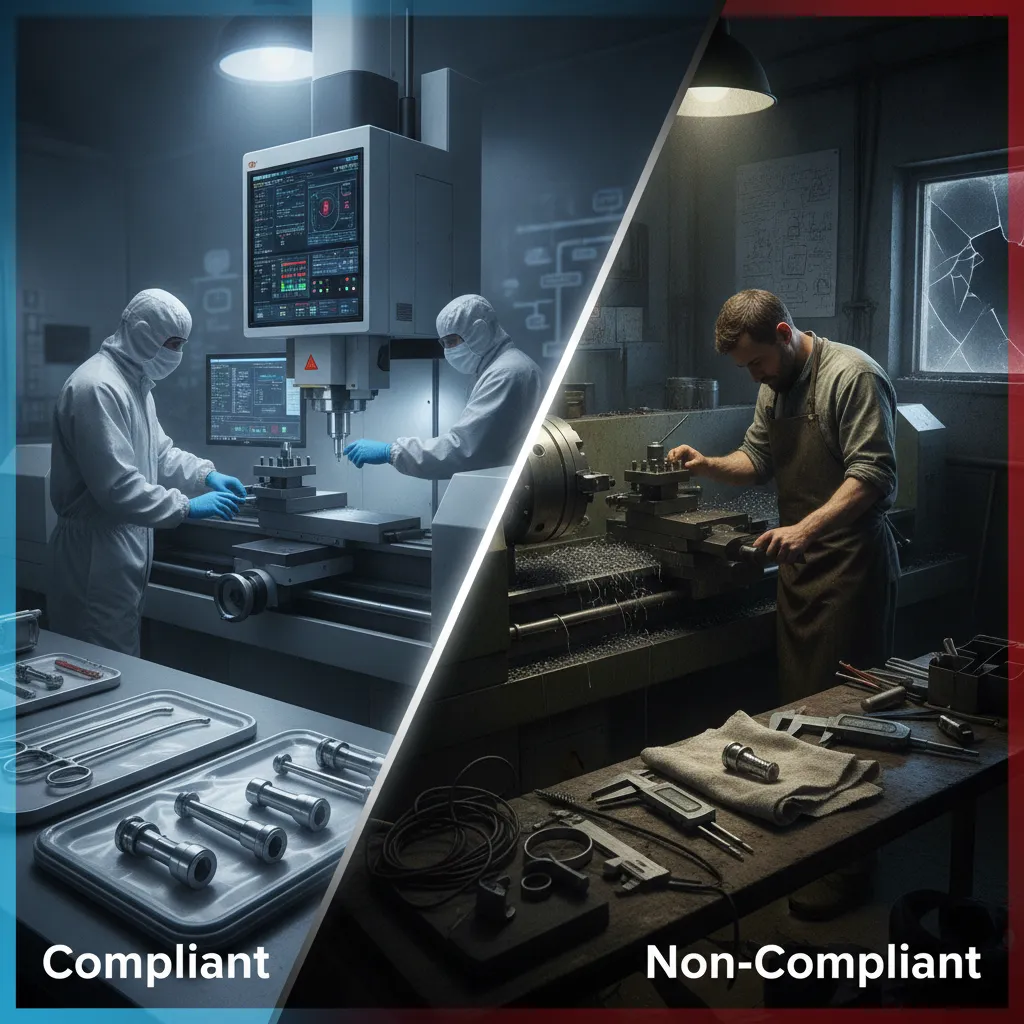
The most frequent medical device machining compliance failures trace back to five specific gaps, each one documented in FDA 483 observations and ISO audit findings.
Mistake 1: Skipping Process Validation for Finishing Operations
Surface grinding and electropolishing on implant surfaces are routinely treated as standard production steps. Under ISO 13485 clause 7.5.6, they require formal validation — documented protocols, acceptance criteria, and revalidation triggers. Running these operations without a validation package puts your entire production record at risk during an audit.
Mistake 2: Inadequate Material Traceability
FDA 21 CFR 820.60 requires device identification throughout production. Lot-level traceability — from the raw material certificate to the finished part — is non-negotiable, and missing it ranks among the top-5 Form 483 observations issued to machining suppliers. Every material heat number must link to every shipped lot. The FDA’s 21 CFR Part 820 regulatory text outlines the full scope of device identification and traceability requirements that machining suppliers must satisfy.
Mistake 3: Treating ISO 9001 as Equivalent to ISO 13485
ISO 9001 does not address risk management under ISO 14971, sterile device requirements, or implant traceability. OEMs sourcing Class II or Class III devices will reject ISO 9001-only suppliers outright. MFG SOLUTION holds ISO 13485:2016 certification specifically because medical customers cannot accept a quality system that stops short of those requirements.
Mistake 4: Ignoring Post-Market Surveillance Documentation
EU MDR requires manufacturers — and their component suppliers — to maintain technical files updated with post-market data. Many machining shops assume this obligation belongs solely to the OEM. It does not. If your parts appear in a device’s technical file, you share the documentation burden.
Mistake 5: Using Unqualified Coolants or Lubricants on Biocompatible Materials
Residual cutting fluid on titanium or PEEK implant components can trigger ISO 10993 biocompatibility failures during device testing. Coolants and lubricants used on these materials must be qualified and documented — not assumed safe because they work on standard steel. See our guide to CNC coolants and lubricants for material-specific selection criteria.
Frequently Asked Questions
What materials are approved for medical device CNC machining under FDA and ISO standards?
FDA and ISO 10993 recognize titanium (Grades 2 and 5), 316L stainless steel, cobalt-chrome alloys, and PEEK as the primary biocompatible materials for machined medical components. Aluminum and brass are acceptable for non-implantable housings and instrument bodies. Each material must pass biocompatibility testing relevant to its intended contact type — surface, short-term, or long-term implant — before FDA clearance. Your machining supplier should maintain documented material certifications and traceability records for every lot used in production.
How long does it take to get ISO 13485 certified as a CNC machining shop?
Most CNC machining shops take 9 to 18 months to achieve ISO 13485:2016 certification from initial gap assessment to final registrar audit. Timeline depends on the shop’s existing quality management infrastructure — shops already holding ISO 9001:2015 typically move faster because core documentation and process control systems are already in place. Budget for internal audits, corrective action cycles, and at least one full surveillance audit before the certification body issues the certificate.
Does a CNC machining supplier need its own FDA registration, or does the OEM cover that?
A CNC machining supplier that manufactures components — but does not assemble or label finished devices — typically does not require its own FDA establishment registration; that obligation falls on the OEM or specification developer. However, if the supplier performs contract sterilization, final assembly, or repackaging, FDA registration is required. Regardless of registration status, the supplier must operate under a quality agreement with the OEM and remain audit-ready as a critical supplier under 21 CFR Part 820 or EU MDR Article 10.
What cybersecurity compliance requirements apply to manufacturers machining components for connected medical devices?
Machining suppliers themselves are not directly subject to FDA cybersecurity guidance, but OEMs building connected devices must now submit a Software Bill of Materials (SBOM) and a cybersecurity risk management plan under the Consolidated Appropriations Act of 2023. If your machined components integrate sensors, firmware interfaces, or electronic assemblies, the OEM will likely require design documentation and change-control records from you to support their FDA premarket submission. Align your design history file practices with IEC 81001-5-1 to stay ahead of OEM audit requests.
What is the difference between a quality agreement and an ISO 13485 certificate when qualifying a machining supplier?
An ISO 13485 certificate confirms that a supplier’s quality management system has been independently audited and meets the standard’s requirements. A quality agreement is a contractual document between the OEM and supplier that defines specific responsibilities, communication protocols, change notification requirements, and audit rights for a particular supply relationship. Both are required for medical device machining compliance — the certificate demonstrates system capability, while the quality agreement governs how that system is applied to your specific parts and device program.
Conclusion
Medical device machining compliance is not a single certification — it is a system of interlocking controls: ISO 13485:2016 quality management, 21 CFR Part 820 design history documentation, validated processes, and full material traceability from raw stock to finished part. Three actions matter most: close your documentation gaps before an FDA audit finds them, validate every critical process with written acceptance criteria, and qualify your machining supplier against the same standards you hold internally.
If you are sourcing small precision components under 38mm diameter, request a supplier’s ISO 13485 certificate and ask specifically for their corrective action closure rate from the last surveillance audit — that single metric reveals more about real compliance maturity than any brochure. Submit your part specifications to MFG SOLUTION for an 8-hour quote and confirm certification documentation before your next production run.
Recommended Articles
Explore more from our content library:
- How to Implement Swiss Machining for Complex Small Parts
- How to Validate Coolant CNC Performance in High-Speed Ops
- How to Specify CNC Workholding for Optimal Part Accuracy
- How to Reduce Deburring Costs CNC: Save 25–40% on Finishing
- How to Manage Tolerance Stackup in Precision Parts