
2026-07-16
Open Die Forged: Process, Materials, Applications

Open die forged parts are shaped by compressing metal between flat or simple dies that do not fully enclose the workpiece, allowing the material to flow outward freely. This process produces parts with superior grain structure, high strength, and excellent fatigue resistance compared to cast or machined alternatives. It is the preferred method for large, custom, or low-volume components in aerospace, energy, and heavy industry where structural integrity is non-negotiable.
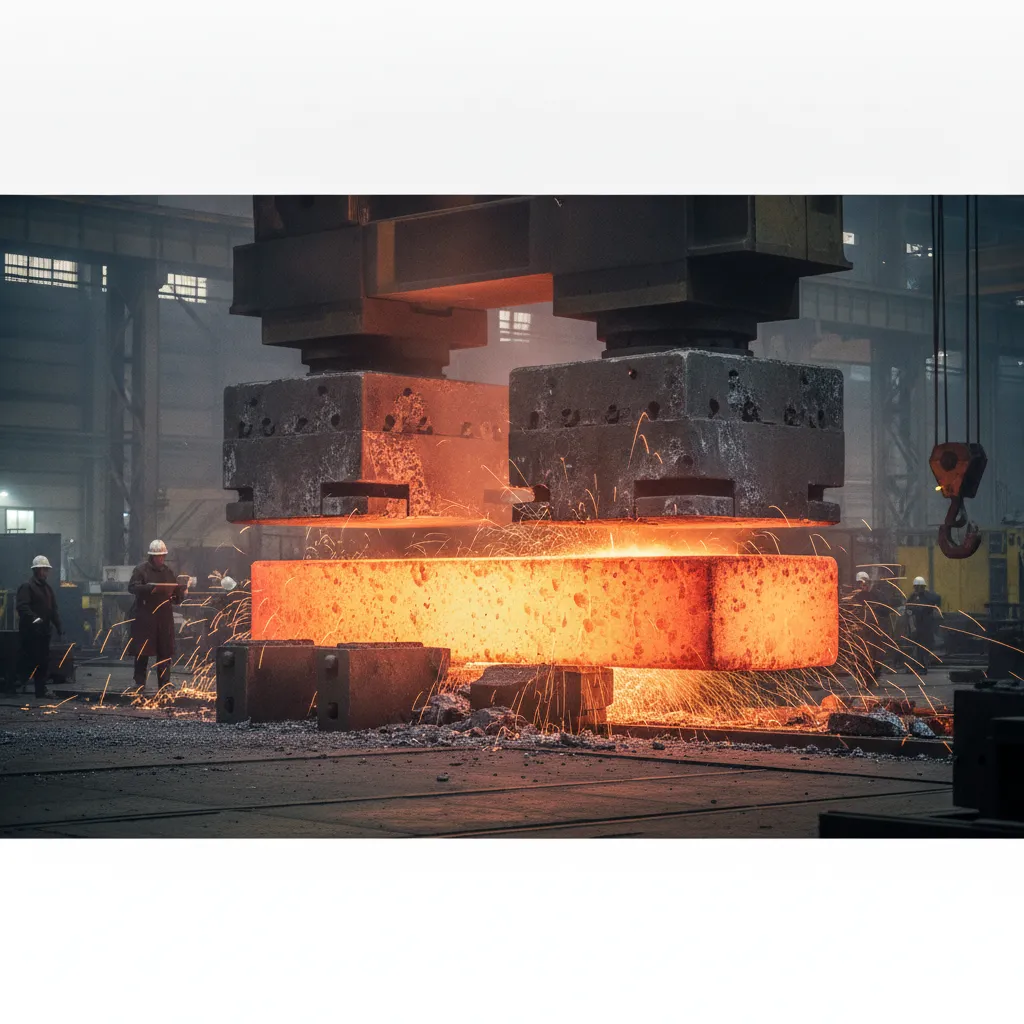
What Open Die Forged Means and How the Process Works
Open die forging shapes metal between dies that never fully enclose the workpiece, letting material flow freely beyond the die faces during each press or hammer blow.
The dies themselves are simple, flat, V-shaped, or contoured, and the workpiece is repositioned repeatedly between strikes to build up the target geometry. Because the metal is never trapped, there is no flash line and no enclosed cavity constraining its movement, which is the defining difference from closed die forging. According to Scot Forge, open die forging is particularly advantageous for large, custom components where closed die tooling would be cost-prohibitive.
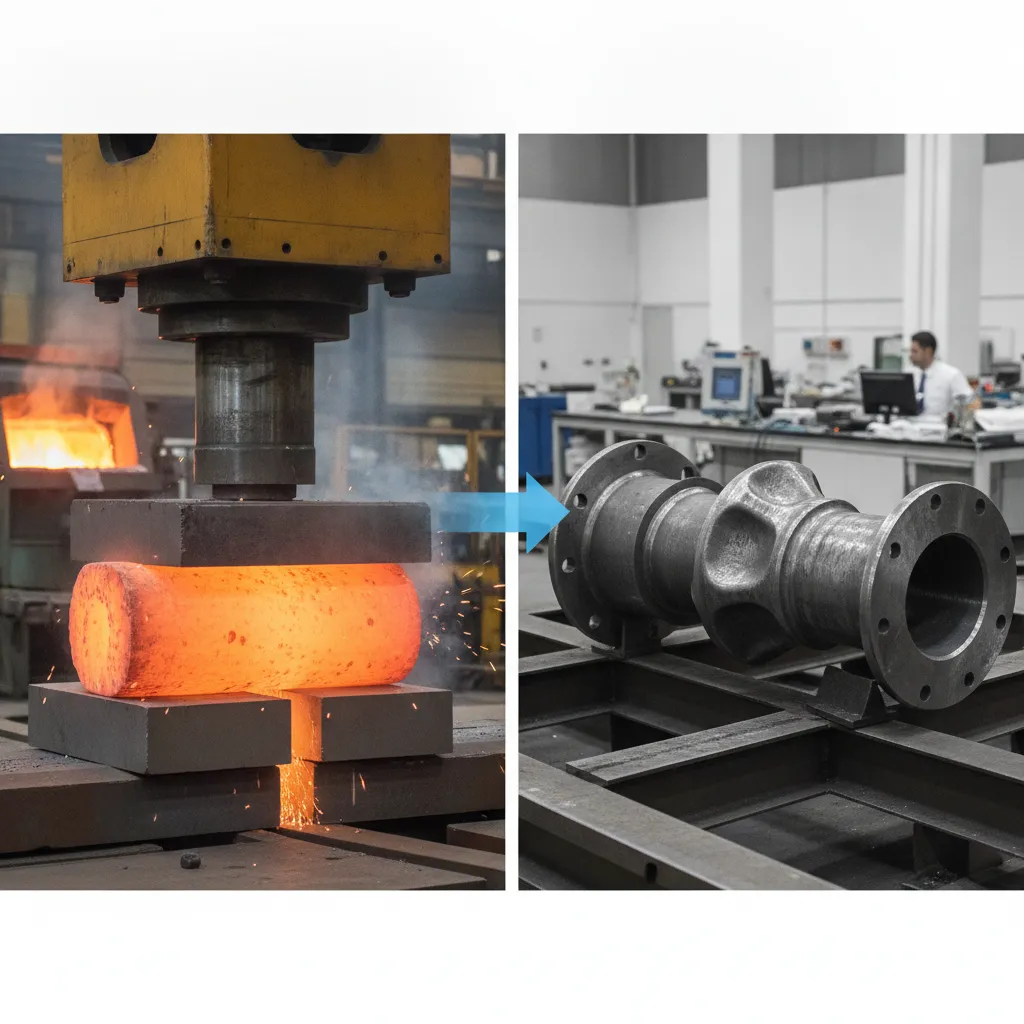
The output is a near-net blank, a shaft, disc, ring, cylinder, or custom profile, that always requires downstream machining to reach final tolerances. Open die forgings are raw material with superior internal structure, not finished parts.
“Open die forging allows us to work with virtually unlimited part sizes and shapes, giving engineers the flexibility to optimize grain flow for maximum structural performance.” — Dr. Rajiv Shivpuri, Professor of Industrial Engineering, The Ohio State University
Key Steps in the Open Die Forging Process
- Heat the billet. Steel billets are raised to forging temperature, typically 1,900–2,400°F depending on alloy grade, to bring the metal into a plastic, workable state.
- Position on the lower die. The heated billet is placed on the stationary lower die, usually on a press bed or anvil.
- Apply press or hammer blows. The upper die descends in repeated strokes, compressing the metal progressively rather than in a single strike.
- Rotate and reposition. The operator or manipulator rotates and repositions the workpiece between blows to distribute deformation and achieve uniform geometry.
- Cool and inspect. The forging is allowed to cool under controlled conditions, then inspected dimensionally before moving to machining.
The mechanical advantage of this sequence is grain flow. When metal deforms plastically under forging pressure, its grain structure aligns with the part’s shape rather than being severed, as it would be during machining from bar stock. That continuous grain flow is why open die forged components consistently outperform machined bar on fatigue life and impact resistance. You can see this process in action in this open die forging demonstration video on YouTube.
What Is the Difference Between Forged and Die Forged Products
The terms “forged,” “open die forged,” and “die forged” are used inconsistently across engineering specs and supplier catalogs, which creates real procurement confusion.
Forged is the broad category, any process that shapes metal through compressive force rather than casting or machining. Open die forged specifies free-form shaping where the workpiece is never enclosed, giving maximum size flexibility and lower tooling cost. Die forged, or “closed die forged”, means the metal is pressed into a machined cavity that defines the final shape precisely, trapping flash at the parting line. For a detailed side-by-side comparison, see this overview of open die vs. closed die forging advantages and disadvantages from Canton Drop Forge.
Engineers specifying parts should name the process explicitly. A drawing stamped “forged” without qualification leaves the manufacturing method open to interpretation and can result in parts with different grain structures, tolerances, and mechanical properties than intended.
Open Die vs. Closed Die Forging: Cost, Lead Time, and Best Use Cases
Open die forging costs less upfront but requires more post-forge machining; closed die delivers tighter tolerances at high volumes but demands $10,000–$100,000+ in tooling investment before the first part ships.
How Cost and Production Timelines Compare Between Open Die and Closed Die Forging
Open die forged parts use simple flat, semi-round, or V-shaped dies, no custom die sets. That minimal tooling investment makes it the practical choice for prototypes, one-off components, and large parts over 200 lbs where a custom die set would never pay for itself.
Closed die tooling runs $10,000–$100,000+ per die set depending on part complexity. That cost amortizes quickly at volume, closed die becomes cheaper per unit above roughly 500–1,000 pieces. Below that threshold, open die wins on total cost.
Lead time follows the same pattern. Open die forgings can move from order to finished blank in days to weeks because there is no tooling to fabricate first. Closed die adds 4–12 weeks for die manufacture before the first part ships, which matters when a product launch or supply chain disruption is driving the schedule.
“For low-volume, large-scale components, open die forging consistently delivers the best combination of mechanical properties and cost efficiency — there is simply no competing process at that scale.” — Michael Gehringer, Senior Applications Engineer, Scot Forge
Advantages and Limitations of Each Forging Method
Open die handles parts from a few pounds up to 300+ tons, large shafts, pressure vessel shells, and custom flanges that no closed die press could accommodate. Design changes cost nothing because there is no die to rework.
The trade-off is dimensional precision. Open die parts carry wider as-forged tolerances and typically require CNC finishing to hit tight specs, a step that adds time and cost. Understanding how those finishing operations affect precision tolerance stackup is critical before committing to an open die process.
Closed die excels at complex near-net shapes under roughly 150 lbs with tight dimensional repeatability across thousands of identical parts. The geometry is locked to the die, which is an advantage for high-volume runs and a constraint for anything requiring mid-project design flexibility. For more information, see Open Mercato.
Quick Comparison: Open Die vs. Closed Die Forging
- Tooling cost: Open die — minimal (flat/simple dies); Closed die — $10,000–$100,000+ per die set
- Part size range: Open die — a few pounds to 300+ tons; Closed die — typically under 150 lbs
- Dimensional tolerance: Open die — wider as-forged tolerances; Closed die — tight near-net tolerances
- Best production volume: Open die — prototypes, one-offs, low volume; Closed die — 500–1,000+ pieces
- Lead time: Open die — days to weeks; Closed die — 4–12 weeks for die fabrication first
- Design flexibility: Open die — high (no die to rework); Closed die — low (geometry locked to die)
- Post-forge machining: Open die — typically required; Closed die — minimal for near-net shapes
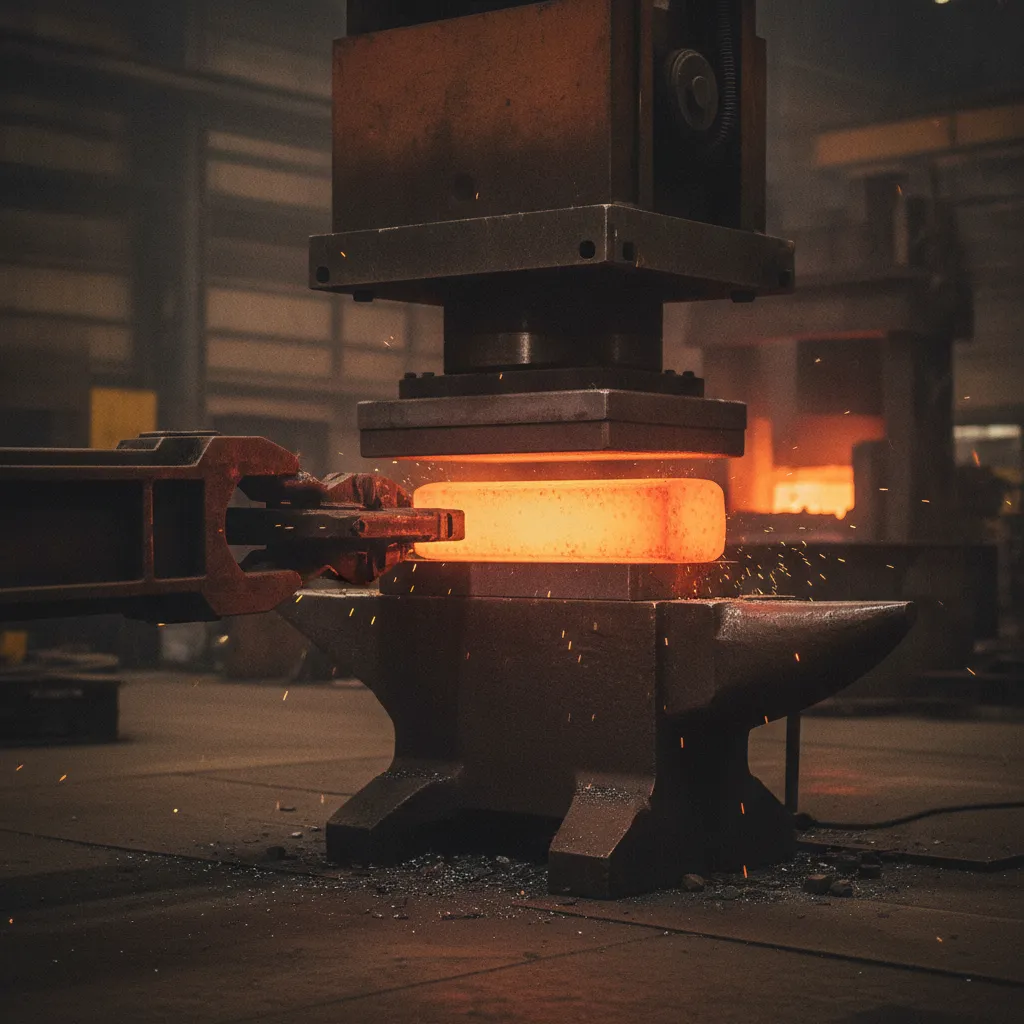
Materials Best Suited for Open Die Forging
Carbon steels, alloy steels, stainless steels, titanium alloys, and nickel superalloys are all open die forged, each with distinct temperature windows and forgeability limits.
What Metals and Alloys Are Best Suited for Open Die Forging
Carbon and alloy steels, 4140, 4340, and 1045, are the most common choices. They offer excellent plastic deformation behavior, predictable grain refinement, and a wide working temperature range of 1,900–2,300°F. That wide window gives press operators room to reposition and reorient workpieces without losing forgeability mid-cycle.
Stainless steels such as 304, 316, and 17-4 PH are regularly open die forged for corrosion-critical applications. They require tighter temperature control and more press tonnage than carbon steel, which raises tooling wear and energy costs.
Titanium alloys (Ti-6Al-4V) and nickel superalloys, Inconel 718 and Waspaloy, are open die forged for aerospace and energy components. Their forging temperature windows are narrow: Ti-6Al-4V typically works between 1,600–1,900°F. Precise furnace control is non-negotiable; even a 50°F deviation can cause surface cracking or incomplete grain refinement. According to the Forging Industry Association, proper temperature management is the single most critical variable in achieving consistent grain refinement in titanium and nickel alloy forgings.
Aluminum alloys 6061 and 7075 are open die forged for lighter structural parts at much lower temperatures, roughly 650–900°F. Because aluminum loses heat fast, press cycles must run quickly to keep the workpiece above the minimum working temperature.
Cast iron, most ceramics, and heavily work-hardened metals without intermediate annealing are not candidates for open die forging. Cast iron is brittle and lacks the plastic deformation capacity the process requires. Engineers specifying these materials should re-evaluate the process route before committing to tooling.
Industries and Applications That Rely on Open Die Forgings
Open die forged components appear in aerospace, oil and gas, power generation, and heavy defense equipment—anywhere part failure carries catastrophic consequences.
Real-World Applications in Aerospace, Automotive, and Energy Sectors
Aerospace engineers specify open die forging for landing gear components, wing spars, engine shafts, and structural bulkheads. Grain flow alignment in these parts is mandatory—AMS and ASTM material specifications require it for flight-critical certification. A forged wing spar with continuous grain flow running along its length resists fatigue crack propagation in ways a cast or machined billet simply cannot match. The ASTM International standards body publishes detailed specifications governing the mechanical property requirements for aerospace-grade forgings.
Oil, gas, and energy applications push part sizes further. Pressure vessel shells, valve bodies, pump shafts, and wellhead components routinely exceed 1,000 lbs and must satisfy ASME Section VIII compliance—a standard open die forgings meet because the process eliminates internal porosity and produces consistent mechanical properties throughout the cross-section.
Power generation relies on open die forging for turbine shafts, generator rotors, and large flanges. GE and Siemens turbine shafts are commonly open die forged in alloy steel or nickel superalloy, with finished lengths often exceeding 20 feet.
Heavy equipment and defense applications include axles, crankshafts, armor plate preforms, and naval propeller shafts. In these sectors, fatigue life must be validated through destructive testing—because failure in service is not recoverable.
Many open die forgings also require post-forge CNC finishing to reach final tolerances. Implant-grade titanium forgings used in surgical applications, for example, demand precision CNC machining after the forging stage to meet surgical-grade surface and dimensional requirements.
Equipment, Quality Standards, and Inspection for Open Die Forgings
Open die forged components require hydraulic presses from 500 to 50,000+ tons, specific inspection protocols, and documented quality standards, ask every supplier which they hold before committing.
What Tonnage and Equipment Specifications Are Required
Press selection depends directly on part size and material. Small alloy forgings run on presses from 500 tons, while large aerospace or naval components demand 50,000+ tons of force. Hydraulic presses dominate large open die work because they deliver sustained squeeze pressure throughout the stroke, not a single impact, which gives metallurgists precise control over deformation rate.
That control matters most with titanium and nickel superalloys. Both materials are sensitive to strain rate; too fast and you introduce adiabatic shear bands that compromise grain structure. Hydraulic presses let operators hold a controlled squeeze for seconds, not milliseconds.
Hammer forging, gravity drop, power drop, and counterblow configurations, suits smaller open die work where faster cycle times offset the reduced deformation control. Counterblow hammers, which strike from both sides simultaneously, reduce the shock load transferred to the foundation and allow larger hits per cycle. Furnace specs matter equally: AMS 2750 sets pyrometry requirements for aerospace heat treatment, covering thermocouple calibration intervals, furnace uniformity surveys, and load temperature verification.
Inspection Methods and Quality Control Standards for Open Die Forgings
Four inspection methods cover the failure modes specific to open die forgings. Ultrasonic testing (UT) detects internal defects, voids, inclusions, and pipe, without cutting the part. Magnetic particle inspection (MPI) finds surface and near-surface cracks in ferrous parts. Dye penetrant testing (PT) performs the same role for non-ferrous alloys where MPI cannot work. Mechanical testing, tensile, Charpy impact, and hardness, runs per heat lot, not per part, so traceability to the original melt record is non-negotiable.
Key standards to request from any supplier: ASTM A668 for steel forgings in general industrial service, ASME B16.34 for valve forgings, and customer-specific drawing callouts that override generic standards. Ask suppliers to confirm which they hold on file, not which they can obtain. The National Institute of Standards and Technology (NIST) provides reference data on material properties that inform many of these forging standards.
Budget realistically for lead time. Open die forgings typically require 2–8 weeks from order to rough forging, depending on material availability and part weight. Post-forge heat treatment, normalize, anneal, or quench and temper, adds 1–3 weeks before any machining begins. Procurement teams who ignore that window routinely miss program schedules. If your application then requires precision-machined features on the forged blank, a certified partner with documented process control, like MFG SOLUTION’s ISO 9001:2015 and IATF 16949 qualified production, can take the heat-treated forging through final dimensions without adding another vendor to the chain.
“The inspection and traceability requirements for open die forgings used in pressure-containing applications are among the most rigorous in manufacturing — every heat lot must be traceable back to the original melt chemistry.” — James Birchmeier, Quality Systems Director, Forging Industry Association
Frequently Asked Questions
How do open die forgings compare to castings in terms of strength and cost?
Open die forgings are significantly stronger than castings because the forging process refines grain structure and eliminates internal porosity that castings commonly produce. A forged part typically delivers 20–30% higher tensile strength and better fatigue resistance than an equivalent cast component. Castings carry lower initial tooling costs and suit complex internal geometries, but they cannot match the mechanical integrity of a forged part under cyclic or impact loading—making forgings the standard choice for structural and safety-critical applications.
What is the maximum size or weight achievable with open die forging?
Open die forging can produce parts weighing several hundred tons, making it the only practical forging method for very large components. Industrial presses used in open die operations can exert forces exceeding 10,000 tons, accommodating shafts, rings, and cylinders that closed die tooling could never contain. Exact limits depend on the press capacity and furnace size at a given facility—there is no universal ceiling, but components over 100 feet in length have been produced using this method.
Do open die forgings require heat treatment before machining?
Most open die forgings require heat treatment—typically annealing, normalizing, or quench-and-temper—before finish machining begins. The forging process introduces residual stresses and uneven hardness across the cross-section; heat treatment relieves those stresses and brings the material to a consistent, predictable hardness. Skipping this step risks dimensional instability and accelerated tool wear during CNC machining. The specific heat treatment cycle depends on alloy grade, part geometry, and the mechanical property targets defined in the engineering specification.
What factors determine which forging type is best for a specific project?
Part size, production volume, geometry complexity, and required mechanical properties are the four primary factors. Open die forging suits large, low-volume, or custom-shaped components where tooling cost must stay low. Closed die forging makes economic sense at higher volumes where the tooling investment is amortized across thousands of identical parts. Tight dimensional tolerances and near-net shapes favor closed die; superior grain flow and flexibility in size favor open die. Material type and lead time requirements also influence the decision.
How do I verify that a supplier’s open die forgings meet required quality standards?
Request documented certifications before placing an order. At minimum, ask for the supplier’s current ASTM A668 compliance records for steel forgings, their material test reports (MTRs) traceable to the original melt heat, and evidence of third-party inspection capability for ultrasonic testing and magnetic particle inspection. For aerospace applications, confirm AMS 2750 pyrometry compliance for heat treatment furnaces. Suppliers should provide these documents as a matter of routine — any hesitation is a red flag worth investigating before committing to a production order.
Conclusion
Open die forged components deliver grain structure refinement, superior mechanical strength, and the geometric flexibility that large or low-volume parts demand—advantages no casting or sheet metal process replicates. Three things worth acting on: first, confirm whether your part’s production volume justifies closed die tooling or whether open die’s lower setup cost is the smarter call; second, specify heat treatment requirements in your engineering drawing before sourcing, not after; third, plan for post-forge machining to hit tight tolerances.
If your application calls for precision-machined components after the forging stage, submit your part specifications to MFG SOLUTION—you’ll receive a detailed quote within 8 hours and can expect shipment within 3 days, backed by ISO 9001:2015 and IATF 16949 certification.
Recommended Articles
Explore more from our content library:
- Quote Threading CNC Jobs Accurately
- Medical Device Machining Compliance Guide
- How to Implement Swiss Machining for Complex Small Parts
- How to Validate Coolant CNC Performance in High-Speed Ops
- How to Specify CNC Workholding for Optimal Part Accuracy