
2026-10-13
9 Questions to Ask a Precision Parts Supplier Before Signing

Evaluating a precision parts supplier means systematically checking nine areas before you sign: certifications, delivery reliability, true total cost, order flexibility, equipment capability, quality assurance process, track record, trial performance, and contract terms. Skipping any one of these raises the risk of scrap, missed deadlines, or disputes down the line. The right approach is to verify each area with documentation or a small trial order rather than relying on a sales pitch alone.
1. Quality Certifications and Compliance Documentation
Verify certifications match your industry’s requirements and confirm them directly with the issuing registrar, not just by reading a PDF on a supplier’s website.
What is the difference between ISO 9001, AS9100, and Nadcap certifications for precision suppliers?
ISO 9001:2015 covers general quality management systems and applies to most manufacturing relationships. AS9100 builds on ISO 9001 with aerospace-specific requirements around configuration management and risk, while Nadcap accredits special processes like heat treat, welding, and non-destructive testing (NDT) that general quality certifications don’t touch. If your parts go into an aircraft or require documented special processes, a supplier without the matching accreditation is a contractual gap, not a minor shortfall.
Don’t stop at the certificate number. Registrars such as those accredited under the IAOB (for AS9100) or Nadcap’s eAuditNet maintain searchable databases, use them to confirm the certification is active and tied to the entity you’re actually contracting with, not a parent company or sister facility.
Certification scope matters as much as the certificate itself. A shop certified for CNC machining isn’t automatically covered for heat treat or plating if those processes are subcontracted and excluded from scope. This is critical for buyers in regulated industries like aerospace and medical device manufacturing, where traceability is contractually required down to the process level. A precision parts supplier working to ISO 13485:2016 and IATF 16949, for example, should be able to produce documented process control records on request, not just a framed certificate.
Ask for recent audit findings and corrective action history. A clean certificate tells you the system passed; the audit trail tells you how the supplier behaves when something goes wrong.
2. Delivery Capability and Lead Time Reliability
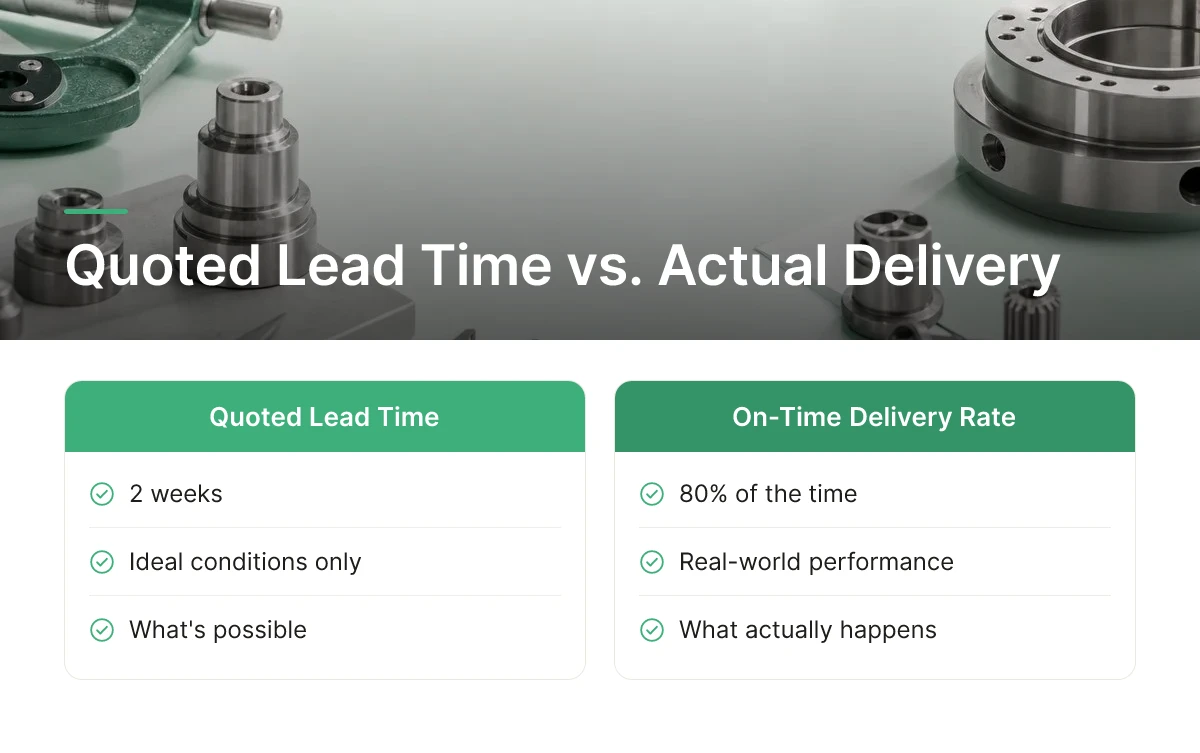
A quoted lead time tells you what’s possible under ideal conditions, on-time delivery rate tells you what actually happens.
How do you compare delivery reliability across multiple precision parts suppliers?
Ask every supplier for their tracked on-time delivery percentage over the past 12 months, not just their standard quoted turnaround. A shop that quotes 2 weeks but delivers on time 80% of the time is a bigger risk to your production schedule than one that quotes 3 weeks and hits it 98% of the time.
Capacity buffers matter more than most buyers realize. Suppliers running heavy subcontracting chains to fill demand spikes introduce handoffs you can’t see in a quote, each one is a point where a delay can originate without your knowledge. In-house scheduling across owned equipment, by contrast, gives a supplier direct control over sequencing when multiple customers compete for the same machine time.
Multi-location capacity or backup tooling reduces single-point-of-failure risk, if a spindle goes down or a batch fails inspection, a supplier with redundant setups can reroute the job instead of resetting your timeline to zero. This matters most for buyers with recurring production schedules, where a missed delivery cascades into downstream assembly delays, rather than one-off prototype runs where some schedule slip is tolerable.
The real differentiator is communication before a delay happens. Ask how a supplier flags a schedule risk, do they call when a tool breaks mid-run, or do you find out when the shipment doesn’t arrive? MFG SOLUTION, as a point of comparison, ships completed orders within 3 days of order approval and tracks that commitment as an operational standard rather than a marketing line.
3. Total Cost Beyond Unit Price
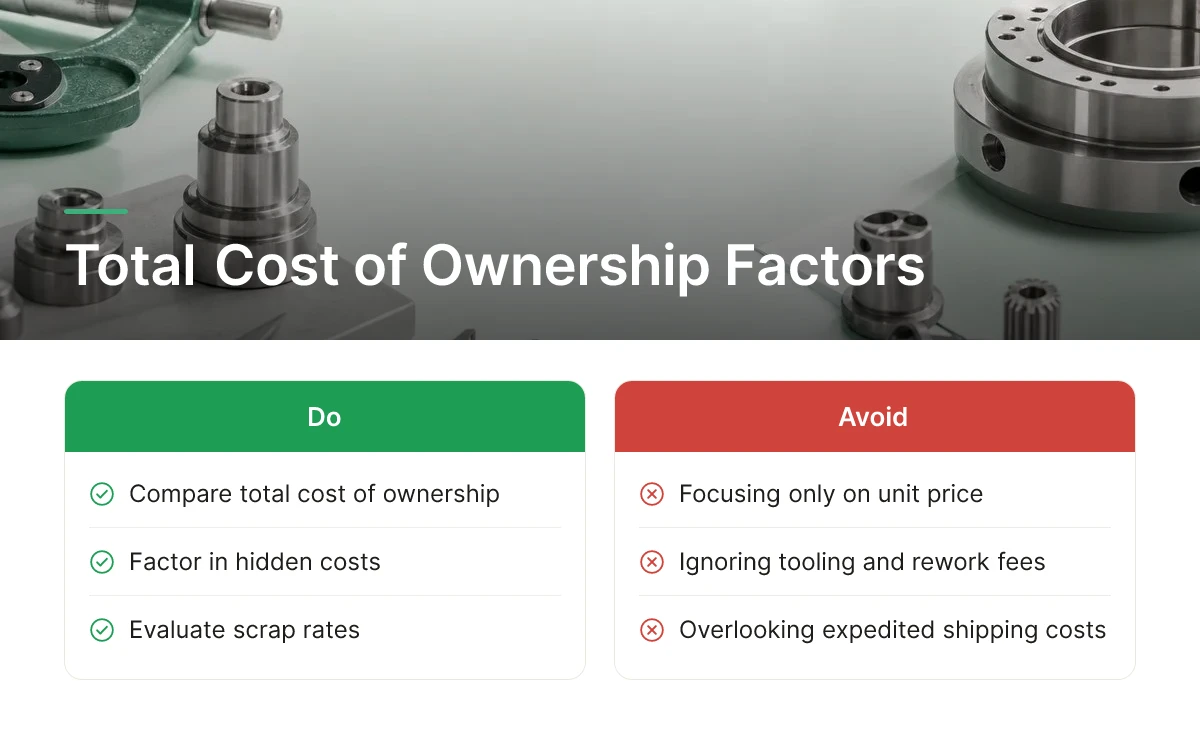
Compare suppliers on total cost of ownership, not the number on the quote line, because hidden costs can turn a budget-friendly unit price into a premium-tier total.
Beyond unit price, what hidden costs should you factor into supplier comparisons?
Tooling setup charges, rework from scrap, expedited shipping fees, inspection costs, and packaging requirements rarely show up on the first quote page but show up on the invoice. A supplier with a low per-part price and a high scrap rate can cost more over a production run than one quoting higher with tighter process control.
Pricing models differ in ways that matter. Per-part quotes are simple to compare but can hide setup amortization assumptions; blanket orders lock in a price across a forecasted volume but may penalize you if actual demand falls short; tiered volume pricing rewards scale but needs scrutiny on where the tier breaks actually land. Read the fine print on what triggers a price change mid-contract.
This is where buyers comparing quotes that look nearly identical on paper get surprised, one supplier’s number includes inspection and packaging, another’s doesn’t, and the gap only appears after the first invoice. Ask for a cost breakdown that separates material, machining time, and setup, so you’re comparing like for like instead of two bundled totals.
A precision parts supplier willing to itemize these costs upfront is signaling confidence in its process control. One that won’t is asking you to find out the hard way.
4. Minimum Order Quantities and Volume Flexibility
Match a supplier’s minimum order quantity (MOQ) policy to your actual growth curve, not just your current order size.
How should volume discount structures influence your long-term supplier strategy?
Many shops set high MOQs to protect machine setup time, a short run doesn’t justify the changeover cost on their side, so they price it out of reach or decline it outright. That math excludes prototype orders and low-volume pilots, which is exactly the stage where you’re still validating the part.
Volume discount tiers reward forecasted commitment, but committing to a tier can lock you into a single supplier before you’ve proven out the relationship on quality and delivery. Read the tier structure carefully: some suppliers reset pricing upward if you fall short of a committed volume, turning a discount into a penalty.
The better approach is negotiating a scaling path: a low-volume trial order to validate quality and fit, with pricing that improves as volume grows rather than a cliff-edge discount structure. This suits buyers who expect to move from pilot quantities to recurring production, which describes most new product launches in electronics and automotive supply chains.
Ask directly whether the supplier will honor a blended rate across a ramp-up schedule instead of resetting pricing at each volume threshold. That one answer tells you whether they’re built for a growing relationship or a single transaction.
5. Equipment and Process Capability
Match the supplier’s actual machine list and process mix to your part’s geometry and tolerance needs before trusting a capabilities page.
How do you determine if a supplier can handle your specific part complexity and tolerances?
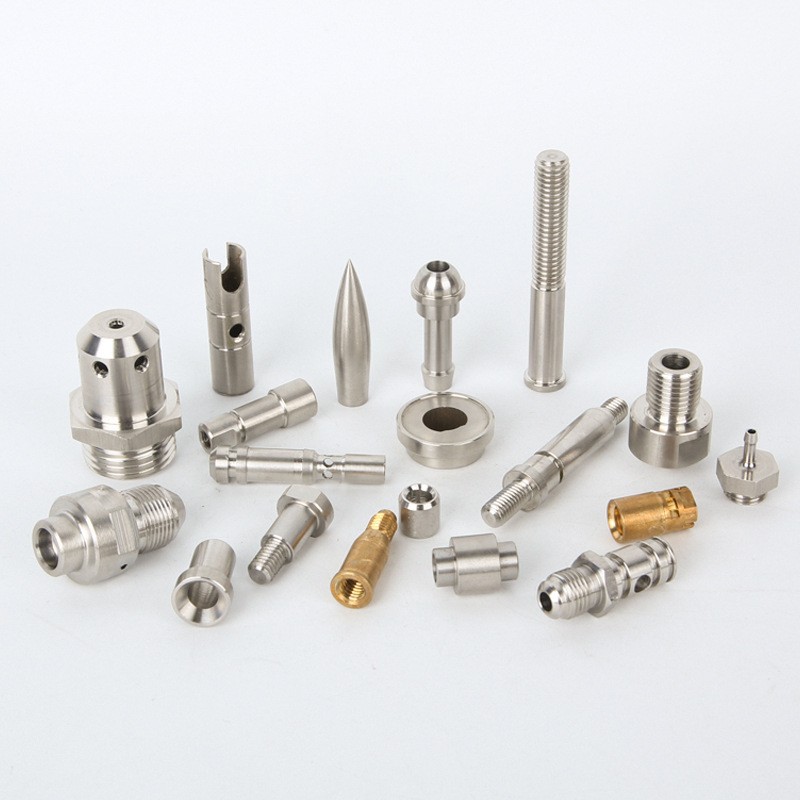
Ask specifically about CNC turning, Swiss lathe machining, CNC mill-turn, cold forging, and 5-axis machining, and which of these the supplier runs in-house versus subcontracts. These aren’t interchangeable: Swiss lathe machining suits small, high-precision turned parts with tight diameter tolerances, while 5-axis CNC handles complex contoured geometry that would need multiple setups on a 3-axis machine.
Matching process to part matters because the wrong method adds cost without adding precision. Cold forging, for instance, is efficient for certain geometries in batch production but isn’t the right call for a part needing fine internal features machined to tight tolerance.
A spec sheet claim isn’t proof of capability. Ask for a capability study, real tolerance data (Cpk or similar) from production runs, not a nominal tolerance range copied from a brochure. This distinction matters most for buyers with tight tolerances or unusual geometries, where a generic shop’s “we can do that” claim often falls apart at first-article inspection.
The real differentiator is asking to see the actual machine list and the in-house versus outsourced process breakdown, not a marketing capabilities page. MFG SOLUTION, for example, operates 5-axis CNC machines and 20 automatic lathes in-house alongside cold heading equipment, and backs that equipment list with 60+ engineering professionals who support design optimization for parts up to 38mm in diameter, specifics a buyer can verify rather than take on faith.
6. Quality Assurance and Inspection Process
Verify a supplier’s inspection rigor by requesting documentation samples and remote facility access before committing, not by scheduling a plant visit.
How do you audit a supplier’s quality control without visiting their facility?
Ask what inspection methods back their process: CMM (coordinate measuring machine) measurement for dimensional accuracy, first-article inspection (FAI) reports for new part approval, statistical process control (SPC) charts for ongoing batch monitoring, and material certifications tracing raw stock to its source. A precision parts supplier that can’t produce these on request is asking you to trust claims instead of evidence.
Request a sample FAI package or inspection report before placing an order. The documentation quality itself tells you something, a report with vague tolerances and no traceable measurement data signals a weaker system than one with full dimensional callouts mapped to the print.
When travel isn’t practical, ask for a live video walkthrough of the production floor, third-party audit reports (ISO 9001:2015 or IATF 16949 certificates include audit history), or a shared copy of the quality manual. This suits buyers managing offshore or distant suppliers who need confidence without a plane ticket.
The real differentiator: ask how nonconformances get documented and what the corrective action process looks like. A supplier with a defined root-cause process reveals a quality culture; one with a vague answer reveals a gap you’ll discover later, in a failed batch.
7. Track Record, Case Studies, and Customer References
Judge a precision parts supplier’s track record by specifics, tolerances held, industries served, problems solved, not by a logo wall or vague testimonials.
What should you look for in a precision parts supplier’s case studies and references?
A useful case study names the part complexity, the tolerance achieved, the industry served, and the specific problem solved, for example, a tight-tolerance medical component that required re-engineering the fixturing to hold concentricity. Generic claims like “trusted by leading manufacturers” tell you nothing about capability.
How do you get honest feedback from a supplier’s existing customers?
Request references from your own industry or part category, not a generic reference list the supplier hands out to everyone. A reference from a consumer-goods account won’t tell you much if you’re sourcing medical device components under ISO 13485:2016.
Ask reference customers pointed questions: Were there delays, and how was it communicated? How did the supplier respond when something went wrong? Vague answers are a signal; specific, detailed accounts are what you want.
This step matters most for buyers evaluating a new, unproven supplier relationship before committing to recurring volume. The differentiator here: ask the supplier directly for a reference where something went wrong and how they resolved it. A supplier willing to share that story, rather than only polished wins, is telling you more about its real operations.
8. Trial Order or Pilot Run Before Full Commitment
Structure a small pilot order with defined pass/fail criteria to validate a precision parts supplier’s claims before signing a recurring contract.
What metrics should you track during a trial run with a new precision parts supplier?
Track dimensional accuracy against the print, on-time delivery against the quoted date, completeness of documentation (FAI reports, material certs, SPC data), and responsiveness when you raise a question or flag an issue. These four areas expose more about a supplier’s real operation than any sales conversation.
How many sample parts should you order to properly evaluate a supplier?
Order enough parts to expose process variation across a batch, a single hand-picked sample proves nothing about repeatability. A trial run should mirror real production conditions: the same tolerances, the same batch size pattern you’d expect in a live order, not an idealized one-off.
This step applies to any buyer entering a new supplier relationship, regardless of order size, a startup validating its first production run and a Fortune 500 procurement team qualifying a second source both benefit from the same discipline.
The differentiator: build a defined pass/fail criteria list with the supplier upfront, covering tolerance bands, documentation requirements, and delivery windows. That turns the trial into an objective outcome instead of a subjective impression of “they seemed fine.”
9. Contract Terms, SLAs, and IP Protection
Negotiate defined service levels, escalation terms, and IP protections before moving from a trial order into a recurring supply agreement.
What contractual terms and SLAs are most important when partnering with a precision parts supplier?
Define on-time delivery percentage, defect rate thresholds, and response time for quality issues as explicit numbers in the agreement, not as general intentions. Also cover escalation clauses: what happens if lead time slips or a defect rate exceeds the agreed threshold, including remedies like expedited replacement runs or credits.
How should you handle intellectual property and confidentiality with a new supplier?
Custom part drawings, tolerances, and material specs represent real engineering investment, so get a confidentiality agreement signed before sharing design files. An NDA should cover how drawings are stored, who inside the supplier’s organization can access them, and restrictions on sharing specs with third parties.
This stage applies to buyers moving from a validated trial order into a recurring supply agreement, where volume and switching cost both increase. The differentiator: ask who owns tooling built specifically for your part. If the supplier owns it outright, switching to another precision parts supplier later could mean paying for new tooling from scratch, a detail worth settling before volume ramps up, not after.
How to Choose the Right Precision Parts Supplier for Your Project
Weigh quality, delivery, and cost against your specific part’s risk profile, then confirm the fit with a trial order before committing to volume.
Start by ranking quality, delivery speed, and cost by what matters most for this specific part, a medical component and a consumer-electronics bracket carry different risk profiles, even if both are machined to similar tolerances. That ranking should come before you compare quotes, not after.
Risk tolerance should shift the framework. Regulated industries, medical devices under ISO 13485:2016, automotive under IATF 16949, should weight certifications and documentation heavier than price. High-mix, low-volume buyers juggling frequent design changes should weight flexibility and quoting speed heavier, since a slow RFQ cycle compounds across every revision.
Whatever the sales pitch promises, start with a trial order on any new supplier relationship. It’s the fastest way to confirm whether inspection documentation, delivery timing, and communication match the claims made during quoting.
Bring a short checklist into your next supplier call: inspection methods and sample reports, remote audit options, industry-specific references, trial order terms, and SLA and IP terms. MFG SOLUTION addresses each of these directly, quotes within 8 hours, shipment within 3 days, and production under ISO 9001:2015, ISO 13485:2016, and IATF 16949 for parts up to 38mm in diameter, with 60+ engineering professionals supporting trial runs and design review before you commit to volume.

Frequently Asked Questions
How is selecting a precision parts supplier different from just finding one online?
Finding a supplier means a search; selecting one means a risk decision that affects launch timelines, part quality, and your ability to explain problems later. A directory listing shows capability on paper. Selection requires checking planning process, inspection systems, communication, and how the shop behaves when specs change, none of which shows up in a search result.
What are the key risks of choosing the wrong precision parts supplier?
The biggest risks are missed launch deadlines, inconsistent part quality, and compliance failures that surface during an audit rather than during qualification. A shop with the right machines but weak planning or communication can create more rework for your team than the parts are worth. Vendor risk also includes IP exposure if security and compliance protocols aren’t enforced.
How do you verify that a supplier’s quality claims are actually backed by certifications?
Ask for current certificates, ISO 9001, ISO 13485, IATF 16949, or AS9100, and confirm scope and expiration directly, not secondhand. Certifications should align with measurable quality metrics and documented process control, not just a logo on a website. Request a sample inspection report before committing to volume.
What lead time benchmarks should you expect from a precision parts supplier?
Expect a detailed quote within hours, not weeks, and production shipment within days once you approve the design. MFG SOLUTION, for example, returns quotes within 8 hours and ships completed batches within 3 days for parts up to 38mm in diameter. Compare any supplier’s stated timeline against your actual sourcing cycle, not just their marketing copy.
What MOQ ranges are typical for precision parts suppliers, and how do they impact your costs?
MOQs vary by manufacturing method: Swiss lathe and automatic lathe production favor larger batches for lower per-unit cost, while CNC mill-turn and cold forging can flex for smaller runs. Choosing the wrong method for your volume inflates unit cost or ties up cash in excess inventory. A supplier offering multiple methods can match the process to your batch size instead of forcing one approach.
Conclusion
Choosing a precision parts supplier comes down to three checks: verified certifications (ISO 9001, ISO 13485, IATF 16949), a quoting and shipping timeline that matches your actual sourcing cycle, and a manufacturing process matched to your part geometry and batch size rather than forced into one method. Skipping any of these shifts risk onto your team later, during a launch delay, a failed audit, or a quality escape.
Next step: pull your current supplier’s last three quote-to-ship timelines and compare them against an 8-hour quote, 3-day ship benchmark before your next RFQ goes out.
Recommended Articles
Explore more from our content library: