
2026-08-12
A Cost-Effective Guide to Small Batch Precision Parts

Small batch precision parts are custom-machined components produced in low quantities—typically 1 to 500 units—held to tight tolerances (often ±0.005 mm or better) using CNC turning, milling, Swiss lathe, or mill-turn processes. They are the right choice when you need production-quality parts without committing to high-volume tooling costs. Turnaround times range from 3 to 10 business days depending on complexity, material, and supplier, making this approach ideal for prototypes, bridge production, and regulated industries like aerospace and medical devices.

What You’ll Need Before Ordering Small Batch Precision Parts
Have your CAD file, material spec, tolerance callouts, and certification requirements ready before contacting any supplier—this cuts quoting time from days to hours.
Suppliers can only quote accurately from complete information. Missing a single detail—an unspecified surface finish, an ambiguous tolerance—forces a back-and-forth that delays your order and pushes out your ship date.
Choosing the Right File Format and Tolerances
Submit a finalized CAD file in STEP or IGES format with full GD&T callouts applied. When files are complete, suppliers can return quotes within 8 hours—MFG SOLUTION operates on exactly that window, which compresses your sourcing cycle significantly.
State your material upfront. Common choices for low-volume precision components include 6061-T6 aluminum (cost-effective, widely machinable), 303 and 316 stainless steel (corrosion resistance), titanium Grade 5 (high strength-to-weight, higher cost), and engineering plastics such as POM or PEEK. Each material affects both per-part cost and achievable lead time.
Standard CNC tolerances run ±0.127 mm. Tighter work—down to ±0.005 mm—requires Swiss lathe or 5-axis CNC machining and raises per-part cost accordingly. Call out every critical dimension explicitly; don’t leave tolerances to a supplier’s default assumptions.
Surface finish must also be specified as an Ra value or equivalent standard. Readers unfamiliar with Ra callouts can refer to our surface finish CNC machining guide before submitting files.
According to the National Institute of Standards and Technology (NIST), dimensional accuracy and surface finish specifications are among the most critical factors in ensuring manufactured components meet functional requirements—making upfront callouts essential rather than optional.
Identifying Your Certification and Compliance Requirements
Confirm your required certifications before you request a quote—discovering a compliance gap after approval wastes weeks. Aerospace orders require AS9100D; medical device components require ISO 13485:2016; automotive suppliers must work with an IATF 16949-certified manufacturer. MFG SOLUTION holds ISO 9001:2015, ISO 13485:2016, and IATF 16949 certifications, covering medical and automotive programs without an additional qualification step.
Missing a certification requirement at the quoting stage forces a new vendor search mid-project—a delay most production schedules cannot absorb.
Select the Right Process for Your Small Batch Precision Parts
Match your process to part geometry, quantity, material, and lead time—wrong method selection is the single biggest driver of cost overruns in low-volume precision manufacturing.
Swiss lathe machining sets the benchmark for small-diameter, high-complexity components under 38 mm. It holds tolerances to ±0.005 mm and is the standard choice for medical pins, surgical connectors, and precision fasteners where dimensional consistency across every unit is non-negotiable. For a detailed implementation guide, see the site’s How to Implement Swiss Machining for Complex Small Parts article.
CNC mill-turn combines turning and milling in a single setup. Eliminating the handoff between separate machines reduces fixturing errors and cuts lead time by up to 30% versus running sequential operations—a measurable advantage when your batch needs both rotational and prismatic features on the same part. MFG SOLUTION operates 5-axis CNC machines and mill-turn centers specifically configured for this geometry class.
“Precision in low-volume production is not just about the machine—it’s about the entire workflow from design intent to first-article verification. A single ambiguous tolerance callout can cascade into days of rework.” — Dr. John S. Agapiou, Senior Research Engineer, Manufacturing Systems Research Lab
When to Choose Small Batch CNC Machining Over 3D Printing
3D printing (SLA, SLS, or DMLS) works for concept prototypes and low-load geometries, but it cannot match CNC surface finish. CNC turning routinely achieves Ra 0.8 µm; FDM typically delivers Ra 3.2 µm or coarser. That gap matters in medical and aerospace applications where surface finish is a certified specification, not a preference. Material certifications required by ISO 13485:2016 or IATF 16949 are also unavailable for most printed parts.
The key differences between CNC machining and 3D printing for precision applications include: For more information, see Cloud Migration Small Business South Africa.
- Surface finish: CNC achieves Ra 0.8 µm; FDM typically delivers Ra 3.2 µm or coarser
- Dimensional accuracy: CNC holds ±0.005 mm; most 3D printing processes hold ±0.1–0.3 mm
- Material certification: CNC uses certified bar stock; most 3D printing materials lack traceability documentation
- Post-processing: CNC parts accept standard anodizing, plating, and heat treatment; printed parts often require additional surface prep
- Regulatory compliance: CNC machining integrates with ISO 13485 and IATF 16949 workflows; additive manufacturing typically does not
When to Choose Small Batch CNC Machining Over Injection Molding
Injection molding tooling costs between $3,000 and $50,000+ before a single part ships. That investment only becomes cost-competitive above roughly 1,000–5,000 units. For batches under 500, CNC machining delivers lower total cost with zero tooling outlay and no minimum-run commitment.
When part diameter exceeds 38 mm or your design calls for near-net-shape raw stock, upstream forging processes become relevant—see the site’s forging block and forging stainless steel content for supply context before committing to a machining method.
For additional context on available CNC machining options for low-volume runs, Xometry’s small batch CNC machining service overview provides a useful benchmark for standard industry lead times and geometry capabilities.
Compare Providers and Understand Pricing for Precision Low-Volume Parts
Custom precision components produced in low quantities cost $8–$300 per piece depending on geometry, material, and batch size—with setup and programming fees dominating at low quantities.
Detailed Cost Breakdown for a Typical Small Batch CNC Order
Five factors drive per-part cost, ranked by impact: setup and programming time (a fixed charge amortized across the batch), raw material, cycle time per part, post-processing such as anodizing or heat treatment, and inspection or certification documentation.
In practice, a simple turned aluminum part in a batch of 50 runs $8–$25 each. A complex 5-axis milled stainless steel part in a batch of 10 runs $80–$300 each—because the same $200–$600 setup charge is spread across far fewer units. Increasing that batch from 10 to 50 units typically cuts per-part cost by 10–20%; moving to 250 units delivers another 15–25% reduction. Ordering in optimized batches is the fastest lever for reducing unit cost without changing the part design.
The ROI case against traditional tooling is clear. A 100-unit bridge production run via small batch CNC avoids $15,000–$50,000 in injection mold tooling costs and compresses time-to-market by 8–16 weeks. For a product still in design iteration, that break-even calculation almost always favors CNC at quantities below 500 units.
“The economics of low-volume precision machining have shifted dramatically. Modern 5-axis CNC centers can produce complex geometries in a single setup that previously required three or four separate operations, fundamentally changing the cost structure for batches under 500 units.” — Mark Albert, Editor Emeritus, Modern Machine Shop
To understand how specialized precision shops approach low-volume production pricing, SGProto’s small batch production precision CNC machining service offers a representative example of how geometry complexity and material selection interact with per-unit pricing.
Turnaround Time Comparison: Xometry vs. Specialized Precision Shops
Xometry provides instant online quoting through a broad supplier network, with typical turnaround of 5–15 days and market-rate pricing that includes a platform markup. That model works well for straightforward geometries with no regulatory requirements.
For medical device, automotive, or electronics applications, the traceability requirements change the calculation. MFG SOLUTION quotes within 8 hours and ships within 3 days, with direct ISO 9001:2015, ISO 13485:2016, and IATF 16949 certification—meaning every step is tracked and auditable without relying on a third-party supplier network. When a compliance audit or a production deadline is at stake, that direct process control is worth more than a marginally lower platform price.
Post-Processing Options That Affect Final Part Cost
Post-processing is frequently underestimated in initial cost projections. The most common finishing operations applied to precision low-volume parts include:
- Anodizing (Type II and Type III): Adds corrosion resistance and hardness to aluminum; Type III hard anodize adds $2–$8 per part depending on surface area
- Electroless nickel plating: Uniform coating for complex geometries; adds $5–$15 per part and requires lead time for bath setup
- Heat treatment: Required for hardened steel components; adds 1–2 days to lead time and $3–$10 per part
- Passivation: Mandatory for stainless steel in medical applications per ASTM A967; adds $2–$6 per part
- Black oxide: Low-cost corrosion protection for steel; typically $1–$3 per part
Specifying post-processing requirements upfront—rather than adding them after initial quoting—prevents cost surprises and ensures your supplier schedules the correct finishing operations within your lead time window.
Common Mistakes to Avoid When Sourcing Small Batch Precision Parts
The costliest sourcing errors for precision low-volume components fall into four categories: over-tolerancing, skipped inspection, mismatched certifications, and chasing the lowest quote.
Over-tolerancing non-critical features. Specifying ±0.005 mm across every dimension—including surfaces that never contact a mating part—increases machining time and cost by 40–60% with no functional gain. Apply tight tolerances only to mating surfaces and critical interfaces. Let your engineer mark which dimensions are truly functional before submitting drawings.
Skipping first-article inspection (FAI). For any batch exceeding 25 units, require a full dimensional report on the first part before the production run starts. A 0.05 mm offset caught at FAI costs a few hours of adjustment; the same error found after 200 parts ship costs weeks of rework and replacement cycles.
Mismatching supplier certifications to your application. Sending automotive or medical components to an ISO 9001-only shop—when your customer contract requires IATF 16949 or ISO 13485—creates compliance gaps that can void contracts and trigger audits. Verify the exact certification scope, not just the certificate name, before placing an order. MFG SOLUTION holds ISO 9001:2015, ISO 13485:2016, and IATF 16949 simultaneously, covering electronics, medical, and automotive requirements under one supplier.
Poorly specified threaded features. Missing the class of fit, thread form, or depth on threaded callouts is a leading cause of rework in small batch runs. Review your thread specifications carefully—our CNC threading optimization content covers the exact callout format to use.
Choosing price over total lead time. A 3-day turnaround from a certified shop frequently beats a 12-day turnaround from a lower-cost supplier when your production schedule has no buffer. Calculate the cost of a line stoppage before selecting the cheapest quote.
“In regulated industries, the cost of a non-conforming part is never just the part itself—it’s the investigation, the corrective action, the customer notification, and the schedule impact. Investing in a qualified supplier upfront is almost always cheaper than managing escapes downstream.” — Patricia Moser, Quality Systems Consultant, ASQ Certified Quality Engineer
The American Society of Mechanical Engineers (ASME) provides comprehensive resources on GD&T standards and tolerance specification best practices that can help engineering teams avoid over-tolerancing errors before drawings are submitted for quoting.
Frequently Asked Questions
What tolerances can small batch precision parts achieve with CNC machining?
CNC machining routinely holds tolerances of ±0.005 mm to ±0.05 mm depending on part geometry, material, and the machining method used. Swiss lathe and 5-axis CNC operations reach the tighter end of that range, making them the right choice for medical implant components or automotive fuel system parts where dimensional variation directly affects function. Confirm your required tolerance class with your supplier before quoting—not every method suits every spec.
What ISO and AS9100 certifications should a precision parts supplier hold for aerospace and medical applications?
For medical applications, require ISO 13485:2016; for automotive, require IATF 16949; for general quality management, require ISO 9001:2015. Aerospace work typically calls for AS9100D, which builds on ISO 9001 with additional risk management and traceability requirements. MFG SOLUTION holds ISO 9001:2015, ISO 13485:2016, and IATF 16949 certifications, covering medical and automotive supply chains with full documented process control. If your program requires AS9100D, confirm that certification explicitly before awarding the contract.
What are typical turnaround times for small batch precision parts orders?
Standard turnaround for low-volume precision components runs 3 to 10 business days from approved drawing to shipment, depending on part complexity and batch size. MFG SOLUTION ships within 3 days of order approval and returns quotes within 8 hours of specification submission, compressing a sourcing cycle that typically runs 4 to 6 weeks at conventional job shops. Complex multi-feature parts or tight-tolerance assemblies may require additional lead time.
How does small batch CNC machining pricing change with order quantity?
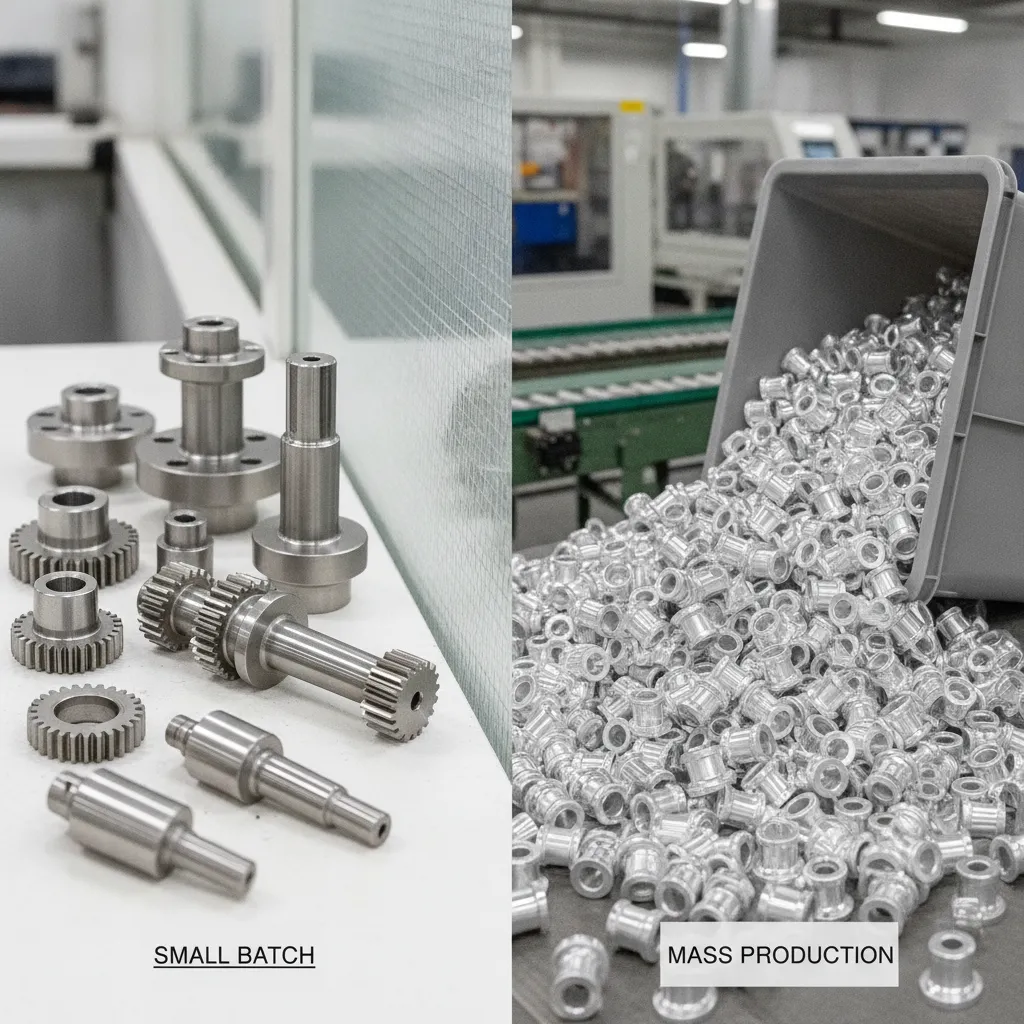
Per-unit cost drops as quantity increases because setup and programming costs spread across more parts. A batch of 10 parts carries a much higher per-piece setup burden than a batch of 500. Selecting the right machining method also affects cost—cold forging and automatic lathe production lower per-unit costs at higher volumes, while CNC turning suits lower quantities where tooling investment is smaller. Request a tiered quote across two or three quantity breaks to identify your best cost point.
What materials are most commonly used for low-volume precision CNC parts?
The most frequently specified materials for precision low-volume CNC components are 6061-T6 aluminum (best cost-to-machinability ratio), 303 and 316 stainless steel (corrosion resistance for medical and food-contact applications), titanium Grade 5 (aerospace and implant-grade strength-to-weight), and engineering plastics such as PEEK and POM (chemical resistance and low weight). Material selection directly affects cycle time, tooling wear, and achievable surface finish—confirm your material choice with your supplier before finalizing your drawing package.
Conclusion
Sourcing small batch precision parts comes down to three decisions that compound quickly: choosing the right machining method for your geometry, specifying tolerances your supplier can actually hold, and confirming the certifications your industry requires before a single chip is cut. Get those three right, and lead time and cost follow.
If your current supplier is quoting 4-to-6-week lead times on parts under 38 mm, that gap is costing you product launch time and inventory buffer. Submit your part drawing to MFG SOLUTION—you’ll have a detailed quote within 8 hours and can evaluate a 3-day ship window against your current sourcing cycle with real numbers in hand.
Recommended Articles
Explore more from our content library: