
2026-08-04
A Practical Buyer’s Guide to Ordering Custom Forgings

Custom forgings are metal components shaped under high pressure or impact to produce parts with superior grain structure, strength, and dimensional consistency compared to casting or machining from bar stock. The process begins with tooling design, followed by heating the billet and pressing or hammering it into a die. Custom forgings are used across aerospace, oil and gas, automotive, and industrial equipment sectors where load-bearing reliability is non-negotiable.
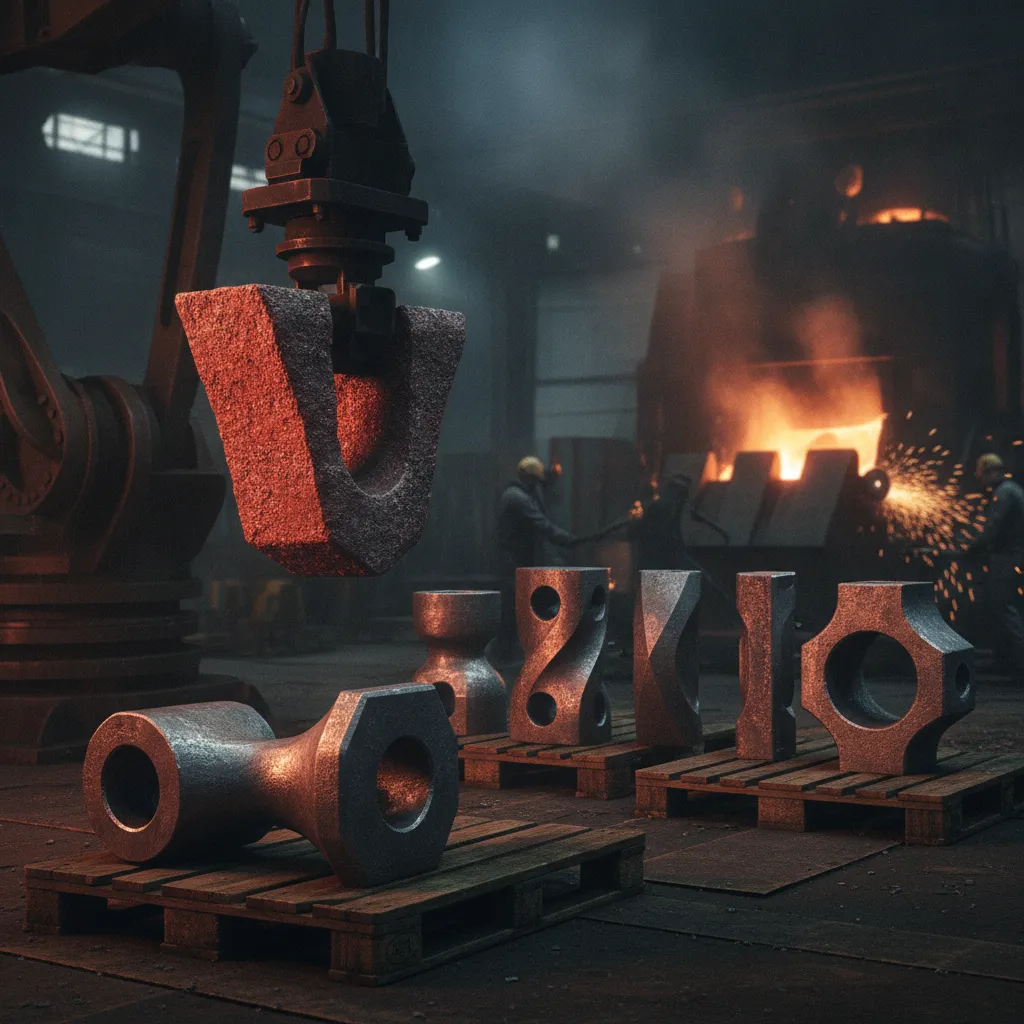
What Are Custom Forgings and How Does the Process Work?
Custom forgings are near-net-shape metal components produced by applying compressive force to a heated billet inside a shaped die, yielding 20–30% higher tensile strength than equivalent castings.
That strength advantage comes from grain flow. When metal is pressed or hammered into a die, the internal grain structure follows the part’s contour rather than being cut across, as it is in machined billet, or frozen randomly, as in a casting. The result is a part built for load-bearing applications where fatigue failure is not an option. According to the Society of Manufacturing Engineers, grain flow continuity in forged parts is the primary reason they outperform castings under cyclic and impact loading conditions.
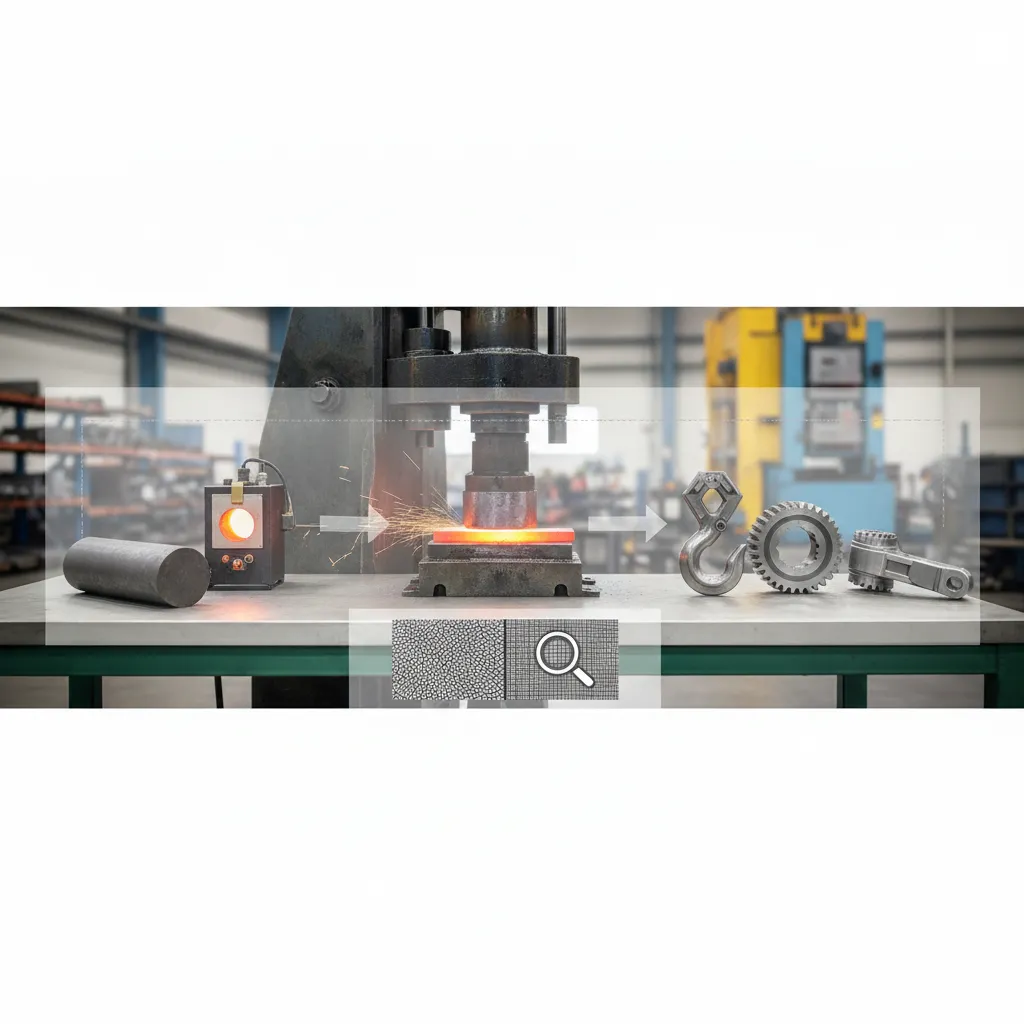
The production workflow runs five stages:
- Material selection, alloy grade chosen to match mechanical, corrosion, and temperature requirements
- Tooling and die design, closed or open dies machined to the target geometry, the largest upfront cost in any forging project
- Billet heating, stock heated to the alloy’s forging temperature range to achieve plastic deformation without cracking
- Forging operation, press, hammer, or ring-rolling applies force until the billet fills the die cavity
- Post-forge machining and inspection, CNC operations remove flash, hit critical tolerances, and add internal features such as bored holes or threaded passages that dies cannot form
“Forging remains the most reliable method for producing high-integrity metal components where structural consistency across the entire cross-section is critical to safety and performance.” — Dr. Taylan Altan, Professor Emeritus, Center for Precision Forming, The Ohio State University
Key Capabilities and Limitations of Custom Forging
Custom forgings cover a wide weight range, from under 1 lb for small fasteners and fittings up to 500+ lbs for flanges and structural blocks. After finish machining, critical dimensions can hold tolerances to ±0.005 in.
The main limitation is upfront tooling cost. Die fabrication can run from several thousand to tens of thousands of dollars depending on part complexity, which makes low-volume runs expensive to justify. Complex internal geometries, undercuts, blind holes, deep bores, cannot be formed in the die and require dedicated post-forge CNC machining to complete.
Buyers should also be aware of the following practical constraints when planning a custom forging program:
- Draft angles of 3–7° are typically required on die walls to allow part ejection without damage
- Parting line placement affects flash location and post-forge trimming cost
- Radii and fillets must meet minimum values set by the die material and forging pressure
- Surface finish before machining typically ranges from Ra 125 to Ra 250 μin depending on the process
- Material certifications (mill certs, heat numbers) must be requested at order placement, not after delivery
Minimum Order Quantities and Project Size Requirements
Most custom forging suppliers require minimum order quantities of 50–500 pieces per run, with the exact threshold driven by die cost amortization and part complexity. A simple carbon steel ring with a low-cost die may qualify at 50 pieces; a multi-cavity aerospace component with tight alloy specs typically demands 200–500 pieces before per-unit economics make sense.
Buyers entering a forging program for the first time should budget for tooling as a one-time capital expense separate from piece-part pricing, and confirm whether the supplier’s post-forge machining capability is in-house or subcontracted, that distinction directly affects lead time and quality accountability. Suppliers such as R&M Forge and Fittings offer dedicated custom metal forging services with in-house tooling management, which simplifies accountability for first-time buyers.
Main Types of Custom Forging Processes Compared
The three primary custom forging methods, hammer, press, and cross roll, differ in speed, achievable tolerance, and the part geometries each handles best.
Hammer Forging vs. Press Forging vs. Cross Roll Forging
Hammer forging uses repeated high-impact blows to shape metal. Each blow takes seconds, making it well-suited for complex shapes and large parts where the grain structure needs to flow through irregular geometries. Surface finish before machining typically runs Ra 125–250 μin, so a secondary machining pass is standard.
Press forging applies slow, controlled hydraulic or mechanical pressure rather than impact. That control produces tighter dimensional tolerances, typically ±0.010 in. versus ±0.030 in. for hammer forging, which is why automotive OEMs favor it for high-volume symmetrical components like connecting rods and hubs.
Cross roll forging is a continuous rotary process. It excels at axisymmetric parts, shafts, rollers, and rings, and achieves material utilization up to 95%, cutting scrap significantly compared to machining the same shape from bar stock.
| Method | Typical Tolerance | Part Weight Range | Relative Tooling Cost | Best-Fit Geometry |
|---|---|---|---|---|
| Hammer Forging | ±0.030 in. | 0.5 lb, 500+ lb | Medium | Complex, irregular shapes |
| Press Forging | ±0.010 in. | 0.1 lb, 200 lb | High | Symmetrical, high-volume parts |
| Cross Roll Forging | ±0.015 in. | 0.05 lb, 50 lb | Medium–High | Axisymmetric: shafts, rings, rollers |
In-House Forging Capabilities vs. Outsourcing Custom Forging Services
Running forging equipment in-house gives a manufacturer direct control over tooling iterations and cycle scheduling, but a hydraulic press, cold heading equipment, and the floor space to run them represent significant capital outlay.
Outsourcing custom forgings to a certified supplier trades that capital cost for flexibility and documented traceability. A supplier operating under ISO 9001:2015 quality management, such as MFG SOLUTION, which also holds IATF 16949 for automotive and ISO 13485:2016 for medical device work, provides full process control without requiring the buyer to own or maintain the press. For procurement teams managing multiple part families, that traceability is auditable and transferable across supplier qualification reviews. Companies like Modern Group demonstrate how full-service outsourced forging operations can consolidate tooling, production, and quality documentation under one certified roof.
“When procurement teams outsource custom forgings to a certified supplier, they gain not just manufacturing capacity but a documented quality chain that stands up to OEM audits and regulatory reviews.” — James Kowalski, Senior Manufacturing Engineer, American Society for Quality
Materials Used in Custom Forgings: Performance and Cost Compared
Carbon steel, alloy steel, stainless steel, aluminum, and titanium cover most custom forgings applications, each with distinct cost and strength trade-offs. For more information, see Cpg Brand Dilemma Omnichannel Marketing Vs Customer Experience.
How Forging Materials Compare in Cost and Mechanical Performance
Carbon steel grades like 1045 remain the lowest-cost option at roughly $0.50–$0.80 per pound, delivering tensile strength between 570–700 MPa. That combination makes 1045 the workhorse material for general industrial and automotive forgings where budget matters as much as performance.
Alloy steels, 4140 and 4340 in particular, carry a 15–30% cost premium over carbon steel but push tensile strength up to 1,080 MPa. Aerospace and power generation engineers specify them for high-stress components where carbon steel’s ceiling isn’t enough.
Stainless steel (300 and 400 series) adds corrosion resistance that food processing and chemical industries require, but it costs 40–60% more than carbon steel and work-hardens during forging, which increases die wear and cycle time. Buyers who need both corrosion resistance and tight tolerances should review material selection carefully before finalizing specifications.
Aluminum grades 6061 and 7075 weigh roughly one-third as much as steel and forge at 400–480°C, a lower temperature that reduces energy cost. High-volume automotive and aerospace programs use them when weight reduction directly affects fuel efficiency or payload.
Titanium delivers the highest strength-to-weight ratio of any common forging material, but raw material cost runs 5–10 times that of steel. Aerospace structural parts and medical implants justify that premium; most other applications do not. The ASM International materials database provides detailed forging temperature ranges, mechanical property benchmarks, and alloy selection guidance for engineers specifying titanium and nickel-based forgings.
Custom Forging Cost, Tooling, and Lead Times: What to Expect
Custom forging costs split into two buckets: upfront tooling and per-part production, and knowing both helps you plan budgets and timelines accurately.
How Tooling Design and Manufacturing Impact Custom Forging Cost
Die cost is the single largest upfront variable in any custom forgings project. Simple single-cavity dies run $2,000–$8,000; complex multi-cavity dies for tight-tolerance parts can reach $25,000–$50,000. Above 500 pieces per run, that tooling cost amortizes sharply, often dropping to under $5 per part at volumes of 5,000 or more.
Per-part production cost breaks down across four drivers: material weight and grade (titanium and nickel alloys cost 4–10× more per kilogram than carbon steel), the number of forging operations required, post-forge machining requirements for surface finish and dimensional accuracy, and inspection or certification overhead tied to standards like ISO 9001:2015 or IATF 16949.
Near-net-shape die design is the most effective cost lever available. Tighter initial geometry reduces post-forge machining hours and, on complex parts, choosing forging over machining from solid billet saves 30–50% of raw material. Ordering in larger batches compounds those savings by spreading fixed tooling costs across more units.
Typical Lead Times and Production Timelines for Custom Forging Projects
New die design and manufacturing typically takes 4–8 weeks. Repeat orders using existing tooling ship in 2–4 weeks, a strong argument for consolidating custom forgings with a single certified supplier who stores your tooling on-site.
Production run lead times vary by material. Standard carbon and alloy steel parts complete in 3–6 weeks. Stainless steel and titanium extend to 6–10 weeks because of tighter process windows and longer material sourcing cycles.
At MFG SOLUTION, cold forging operations complement CNC turning and Swiss lathe machining for parts up to 38mm diameter, letting procurement teams consolidate forged and machined components under one ISO 9001:2015, ISO 13485:2016, and IATF 16949 certified roof, with quotes returned within 8 hours of specification submission.
Industries and Applications: Where Custom Forgings Deliver Results
Custom forgings solve specific structural and contamination problems across oil and gas, power generation, automotive, aerospace, and food processing—with measurable outcomes in each.
Oil and Gas
Valve bodies and wellhead components forged from 4140 alloy steel replace welded assemblies in high-pressure sour gas environments. Eliminating weld-zone failure points extends service life from 3 years to 8 or more—a direct reduction in unplanned downtime and replacement costs.
Power Generation
Turbine shaft flanges forged to near-net shape reduce finish machining time by 40% compared to machining from round bar stock. That time saving translates directly into lower per-unit cost on long production runs.
Automotive
Steering knuckles and suspension arms forged in 6061 aluminum cut component weight by 35% versus cast iron equivalents. Parts still meet IATF 16949 fatigue-life requirements—the same standard MFG SOLUTION holds for its precision machined automotive components.
Aerospace and Defense
Titanium Ti-6Al-4V forged brackets achieve strength-to-weight ratios that casting cannot match. AS9100 programs require full material traceability on every forged blank, making documented process control a non-negotiable supplier requirement. The National Institute of Standards and Technology (NIST) publishes measurement standards and material property data that aerospace forging programs rely on for qualification testing and dimensional verification.
Food Processing
316L stainless steel forged fittings replace cast equivalents to eliminate porosity—a contamination risk that cast parts carry by nature. Forged 316L produces a fully dense grain structure with no internal voids for bacteria to accumulate.
“In food-grade and pharmaceutical applications, the fully dense grain structure of forged stainless steel components is not a preference — it is a hygiene and regulatory requirement that cast alternatives simply cannot meet.” — Linda Hartwell, Materials Compliance Specialist, Food Equipment Manufacturers Association
Frequently Asked Questions
What is the difference between custom forgings and castings?
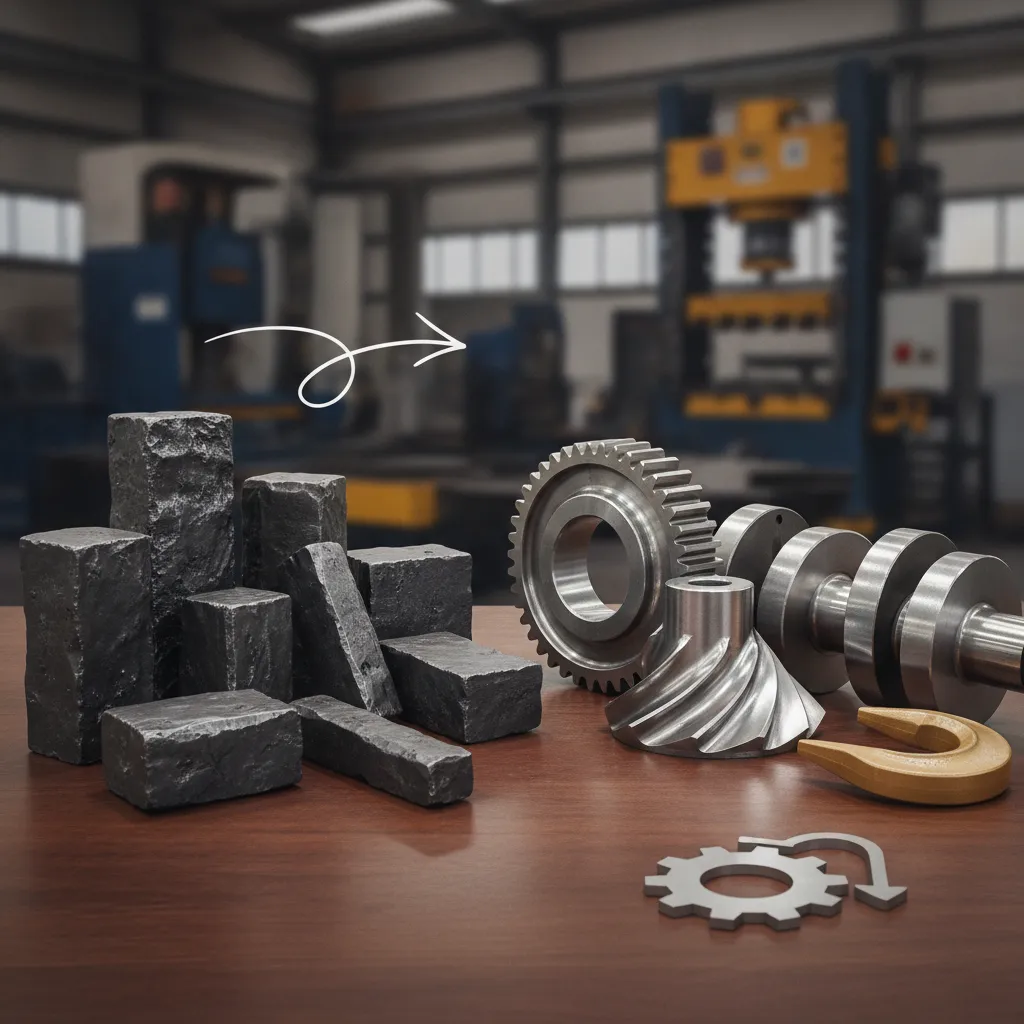
Forgings are shaped by compressing solid metal under high pressure; castings are made by pouring molten metal into a mold. That difference in process matters mechanically: forging aligns the grain structure of the metal, producing parts with higher tensile strength and fatigue resistance than cast equivalents. For high-stress applications in automotive, aerospace, or oil and gas, forgings typically outlast castings under cyclic loading—though castings can achieve more complex internal geometries that forging dies cannot.
Can custom forgings be produced in small quantities, or is there a minimum order?
Most forging suppliers set minimum order quantities because die setup costs must be spread across a production run. Open-die and ring-rolling processes tend to accommodate lower volumes than closed-die forging, where tooling investment is higher. For small precision components under 38mm, cold forging methods—like those used at MFG SOLUTION—can reduce per-part tooling costs and make shorter runs more economical. Ask your supplier for a tooling amortization breakdown before committing to a quantity.
How long does it take to get a quote for custom forgings?
Quote lead times vary by supplier complexity, but you should expect 24–72 hours from most traditional forging houses. MFG SOLUTION returns quotes within 8 hours of receiving your part specifications—covering cold forging and CNC mill & turn operations for parts up to 38mm in diameter. Faster quoting reduces your sourcing cycle and lets engineering teams iterate on design without waiting days for cost feedback.
What certifications should a custom forging supplier hold?
At minimum, look for ISO 9001:2015 for general quality management. If your parts go into medical devices, require ISO 13485:2016; for automotive components, IATF 16949 is the industry standard. Suppliers serving aerospace or pressure vessel applications may also need AS9100 or PED compliance. Certifications confirm that a supplier’s processes are documented, audited, and traceable—reducing your risk of non-conforming parts reaching production or triggering a compliance failure during an OEM audit.
How do I choose the right forging process for my part geometry?
Start with your part’s shape and symmetry. Axisymmetric parts—shafts, rings, and rollers—are natural candidates for cross roll or ring-rolling processes. Irregular or complex geometries with varying cross-sections suit hammer forging. High-volume symmetrical parts like hubs and flanges are best matched to press forging for tighter tolerances and repeatability. Share a 2D drawing or 3D model with your supplier early; most experienced forging engineers can recommend the optimal process within the first technical review, saving costly tooling redesigns later.
Conclusion
Material selection, process method, and supplier certifications determine whether a custom forging performs or fails in service. Closed-die forging delivers the tightest tolerances; open-die suits large or low-volume work; cold forging cuts per-part cost on small, high-volume components. Whichever method fits your geometry, verify that your supplier holds the certifications your industry requires—ISO 9001:2015, ISO 13485:2016, or IATF 16949—before production begins.
Your next step: submit your part drawing to MFG SOLUTION with your target quantity and material spec. You’ll receive a detailed quote within 8 hours, covering cold forging and CNC mill & turn options for parts up to 38mm—so you can compare process costs before committing to tooling.
Recommended Articles
Explore more from our content library: