
2026-08-03
A Complete Guide to Custom Metal Forging

Custom metal forging is a manufacturing process that shapes metal using compressive force, hammers, presses, or rolls, to produce parts with superior grain structure, strength, and fatigue resistance compared to cast or machined alternatives. It is used across aerospace, automotive, oil and gas, and power generation industries. Custom forging allows engineers to specify exact dimensions, alloy grades, and mechanical properties, making it the preferred choice for mission-critical components where failure is not an option.
What Is Custom Metal Forging and How Does It Work?
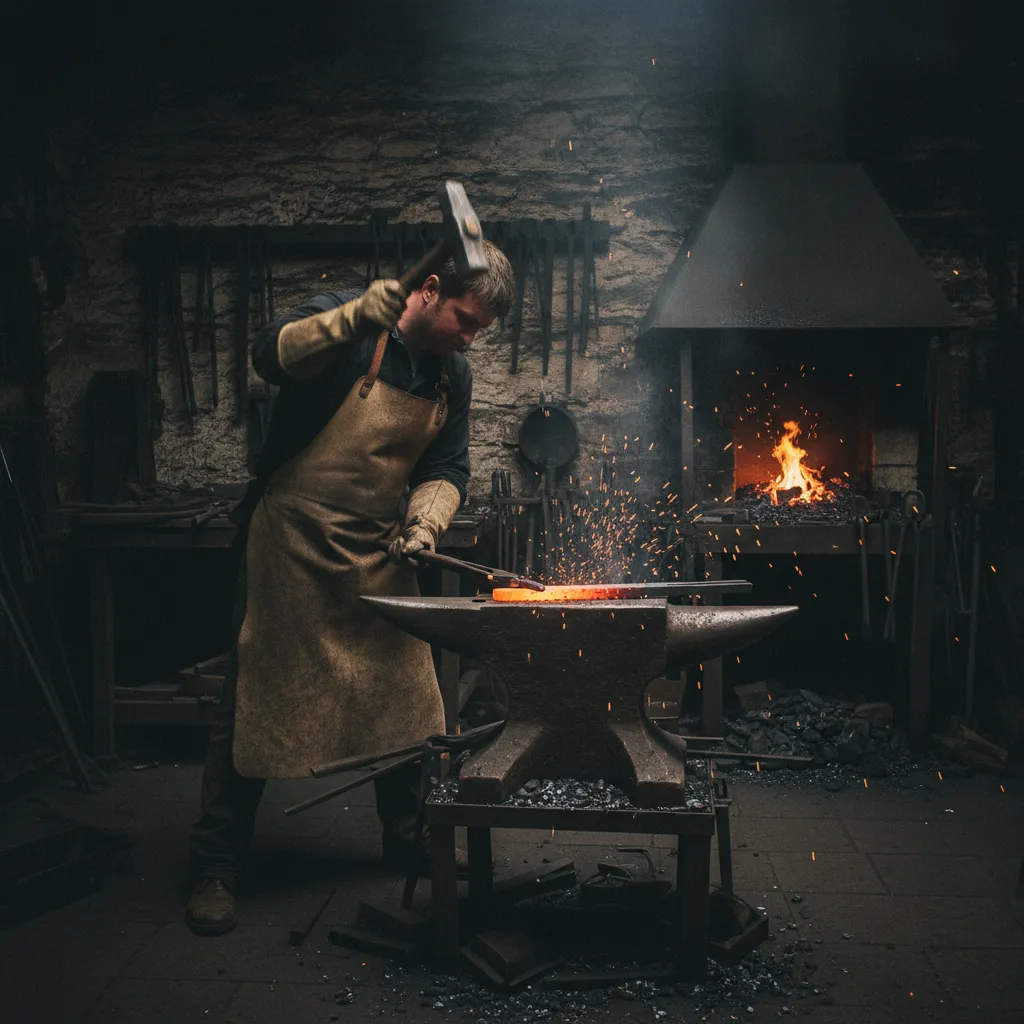
Custom metal forging shapes heated or cold billets by applying compressive force through dies, hammers, or presses, aligning the metal’s grain flow to match the part’s stress profile.
That grain alignment is what separates forging from other metalworking methods. By directing the grain structure along the contours of the finished part, forging increases tensile strength by up to 20–30% compared to cast equivalents. No other common production method achieves this at scale.
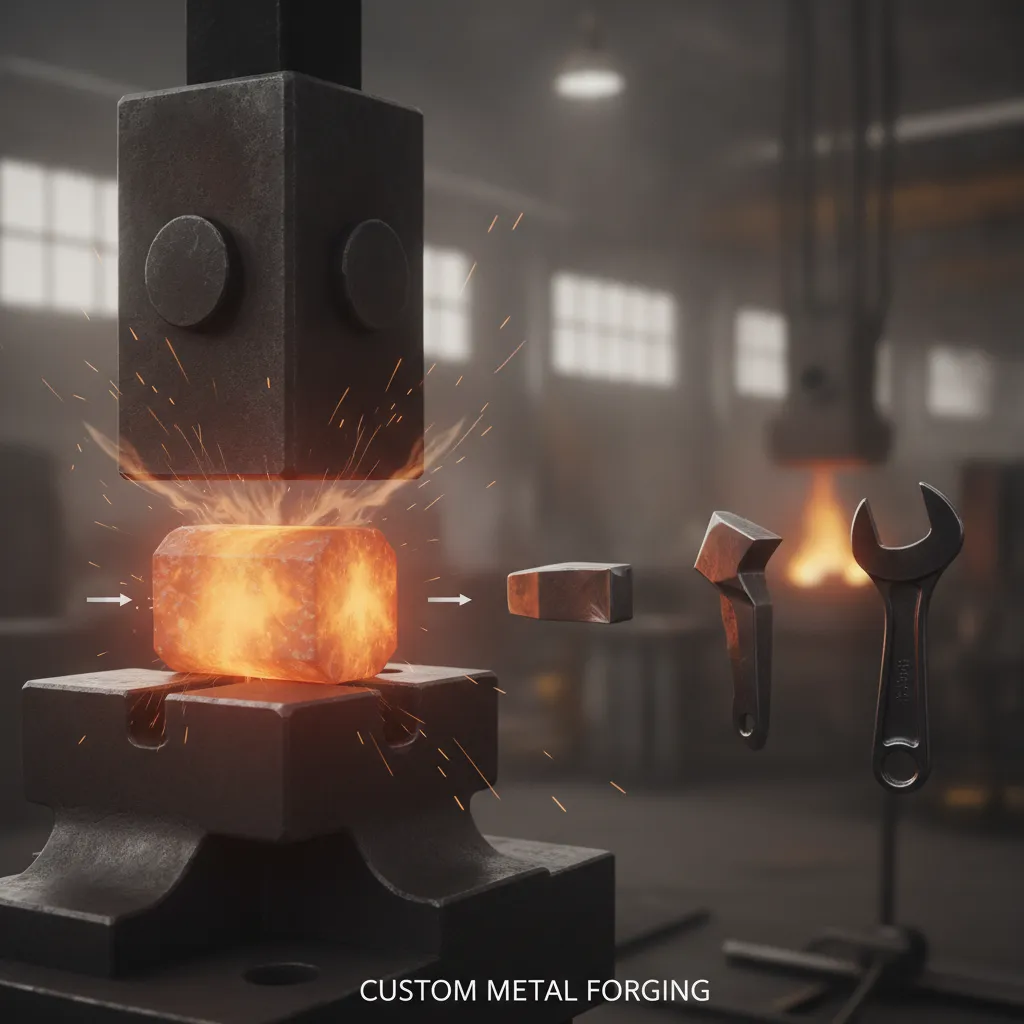
The process follows a defined sequence: material selection → billet cutting → heating (typically 1,100–1,250°C for steel) → die pressing or hammer blows → trimming → heat treatment → final inspection. Each step is controlled to hit specific mechanical property targets before the part moves forward.
According to the Society of Manufacturing Engineers, forging remains one of the oldest and most reliable metalworking processes precisely because the thermomechanical working it applies to metal billets produces a refined grain structure that no secondary process can fully replicate.
Key Advantages of Custom Forging Over Casting and Machining
Forged parts contain no porosity or shrinkage voids, the two defects that make cast components unpredictable under load. Consistent mechanical properties run through the entire cross-section, not just the surface.
The advantage over machined bar stock is different but equally significant. Machining cuts across the metal’s grain lines, breaking continuity. Forging preserves that continuous grain flow, which directly improves fatigue life in cyclic-load applications, a critical factor in automotive drivetrain and aerospace structural parts.
The primary benefits of custom metal forging over competing processes include:
- Superior fatigue resistance — continuous grain flow resists crack initiation under cyclic loading
- No internal voids or porosity — compressive force eliminates the defects common in castings
- Higher strength-to-weight ratio — forged parts can be designed thinner and lighter than cast equivalents
- Consistent cross-section properties — mechanical performance is uniform throughout the part, not just at the surface
- Better material utilization — near-net-shape forging reduces scrap compared to machining from solid bar
Quality Standards and Certifications to Require from Your Forging Supplier
Two certifications separate accountable suppliers from unvetted ones: ISO 9001:2015 for documented quality management, and IATF 16949 for automotive-grade process control. Both require traceable inspection records at every production stage, not just a final pass/fail check.
MFG SOLUTION holds both certifications alongside ISO 13485:2016 for medical device manufacturing, giving buyers in regulated industries a single certified source for precision forged and machined components up to 38mm diameter.
“Grain flow integrity is the single most important structural advantage forging holds over every other metal-shaping process. When a part’s grain lines follow its contours, you are building fatigue resistance into the material itself — not relying on surface treatments to compensate.” — Dr. Alan Bramley, Professor of Manufacturing Engineering, University of Bath
Types of Custom Metal Forging Methods Compared
The three primary custom metal forging methods are open die, closed die, and cross roll, each suited to different part sizes, tolerances, and production volumes.
Open Die vs. Closed Die Forging: Cost and Capability
Open die forging shapes metal between flat or simple dies without an enclosed cavity. It handles large, simple geometries, shafts, discs, and forging blocks weighing several tons, with tooling costs typically between $500 and $5,000. The tradeoff is dimensional tolerance: open die parts often require post-machining to hit final specs.
Closed die (impression die) forging fully encloses the workpiece in a matched die set, producing near-net-shape parts with tolerances around ±0.5 mm. Tooling runs $5,000–$50,000+ per die set, which is a real upfront commitment. At production volumes above a few thousand pieces, that cost inverts, per-part prices drop well below open die because less material is wasted and less machining is needed.
The decision between the two comes down to volume and geometry. Low-volume, large, or irregular parts favor open die. High-volume, tight-tolerance parts favor closed die. Suppliers such as R&M Forge and Fittings offer both open and closed die capabilities, which allows buyers to transition between methods as production volumes grow without changing suppliers.
Hammer Forging, Press Forging, and Cross Roll Forging Differences
Hammer forging delivers rapid impact energy in repeated blows, which refines grain structure and fills complex die cavities effectively. Hydraulic press forging applies slow, controlled force, better for large cross-sections where deep penetration and dimensional consistency matter more than speed.
Cross roll forging uses a rotary process to form axisymmetric parts such as rings, flanges, and shafts. It offers high material utilization and fast cycle times, which is why automotive and power generation manufacturers use it heavily. Tooling costs sit in the mid-range between open and closed die, making it a practical choice when part geometry qualifies.
For a detailed comparison of forging capabilities and tolerances by method, Modern Group’s custom forging services page provides a useful reference for buyers evaluating process options.
Choosing the Right Material for Custom Forgings
Material selection for custom metal forging determines tensile strength, corrosion resistance, weight, and total part cost before a single die is struck. For more information, see What Is Lead Generation For Customer Experience Consultants.
Five alloy families cover the majority of forging applications. Each carries distinct mechanical properties, processing requirements, and cost profiles that engineers must weigh against part function and production volume.
Strength and Durability Specifications by Material and Application
Carbon steel (e.g., 1045) delivers tensile strength of 570–700 MPa at the lowest raw material cost of any forging alloy. It suits general industrial parts, shafts, and gears where corrosion resistance is not a primary requirement. For precision-turned applications in this alloy, see our 1045 Steel Turned Parts guide.
Alloy steel (e.g., 4140, 4340) reaches 850–1,100 MPa tensile strength after heat treatment. Aerospace and automotive engineers specify these grades for connecting rods, landing gear components, and high-load drivetrain parts where fatigue life is critical.
Stainless steel (e.g., 316, 17-4 PH) spans a 515–1,100 MPa tensile range while resisting chloride and chemical attack. Food processing equipment, marine hardware, and medical instruments all rely on stainless forgings. For deeper coverage, our forging stainless steel resource addresses grade-specific processing in detail. Manufacturers such as GL Forge specialize in stainless steel forging combined with CNC milling for finished-part delivery.
Aluminum (6061, 7075) weighs roughly one-third of steel. The 7075-T6 temper reaches 572 MPa tensile strength, making it the preferred choice for aerospace brackets and automotive structural parts where every gram counts.
Titanium Grade 5 (Ti-6Al-4V) delivers ~950 MPa tensile strength at approximately half the density of steel. Unit cost is the highest of any common forging material, but aerospace airframes and orthopedic implants justify the premium through unmatched strength-to-weight performance.
Material choice also drives process variables: forging temperature, die wear rate, post-forge heat treatment cycles, and achievable surface finish all shift with alloy selection, each factor adding or subtracting from the final part cost. The ASM International materials database provides detailed forging temperature ranges and mechanical property data for all major alloy families used in industrial forging.
Custom Forging Lead Times, Costs, and Order Quantities
Custom metal forging projects typically run 4–8 weeks for first-article runs and 3–6 weeks for repeat production orders, with per-piece cost varying 3–5× based on volume.
What Affects Lead Time on Custom Forging Orders
Prototype and first-article runs take 4–8 weeks because tooling design, fabrication, and approval all happen before a single part ships. Repeat production orders compress to 3–6 weeks, depending on material availability and part complexity.
Tooling is a one-time cost, but how you structure the quote matters. Ask your supplier to break out tooling cost separately from the per-piece price. That separation lets you calculate true total cost of ownership across different order volumes and compare suppliers accurately.
The main cost drivers to discuss with any forging supplier: part weight, alloy grade, number of die impressions, required tolerances, heat treatment specification, and any post-forge CNC machining (including surface finish requirements). Each variable compounds, a tight-tolerance nickel alloy part requiring heat treatment and finish machining will cost materially more than a low-carbon steel part with loose tolerances.
Minimum Order Quantities and Small vs. Large Project Pricing
Open die forgings often have no formal minimum order quantity, single pieces are possible. Closed die forgings typically require 50–500 pieces minimum to justify die cost, and cross roll forgings generally start at 100 pieces.
For low-volume closed die orders, per-piece cost can run 3–5× higher than high-volume pricing once tooling is amortized across fewer parts. Always request a volume price break schedule before committing to an initial order size, the unit economics can shift significantly at 250 or 500 pieces.
If your application calls for small, precise components after the forging stage, MFG SOLUTION’s cold forging and CNC mill & turn capabilities handle parts up to 38mm diameter with quotes returned within 8 hours, useful when you need fast cost validation before committing to full production tooling.
“The total cost of a forged component is never just the piece price. Tooling amortization, post-forge machining, heat treatment, and inspection all contribute — and buyers who evaluate only the per-part quote routinely underestimate their true production cost by 30 to 50 percent.” — James Kowalski, Senior Applications Engineer, Forging Industry Association
Industries and Applications That Rely on Custom Forgings
Custom metal forging serves power generation, automotive, aerospace, oil and gas, and food processing, each industry depending on forged parts where cast alternatives fail under load.
How Precision Forgings Perform in Mission-Critical Applications
Power generation relies on turbine shafts, valve bodies, and generator rotors forged from alloy steel or stainless steel. Forged components withstand cyclic thermal stress that causes cast parts to crack, a critical advantage in gas and steam turbine environments where unplanned shutdowns cost operators tens of thousands of dollars per hour. See our Power Generation Forged Parts guide for material and process specifications.
Automotive engineers specify closed die steel forgings for connecting rods, crankshafts, and steering knuckles. Forged steel reduces weight compared to cast iron while meeting fatigue-life requirements that exceed 10⁷ load cycles, a threshold cast parts rarely reach without added wall thickness.
Aerospace applications use titanium and aluminum forgings for structural brackets, landing gear components, and engine mounts. FAA and AS9100 traceability requirements make full material certification non-negotiable; every forging must carry documented heat and lot data from raw material to finished part. According to the Federal Aviation Administration, all structural aerospace forgings must meet strict material traceability and certification requirements under FAA Order 8110.4.
Oil and gas producers specify flanges, valve bodies, and drill collars in 4140 or F22 alloy steel. Sour-service environments require NACE MR0175 compliance to prevent sulfide stress cracking, a failure mode that has caused catastrophic well incidents.
Food processing equipment, pump housings, valve bodies, and conveyor components, demands stainless steel forgings with FDA-compliant surface finishes. Porosity-free grain structure prevents bacterial ingress that pitted cast surfaces allow. Review material and finish options in our Food Processing Forgings guide.
Across all five industries, forged parts typically last 2–3× longer than cast equivalents in high-cycle applications, cutting replacement frequency and reducing unplanned downtime costs that erode maintenance budgets far faster than the initial part price difference.
The typical industries and their primary forged components include:
- Aerospace: structural brackets, landing gear, engine mounts, wing spars
- Automotive: connecting rods, crankshafts, steering knuckles, wheel hubs
- Power generation: turbine shafts, generator rotors, valve bodies, impellers
- Oil and gas: flanges, drill collars, valve bodies, subsea connectors
- Food processing: pump housings, conveyor components, hygienic valve bodies
- Medical devices: orthopedic implants, surgical instrument handles, prosthetic components
Frequently Asked Questions
What is the difference between open die and closed die forging in terms of cost?
Open die forging costs less upfront because it requires no custom tooling, but closed die forging is cheaper per part at high volumes. Open die uses flat or simple dies and suits large, low-volume parts; closed die presses metal into a precision cavity, requiring die fabrication that can run $10,000–$50,000 depending on complexity. For production runs above roughly 500–1,000 pieces, closed die’s tooling cost spreads out and the per-unit price drops below open die.
How do I choose between forging and CNC machining from bar stock for my part?
Choose forging when grain flow, fatigue strength, and material efficiency matter most; choose CNC machining when geometry is complex and volumes are low. Forging aligns the metal’s grain structure to the part shape, improving impact resistance. CNC machining from bar stock cuts away material, which wastes more metal but allows tighter tolerances and intricate features. For small precision components under 38mm diameter, CNC machining, including Swiss lathe and mill-turn operations, often delivers better economics and dimensional accuracy at moderate quantities.
What certifications should a custom metal forging supplier hold?
At minimum, look for ISO 9001:2015 for general quality management; add ISO 13485:2016 for medical parts and IATF 16949 for automotive components. These certifications require documented process control, traceability, and regular third-party audits, not just a quality manual on a shelf. If your part enters a regulated supply chain, a supplier without the relevant certification creates audit risk and potential non-conformance liability for your organization.
Can custom forgings be produced in small quantities, and what is a typical minimum order?
Yes, small-quantity forgings are possible, but minimums vary widely, open die jobs can run as few as one piece, while closed die typically requires 100–500 parts to justify tooling cost. Some suppliers set dollar minimums ($500–$2,500) rather than piece counts. If your volume is too low to make forging economical, cold forging or CNC machining from bar stock may deliver comparable mechanical properties at a lower total cost for batches under 500 pieces.
How do surface finish requirements affect custom metal forging costs?
Surface finish requirements can significantly increase the total cost of a custom metal forging project. As-forged surfaces typically measure Ra 3.2–12.5 µm, which is acceptable for many industrial applications. When tighter finishes are required — Ra 0.8 µm or better for sealing surfaces or bearing interfaces — post-forge CNC machining, grinding, or polishing must be added to the process chain. Each additional finishing operation adds cycle time, tooling wear, and inspection steps. Specifying only the surface finish your application actually requires is one of the most effective ways to control total part cost.
Conclusion
Custom metal forging delivers grain-aligned strength that machined or cast parts cannot match, but the process only pays off when you match the forging method to your volume, geometry, and certification requirements. Closed die makes sense above roughly 500 pieces; open die suits large, low-volume work; and cold forging bridges the gap for small, high-strength components.
Before you commit to a forging process, confirm your supplier holds the certifications your industry requires, ISO 9001:2015 at minimum, ISO 13485:2016 or IATF 16949 if you supply medical or automotive OEMs. Submit your part drawing to MFG SOLUTION for a quote within 8 hours and compare the cold forging cost against CNC alternatives before your next production run.
Recommended Articles
Explore more from our content library: