
2026-08-22
How to Choose Between CNC Machining vs Manual Machining for

Understanding CNC machining vs manual machining is essential. CNC machining uses computer-controlled automation to execute programmed toolpaths with repeatable precision, while manual machining relies on a skilled operator to control cutting tools by hand. CNC excels at high-volume production, tight tolerances, and complex geometries; manual machining remains practical for one-off repairs, simple setups, and situations where programming time would outweigh the run time. Choosing between them depends on volume, geometry complexity, tolerance requirements, and available budget.
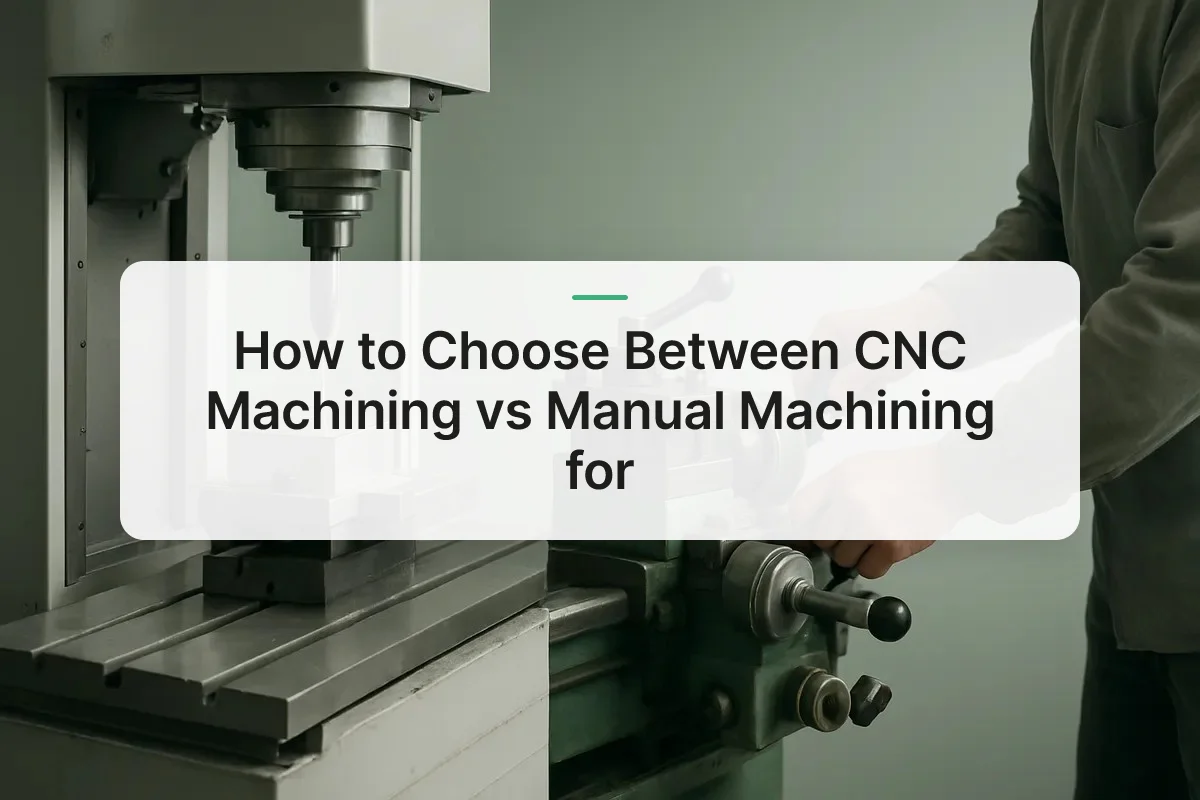
CNC Machining vs Manual Machining: Core Differences Explained
The defining split between CNC and manual machining is control: one method delegates cutting decisions to software; the other keeps them with the operator’s hands.
What Is CNC Machining and How Does It Work?
CNC machining converts a digital part design into a sequence of G-code instructions, either written directly or generated by CAM software, that drive servo motors along multiple axes. The machine executes each toolpath automatically: spindle speed, feed rate, depth of cut, and tool changes all happen without the operator intervening between passes.
Because the same G-code file runs on every cycle, the machine re-executes an identical toolpath on each part. That mechanical consistency is what allows CNC systems to hold tight tolerances across hundreds or thousands of parts — operator fatigue and judgment play no role once the program is proven.
The tradeoff is front-loaded setup time. Before the first chip falls, a programmer must write and verify the toolpath, set tool-length offsets, and confirm work-holding. That investment makes CNC most cost-effective when the same program runs many times. According to the National Institute of Standards and Technology (NIST), consistent process control is a foundational requirement for modern precision manufacturing.
What Is Manual Machining and What Skills Does It Require?
On a conventional lathe or milling machine, the operator controls feed rate, depth of cut, and tool position directly through handwheels and levers. Every pass is a real-time judgment call — the machinist reads surface finish, listens to cutting sound, and adjusts on the fly.
That continuous craft judgment is the core skill manual machining demands. A skilled manual machinist can fixture a part and begin cutting within minutes, with no programming step required.
The limitation is repeatability. Pass-to-pass and operator-to-operator variation naturally widens tolerance bands, making manual methods less reliable for tight-tolerance production runs. When comparing CNC machining vs manual machining, this repeatability gap is the most consequential practical difference for any manufacturer choosing between the two approaches.
How CNC and Manual Machining Compare in Cost, Speed, and Accuracy
CNC machining wins on speed, accuracy, and per-part cost at volume; manual machining wins on low setup cost and flexibility for single, simple parts.
Cost Structure
CNC carries significant upfront capital — equipment, tooling, and programming — but that investment spreads across every part in a production run. Once a program is written and proven, each subsequent part costs roughly the same to produce. Manual machining has a lower entry cost, but labor hours scale directly with part count: double the quantity, double the operator time, and per-part cost climbs steeply as volume grows.
Speed
CNC eliminates operator reaction time entirely. A servo-controlled axis moves at the programmed feed rate without hesitation, fatigue, or variation between shifts, and modern CNC equipment runs unattended through lights-out production cycles. Manual machining speed is bounded by the operator’s judgment on feed rate and depth of cut. That said, for a single straightforward part, skipping the programming and setup cycle can make manual machining faster end-to-end.
Accuracy
CNC holds tighter tolerances consistently because servo feedback corrects axis position in real time during the cut. Manual tolerance depends on operator skill, tool condition, and how often the machinist stops to measure. That gap widens as part complexity increases — a five-feature turned part is manageable by hand, but a component with 20 interdependent dimensions becomes difficult to hold manually without cumulative error.
What Is the ROI Case for CNC Equipment Over Manual Tools?
The break-even logic is straightforward. At low volumes — a one-off prototype or a handful of parts — the programming investment is never recovered, and manual machining is the more economical path. At higher volumes or on complex geometries, labor savings and reduced scrap justify the premium equipment tier. When comparing CNC machining vs manual machining across a long production run, the per-part cost advantage of CNC compounds with every additional unit.
How Do Material Compatibility and Process Limitations Differ?
CNC’s controlled feed and speed parameters make it better suited to difficult-to-machine alloys — titanium, hardened steels, and high-temperature nickel alloys — where consistent cutting conditions prevent tool failure and thermal damage. A manual operator cannot maintain the precise, repeatable parameters these materials demand across a full run. MFG SOLUTION’s 5-axis CNC machines and Swiss lathe equipment, for example, hold the controlled cutting conditions that medical-grade titanium components require, conditions a manual setup cannot reliably replicate across batch production.
The table below summarizes the key performance differences at a glance:
- Repeatability: CNC delivers consistent tolerances across every part in a run; manual machining introduces operator-to-operator variation.
- Setup time: Manual machining requires minimal setup for simple parts; CNC requires programming, offset verification, and a dry-run cycle.
- Material range: CNC handles difficult alloys more reliably by maintaining precise cutting parameters throughout the run.
- Capital cost: Manual equipment carries a lower entry cost; CNC investment is higher but amortizes across volume production.
- Geometric complexity: Multi-axis contours and tight positional tolerances favor CNC; straightforward profiles are manageable manually.
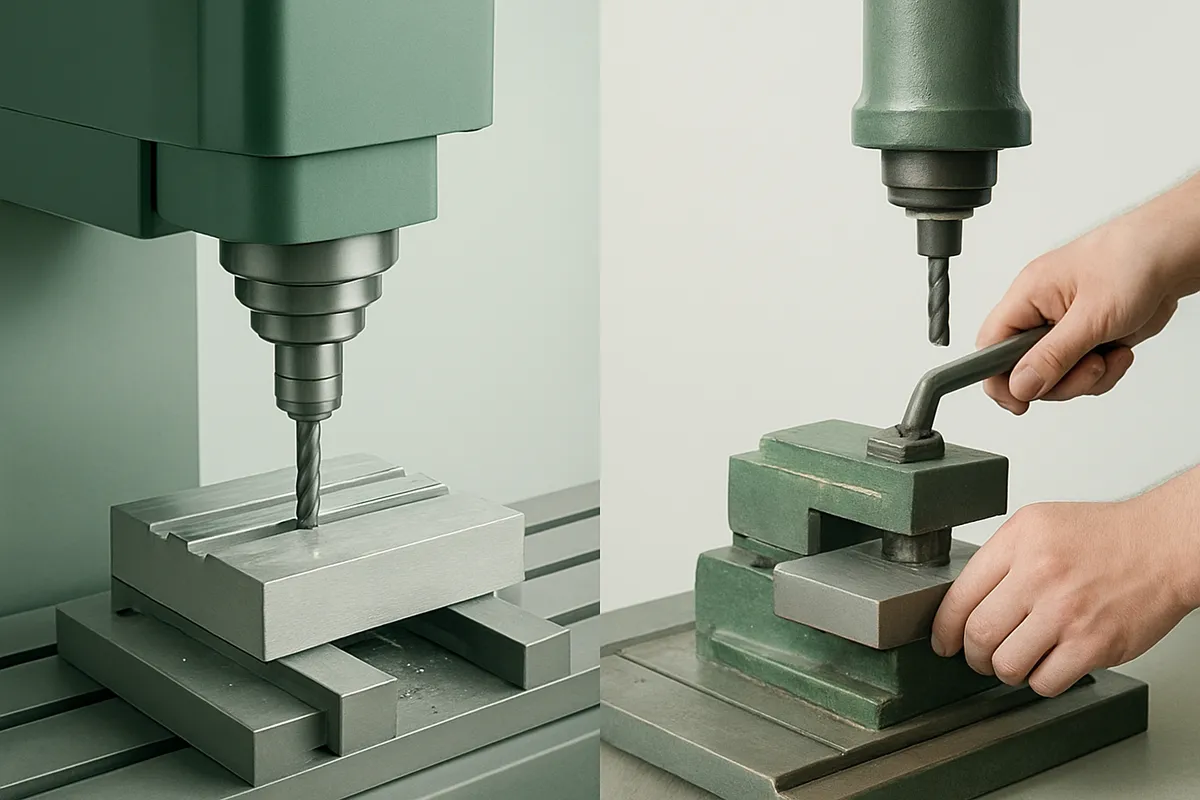
Downsides of CNC Machining and When Manual Machining Makes More Sense
CNC machining has real limitations — programming overhead, capital cost, and setup complexity make it the wrong tool for certain jobs.
Is Manual Machining Still Relevant in Modern Manufacturing?
For a single non-repeating part or an emergency repair, CNC can actually slow you down. Writing a CAM program, setting tool offsets, and running a dry cycle can consume more time than the cut itself. A skilled manual machinist can often chuck a part, make the cut, and hand it off in a fraction of that time.
The capital commitment behind CNC is also significant. Machine purchase, tooling libraries, software licenses, and scheduled preventive maintenance represent a premium-tier investment that only pays off at meaningful production volumes. Low-volume or intermittent work rarely justifies that cost floor.
Manual machinists remain essential in toolrooms, maintenance shops, and prototype environments precisely because flexibility matters more than throughput in those settings. A machinist who can read a print and immediately set up a manual lathe or mill is invaluable when a production line goes down at 2 a.m. and there is no time to write G-code.
Manual skill also makes better CNC operators. Machinists who understand feeds, speeds, and tool deflection by feel diagnose CNC alarms faster and write more effective programs. The trade is not dying — it is evolving into a foundation skill that underpins CNC competence. The Society of Manufacturing Engineers (SME) recognizes manual machining fundamentals as a core competency that supports advanced CNC programming and process planning.
When Should You Use a Hybrid CNC and Manual Approach?
In the CNC machining vs manual machining debate, the most practical answer for many shops is neither exclusively — it is both. Many professional shops run CNC machines for primary complex features and route parts to a manual machine for facing, deburring, or simple secondary operations that would otherwise require a full CNC setup changeover.
That efficiency mechanism is straightforward: tying up a CNC spindle to take a 0.5mm cleanup pass is wasteful when a manual mill can do it in 90 seconds with zero programming. Reserving CNC capacity for high-complexity, high-repeatability work and handling trivial cuts manually keeps throughput high across the shop floor.
Learning Curve: How Long It Takes to Become Proficient in Each Method
What Are the Training Timelines and Skill Requirements for Each Method?
Manual machining takes years to master; CNC operation can be learned in weeks, but full CNC programming proficiency takes considerably longer.
Manual machining follows a layered path. Apprenticeship or vocational programs typically build foundational competency first — safe workholding, blueprint reading, and holding basic tolerances on a lathe or mill. From there, operators progress to more complex setups: compound angles, multi-step turning sequences, and precision boring. Each skill layer depends on the one before it, which is why structured programs exist rather than informal self-teaching.
CNC machining splits into two distinct skill levels:
- CNC operation — loading a program, setting tool offsets, and monitoring a production run — can typically be learned in days to weeks with structured instruction.
- CNC programming — writing CAM toolpaths, selecting feeds and speeds, and planning multi-axis sequences to hit tight tolerances — is a separate discipline that takes months of deliberate practice to perform reliably.
Manual experience accelerates CNC mastery in a way that’s hard to replicate otherwise. An operator who understands how chip load affects tool deflection, or how poor fixturing introduces vibration, makes better programming decisions before the machine ever starts cutting. That physical intuition translates directly into smarter toolpath choices and fewer scrapped parts.
The skill contrast in CNC machining vs manual machining is clear: manual work demands tactile interpretation and real-time judgment; CNC demands software literacy, systematic offset documentation, and disciplined program management. Readers who want to go deeper on specific CNC skill areas can explore surface finish optimization and CNC threading techniques as practical next steps.
Which Machining Method Should You Choose for Your Application?
Choose CNC for volume, tight tolerances, and complex geometry; choose manual for one-off parts, quick iterations, and toolroom work where setup time outweighs automation gains.
Volume and Tolerance as the First Filter
High-volume production almost always defaults to CNC. Consistent tolerances, unattended operation, and built-in error-detection mechanisms reduce scrap rates once the initial setup investment is absorbed across a sufficient run. The per-part cost drops steadily as volume climbs — a dynamic that manual machining simply cannot replicate at scale.
Geometric complexity is the second filter. Parts with multi-axis contours, tight positional tolerances, or deep internal cavities reach a threshold where manual execution becomes inconsistent, not just slow. At that point, CNC is not a preference; it is the only reliable path to repeatable quality. CNC hole drilling technology, coolant and lubrication strategies, and surface finish control all become relevant considerations as you move toward CNC implementation.
How Do Industry-Specific Use Cases Differ Across Aerospace, Prototyping, and Small Batch Production?
Aerospace demands CNC without exception — complex geometries, audit-trail documentation, and zero-defect requirements make manual methods impractical for flight-critical components. Medical device production carries the same logic: ISO 13485 compliance requires the repeatability and process traceability that only CNC delivers. MFG SOLUTION holds ISO 13485:2016 certification precisely because medical customers cannot accept dimensional variation between batches.
Prototyping and one-off parts present a genuine split. Manual machining offers no programming lead time and immediate physical iteration — an advantage when geometry is straightforward and speed of concept validation matters most. When a prototype must match production tolerances exactly, or when the geometry is too complex for manual execution, CNC becomes necessary even at quantity one.
Small-batch custom work and toolroom maintenance remain the strongest territory for manual or hybrid approaches, where setup overhead would consume any efficiency gain from automation. If you are also evaluating whether machining is even the right primary process for your part, forging block production and stainless steel forging are worth reviewing before committing to a CNC machining vs manual machining decision.
Frequently Asked Questions
Can a manual machinist operate a CNC machine without additional training?
No, a manual machinist needs additional training to operate CNC equipment safely and effectively. Manual skills transfer in terms of material knowledge and tooling familiarity, but CNC operation requires learning G-code programming, CAM software, and machine-specific control interfaces. Most employers require formal CNC training or a structured on-the-job program before a manual machinist runs production on CNC equipment independently.
What types of parts are impossible or impractical to produce on a manual machine?
Parts with complex 3D contours, tight multi-axis tolerances, or high-volume repeatability requirements are impractical on manual machines. Specifically, components requiring simultaneous 4- or 5-axis movement — such as turbine blades, orthopedic implants, or helical gear profiles — cannot be produced manually with consistent accuracy. Any part where dimensional variation between units must stay within very tight bands across hundreds of pieces also falls outside what manual machining can reliably deliver.
Is CNC machining always more accurate than manual machining?
Not always — a skilled manual machinist can match CNC accuracy on simple, single-feature parts in a one-off context. CNC’s accuracy advantage becomes decisive when the same tolerance must be held across dozens or thousands of identical parts, or when the geometry involves multiple interdependent features. For single prototypes with straightforward geometry, an experienced manual operator can achieve comparable results.
What career path pays more, CNC machining or manual machining?
CNC machining roles generally pay more than manual machining positions in current manufacturing markets. CNC programmers and operators command higher wages because their skill set spans software, toolpath planning, and quality inspection — not just machine operation. Manual machining roles remain valued for toolroom and repair work, but the broader demand and specialization premium sit firmly on the CNC side of the trade.
How does part volume affect the decision between CNC and manual machining?
Part volume is often the single most decisive factor when choosing between CNC and manual machining. For very low quantities — a single prototype or a handful of repair parts — the time required to write, verify, and set up a CNC program frequently exceeds the actual cutting time, making manual machining more efficient end-to-end. As quantity increases, CNC’s consistent cycle time and unattended operation capability drive per-part cost steadily downward, while manual labor costs scale linearly with every additional unit produced.
Conclusion
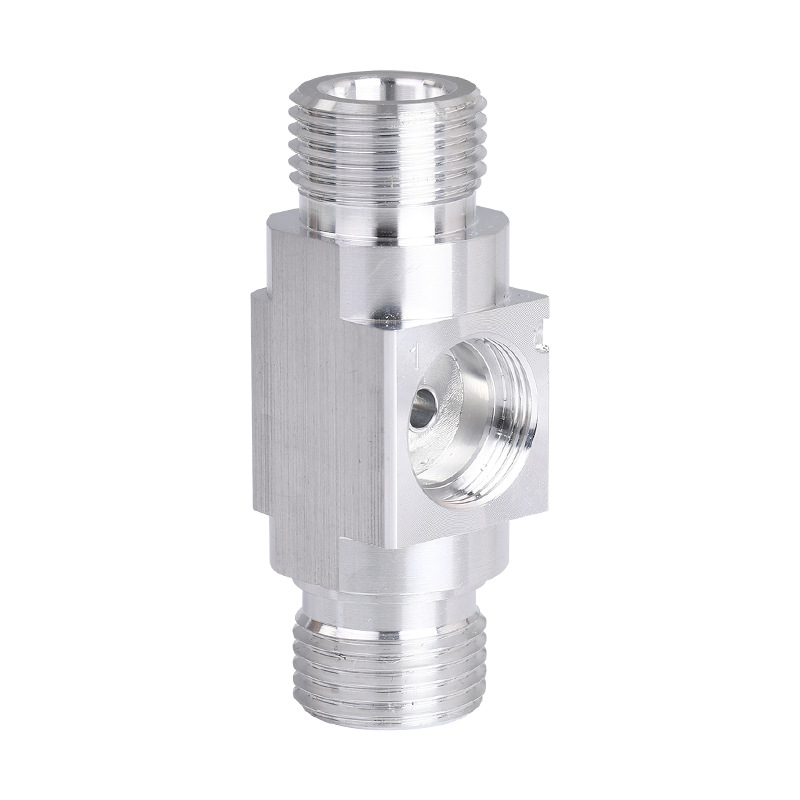
The choice between CNC and manual machining comes down to three variables: volume, geometry complexity, and tolerance repeatability. Manual machining remains the right call for one-off repairs, simple prototypes, and setups where programming time would cost more than the job itself. CNC wins decisively the moment you need the same tight tolerance held across a production run, or when the part geometry requires simultaneous multi-axis movement no human hand can replicate consistently.
If your next project involves small precision parts under 38mm in diameter and you need a certified production partner, submit your part specifications to MFG SOLUTION. You’ll receive a detailed quote within 8 hours — enough information to make a fully informed make-vs-buy decision before your next planning meeting.
Recommended Articles
Explore more from our content library: