
2026-07-20
Casting and Forging: Choosing the Right Process
Understanding casting and forging is essential. Casting pours molten metal into a mold; forging shapes solid metal under high pressure. Casting handles complex geometries and large volumes at lower tooling cost, while forging produces denser grain structure, higher tensile strength, and better fatigue resistance. The right choice depends on your part geometry, required mechanical properties, production volume, and budget, factors this guide breaks down with specific examples and cost data.
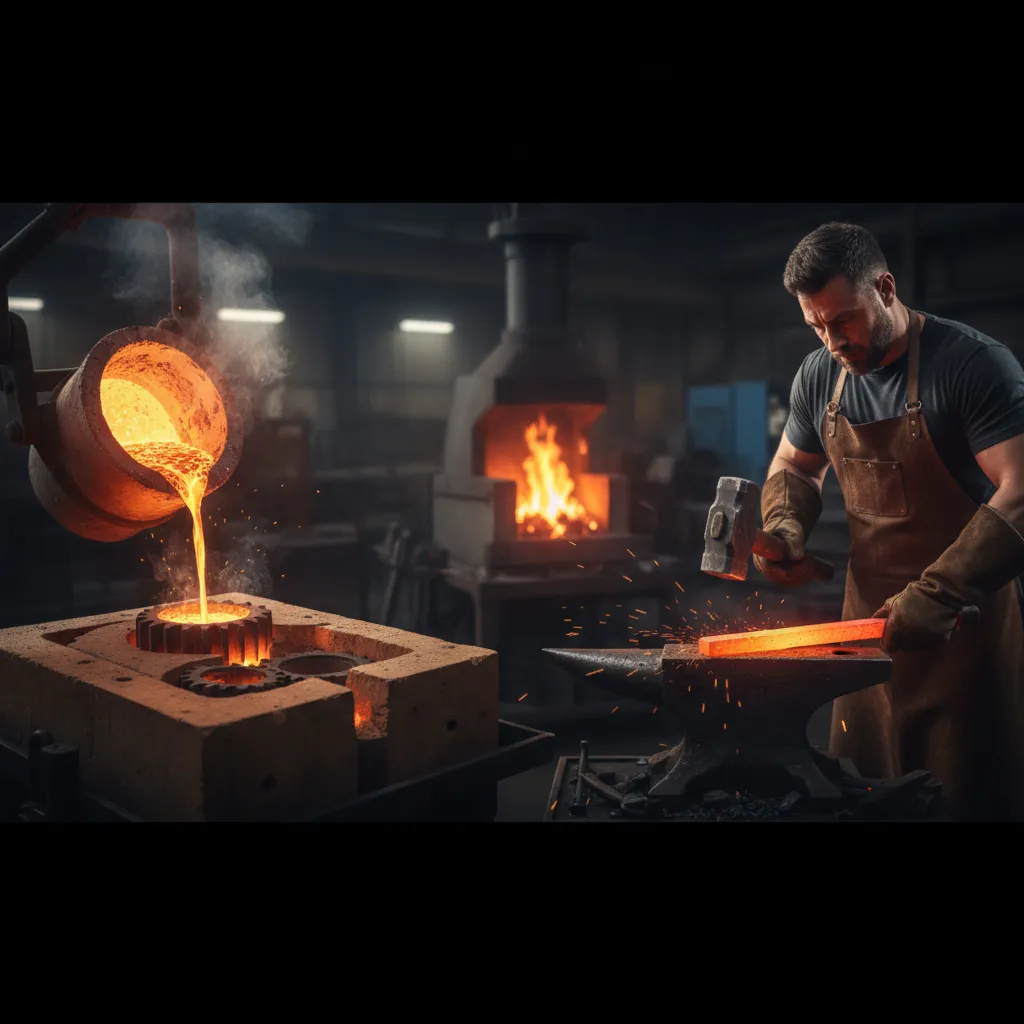
Casting and Forging: Core Process Differences Explained
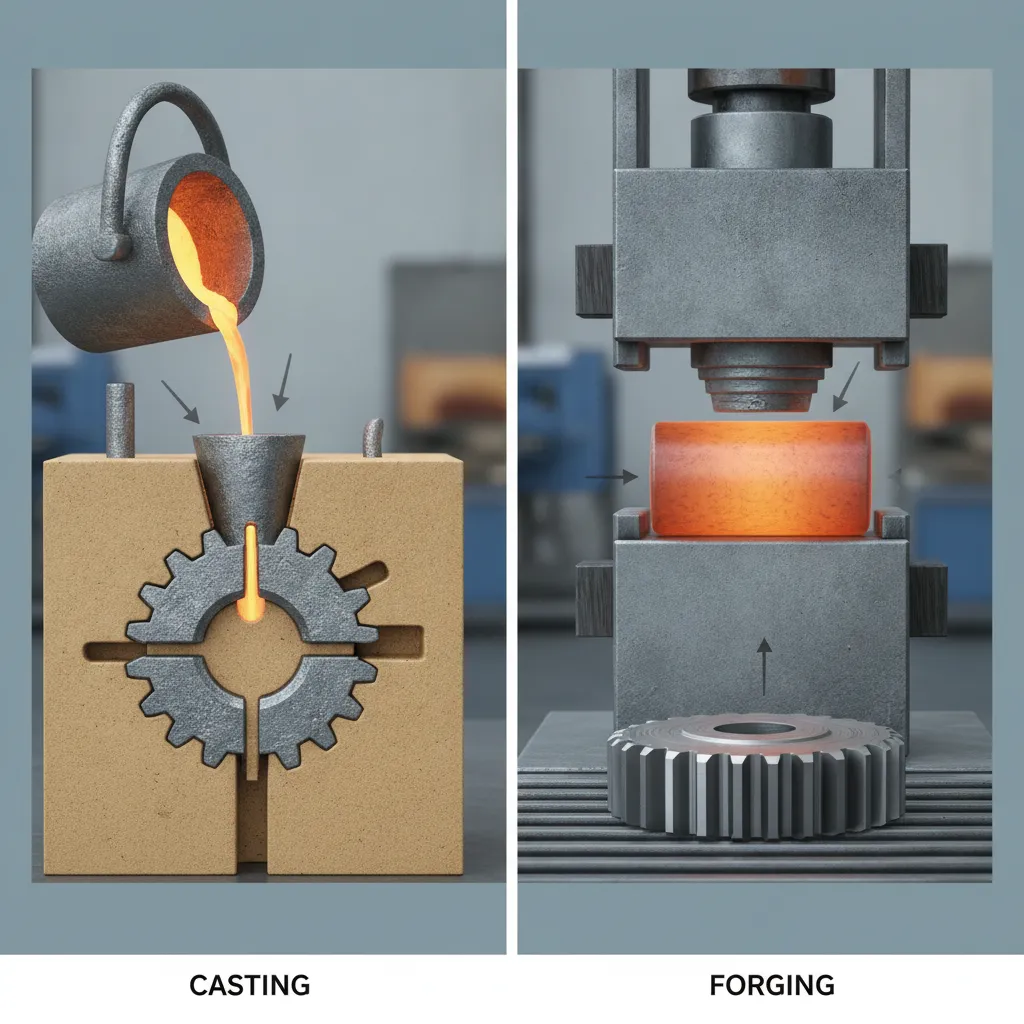
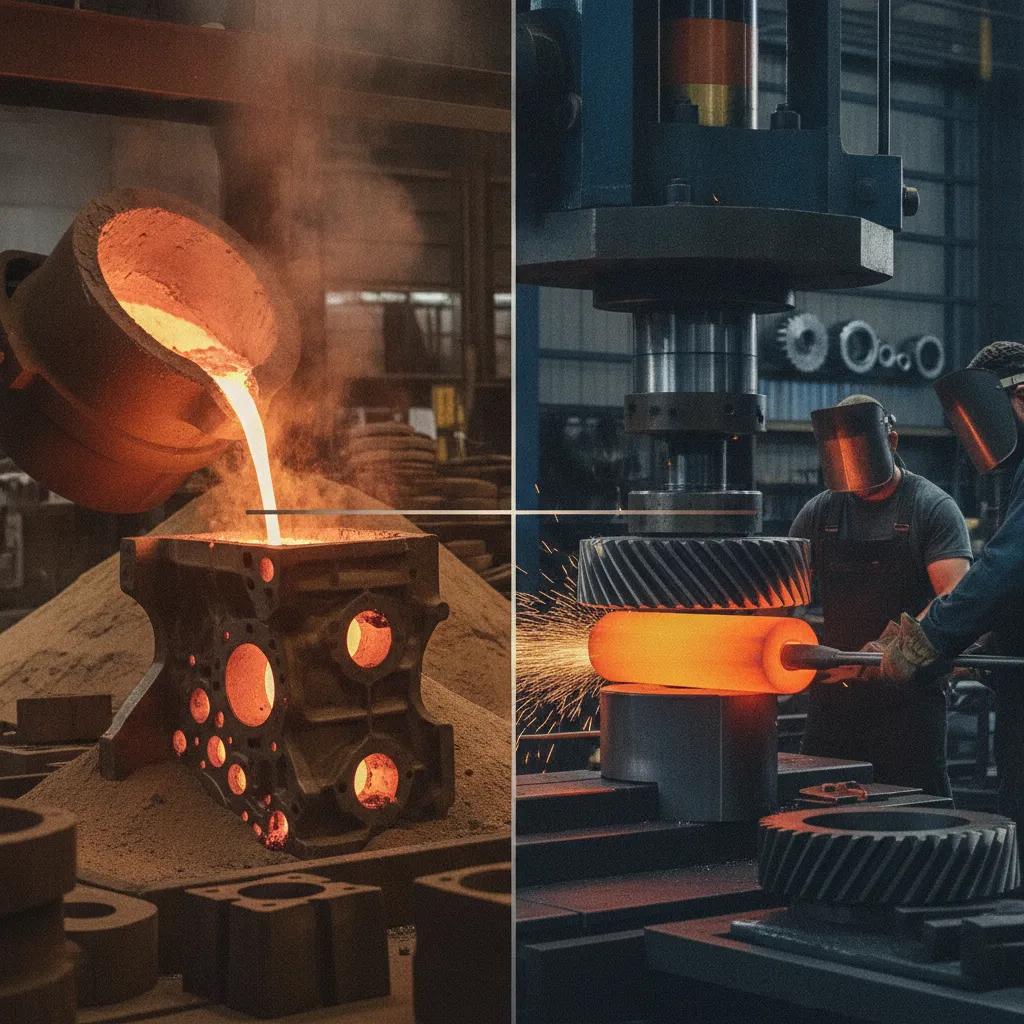
Casting fills a mold with molten metal; forging compresses a solid billet under dies, and that single difference drives every structural outcome downstream.
In casting, metal is heated until liquid, then poured into a mold cavity where it solidifies to shape. The resulting grain structure is random and isotropic, which can introduce porosity, small internal voids left by solidification shrinkage. Those voids are not cosmetic defects; they reduce fatigue life and can cause failure under cyclic load.
Forging starts with a solid billet and deforms it under a hammer, press, or roll. The mechanical compression aligns grain flow with the part geometry, increasing tensile strength by up to 26% compared to cast equivalents. Forged parts also eliminate the internal voids that solidification inherently creates.
Casting handles geometries that forging dies physically cannot reach, hollow sections, undercuts, and complex internal passages are all achievable in a mold. Forging dies work from the outside in, so internal cavities are off-limits.
According to TLV’s engineering reference on casting and forging, the fundamental distinction between the two processes determines not only the mechanical properties of the finished part but also the range of geometries that are economically achievable in production.
“Forging improves the mechanical properties of metals by refining the grain structure and producing a continuous grain flow that follows the contour of the part.” — ASM International, Metals Handbook: Forming and Forging
Key Benefits and Defects of Each Process
Casting’s main advantage is geometric freedom; its main liability is porosity and the weaker, isotropic grain it produces. Forging’s main advantage is mechanical density and directional grain strength; its liability is that die geometry limits part complexity. Neither process is universally superior, the right answer depends on load requirements, geometry, and volume.
The key benefits and liabilities of each process can be summarized as follows:
- Casting advantages: geometric freedom, ability to produce hollow sections and undercuts, lower tooling cost, shorter lead times for low volumes
- Casting disadvantages: porosity risk, weaker isotropic grain structure, higher scrap rates from sprues and risers
- Forging advantages: aligned grain flow, higher tensile and fatigue strength, denser microstructure with fewer internal voids
- Forging disadvantages: limited geometric complexity, higher tooling cost, longer die lead times
How Production Timelines and Volume Requirements Differ
Sand casting molds can be ready in days, making casting attractive for early-stage production or low-volume runs. Closed-die forging dies take 4–12 weeks to manufacture and cost between $10,000 and $100,000 or more depending on part complexity. That upfront investment only makes economic sense at production volumes where the per-part cost savings offset tooling spend.
For precision small parts, particularly those under 38mm in diameter where dimensional tolerance is tight, cold forging and CNC machining are often combined to capture the grain-strength benefit of forging while hitting geometry targets that dies alone cannot achieve. MFG SOLUTION’s cold forging capability addresses exactly this tradeoff, pairing forged blanks with multi-axis CNC finishing to meet automotive and medical tolerances without the lead-time penalty of large closed-die tooling.
Main Types of Casting and Forging Processes
Casting and forging each split into four main process types, and choosing the wrong one adds cost, lead time, or defects to your part.
The 4 Types of Forging
Open-die forging shapes large, simple billets between flat dies, common in heavy industry for shafts, rings, and structural blocks. Tolerances are loose, but part size can reach several tons.
Closed-die (impression-die) forging presses metal into a shaped cavity to produce near-net-shape parts. Automotive and aerospace suppliers use it for connecting rods, gears, and structural brackets where grain flow and fatigue strength matter.
Roll forging passes a heated bar between grooved rolls to taper or elongate it, the standard method for axle shafts, leaf springs, and tapered hand tools.
Cold forging works metal at room temperature, producing parts with tight dimensional tolerances and excellent surface finish, often without secondary machining. MFG SOLUTION applies cold forging alongside CNC turning and Swiss lathe machining to manufacture small precision parts up to 38mm diameter, holding tolerances that would otherwise require a dedicated grinding operation.
The 4 Types of Casting
Sand casting uses a packed-sand mold that’s broken after each pour. Tooling runs $500–$5,000, making it the lowest-cost entry point, but the process is manual and slower, best suited for prototypes or runs under 500 parts.
Die casting injects molten aluminum or zinc into a hardened steel die under high pressure. Cycle times run 15–60 seconds per part, making it viable for millions of units with tight, repeatable tolerances. For more information, see Thegoodcode.
Investment casting builds a wax pattern, coats it in ceramic, then melts the wax out before pouring metal. The result is complex geometry at near-net shape, with tolerances reaching ±0.005 in., close enough to compete with CNC machining for certain part geometries.
Permanent mold casting uses a reusable metal mold (no pressure injection). Surface finish and dimensional consistency beat sand casting, and tooling cost sits between sand and die casting, a practical middle ground for medium-volume aluminum parts.
“The choice between casting and forging is rarely about which process is technically superior — it is about matching the process to the part’s functional requirements, production volume, and total cost of ownership.” — Dr. Rajiv Shivpuri, Professor of Industrial and Systems Engineering, The Ohio State University
Which Metals Work Best for Casting Versus Forging
Metal choice largely determines whether casting or forging is viable, ductility, carbon content, and melting behavior all dictate the right process.
Forging works best with metals that deform plastically under pressure without cracking. Carbon steel, alloy steel, stainless steel, aluminum grades 6061 and 7075, titanium, and copper alloys all have sufficient ductility to flow into die cavities under compressive load. These metals emerge with a refined grain structure that increases tensile strength compared to the same alloy in cast form.
Casting suits metals that are either too brittle to forge, too complex in geometry, or require internal features that dies cannot produce. Cast iron, magnesium alloys, high-silicon aluminum alloys, and nickel-based superalloys used in turbine blades, where intricate internal cooling channels are required, are all processed by casting rather than forging.
According to VPIC Group’s technical overview of casting and forging differences, the ductility of the base metal at working temperature is the single most important factor in determining whether a given alloy can be reliably forged or must be cast.
Which Metal Cannot Be Forged and Why
Cast iron cannot be forged. Its carbon content runs between 2% and 4%, which makes the material brittle at the microstructural level. Under die pressure, it fractures rather than deforms plastically, the defining failure mode that rules it out for any forging operation.
Titanium sits at the opposite end of the spectrum. It is forgeable, but only under tightly controlled conditions: hot forging at 1,650–1,950°F using specialized dies. The process is expensive, but the resulting strength-to-weight ratio justifies the cost in aerospace frames and medical implants. Titanium and cobalt-chrome implants are typically forged to near-net shape, then CNC-machined to final dimensional tolerance, a workflow that demands both forging precision and post-process machining capability.
Material Limitations to Consider Before Choosing a Process
Engineers must account for three constraints before committing to a casting and forging decision: the metal’s ductility at working temperature, whether internal geometry requires a mold rather than a die, and whether post-process machining will be needed to hit final tolerances. Skipping this analysis early adds cost at every downstream stage.
The following metals are commonly processed by each method:
- Best metals for forging: carbon steel, alloy steel, stainless steel, aluminum 6061 and 7075, titanium alloys, copper alloys, nickel alloys
- Best metals for casting: cast iron, gray iron, ductile iron, high-silicon aluminum alloys, magnesium alloys, nickel-based superalloys, cobalt alloys
- Metals that cannot be forged: cast iron (carbon content 2–4% causes brittle fracture under die pressure), most ceramics, and highly brittle intermetallic compounds
When to Choose Casting or Forging for Your Project
Choose casting for complex geometry or low volumes; choose forging when your part carries dynamic loads or you’re producing above 10,000 units.
The right process depends on three variables: part geometry, load conditions, and production volume. A part with walls thinner than 3mm, internal voids, or undercuts is a casting candidate, those features are physically impossible or prohibitively expensive to forge. A part that absorbs cyclic stress, impact loads, or fatigue cycles belongs in the forge press, where grain flow alignment delivers measurable strength gains over cast alternatives.
Industry-Specific Needs: Automotive, Aerospace, and Medical Devices
Automotive engineers specify forged connecting rods, crankshafts, and wheel hubs because fatigue life under cyclic load is the governing design constraint. Engine blocks and transmission housings, by contrast, are routinely cast, their geometry complexity (water jackets, bolt bosses, integrated passages) makes casting the only practical process, and static load demands don’t require the strength premium forging adds.
Aerospace applies the same logic. Titanium airframe brackets and landing gear components are forged to meet FAA and AS9100 fatigue requirements, where a grain-flow discontinuity is a certification risk. Turbine blades are investment cast, their internal cooling passages are geometrically impossible to forge, and investment casting produces the tight dimensional tolerances those blades require.
Medical device selection follows load type. Orthopedic implants, hip stems and knee tibial trays, are forged because they carry sustained and cyclic body-weight loads across decades of service. Surgical instrument handles, where geometry and ergonomics matter more than fatigue strength, are typically cast. After either process, CNC machining brings critical surfaces to final tolerance; MFG SOLUTION’s precision machining service, certified to ISO 13485:2016, handles that post-process step for medical device manufacturers.
Production Volume Thresholds for Casting vs. Forging
Casting becomes cost-competitive below 1,000 parts for complex shapes because tooling cost amortizes quickly across a short run. Forging die sets cost more upfront, typically $10,000–$50,000 depending on complexity, so forging is preferred above 10,000 parts, where that die cost spreads across enough units to drop per-part cost below cast alternatives.
Between 1,000 and 10,000 parts, the decision turns on geometry and load. Use this rule of thumb: if your part has walls thinner than 3mm, complex internal voids, or undercuts, casting wins on manufacturability. If it carries dynamic or impact loads, forging wins on performance, regardless of volume.
Cost and Sustainability Differences Between Casting and Forging
Casting typically costs less to tool and run at high volumes, but forging delivers lower total cost when fatigue life and scrap rates are factored in.
Price Ranges and Cost-Benefit Tradeoffs
Tooling is where the upfront gap is sharpest. Sand casting molds run $500–$5,000; die casting dies climb to $15,000–$75,000; closed-die forging dies range from $10,000 to over $100,000 depending on part geometry and alloy. That spread makes casting the default choice for short runs or complex internal cavities.
At volume, the math shifts. A die-cast aluminum part at 50,000 units typically costs $1–$5 each. The equivalent forged part runs $3–$15 each, a 2–3× premium. That premium is justified when the forged part’s fatigue life doubles or triples under cyclic load, which is common in automotive suspension and aerospace fastener applications where a field failure costs far more than the per-part delta.
Secondary machining costs add another layer. Cast parts frequently require porosity repair, additional surface finishing, and tighter post-process tolerances, all of which drive up total cost per finished part. Forged parts, with their denser grain structure, typically need less corrective machining before they meet final spec.
“When total lifecycle cost is considered — including scrap rates, secondary operations, and field failure risk — forged components frequently deliver a lower cost per service hour than their cast counterparts in dynamic load applications.” — Forging Industry Association, Forging Design Manual
Material Waste and Environmental Impact Compared
Casting and forging both produce recyclable scrap, but at different rates. Forging is near-net shape; flash accounts for roughly 10–20% scrap. Casting generates 20–40% scrap from sprues, risers, and rejected porous parts, a meaningful material cost at scale.
Energy consumption follows the same pattern. Forging a steel billet requires approximately 0.3–0.5 kWh/kg. Melting and casting steel consumes 0.5–0.8 kWh/kg, a 40–60% higher energy draw that translates directly into a larger carbon footprint per part at equivalent production volumes.
For buyers sourcing small precision components, MFG SOLUTION’s cold forging process reduces both material waste and energy input compared to hot casting methods, while its CNC turning and mill-and-turn operations handle the post-process machining in-house, eliminating the vendor handoffs that inflate total part cost.
Frequently Asked Questions
Is forging stronger than casting?
Yes, forged parts are generally stronger than cast parts because the forging process aligns the metal’s grain structure along the part’s geometry. This directional grain flow reduces internal voids and weak points, giving forged components higher tensile strength and fatigue resistance. Cast parts can match forged ones in compressive strength for static applications, but in high-stress or cyclically loaded environments, automotive suspension arms, aircraft fittings, forging wins on mechanical performance.
What are the most common defects in casting and forging?
Casting defects include porosity, shrinkage cavities, cold shuts, and misruns caused by improper metal flow or cooling. Forging defects include laps (folded metal surfaces), cracks from excessive deformation, and die mismatch when tooling is misaligned. Both processes can produce surface scale or dimensional variation if process parameters drift. Catching these defects early requires in-process inspection, dimensional checks, dye penetrant testing, or ultrasonic scanning, rather than end-of-line visual review alone.
Can a part be both cast and forged?
A part cannot be cast and forged simultaneously, but some manufacturers cast a near-net-shape blank and then forge it to improve grain structure and mechanical properties. This cast-then-forge sequence is used for large titanium aerospace components where full forging from billet would waste expensive material. The two processes serve different stages, not the same one.
How long does it take to get parts from casting versus forging?
Lead times vary widely by method and volume, die casting and impression-die forging both require tooling that can take 4–8 weeks to produce before the first part ships. Once tooling exists, production runs typically deliver in 2–6 weeks depending on order size and finishing requirements. Sand casting and open-die forging have shorter tooling lead times but slower per-part cycle times. For small precision parts under 38mm, cold forging at a shop like MFG SOLUTION ships within 3 days of order approval.
What quality standards apply to casting and forging for aerospace and medical applications?
Aerospace casting and forging suppliers are typically required to hold AS9100 certification, which governs quality management systems for aviation, space, and defense manufacturing. Medical device components produced by either process must comply with ISO 13485:2016. For automotive applications, IATF 16949 is the relevant standard. Parts destined for these industries also undergo non-destructive testing — including ultrasonic inspection, dye penetrant testing, and X-ray examination — to verify internal integrity before shipment.
Conclusion
Casting and forging each solve a different problem: casting handles complex geometry at scale, forging delivers grain-aligned strength where fatigue and load matter most. The right choice depends on three variables, part geometry, mechanical requirements, and production volume, not on which process sounds more advanced.
Two actions worth taking now: first, map your part’s stress profile before committing to a process, because switching after tooling is built is expensive. Second, if your parts fall under 38mm diameter and need certified quality fast, submit your specifications to MFG SOLUTION, you’ll have a quote within 8 hours and parts on the way within 3 days, backed by ISO 9001:2015, ISO 13485:2016, and IATF 16949 certification.
Recommended Articles
Explore more from our content library: