
2026-10-20
8 Manufacturing Process Optimization Wins for All CNC Shops

CNC shops improve throughput and cut costs fastest by targeting a handful of proven, high-use changes rather than overhauling everything at once: tightening setup and changeover time, automating in-process inspection, scheduling jobs around machine capacity instead of due dates, and tracking spindle utilization in real time. Manufacturing process optimization, in this context, means systematically matching machining workflows, tooling, and scheduling to actual shop-floor constraints so parts move faster without sacrificing tolerance or surface finish. The wins below are ordered from fastest-to-implement to most resource-intensive.

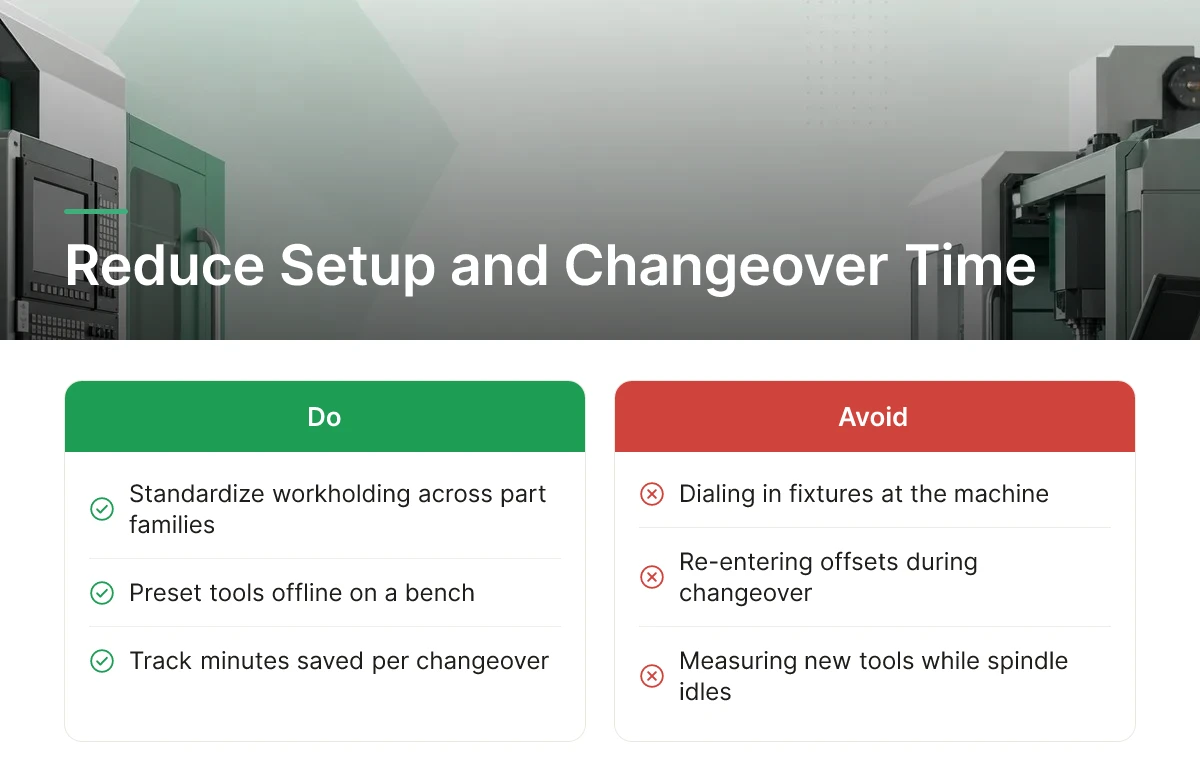
1. Reduce Setup and Changeover Time
Cutting the minutes between jobs turns idle spindle time into cutting time, which is the fastest throughput gain without buying new machines. This is one of the simplest manufacturing process optimization moves a shop can make, and it usually requires no capital at all.
Every minute spent dialing in fixtures, re-entering offsets, or swapping tools is a minute the spindle isn’t making chips. That math compounds across a shift: a shop running eight changeovers a day that cuts 15 minutes per changeover recovers two hours of spindle-on time without touching cycle time or feed rates.
The core tactic is standardizing workholding across part families and presetting tools offline, on a bench or secondary presetter, so the machine isn’t sitting idle while an operator measures a new tool. Modular fixture plates and quick-change tooling systems move this prep work outside the machine cycle entirely. For more detail on how tolerance requirements shape these workholding decisions, see this guide on CNC machining tolerances and what OEM buyers need to specify.
This lever matters most for shops running frequent small-batch or mixed-part-number work, where changeovers happen daily rather than monthly. Long single-part production runs see little benefit here since setup cost amortizes over thousands of parts anyway.
What generic efficiency advice misses in precision machining specifically: offset verification and first-article inspection after a changeover add real time that a simple fixture swap doesn’t account for. A shop optimizing only fixture speed while ignoring first-article turnaround is solving half the problem.
2. Manufacturing Process Optimization Through Bottleneck Mapping
Manufacturing process optimization starts with finding the one operation that paces the entire job, not the one that looks busiest.
In most precision machining workflows, the constraint isn’t the CNC mill or lathe at all. It’s a secondary operation, deburring, washing, or inspection, that runs slower than the machining step feeding it. Speeding up the CNC in that scenario just builds a bigger pile of work-in-process in front of the real bottleneck.
Finding it requires comparing queue times and WIP accumulation across stations rather than assuming the most expensive machine is the constraint. If parts pile up waiting for a CMM or a deburring bench while the lathe sits ready for its next job, that queue identifies the bottleneck.
This approach pays off most for shops running multi-step jobs that involve outside processes like plating or heat treat, or manual secondary operations that don’t scale with machine output.
What Are the Most Common Challenges CNC Shops Face When Adopting New Processes?
Shops adopting new workflows typically underestimate three specific constraints:
- Fixture availability when multiple jobs compete for the same tooling
- Gauge or CMM queue time during high-mix production
- Tool crib delays when operators wait on inserts or specific tool assemblies
Generic process-improvement content rarely names these, they’re specific to precision machining’s reliance on precise, shared resources rather than generic labor capacity.
3. Preventive and Predictive Tool Maintenance
Tracking tool wear before it affects part dimensions prevents scrap and unplanned downtime more reliably than reacting to a broken tool.
Tool wear drives dimensional drift and surface finish problems well before a tool visibly fails or breaks. A cutting edge that’s 70% through its useful life can still cut, but it’s already pushing a bore or diameter toward the edge of tolerance.
The practical starting point is tracking tool life by cycle count or parts produced, not calendar time. A tool run hard for three shifts wears differently than one sitting idle, cycle-based tracking catches that difference where a replacement schedule based on weeks doesn’t. Shops looking to tighten this further can review these approaches to improving precision and efficiency in CNC machining.
This matters most for shops machining harder alloys like stainless steel or titanium, where tool wear curves are steep and the difference between a fresh insert and a worn one shows up fast in surface finish.
The real payoff isn’t just less downtime, it’s avoiding scrapped parts and the inspection rework that follows a drifting tool nobody caught in time. A single batch of out-of-tolerance parts often costs more than the tool change that would have prevented it.
4. Real-Time Machine Monitoring and Data Capture
Capturing spindle utilization and downtime causes as they happen shows shops where their biggest losses actually occur, not just the loudest complaint.
Without utilization data, improvement efforts tend to chase whatever problem was most visible last week, a jammed conveyor, a frustrated operator, instead of the operation actually costing the most machine time. Cycle time is a key performance indicator precisely because small per-part delays compound into large losses at volume.
What to track concretely:
- Spindle-on time versus idle time
- Idle time broken down by cause (waiting on material, tool change, operator unavailable)
- Cycle time variance per part number across different operators and shifts
Variance between two operators running the same program often points to a process or fixturing issue worth fixing. This is most useful for multi-machine shops where no single manager can watch every spindle directly.
How Do MES, IoT, and AI Systems Help Optimize CNC Workflows?
Full MES platforms and AI-driven analytics can model vibration data and cutting parameters to recommend optimized spindle speeds and feed rates, but most shops don’t need that scale to start. Lightweight monitoring add-ons, simple spindle sensors or software that logs cycle times per job, deliver the same early visibility into utilization gaps at a fraction of the implementation effort, making them the more realistic first step for shops without a dedicated IT team. This academic overview of the optimization of manufacturing production and process covers how these feedback loops fit into broader process control strategies.
5. Statistical Process Control for In-Process Quality
Control charts on critical dimensions flag a process drifting toward its tolerance limit before a single part fails inspection.
The mechanism is straightforward: plotting key measurements over time against control limits reveals a trend, tool wear gradually opening a bore, thermal drift shifting a diameter, while the parts are still in spec. That’s a fundamentally different signal than final inspection, which only tells you a batch already went bad after the fact.
This distinction matters most for regulated or tight-tolerance work, aerospace and medical device components especially, where scrap cost per part is high and a batch rejection can mean re-running an entire lot under ISO 13485 or IATF 16949 documentation requirements. MFG SOLUTION builds this kind of full process control, every step tracked and documented, into production runs for medical and automotive parts up to 38mm in diameter, rather than relying on inspection at the end of the line.
The differentiator most process advice skips: SPC gives a repeatable metric for whether a process is actually improving, not just a one-time pass/fail inspection snapshot. A shrinking control chart spread over successive runs is evidence of real manufacturing process optimization, not a one-off quality win.

6. Right-Sizing Methodology: Lean, Six Sigma, or Neither
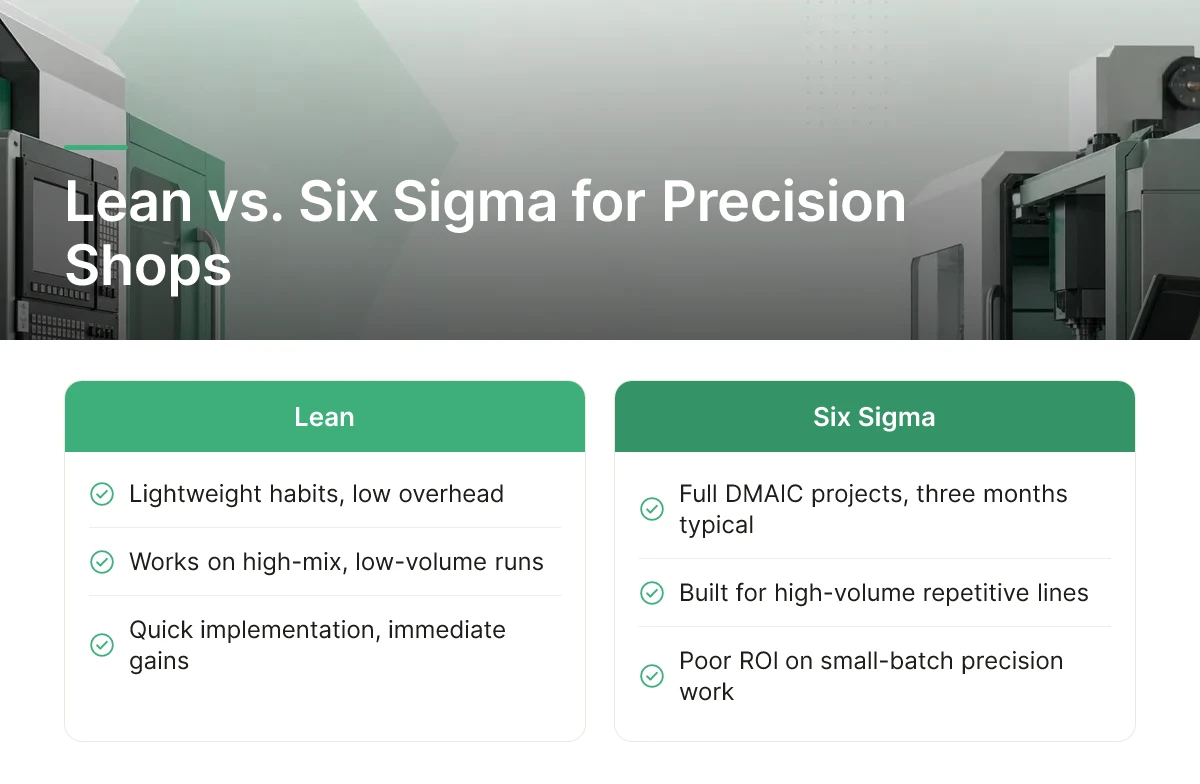
Pick the methodology that matches your run volume, full Six Sigma projects rarely pay off on small-batch precision work, while lightweight Lean habits almost always do.
Classic Lean and Six Sigma tools were built for high-volume repetitive lines, automotive stamping, consumer goods assembly, where a single process runs millions of times. Precision machine shops running high-mix, low-volume work need to adapt those tools rather than adopt them wholesale. A DMAIC project that takes three months to validate a fix doesn’t make sense on a part you run twice a year.
Which Optimization Approach Works Best for Different Types of Precision Machining?
5S and visual management translate directly to a machine shop floor, labeled tool cribs, shadow boards for fixtures, marked locations for work-in-process carts at each cell. These cost little and pay back fast regardless of volume. Full statistical process control and root cause analysis make sense only where the volume justifies the data collection effort.
Job shops with constantly rotating part numbers get the most value from lightweight Lean practices: 5S, standardized changeover checklists, and visual scheduling boards. Shops that run a handful of high-volume repeat parts, the parts that make up most of their revenue, can justify Six Sigma-style root cause analysis on those specific numbers, where fixing a recurring scrap issue multiplies across thousands of cycles. Treating methodology choice this way, scoped to part mix rather than as generic business advice, is what separates useful manufacturing process optimization from a binder nobody opens.
7. Scheduling and Capacity Planning by Machine Availability
Schedule jobs against actual open machine and tooling capacity, not just due dates, or rush orders will push every other job late.
Due-date-driven scheduling treats every machine as if it has infinite capacity. It doesn’t. When a rush order gets dropped onto a Swiss lathe that’s already booked solid, something else on that machine slides, and that delay cascades to every job scheduled behind it, often without anyone noticing until the ship date is missed.
Finite-capacity scheduling logic solves this by checking real machine and tooling availability before committing to a date, instead of simply sorting open orders by due date and hoping capacity works itself out. This matters most for shops juggling several customers with competing rush requests, where one fire drill can quietly set off three more. Shops running high-volume programs can find practical tactics for this in these 10 strategies for faster high-volume CNC production.
The link most process-optimization advice misses: scheduling discipline only works if quoting is honest about capacity in the first place. If sales promises a 3-day turnaround without checking whether a 5-axis cell is already loaded, the shop is scheduling against a number that was never real. Tying the quoting process to actual machine availability, the same discipline behind MFG SOLUTION’s 8-hour quote and 3-day ship commitment, keeps promises and schedules aligned instead of fighting each other.
8. Supplier and Material Flow Optimization
Unreliable raw stock delivery starves machines of material and forces costly, reactive expediting, fix the supply side before blaming the floor.
Inconsistent material delivery is a common hidden driver of late jobs. When bar stock or forging blanks arrive late or short, schedulers react by expediting freight or resequencing jobs on the fly, which disrupts every other job already planned around that machine’s time.
Two concrete tactics address this directly:
- Consolidating raw material suppliers to reduce the number of delivery schedules a shop has to track
- Holding buffer stock on repeat part numbers so a single late shipment doesn’t stop production
This fits shops running recurring production parts far better than shops doing pure one-off prototyping, where buffer stock doesn’t make sense.
Generic efficiency content treats this as a purchasing cost problem, negotiate better unit pricing. The real issue is throughput: a machine sitting idle because it has no stock to cut is lost capacity, not just a line item on a purchase order. Framed that way, material flow becomes part of manufacturing process optimization, not a procurement side task disconnected from the shop floor. For shops looking to tighten overall equipment efficiency alongside material flow, this piece on improving the efficiency of CNC machines is a useful companion read.
9. Workforce Cross-Training and Standard Work Instructions
Document setups and cross-train operators, because undocumented improvements disappear the moment the one person who knew them is out.
Shops that depend on one experienced machinist’s memory for a tricky setup are one vacation or resignation away from losing that gain entirely. The fix is a physical artifact: a standard work instruction sheet with photos of the fixture setup, recorded offsets, tool numbers, and inspection points for that specific job. Anyone on any shift can pick it up and reproduce the result.
What’s the Difference Between Quick Fixes and Sustainable Process Improvements?
A quick fix is an operator finding a faster setup method and keeping it in their head. A sustainable improvement is that same method written down, photographed, and filed where the next shift can find it. The difference shows up the day that operator isn’t on the floor, the quick fix evaporates, the documented standard doesn’t.
What Does a Realistic Implementation Timeline Look Like for Process Changes?
Expect weeks, not days. Capturing setup details for a shop’s top 20-30 recurring parts, photographing fixtures, and training a second operator on each takes sustained effort across several production cycles. Shops with high part-number variety and multiple shifts benefit most, since that’s exactly where tribal knowledge gaps cause the most repeat setup errors.
How to Choose the Right Process Optimization Wins for Your Shop
Start with zero-cost changes like changeover discipline and scheduling fixes before spending on software or formal methodology training.
Sequence matters more than the individual tactic. Begin with the wins that cost nothing but attention: tightening changeover procedures, enforcing scheduling against real machine availability, and cleaning up material flow for repeat parts. These require no capital and often remove the largest sources of delay before a shop ever needs to evaluate monitoring software or send anyone to Six Sigma training.
What Common Mistakes Do CNC Shops Make When Trying to Optimize Their Processes?
Three mistakes show up repeatedly in manufacturing process optimization efforts:
- Optimizing a station that looks busy but isn’t the actual bottleneck, use the bottleneck mapping approach from earlier in this list to confirm which machine or step truly constrains output before investing time there
- Adopting monitoring software or automation before fixing basic process discipline, which just generates more data about the same uncontrolled problems
- Treating a methodology like Lean or Six Sigma as a one-time project with an end date, rather than an ongoing habit built into daily shop routines
Judge payoff qualitatively: weigh the implementation effort, time, operator training, new tooling, against the scale of scrap, downtime, or rush-fee cost the fix actually removes. A documented setup sheet that takes an afternoon to build but prevents a recurring weekly rework cycle is worth more than a dashboard that takes a month to configure and changes nothing on the floor. Matching the fix to the real constraint, in that order, is what makes manufacturing process optimization stick instead of stalling after the first few weeks.

Frequently Asked Questions
What financial metrics should a CNC shop track to prove optimization worked?
Track cycle time per part, scrap and rework rate, machine utilization, and cost per good part, these four numbers show whether a manufacturing process optimization change actually paid off.
Cycle time reductions should show up directly in cost per part since machine time and labor time both drop. Scrap rate matters because material waste and rework hours quietly erase margin even when throughput looks fine. Compare each metric before and after the change, not just against an industry average.
How much time and resources does it take to implement process improvements in a machine shop?
Simple fixes, tool path tweaks, maintenance schedules, take days; equipment or workflow overhauls take months.
Low-cost changes like better fixturing, updated cutting parameters, or a stricter preventive maintenance plan can show results within a production run or two. Bigger investments, such as adding 5-axis capacity or automation, require capital planning and operator training, often spanning one or two quarters before the payback shows up in unit cost. Start small and measure before committing to large capital spend.
How do you evaluate and choose between different shop-floor optimization software tools?
Match the tool to a specific bottleneck, scheduling, tolerance monitoring, or predictive maintenance, rather than buying a general platform.
Shops dealing with inconsistent tolerances benefit most from real-time feedback and sensor-based monitoring that catches variation before parts fail inspection. Shops fighting idle machine time need scheduling and utilization tracking instead. Pilot any tool on one cell or one machine first, confirm it reduces scrap or downtime, then scale it across the floor.
Why should a small CNC shop bother optimizing its processes at all?
Small shops compete on margin, and even modest cycle time or scrap reductions translate directly into lower cost per part.
A shop running thin margins can’t absorb rework or idle machine hours the way a larger operation can. Incremental, low-cost changes, better fixturing, tighter maintenance schedules, often deliver the fastest payback without requiring new capital equipment.
How often should a shop revisit its manufacturing process optimization efforts?
Treat it as an ongoing review, not a one-time project, revisit key metrics quarterly or whenever a new part family, machine, or major customer is onboarded.
A process that was optimized for last year’s part mix can quietly drift out of alignment as volumes shift or new equipment comes online. Shops that schedule a regular review of cycle time, scrap rate, and utilization data catch this drift early, rather than rediscovering the same bottlenecks months later.
Conclusion
Cycle time, scrap rate, and machine utilization are the three levers that determine whether a precision machining operation makes money on a job or just breaks even. Real-time feedback and tolerance monitoring catch problems before they become scrapped parts, and matching the manufacturing method to the part geometry, CNC turning versus Swiss lathe versus cold forging, cuts cost before a single part gets cut. Treated as an ongoing discipline rather than a one-time fix, manufacturing process optimization is what keeps a shop’s margins intact as part mix and volume shift over time.
If your current supplier’s quoting and lead times are the bottleneck rather than your own floor, that’s worth testing directly: submit a part spec to MFG SOLUTION and compare the 8-hour quote and 3-day ship window against your existing vendor’s cycle.
Recommended Articles
Explore more from our content library: