
2026-06-27
17-4 Metal: Properties, Uses & Machining Guide

| Key Insight | Explanation |
|---|---|
| What it is | 17-4 metal is a precipitation-hardening martensitic stainless steel (UNS S17400) containing ~17% chromium and ~4% nickel, plus copper and niobium. |
| Strength range | Tensile strength ranges from ~930 MPa (H1150 condition) to ~1310 MPa (H900 condition) depending on heat treatment. |
| Heat treatment conditions | Designated H900 through H1150, each offering a different balance of strength, hardness, and toughness. |
| Corrosion resistance | Superior to standard 304 and 316 in many environments; oxidation resistance holds to approximately 1100°F (593°C). |
| Key industries | Aerospace, medical devices, oil and gas, food processing, and precision mechanical components. |
| Machinability | Best machined in the annealed (Condition A) state; post-machining aging achieves final mechanical properties without distortion. |
17-4 metal is a precipitation-hardening martensitic stainless steel that delivers an exceptional combination of high strength, good corrosion resistance, and straightforward heat treatability. Formally designated UNS S17400 and also known as SAE Type 630, it’s the most widely used grade in the precipitation-hardening stainless steel family. Engineers across aerospace, medical, and industrial sectors choose it when standard austenitic grades like 304 or 316 simply don’t have enough strength for the job.
This guide covers everything you need to know: composition, heat treatment conditions, mechanical properties, machinability, real-world applications, and the common mistakes that cause expensive rework. Whether you’re a procurement manager sourcing bar stock or an engineer specifying a part, you’ll leave with a clear picture of what this alloy can and can’t do.
What Is 17-4 Metal?
17-4 metal is a martensitic, precipitation-hardening stainless steel containing approximately 17% chromium and 4% nickel, heat-treatable to tensile strengths exceeding 1300 MPa. It combines the corrosion resistance of stainless steel with strength levels that approach many alloy steels. That combination makes it uniquely versatile for demanding structural and environmental conditions.
The Naming Convention Explained
The “17-4” designation directly reflects the alloy’s nominal chemical composition: 17% chromium and 4% nickel. The “PH” suffix stands for precipitation hardening, the heat treatment mechanism responsible for its high strength. You’ll also see it listed as UNS S17400, AMS 5604 (sheet and plate), AMS 5643 (bar and rod), and ASTM A564 Grade 630.
Chromium is what gives any stainless steel its corrosion resistance. At 17%, 17-4 metal forms a stable passive oxide layer that resists most industrial environments. The nickel content stabilizes the microstructure, while additions of 3–5% copper and small amounts of niobium (columbium) are what enable the precipitation-hardening response during aging heat treatments.
How It Differs from Standard Stainless Steels
Most engineers are familiar with 304 and 316 austenitic stainless steels. Those grades are tough and corrosion-resistant, but they can’t be hardened by heat treatment. 17-4 metal is fundamentally different. Its martensitic structure means it responds to aging treatments, allowing you to dial in the exact balance of strength and toughness you need for a specific application.
- vs. 304 SS: 17-4 offers roughly 2–3x the yield strength in the H900 condition.
- vs. 316 SS: Comparable corrosion resistance in many environments, but significantly higher strength.
- vs. 410 SS: Better corrosion resistance and toughness at equivalent hardness levels.
- vs. 15-5 PH: Very similar properties; 17-4 has slightly better machinability due to its delta ferrite content.
Industry analysts consistently rank 17-4 PH as the go-to choice when a design requires both structural integrity and environmental durability in a single alloy, without the cost or fabrication complexity of titanium or nickel superalloys.
Chemical Composition and Heat Treatment Grades
17-4 metal’s final properties are determined not just by chemistry, but by which aging (precipitation hardening) condition it’s supplied in. Understanding the heat treatment designations is critical before you specify a part.
Chemical Composition
The nominal composition per ASTM A564 and AMS 5643 is tightly controlled. Small deviations in copper or niobium content significantly affect the aging response.
| Element | Nominal Content | Role in Alloy |
|---|---|---|
| Chromium (Cr) | 15.5–17.5% | Corrosion and oxidation resistance |
| Nickel (Ni) | 3.0–5.0% | Microstructure stabilization |
| Copper (Cu) | 3.0–5.0% | Enables precipitation hardening response |
| Niobium + Tantalum | 0.15–0.45% | Grain refinement, strengthening |
| Carbon (C) | 0.07% max | Low carbon reduces sensitization risk |
| Manganese (Mn) | 1.0% max | Deoxidizer, minor strengthening |
Heat Treatment Conditions: H900 Through H1150
After solution annealing (Condition A), 17-4 metal is aged at specific temperatures to precipitate copper-rich phases within the martensitic matrix. Each condition is named for its aging temperature in degrees Fahrenheit.
| Condition | Aging Temp. | UTS (MPa) | Yield (MPa) | Best For |
|---|---|---|---|---|
| H900 | 482°C (900°F) | 1310 | 1170 | Maximum strength, aerospace fasteners |
| H1025 | 552°C (1025°F) | 1070 | 1000 | Good strength-toughness balance |
| H1075 | 579°C (1075°F) | 1000 | 862 | Pressure vessels, valves |
| H1150 | 621°C (1150°F) | 930 | 724 | Maximum toughness, forming operations |
Pro Tip: If your part requires forming or extensive machining after heat treatment, specify Condition A (annealed) or H1150 for maximum ductility. Reserve H900 for final-condition parts that won’t see further cold work — the brittleness at peak hardness is a real fabrication risk.
Mechanical Properties and Performance
17-4 metal in the H900 condition achieves tensile strengths above 1300 MPa, corrosion resistance comparable to 316 SS in many environments, and maintains useful mechanical properties up to 315°C (600°F). This combination is hard to match at its price point.
Strength, Hardness, and Toughness
The precipitation-hardening mechanism produces a fine dispersion of copper-rich precipitates within the martensite matrix. This microstructure blocks dislocation movement, which is what drives the dramatic increase in hardness and strength compared to the annealed state.
- Hardness (H900): Up to 40 HRC, equivalent to many tool steels.
- Fatigue strength: Approximately 620 MPa at 107 cycles in the H900 condition.
- Impact toughness: Charpy impact values improve significantly from H900 to H1150 — a key trade-off to understand.
- Modulus of elasticity: ~197 GPa, consistent across heat treatment conditions.
Research published in peer-reviewed materials science literature confirms that 17-4 PH stainless steel offers an impressive combination of high strength, exceptional ductility, ease of workability, and excellent corrosion resistance, making it one of the most studied precipitation-hardening alloys in engineering applications.
Corrosion and Temperature Resistance
Corrosion resistance in 17-4 metal is genuinely good, though not unconditional. The alloy performs well in mildly corrosive environments including fresh water, mild acids, and industrial atmospheres. Oxidation resistance holds to approximately 1100°F (593°C), and creep-rupture strength is maintained to around 900°F (482°C).
- Performs comparably to 304 SS in atmospheric and fresh water environments.
- Inferior to 316 SS in chloride-rich environments (marine, coastal, salt spray).
- Not recommended for strong reducing acids (hydrochloric, dilute sulfuric).
- Passivation per ASTM A967 or AMS 2700 significantly improves surface corrosion resistance.
One limitation is stress corrosion cracking (SCC) susceptibility in the H900 condition when exposed to chloride environments. Engineers specifying parts for marine or chemical processing applications should consider H1025 or higher to reduce this risk.
Machining 17-4 Metal: Best Practices for 2026
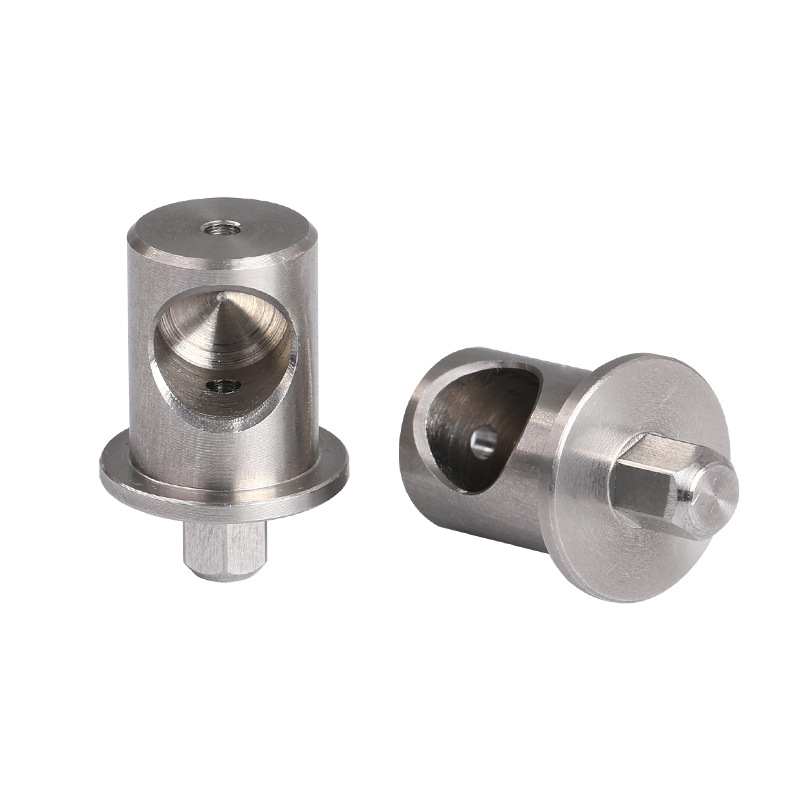
17-4 metal machines best in the annealed (Condition A) state, where hardness is around 28–32 HRC — firm but workable. Attempting aggressive material removal in the H900 condition accelerates tool wear significantly and risks dimensional instability.
Recommended Machining Approach
The standard workflow for precision 17-4 PH components follows a logical sequence that separates material removal from property development:
- Receive material in Condition A (solution annealed, ~28 HRC). Confirm with hardness check before starting.
- Perform all rough and semi-finish machining while the material is in Condition A. This is where you remove the bulk of material efficiently.
- Leave a small finish stock (typically 0.05–0.15 mm per side) to account for any minor distortion during aging.
- Age harden to specified condition (H900, H1025, etc.) per the engineering drawing. Use a calibrated furnace with tight temperature control (±5°C).
- Perform finish machining to final dimensions and tolerances. Use sharp carbide tooling with appropriate coatings.
- Inspect to drawing using CMM or optical measurement, verifying all critical dimensions and surface finish requirements.
At MFG SOLUTION, we’ve found that planning the machining sequence around the aging step — rather than trying to machine fully hardened material — consistently delivers tighter tolerances and longer tool life on 17-4 PH components.
Tooling, Feeds, and Speeds
17-4 metal work-hardens less aggressively than austenitic grades, but it still requires attention to cutting parameters. Using dull tooling or insufficient feed rates causes rubbing rather than cutting, which generates heat and accelerates work hardening at the surface.
- Tooling: Coated carbide (TiAlN or AlTiN coating) is the standard choice. CBN inserts for hardened condition finishing.
- Cutting speed: 60–100 m/min for rough turning in Condition A; reduce by 30–40% for hardened conditions.
- Feed rate: Maintain positive chip load — 0.10–0.25 mm/rev for turning. Avoid light, rubbing passes.
- Coolant: High-pressure coolant (70+ bar) is highly effective for 17-4 PH; it evacuates chips and controls thermal expansion. Proper selection of CNC coolants and lubricants is critical for maintaining dimensional accuracy on tight-tolerance 17-4 parts.
- Depth of cut: Keep above 0.5 mm to stay below the work-hardened surface layer from previous passes.
Pro Tip: For small-diameter 17-4 PH components (under 38mm), Swiss lathe machining excels. The guide bushing supports the workpiece close to the cutting zone, minimizing deflection and enabling tight tolerances even on slender parts that would chatter on a conventional CNC lathe.
Achieving consistent machining tolerances on 17-4 metal requires understanding how the material moves during aging. Parts with asymmetric cross-sections or significant material removal on one side can distort slightly during the heat treatment step. Factoring this into your precision tolerance stackup planning prevents costly rework.
Common Challenges and Mistakes to Avoid
Several predictable failure modes appear repeatedly in 17-4 metal machining and specification. Knowing them in advance saves real money.
Specifying the Wrong Heat Treatment Condition
The single most common mistake is specifying H900 when the application doesn’t actually require maximum strength. H900 gives you the highest hardness, but it also gives you the lowest toughness and the highest SCC susceptibility. Many parts that “need to be strong” would perform better in H1025 or H1075, which offer a more balanced property profile.
- H900 is appropriate for high-stress aerospace fasteners and tooling components where strength is the primary driver.
- H1025 suits most general industrial applications requiring both strength and reasonable ductility.
- H1150 is the right choice when forming after heat treatment, or when maximum toughness matters more than peak strength.
A procurement manager at a precision instruments company once described ordering H900 bar stock for a shaft application, only to discover the parts cracked during press-fit assembly. The fix was straightforward: re-specify to H1025. The cost was a 3-week delay and wasted material.
Machining in the Fully Hardened State
Trying to machine 17-4 metal in H900 condition without the proper tooling and process setup is a fast way to destroy inserts and blow tolerances. The hardness at H900 (up to 40 HRC) demands CBN tooling for finishing and significantly reduced cutting speeds.
- Tool life in H900 can be 5–10x shorter than in Condition A for equivalent material removal rates.
- Thermal expansion during aggressive cutting in hardened material introduces dimensional errors that are difficult to predict.
- Surface finish suffers when tools wear mid-cut — and on precision parts, that means scrapped components.
The PMPA (Precision Machined Products Association) has documented that machining 17-4 PH in Condition A before aging is the industry-standard best practice for precision components, specifically to avoid the brittleness and tool wear issues associated with working in the fully hardened state.
Pro Tip: Always verify incoming material condition with a Rockwell hardness test before starting machining. Material mix-ups between Condition A and aged stock happen more often than you’d expect in busy shops, and the machining behavior difference is immediately obvious — but only after you’ve already started cutting.
Key Applications Across Industries
17-4 metal is found in applications wherever engineers need a single alloy to handle both structural loads and corrosive environments, without the cost of superalloys or the weight penalty of conventional alloy steels.
Aerospace and Defense
Aerospace is the original home of 17-4 PH. The alloy meets AMS 5604 and AMS 5643 specifications used throughout aerospace structural applications. Common parts include:
- Aircraft structural fasteners and bolts (H900 condition)
- Valve bodies and actuator components
- Pump shafts and impellers
- Gears and bushings in flight control systems
The combination of high strength-to-weight ratio and corrosion resistance makes 17-4 metal a direct competitor to some titanium alloys in non-weight-critical aerospace applications, at significantly lower material cost.
Medical Devices and Industrial Components
Medical device manufacturing is a growing application area for 17-4 metal, particularly for surgical instruments, orthopedic implant components, and dental tools. The alloy’s combination of hardness, corrosion resistance, and sterilizability (it withstands autoclaving without degradation) suits it well for these demanding environments.
For CNC machining of medical devices, 17-4 PH is frequently specified for instrument handles, cutting guides, and small structural components where both sterility and mechanical reliability are non-negotiable. ISO 13485:2016 certification is essential for any shop producing 17-4 components for medical use.
- Oil and gas: Gate valves, wellhead components, pump shafts in mildly corrosive service
- Food processing: Conveyor components, mixing shafts, valve bodies (H1025 or H1150 for toughness)
- Electronics: Precision shafts, connectors, and housings requiring dimensional stability
- Firearms: Barrels, receivers, and action components where hardness and corrosion resistance both matter
Industry analysts note that as of 2026, demand for 17-4 PH in medical and semiconductor manufacturing applications continues to grow, driven by tighter component specifications and the need for materials that maintain dimensional stability across thermal cycles.
Frequently Asked Questions
1. Is 17/4 stainless steel stronger than titanium?
In the H900 condition, 17-4 metal achieves tensile strengths of approximately 1310 MPa, which exceeds common titanium alloys like Ti-6Al-4V (typically 900–950 MPa UTS). However, titanium is roughly 40% lighter, so on a strength-to-weight basis, titanium still wins. For applications where absolute strength matters more than weight, H900-condition 17-4 PH is a cost-effective alternative to titanium — but for weight-critical aerospace structures, titanium remains the better choice.
2. What is another name for 17-4 stainless steel?
17-4 metal is formally designated UNS S17400 and is also known as SAE Type 630, 17-4 PH (where PH stands for precipitation hardening), and Carpenter 17-4 PH. It is covered by multiple specifications including AMS 5604 (sheet and plate), AMS 5643 (bar and rod), and ASTM A564 Grade 630. In European standards, it corresponds approximately to EN 1.4542 (X5CrNiCuNb16-4).
3. What is the difference between 17-4 PH and 316 stainless steel?
316 SS is austenitic, non-magnetic, and cannot be hardened by heat treatment — it’s chosen primarily for its excellent chloride corrosion resistance (thanks to 2–3% molybdenum). 17-4 metal is martensitic, slightly magnetic, and heat-treatable to much higher strengths. In chloride-heavy environments like marine service, 316 generally outperforms 17-4 PH. For structural applications requiring high strength with moderate corrosion resistance, 17-4 is the better choice.
4. Can 17-4 metal be welded?
Yes, 17-4 PH is weldable, but it requires careful procedure control. The recommended approach is to weld in the annealed (Condition A) state, then solution anneal the entire assembly before aging to the final condition. Welding in the hardened state risks heat-affected zone cracking and loss of mechanical properties near the weld. Filler metal AWS ER630 is the standard choice for matching composition welds.
5. What is the density and weight of 17-4 metal?
The density of 17-4 PH stainless steel is approximately 7.78 g/cm³ (0.281 lb/in³), which is essentially the same as most other stainless steel grades. This is roughly 2.4x denser than titanium (4.43 g/cm³) and about 10% denser than carbon steel. For weight calculations on small precision components, use 7.78 g/cm³ as your baseline figure.
6. Is 17-4 metal suitable for CNC turning and Swiss lathe machining?
Yes, and it’s well-suited to both processes when approached correctly. CNC turning in Condition A with coated carbide tooling produces excellent results. Swiss lathe machining is particularly effective for small-diameter 17-4 PH parts (under 38mm), because the guide bushing support minimizes deflection and enables the tight tolerances that hardened-state machining would otherwise make difficult to achieve consistently. Post-machining aging then brings the part to final properties.
Conclusion
17-4 metal earns its place as the most widely used precipitation-hardening stainless steel for good reason. It offers a rare combination: real structural strength, genuine corrosion resistance, and the flexibility to tune its properties through heat treatment. No other stainless grade gives you that range in a single alloy at this price point.
The keys to getting the most out of this strategy are simple in principle but require discipline in practice. Machine in Condition A, age to the right condition for your application (not just the highest strength), use proper tooling and coolant, and account for minor distortion in your tolerance planning. Get those four things right and 17-4 PH is one of the most reliable materials you’ll work with.
Our team at MFG SOLUTION machines 17-4 PH components regularly across medical, aerospace, and industrial applications. With ISO 9001:2015, ISO 13485:2016, and IATF 16949 certifications, full process control, and 60+ engineering professionals, we handle the full workflow from Condition A stock through final inspection. Parts up to 38mm diameter, quotes within 8 hours, shipment within 3 days. If you’re specifying this approach components and need a precision machining partner who understands the material, we’re ready to help.
Recommended Articles
Explore more from our content library: