
2026-06-23
Open Forging: Process, Benefits & Best Practices

| Key Insight | Explanation |
|---|---|
| Definition | Open forging (also called open die forging or free forging) shapes heated metal between flat or simple dies that don’t fully enclose the workpiece. |
| Superior Grain Structure | Compressive deformation refines the metal’s grain flow, producing parts with better fatigue resistance and tensile strength than cast equivalents. |
| Size Range | Open die forging can produce parts from a few pounds up to more than 150 tons, making it uniquely suited for large industrial components. |
| Lower Tooling Cost | Because dies are simple and generic, tooling investment is significantly lower than closed die forging, benefiting low-to-medium volume production. |
| Post-Forging Machining | Open forged parts typically require CNC machining to achieve final tolerances, making precision machining partnerships critical to part quality. |
| Key Applications | Common in aerospace, oil and gas, power generation, defense, and heavy industrial sectors requiring custom, high-strength metal components. |
Open forging is a metalworking process that shapes heated metal between flat or simple dies that don’t fully enclose the workpiece, allowing the metal to flow freely in the unconstrained direction. It’s one of the oldest and most versatile forming methods in manufacturing. Understanding how it works helps engineers and procurement managers make smarter decisions about part strength, cost, and lead time.
This guide covers everything you need to know: the mechanics of the process, its real advantages over other forming methods, common pitfalls, and what to look for in a manufacturing partner when open forged blanks need precision finishing. Whether you’re sourcing parts for aerospace, automotive, or heavy industrial applications, the information here will help you get it right.
What Is Open Forging?
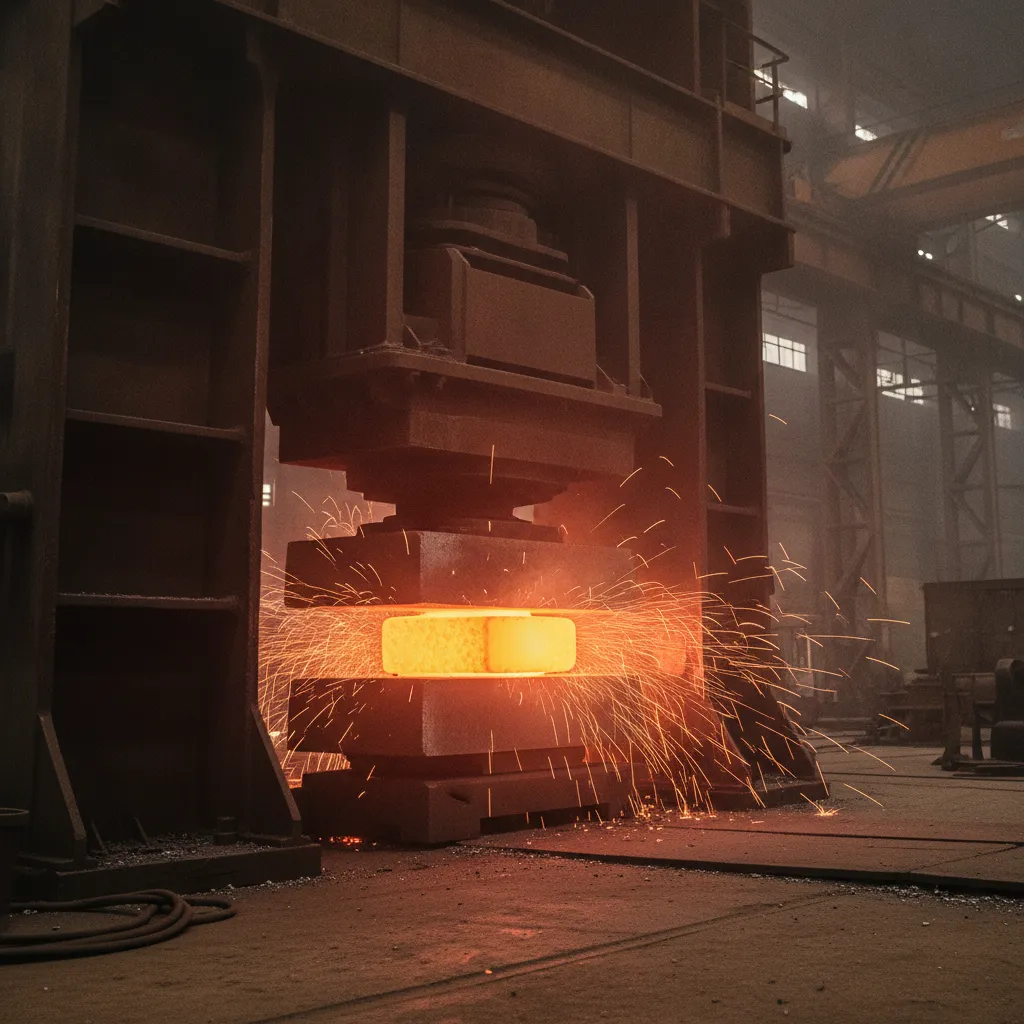
Open forging is a bulk metal forming process where heated metal is compressed between dies that do not completely surround or confine the workpiece, allowing excess material to flow outward without restriction.
More specifically, open die forging (the formal technical term) involves placing a heated metal billet or ingot between a top die attached to a ram and a bottom die fixed to an anvil or bolster. The dies are typically flat, though they may also be shaped as V-blocks, swages, or mandrels depending on the desired geometry. Because the dies don’t enclose the part, the operator repositions and rotates the workpiece between hammer blows to gradually achieve the target shape.
The process is also known by several other names in the industry:
- Free forging — emphasizing the unrestricted metal flow
- Smith forging — referencing its blacksmithing origins
- Hammer forging — describing the primary forming force used
- Open die forging — the most precise technical designation per ASM International standards
According to the Forging Industry Association’s published educational materials, open die forging can produce forgings from a few pounds up to more than 150 tons. That extraordinary size range is one reason this process remains indispensable in heavy industries where closed die tooling simply isn’t practical.
Why Open Forging Still Matters in 2026
Despite advances in additive manufacturing and near-net-shape casting, open forging retains a firm position in the manufacturing landscape. The reason is straightforward: no other process delivers the same combination of refined grain structure, material density, and mechanical strength in large or custom cross-sections.
Industry analysts suggest that demand for open die forged components in energy, defense, and aerospace sectors has remained stable through 2024-2026, driven by infrastructure investment and defense modernization programs globally. Parts like shafts, spindles, rings, cylinders, and blanks that require exceptional fatigue resistance are still routinely specified as open forged.
Pro Tip: If your part requires a tight final tolerance (under ±0.1mm), plan for a CNC turning or milling operation after open forging. The forging step establishes grain integrity and near-net shape; the machining step delivers dimensional precision. Combining both gives you the best of each process.
How Open Forging Works
Open forging works by heating metal to its plastic deformation temperature, then applying repeated compressive blows between simple dies while the operator manipulates the workpiece to progressively shape it toward the desired geometry.
The Open Forging Process Step by Step
- Material selection and preparation: A billet, ingot, or bloom of the target alloy (steel, aluminum, titanium, nickel superalloy, etc.) is cut to the correct starting weight.
- Heating: The workpiece is heated in a furnace to the appropriate forging temperature. For carbon steel, this is typically 1,100–1,250°C. Temperature control is critical; overheating causes grain growth, while underheating increases cracking risk.
- Initial breakdown: The hot billet is placed between the dies and struck repeatedly to break down the as-cast grain structure, close internal porosity, and begin shaping.
- Progressive shaping: The operator (or automated manipulator on larger presses) rotates and repositions the workpiece between blows. This is what distinguishes open forging from closed die work. The part is shaped incrementally.
- Intermediate reheating: For large or complex parts, the workpiece may be returned to the furnace one or more times to maintain workability.
- Final forming: The part is brought to near-net shape, leaving sufficient machining stock for final dimensional finishing.
- Heat treatment: Depending on alloy and application, the forged part undergoes normalizing, annealing, quenching, or tempering to achieve target mechanical properties.
- Inspection and machining: The forged blank is dimensionally inspected, then transferred to CNC machining operations for final geometry, surface finish, and tight tolerances.
The equipment used varies by part size. Hydraulic presses are preferred for large forgings because they deliver controlled, sustained force rather than impact energy. Hammer forging equipment (gravity drop hammers, power drop hammers, counterblow hammers) is common for smaller and medium-sized parts where impact energy is more efficient.
Key Process Variables to Control
Controlling open forging quality comes down to managing a handful of critical variables:
- Forging temperature: Must stay within the alloy’s hot working window throughout the process
- Reduction ratio: The ratio of original cross-section area to final cross-section area; higher ratios produce better grain refinement
- Strain rate: How quickly deformation is applied; affects recrystallization behavior
- Die geometry: Flat, V-shaped, or profiled dies each produce different metal flow patterns
- Lubrication: Reduces die wear and prevents workpiece sticking
According to ASM International’s metalworking handbooks, proper reduction ratios in open die forging are essential for achieving the refined grain flow that gives forged parts their mechanical advantage over castings. A reduction ratio of at least 3:1 is generally recommended for structural applications.
Key Benefits of Open Forging
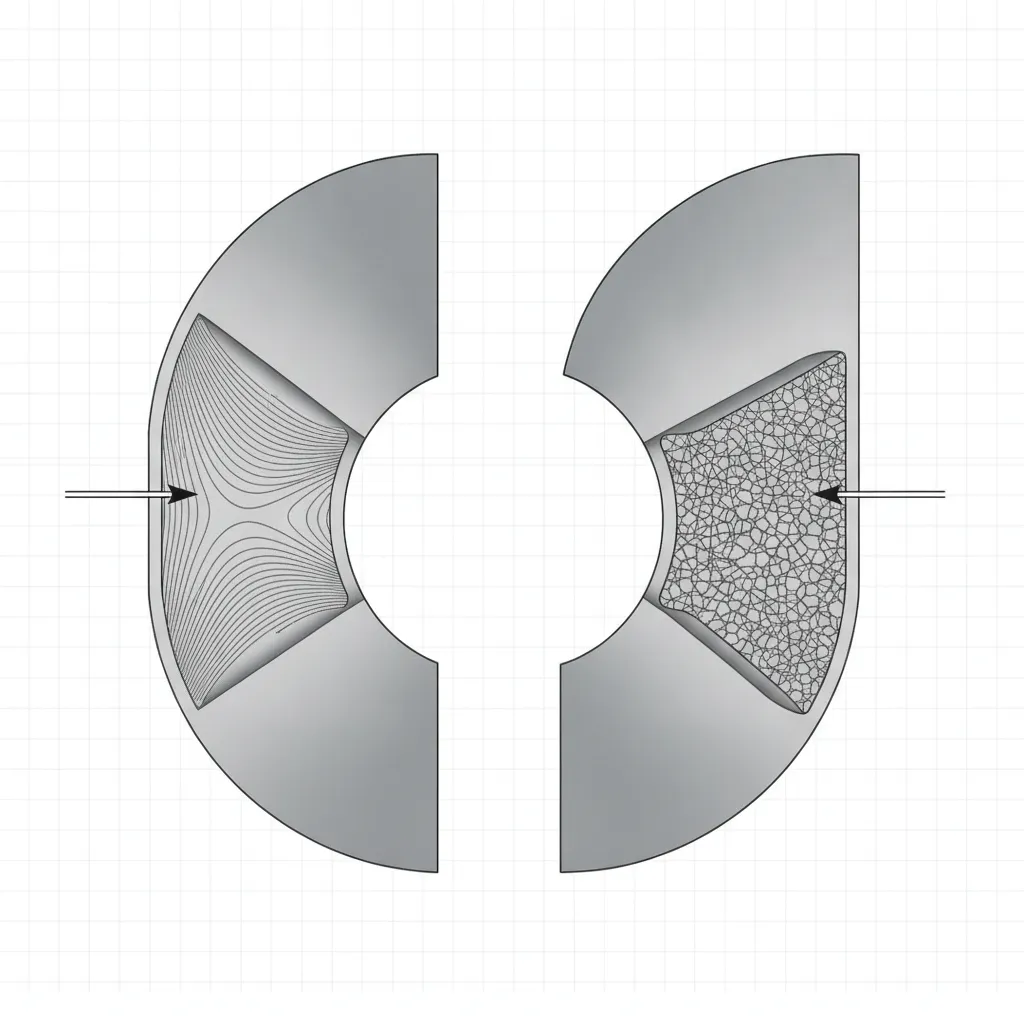
The main advantage of open forging is the significant improvement in mechanical properties it delivers compared to casting or machining from bar stock, achieved through grain refinement and the elimination of internal porosity during compressive deformation. For more information, see Open Banking Definition Enjeux Et Fonctionnement.
Mechanical and Structural Advantages
Open forging doesn’t just shape metal. It fundamentally improves it. The compressive working of the material during forging:
- Refines the grain structure, reducing grain size and improving uniformity
- Closes internal voids, shrinkage cavities, and porosity present in cast ingots
- Aligns grain flow with the part’s stress directions, improving fatigue life
- Increases tensile strength, yield strength, and impact toughness compared to cast equivalents
- Improves ductility and resistance to stress corrosion cracking
Research from the Forging Industry Association indicates that forged parts typically show 20-30% higher fatigue strength and significantly better impact resistance compared to equivalent cast components. For applications in aerospace, oil and gas, and defense, these properties aren’t optional. They’re specification requirements.
Economic and Operational Benefits
Beyond mechanical properties, open forging offers real economic advantages, particularly for custom or low-to-medium volume production:
- Low tooling cost: Simple flat or V-block dies cost a fraction of closed die tooling, which can run into tens of thousands of dollars per cavity
- Flexibility: The same set of dies can produce a wide variety of part shapes and sizes, reducing changeover costs
- Scalability for large parts: Closed die tooling for very large components is often impractical or prohibitively expensive; open die forging has no practical size ceiling
- Short lead times for custom work: Without complex tooling to fabricate, open forging can begin production faster than closed die alternatives
- Material efficiency: Starting from a near-net shape blank reduces CNC machining time and material waste compared to machining from solid bar stock
Just as the financial technology sector has seen structural shifts in how services are delivered (concepts like those explored in resources covering Open Banking Definition Enjeux Et Fonctionnement illustrate how “open” architectures create flexibility and reduce barriers), open forging’s “open” architecture, with its unrestricted die geometry, similarly creates flexibility that closed systems simply can’t match for custom or large-format work.
Pro Tip: For parts that will see cyclic loading (shafts, spindles, connecting rods), always specify the minimum reduction ratio in your forging drawing notes. A reduction ratio of 4:1 or higher ensures the grain refinement needed for long fatigue life. Don’t leave this to the forge shop’s discretion.
Open Forging vs. Closed Die Forging
Open forging and closed die forging differ fundamentally in how the dies constrain the workpiece: open die processes allow metal to flow freely, while closed die (impression die) forging fully encloses the material to produce near-net-shape parts with tighter dimensional control.
Side-by-Side Comparison
| Attribute | Open Forging | Closed Die Forging |
|---|---|---|
| Die type | Flat, V-block, or simple shapes | Machined cavities matching final part shape |
| Metal flow | Unrestricted (free flow) | Constrained within die cavity |
| Dimensional accuracy | Lower; requires post-machining | Higher; near-net-shape possible |
| Tooling cost | Low | High (custom dies per part) |
| Part size range | Few lbs to 150+ tons | Typically under 25 kg for most applications |
| Production volume | Best for low-to-medium volume, custom parts | Best for high-volume, consistent parts |
| Shape complexity | Simpler: bars, shafts, rings, discs | Complex: flanges, gears, connecting rods |
| Lead time to first part | Shorter (no die fabrication wait) | Longer (die design and machining required) |
| Typical applications | Shafts, spindles, rings, pressure vessels, aerospace blanks | Automotive connecting rods, turbine blades, fasteners |
Choosing the Right Process for Your Application
The choice between open and closed die forging isn’t about which is “better.” It’s about which fits your part’s geometry, volume, and budget. Open forging wins when you need large parts, custom shapes, or short-run production without heavy tooling investment. Closed die forging wins when you need high-volume, repeatable, near-net-shape parts with minimal post-machining.
A precision machining client we worked with recently needed 50 custom steel spindle blanks for a power generation application. The parts were 200mm diameter and required exceptional fatigue resistance. Open die forging was the clear choice: tooling cost was minimal, the forging process refined the grain structure exactly as the application demanded, and CNC turning brought the blanks to final tolerance. Closed die tooling for that part size would have cost more than the entire production run.
According to Anchor Harvey’s published technical guidance on aerospace forging applications, open die forging is ideal for simpler parts such as pins, bars, blanks, and spindles, while closed die forging suits more precision-complex geometries. That division of labor remains accurate as of 2026.
Challenges and Best Practices for 2026
The main challenges in open forging involve maintaining dimensional consistency, controlling grain flow direction, and managing the interface between the forging operation and subsequent precision machining steps.
Common Mistakes and How to Avoid Them
In practice, most quality failures in open forged parts trace back to a handful of recurring mistakes:
- Insufficient reduction ratio: A common mistake is accepting forgings with low reduction ratios to save time or material. This leaves residual cast structure in the core, undermining the mechanical advantage of forging entirely.
- Inadequate machining stock allowance: Open forging produces parts with surface scale, decarburization layers, and dimensional variation. Specifying insufficient machining stock means these defects end up in the finished part.
- Poor temperature control during reheating: Returning a part to the furnace without proper temperature monitoring can cause grain growth in already-worked zones, creating non-uniform properties.
- Skipping non-destructive testing (NDT): Ultrasonic testing (UT) is standard for structural open die forgings. Skipping it to save cost is a false economy, particularly for aerospace and pressure vessel applications.
- Misaligned grain flow: Forgings should be oriented so grain flow runs parallel to the primary stress direction. A one-size-fits-all approach to workpiece orientation during forging can produce parts that look fine but fail prematurely in service.
Best Practices for Specifying and Sourcing Open Forgings
Experienced procurement teams and engineers follow a consistent set of practices when specifying open forged components:
- Define the minimum reduction ratio on the forging drawing, not just the final dimensions
- Specify the heat treatment condition (normalized, quenched and tempered, annealed) as part of the material specification
- Require a material test report (MTR) certifying chemical composition and mechanical properties per the relevant standard (ASTM, EN, or JIS)
- Specify ultrasonic testing acceptance criteria per ASTM A388 or equivalent for structural applications
- Leave adequate machining stock: typically 5-10mm per surface for medium forgings, more for larger cross-sections
- Coordinate closely between the forge shop and the precision machining partner to ensure forging dimensions support the final machining plan
At MFG SOLUTION, we’ve found that the handoff between forging and precision machining is where most dimensional problems originate. When forging drawings and machining drawings aren’t coordinated, parts arrive with insufficient stock in critical areas, forcing expensive rework or scrap. Getting both teams aligned on the machining stock plan before forging begins eliminates this problem almost entirely.
Pro Tip: Request a forging simulation or process review from your forge supplier for any new part over 50kg. Modern simulation software can predict grain flow, potential defect zones, and optimal die positioning before a single piece of metal is heated. The cost is negligible compared to discovering a grain flow problem after heat treatment.
One pitfall to watch for in 2026: as supply chains continue to consolidate, some suppliers are substituting bar stock machining for the practice on parts originally specified as forged, without disclosing the change. Always require a forging certificate or process verification as part of your incoming inspection protocol.
Frequently Asked Questions
1. What is the difference between open and closed forging?
this practice uses flat or simple dies that don’t fully enclose the workpiece, allowing metal to flow freely in unconstrained directions while the operator repositions the part between blows to achieve the desired shape. Closed die forging uses matched die cavities that fully surround the workpiece, constraining metal flow to produce a near-net-shape part with tighter dimensional accuracy. The practical result: this method suits large, simple, or custom geometries with lower tooling cost, while closed die forging suits high-volume, complex shapes where dimensional repeatability is critical.
2. What is another name for open die forging?
Open die forging is also known as free forging, smith forging, and hammer forging. The term “free forging” emphasizes the unrestricted metal flow characteristic of the process. “Smith forging” traces back to the blacksmithing tradition from which the process evolved. “Hammer forging” describes the primary energy source. All four terms refer to the same fundamental process: shaping heated metal between dies that don’t fully enclose the workpiece.
3. What is the main advantage of open die forging?
The primary advantage of this strategy is the significant improvement in mechanical properties it produces through grain refinement and porosity closure. Compressive working breaks down the as-cast grain structure, aligns grain flow with the part’s primary stress directions, and closes internal voids, resulting in parts with superior fatigue strength, tensile strength, and impact toughness compared to cast or machined-from-bar equivalents. Secondary advantages include low tooling cost, flexibility for custom or oversized parts, and no practical upper size limit, making it the only viable process for very large structural components.
4. What materials can be open forged?
this approach is compatible with a wide range of metals and alloys. Carbon and alloy steels are the most common. Stainless steels, tool steels, aluminum alloys, titanium alloys, copper alloys, and nickel-based superalloys (such as Inconel) are all routinely open forged. The key requirement is that the material must be workable in its hot plastic state. Refractory metals and some brittle intermetallics are generally not suitable for open die forging.
5. How does open forging compare to cold forging?
the practice is performed hot (above the metal’s recrystallization temperature), which allows large deformations with lower force and produces the grain refinement that defines the process. Cold forging is performed at or near room temperature, which increases work hardening and surface finish quality but is limited to smaller parts and simpler shapes due to the higher forces required. Cold forging is excellent for high-volume small parts (fasteners, pins, connectors) where dimensional accuracy and surface finish are critical. this practice is better suited to large, custom, or structurally demanding components.
6. Does open forging require post-process machining?
Yes, in almost all industrial applications. this method produces a near-net-shape blank with surface scale, a decarburized surface layer, and dimensional variation that makes it unsuitable for direct use in precision assemblies. CNC turning, milling, or grinding operations are required to achieve final dimensions, surface finish, and tight tolerances. This is why coordinating between the forge shop and the precision machining partner is so important: the forging must leave enough material stock in the right locations for machining to remove without compromising the part’s structural integrity.
For context on the full forging process and its historical development, the Wikipedia article on Forging provides a solid technical overview. For deeper technical standards, the ASM International Open-Die Forging handbook chapter is the authoritative reference. The Forging Industry Association’s Forging 101 presentation is an accessible starting point for procurement and engineering teams new to the process.
Conclusion
this strategy remains one of manufacturing’s most reliable and mechanically effective metal forming processes. Its ability to refine grain structure, eliminate internal defects, and produce components with exceptional fatigue and tensile strength keeps it firmly relevant across aerospace, energy, defense, and heavy industrial sectors in 2026.
The process works best when it’s treated as the first step in a precision manufacturing workflow, not a standalone solution. The forging establishes the metallurgical foundation. Precision CNC machining delivers the final dimensions and surface quality that modern applications demand.
At MFG SOLUTION, our team works with customers who need precision-machined components that start life as open forged blanks. With ISO 9001:2015, ISO 13485:2016, and IATF 16949 certifications, 60+ engineering professionals, and 5-axis CNC capability, we handle the critical machining step with the process control and speed your supply chain requires. We provide quotes within 8 hours and ship within 3 days, so you’re not waiting weeks to validate your this approach and machining workflow. If your next project involves forged blanks that need precision finishing, our team is ready to help you get it right.
Recommended Articles
Explore more from our content library: