
2026-02-02
The Process of Cold Heading Custom Titanium Alloy Fasteners
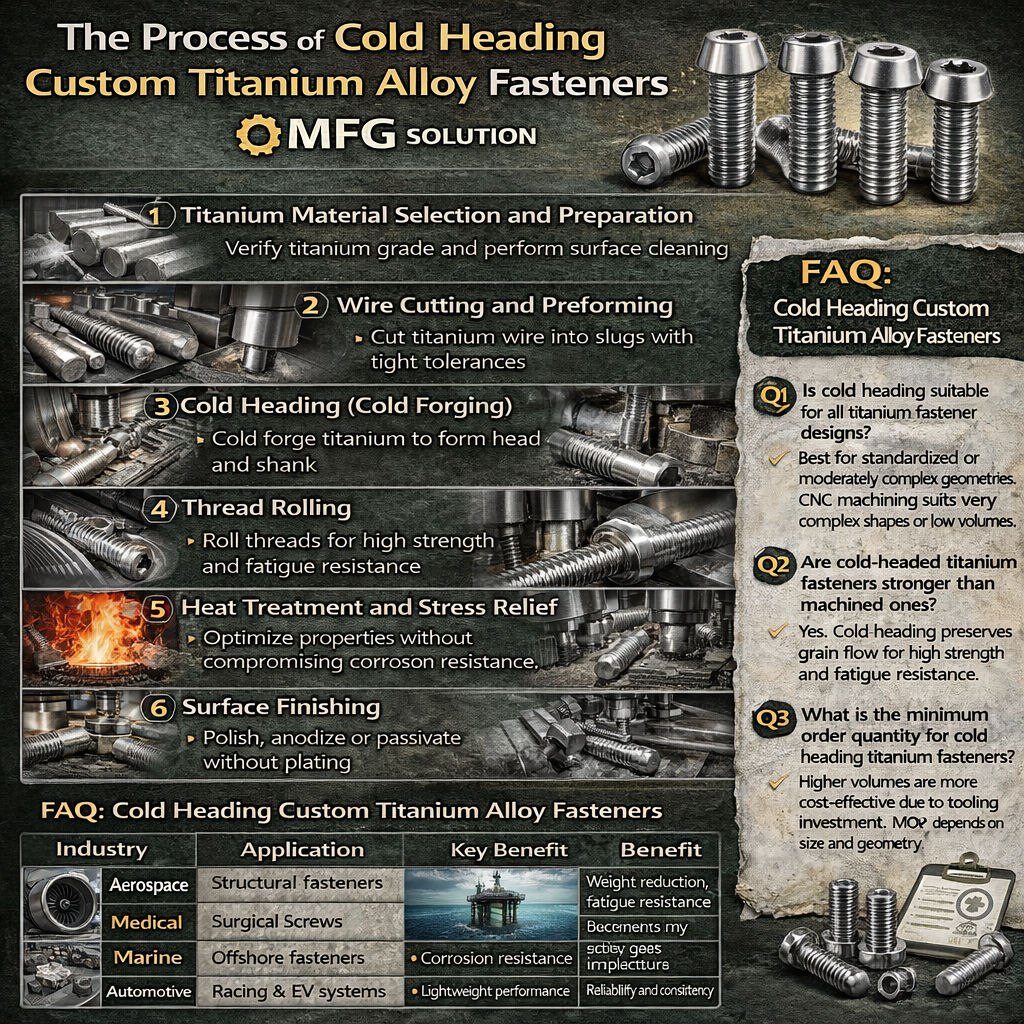
Titanium alloy fasteners are widely used in aerospace, medical, marine, and high-performance industrial applications due to their exceptional strength-to-weight ratio and corrosion resistance. When production volume increases and performance requirements are strict, cold heading (cold forging) becomes one of the most effective manufacturing methods for custom titanium screws, bolts, and studs.
This article explains the complete cold heading process for custom titanium alloy fasteners, from material preparation to final inspection, and highlights key technical considerations throughout production.
1. Why Choose Cold Heading for Custom Titanium Fasteners?
Cold heading forms fasteners at room temperature using high-pressure dies. Unlike CNC machining, which removes material, cold heading reshapes the material while preserving its internal grain structure.
Key benefits include:
- Higher mechanical strength
- Better fatigue performance
- Excellent dimensional consistency
- Lower material waste
- Reduced unit cost for volume orders
For custom titanium fasteners, cold heading offers a strong balance between performance and cost efficiency.
2. Step 1: Titanium Material Selection and Preparation
The process begins with selecting the correct titanium alloy based on application requirements.
Common Titanium Grades
- Grade 2: Good corrosion resistance, moderate strength
- Grade 5 (Ti-6Al-4V): High strength, most widely used
- Grade 23 (ELI): Medical-grade applications
Before forming, titanium wire undergoes:
- Chemical composition verification
- Surface cleaning
- Straightening
- Controlled heat treatment (if required)
Material consistency is critical for stable cold heading performance.
3. Step 2: Wire Cutting and Preforming
Titanium wire is cut into precise lengths, known as slugs. These slugs must be tightly controlled in length and volume to ensure proper die filling during forming.
Preforming may be applied to:
- Reduce forming stress
- Improve die life
- Achieve complex head shapes
This step lays the foundation for dimensional accuracy.
4. Step 3: Cold Heading (Cold Forging)
Cold heading shapes the fastener head and shank through one or multiple forming stages.
Key Characteristics of Cold Heading
- Material flows to fill the die cavity
- Grain structure follows the fastener shape
- No cutting or material removal
Multi-station cold heading machines are often used for:
- Hex bolts
- Socket head screws
- Flanged fasteners
Process stability is essential due to titanium’s high strength and limited ductility compared to steel.
5. Step 4: Thread Rolling
After head forming, threads are typically produced by thread rolling, not cutting.
Advantages of Thread Rolling
- Stronger threads due to work hardening
- Smooth surface finish
- Improved fatigue resistance
- Reduced risk of stress concentration
Thread rolling is especially important for titanium fasteners used under cyclic load conditions.
6. Step 5: Heat Treatment and Stress Relief
Depending on the titanium grade and application, fasteners may undergo:
- Stress relief treatment
- Solution treatment and aging (for Grade 5)
These processes optimize mechanical properties and dimensional stability without compromising corrosion resistance.
7. Step 6: Surface Finishing
Titanium fasteners generally do not require protective plating, but surface finishing may include:
- Polishing
- Anodizing (for color coding or identification)
- Passivation
Surface finishing improves appearance and consistency while maintaining titanium’s natural corrosion resistance.
8. Step 7: Inspection and Quality Control
Due to the critical applications of titanium fasteners, inspection standards are strict.
Typical Inspection Items
- Dimensional measurement
- Thread gauge inspection
- Mechanical property testing
- Visual and surface defect inspection
For aerospace and medical projects, full material traceability is often required.
At MFG Solution, quality control is integrated into every production stage to ensure reliability and repeatability.
9. When Cold Heading Is the Right Choice
Cold heading is most suitable when:
- Order volume is medium to high
- Fastener geometry is standardized or semi-custom
- High strength and fatigue resistance are required
- Cost optimization is a priority
For very low volumes or complex prototypes, CNC machining may still be preferred.
FAQ: Cold Heading Custom Titanium Alloy Fasteners
Cold heading works best for standardized or moderately complex fastener geometries. Extremely complex shapes or very small quantities are better suited to CNC machining.
Yes. Cold heading preserves and redirects grain flow, which generally results in higher strength and better fatigue resistance compared to machined fasteners.
Because tooling is required, cold heading is most cost-effective for medium to high volumes. The exact MOQ depends on fastener size, geometry, and tolerance requirements.
Yes. Custom head shapes, lengths, and thread specifications can be produced through dedicated tooling and controlled forming stages.
Cold heading requires higher upfront tooling cost but significantly reduces per-unit cost for volume production. CNC machining has lower setup cost but higher unit cost.
Conclusion
Cold heading is a highly efficient and reliable process for manufacturing custom titanium alloy fasteners at scale. By combining controlled material preparation, precision forming, thread rolling, and strict quality inspection, cold heading delivers high-strength, fatigue-resistant, and cost-effective titanium screws and bolts.
For projects that require consistent quality and long-term cost efficiency, cold-headed titanium fasteners offer a clear manufacturing advantage.