
2026-02-02
Manufacturing Processes and Applications of Titanium Alloy Screws
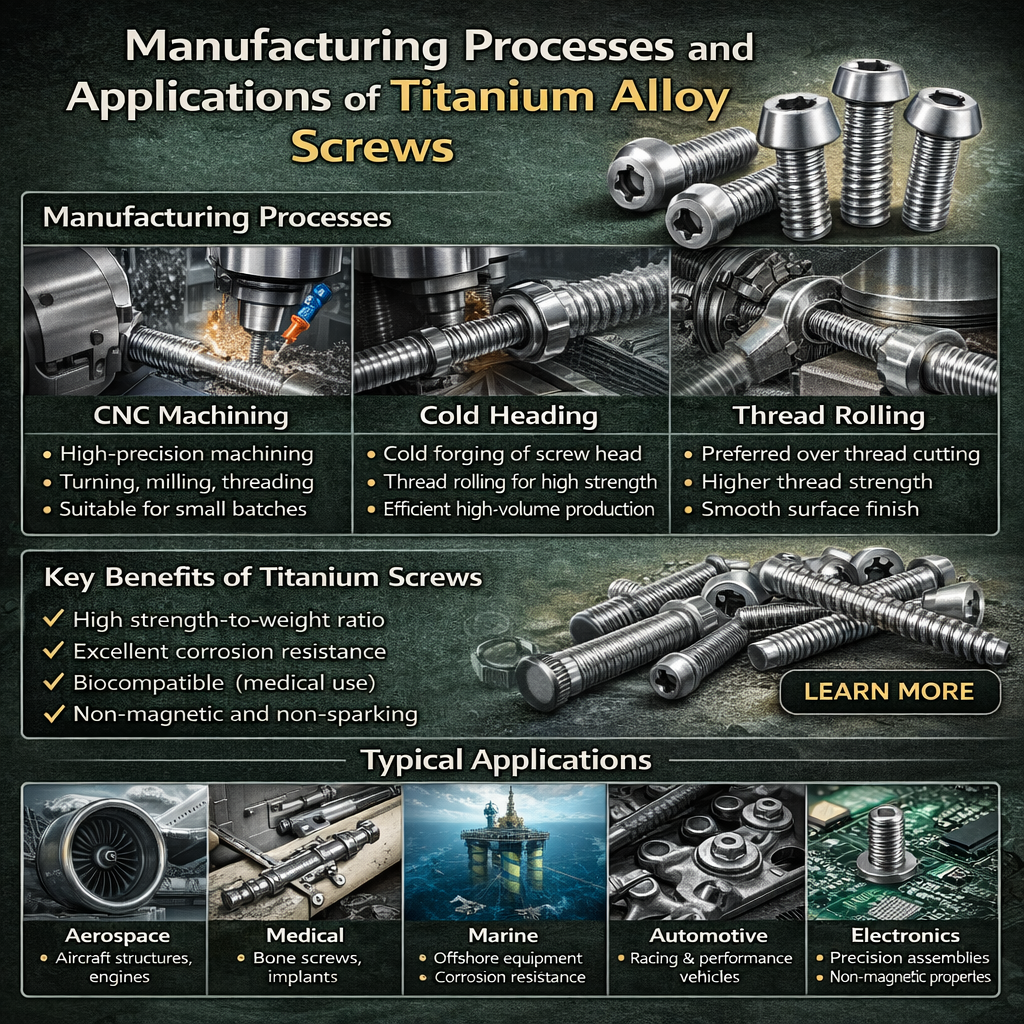
Titanium alloy screws are widely used in industries that demand high strength, low weight, and excellent corrosion resistance. Compared with carbon steel or stainless steel fasteners, titanium screws offer superior performance in extreme environments, making them ideal for aerospace, medical, marine, and high-end industrial applications.
This article explains the manufacturing processes of titanium alloy screws, key technical challenges, and their typical application scenarios.
1. Why Titanium Alloy Is Used for Screws
Titanium alloys combine several outstanding material properties:
- High strength-to-weight ratio
- Excellent corrosion resistance
- Good fatigue performance
- Non-magnetic and biocompatible
- Strong resistance to heat and chemicals
Because of these advantages, titanium alloy screws are often selected when weight reduction and reliability are critical.
2. Common Titanium Alloys for Screws
The most widely used titanium alloy for fasteners is Ti-6Al-4V (Grade 5).
Typical Titanium Grades
- Grade 2: Commercially pure titanium, good corrosion resistance
- Grade 5 (Ti-6Al-4V): High strength, most common for screws
- Grade 23 (ELI): Medical-grade titanium with improved toughness
Material selection depends on load requirements, operating environment, and industry standards.
3. Raw Material Preparation
Titanium alloy screws typically start from:
- Titanium wire rods (for cold forming)
- Titanium bars (for CNC machining)
Material preparation includes:
- Chemical composition verification
- Straightening and surface cleaning
- Heat treatment for forming consistency
Strict material control is essential due to titanium’s sensitivity to impurities.
4. Manufacturing Processes for Titanium Alloy Screws
4.1 CNC Machining
CNC machining is commonly used for small batches, custom screws, or high-precision applications.
Process Characteristics
- Turning of the screw shank
- Milling or rolling of threads
- Precise head shaping
Advantages
- High dimensional accuracy
- Flexible design changes
- Suitable for low-volume production
Limitations
- Higher cost per unit
- Lower production efficiency compared to forming
4.2 Cold Heading (Cold Forging)
Cold heading is used for medium to high-volume titanium screw production, although it is more challenging than steel forming.

Process Characteristics
- Multi-stage forming of screw head
- Thread rolling instead of cutting
Advantages
- Improved material strength due to grain flow
- Better fatigue performance
- Higher production efficiency
Challenges
- High tool wear
- Strict process control required
- Limited to simpler geometries
4.3 Thread Rolling
Thread rolling is preferred over thread cutting for titanium screws.
Benefits
- Higher thread strength
- Improved surface finish
- Reduced stress concentration
Thread rolling significantly improves fatigue life, which is critical for aerospace and medical applications.
5. Heat Treatment and Surface Finishing
Titanium alloy screws may undergo:
- Stress relief heat treatment
- Solution treatment and aging (for Grade 5)
Common Surface Treatments
Unlike steel fasteners, titanium screws do not require plating for corrosion protection.
6. Quality Control and Inspection
Due to high performance requirements, titanium screws undergo strict inspection:
- Dimensional measurement
- Thread gauge inspection
- Mechanical property testing
- Surface defect inspection
In aerospace and medical fields, full material traceability is often required.
7. Typical Applications of Titanium Alloy Screws
| Industry | Application | Key Benefit |
|---|---|---|
| Aerospace | Aircraft structures, engines | Weight reduction, strength |
| Medical | Bone screws, implants | Biocompatibility |
| Marine | Offshore equipment | Corrosion resistance |
| Automotive | Racing and performance vehicles | Lightweight |
| Electronics | Precision assemblies | Non-magnetic properties |
Titanium screws are especially valuable where failure is not an option.
8. Cost Considerations and Procurement Tips
Titanium alloy screws are more expensive than steel fasteners due to:
- Raw material cost
- Machining difficulty
- Tool wear
To control cost:
- Avoid over-specification
- Choose the correct titanium grade
- Use CNC machining only where necessary
- Consolidate custom fastener designs
A technical sourcing approach helps balance cost and performance.
Conclusion
Titanium alloy screws offer unmatched performance in demanding environments. Their manufacturing involves advanced machining or forming processes, strict material control, and precise quality inspection. While the cost is higher than traditional fasteners, their long service life, weight savings, and reliability often justify the investment.
By understanding titanium screw manufacturing processes and application requirements, engineers and buyers can make informed decisions and achieve optimal performance in critical assemblies.