
2026-05-11
Custom Metal Forging: What It Is and How It Works

| Key Insight | Explanation |
|---|---|
| Forging vs. Casting | Forged parts have a continuous grain structure, making them stronger and more fatigue-resistant than cast equivalents. |
| Main Process Types | Open-die, closed-die, and cold forging each suit different part geometries, volumes, and tolerance requirements. |
| Material Range | Steel, aluminum, brass, bronze, copper, and titanium are all commonly forged for industrial and precision applications. |
| Quality Standards | ISO 9001:2015, IATF 16949, and Nadcap certifications are the benchmarks for forging quality in automotive and aerospace sectors. |
| Cold Forging Advantage | Cold forging produces near-net-shape parts with tight tolerances and excellent surface finish, reducing secondary machining costs. |
| Supplier Selection | Certifications, material traceability, and rapid quoting capability are the three most critical factors when choosing a forging partner. |
You need 50,000 small steel connectors. Tight tolerances. Aggressive deadline. Your current supplier quotes six weeks. That gap between what you need and what most vendors deliver is exactly where custom metal forging services prove their value. Custom metal forging services are specialized manufacturing processes that shape metal under compressive force to produce parts built to a buyer’s exact engineering specifications. The result is a component with superior mechanical properties, dimensional accuracy, and material integrity that off-the-shelf parts simply can’t match. This guide covers every key aspect: process types, real-world benefits, common pitfalls, and what to look for in a forging partner as of 2026.
What Is Custom Metal Forging?
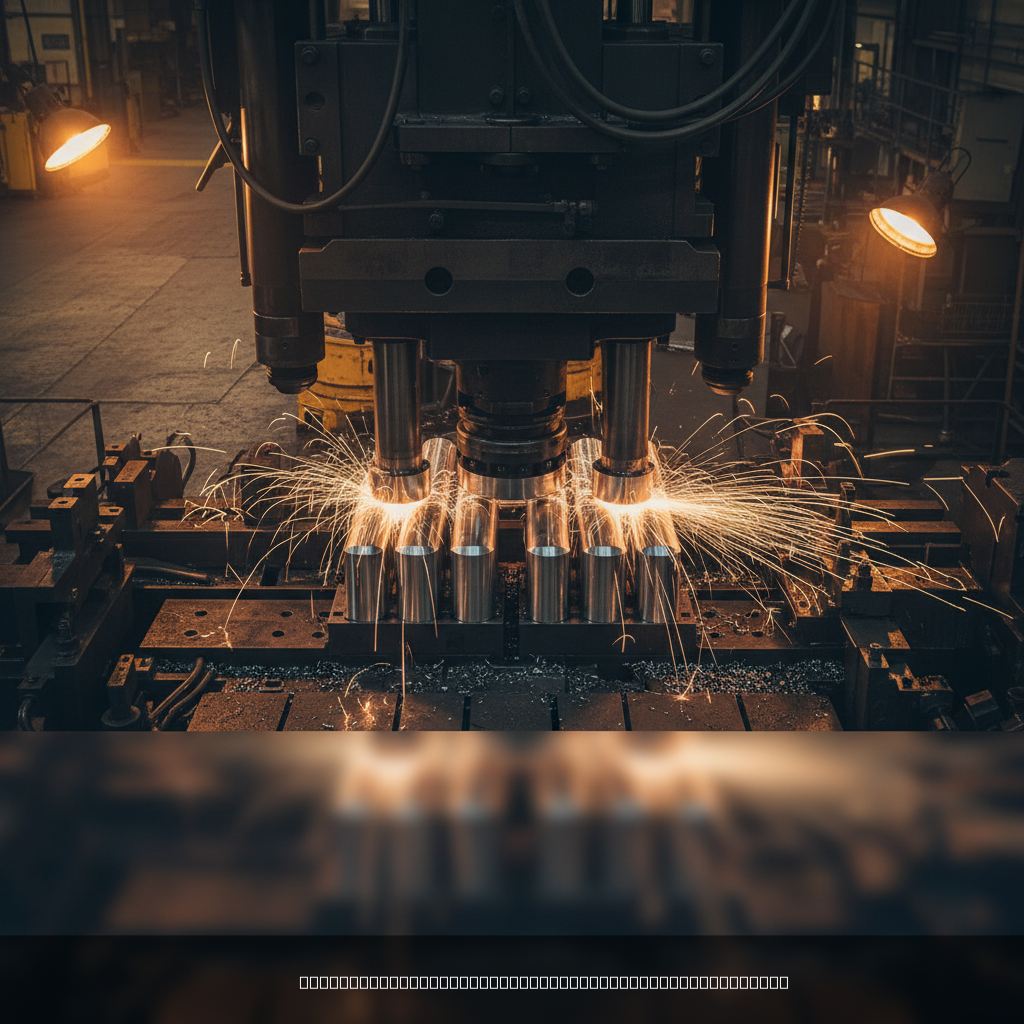
Custom metal forging is a manufacturing process that shapes metal by applying controlled compressive forces, producing parts with specific geometries, tight tolerances, and enhanced mechanical properties tailored to a customer’s design. It differs from standard catalog forging because every die, process parameter, and material selection is driven by the buyer’s engineering drawing.
The Core Definition
The Forging Industry Association (FIA), which comprises more than 220 North American metal forging producers as of 2026, defines forging as a process that refines grain structure and improves mechanical properties compared to castings or machined bar stock [1]. That grain refinement is the physical reason forged parts outperform alternatives under cyclic loading, impact, and high-stress conditions.
Three broad categories define the field:
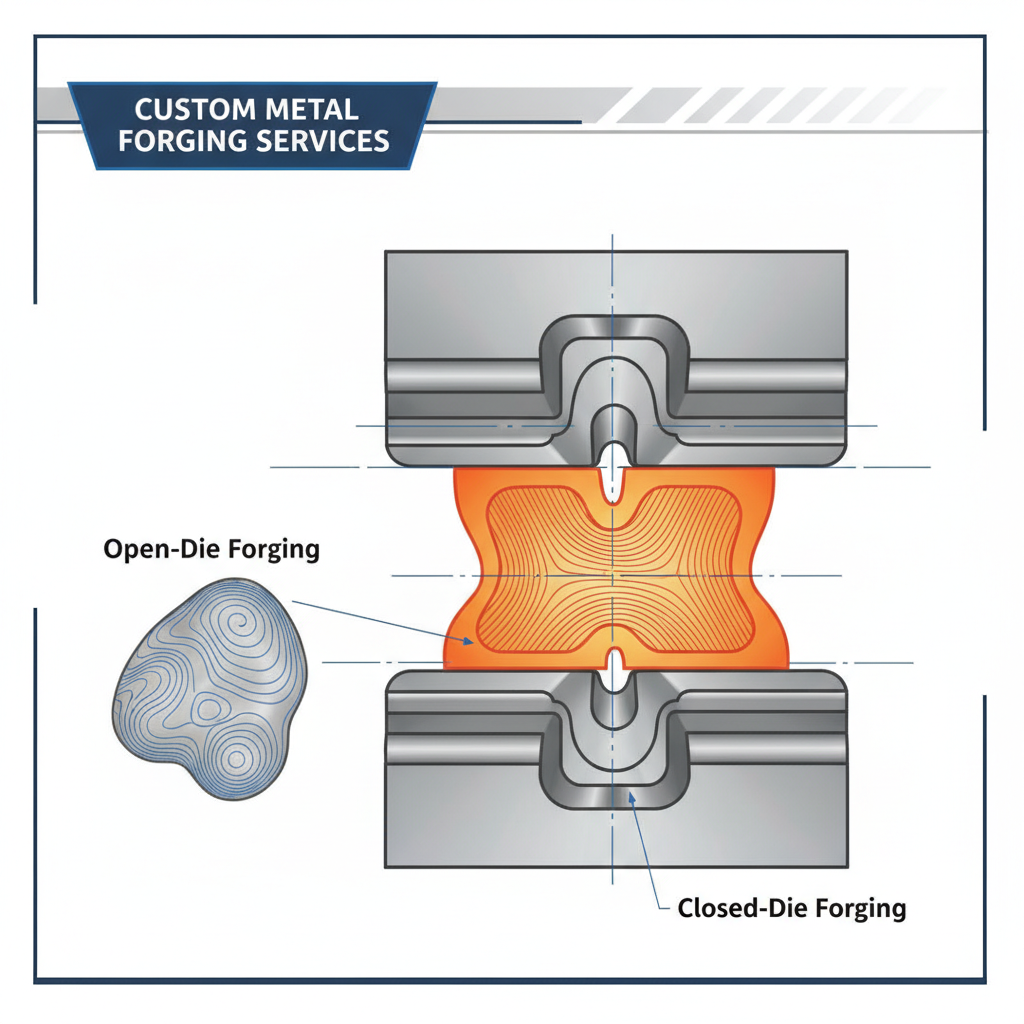
- Open-die forging: Metal is worked between flat or simple-shaped dies. Best for large, simple geometries and low-volume runs. Scot Forge, for example, is recognized as an industry leader specifically in open-die and rolled ring forging [2].
- Closed-die (impression-die) forging: Metal fills a precision cavity machined into the die set. Produces complex near-net-shape parts with tighter tolerances. Trinity Forge describes this as “built-to-print” production, where every part matches the customer’s exact specifications [3].
- Cold forging: Metal is shaped at or near room temperature, typically using cold heading or cold extrusion. Produces excellent surface finish and dimensional consistency without heating costs.
Why It Matters for Precision Parts
Forging isn’t just about shape. The compressive working of metal aligns the grain flow with the part’s geometry, which directly increases tensile strength, fatigue life, and impact resistance. According to the Nadcap Metallic Materials Manufacturing standard, forging is specifically used “to produce the required material properties” of a part, not just its geometry [4]. For industries like automotive, aerospace, and medical devices, that distinction is non-negotiable.
Custom forging also reduces material waste compared to machining from solid bar stock. A near-net-shape forging might require only light finishing cuts, which lowers both material cost and cycle time.
How Custom Metal Forging Services Work
Custom metal forging services follow a structured process from engineering review to finished part, typically involving die design, material selection, forging, heat treatment, and final inspection. Each stage directly affects part quality and cost.
The Step-by-Step Process
- Design review and DFM analysis: The supplier reviews the customer’s drawing and performs Design for Manufacturability (DFM) analysis. This step identifies geometry features that could cause die fill problems, stress concentrations, or excessive flash.
- Material selection: Common materials include carbon steel, alloy steel, stainless steel, aluminum alloys, brass, bronze, copper, and titanium. Interstate Metal, for instance, specializes in precision closed-die forging for brass, bronze, and copper components [5].
- Die design and machining: For closed-die work, tooling is machined to match the part geometry. Die cost is the largest upfront investment, typically amortized over the production run.
- Billet preparation: Raw material is cut to precise weight, since forging volume must match die cavity volume within tight limits.
- Forging operation: Hot forging heats billets to above the recrystallization temperature; warm forging uses intermediate temperatures; cold forging works at room temperature. Each method suits different materials and tolerances.
- Heat treatment: Post-forge heat treatment (annealing, normalizing, quenching and tempering) restores or enhances mechanical properties. Interstate Metal notes in-house heat treatment as a key quality control step [5].
- Finishing and machining: Flash is trimmed, surfaces are finished, and critical dimensions are machined to final tolerance. CFS Forge highlights that machining service for steel forgings is a standard value-added step [6].
- Inspection and certification: Dimensional inspection, hardness testing, and material certification confirm the part meets specification before shipment.
Cold Forging: The Precision Specialist
Cold forging (cold heading) deserves special attention for small precision parts. The process shapes metal at room temperature using high-pressure dies, producing parts with:
- Tolerances as tight as ±0.01mm on critical dimensions
- Excellent surface finish, often eliminating secondary grinding
- Work-hardened surfaces with improved fatigue resistance
- Near-zero material waste compared to machining from bar
At MFG SOLUTION, we’ve found that cold forging is the most cost-effective process for high-volume small parts up to 38mm in diameter, particularly for fasteners, connectors, and precision shafts in the automotive and electronics sectors. Our cold heading equipment handles these geometries with consistent dimensional repeatability across large batch runs.
Pro Tip: Request a grain flow diagram from your forging supplier before approving a die design. Proper grain flow orientation relative to the part’s stress axis can increase fatigue life by 20-30% compared to a machined equivalent, according to industry data from the Forging Industry Association [1].
Key Benefits of Custom Metal Forging Services
Custom metal forging services deliver stronger parts, lower per-unit costs at volume, and better material traceability than most alternative manufacturing methods. These advantages compound across the product lifecycle.
Mechanical and Material Advantages
The structural case for forging is well-established. According to Modern Group, which brings over 100 years of experience in custom forged manufacturing solutions, forged parts consistently outperform cast and machined alternatives in fatigue strength and impact resistance [7]. The reasons are physical:
- Continuous grain structure: No porosity or shrinkage voids, which are common in castings
- Higher strength-to-weight ratio: Particularly relevant for aluminum and titanium aerospace components
- Predictable mechanical properties: Forging parameters can be controlled and documented, supporting traceability requirements under ISO 9001:2015 and IATF 16949
- Longer service life: Forged components typically outlast cast equivalents under cyclic loading conditions
Economic and Supply Chain Benefits
The economic argument is equally compelling, especially at production volumes above 1,000 pieces.
| Factor | Forging | CNC Machining from Bar | Die Casting |
|---|---|---|---|
| Material waste | Low (near-net-shape) | High (chips) | Low |
| Tooling cost | Medium | Low | High |
| Part strength | Highest | High | Medium |
| Surface finish (as-produced) | Good (cold) / Fair (hot) | Excellent | Good |
| Best volume range | 1,000+ pieces | 1–10,000 pieces | 10,000+ pieces |
| Porosity risk | None | None | Present |
Bunty LLC, a full-service custom machined, forged, and cast metal parts supplier, emphasizes that combining forging with downstream machining in a single supply chain reduces vendor complexity and inspection overhead [8]. That consolidation benefit is especially valuable for procurement teams managing multiple part numbers.
For parts that combine forged strength with tight machined tolerances, a hybrid approach works well. Forge the blank to near-net shape, then finish-machine critical surfaces. This is precisely how MFG SOLUTION’s Cold Forging Service integrates with our CNC Turning and Swiss Lathe capabilities to deliver complete, inspection-ready parts in a single workflow.
Just as precision manufacturing requires careful planning and the right process selection, so does any complex project involving custom specifications. Whether you’re sourcing precision components or exploring Custom Homes built to exact requirements, the principle is the same: custom work demands a partner with documented processes and proven quality controls.
Common Challenges and Mistakes in Metal Forging
The most common mistakes in custom metal forging involve underestimating tooling lead times, choosing the wrong process for the part geometry, and neglecting material traceability requirements. Each error can add weeks and significant cost to a project.
Process Selection Errors
A common mistake is specifying closed-die forging for a part that’s better suited to cold heading, or vice versa. Closed-die forging excels at complex 3D shapes with significant mass redistribution. Cold forging is better for rotationally symmetric parts, fasteners, and small precision components where surface finish and dimensional consistency are priorities.
One pitfall to watch for: using hot forging when cold forging would achieve the required tolerances. Hot forging introduces scale and thermal distortion that requires more aggressive machining allowances, erasing some of the near-net-shape cost advantage. Deeco Metals notes that closed-die metal forging techniques can create parts for “countless” applications, but the key is matching the process to the specific geometry and material [9].
Tooling and Lead Time Miscalculations
Die design and machining is the longest-lead item in a new forging program. Buyers who don’t account for tooling lead time in their project schedule often face delays of four to eight weeks before the first production piece is made. Mitigation strategies include:
- Request a detailed tooling timeline at the quoting stage, not after purchase order
- Ask whether the supplier maintains standard die blanks that reduce machining time
- Consider bridge tooling (soft dies) for initial production while hard tooling is completed
- Clarify die ownership and storage terms in the contract, especially for long-term programs
Material Traceability Gaps
Automotive and medical device customers require full material traceability from raw stock through finished part. A supplier without a documented quality management system can’t provide the material certifications, heat codes, and inspection records these industries demand. The Nadcap program specifically addresses this for aerospace and defense: Nadcap Metallic Materials Manufacturing Forgings accreditation requires documented control of every process variable [4].
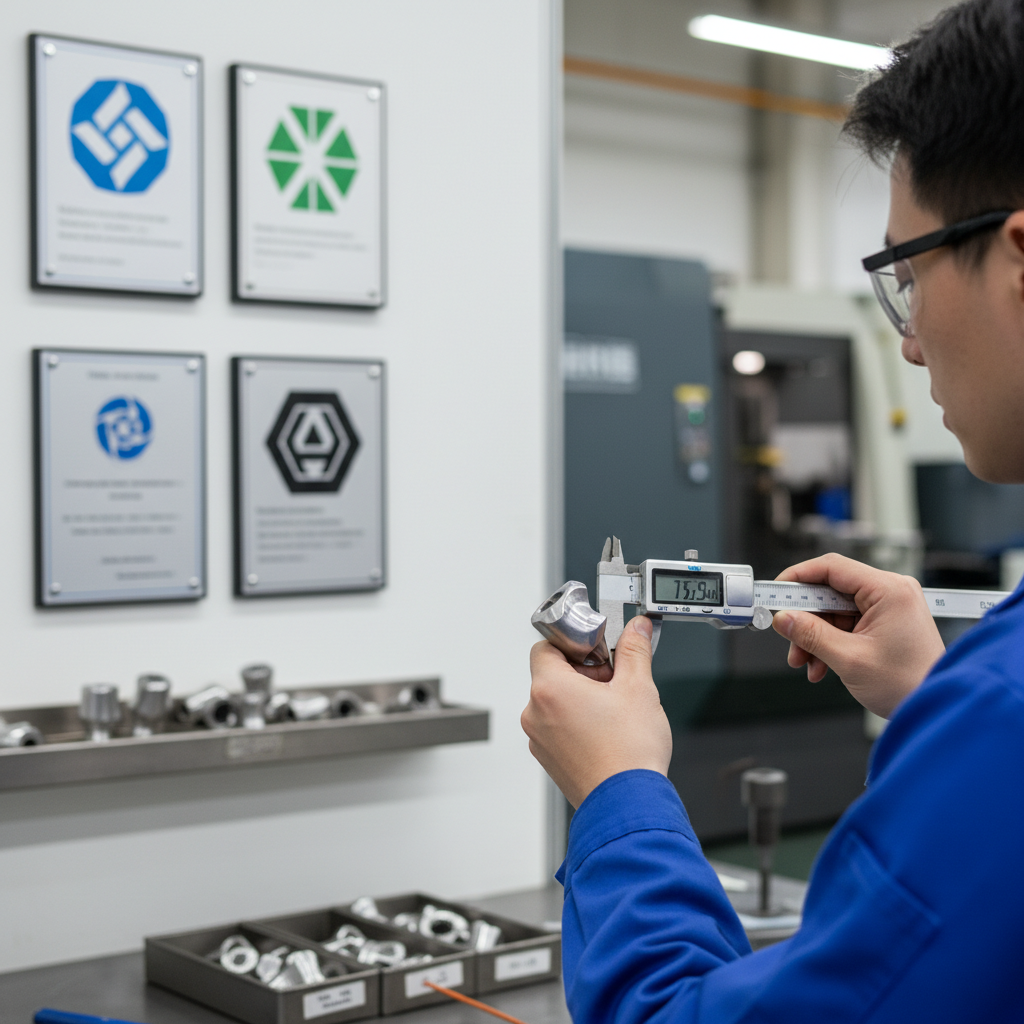
Pro Tip: Always request a copy of the supplier’s quality management system certificate before issuing a purchase order. ISO 9001:2015 is the baseline; for automotive parts, require IATF 16949. For medical components, ISO 13485:2016 is non-negotiable. These certifications aren’t just paperwork — they mean every step is tracked, documented, and auditable.
Best Practices for Sourcing Forging Services in 2026
Sourcing custom metal forging services effectively in 2026 means evaluating suppliers on certifications, process transparency, quoting speed, and their ability to integrate forging with downstream finishing operations. The market has shifted toward consolidated, certified suppliers who can handle the full part lifecycle.
Evaluating Supplier Capabilities
The IQS Directory, which catalogs metal forging manufacturers and suppliers across North America, identifies several key capability dimensions buyers should assess [10]:
- Process range: Does the supplier offer open-die, closed-die, and cold forging, or only one method? Multi-process capability means they can recommend the most cost-effective approach for your geometry.
- Material certifications: Can they forge and certify the specific alloy your design requires, including aerospace grades or medical-grade stainless?
- In-house finishing: Suppliers who combine forging with machining, heat treatment, and surface finishing reduce your vendor count and inspection burden.
- Quality certifications: ISO 9001:2015 is the baseline. IATF 16949 for automotive, ISO 13485:2016 for medical, and Nadcap for aerospace are industry-specific requirements.
- Quoting responsiveness: A supplier who takes two weeks to quote is a risk indicator. Fast, detailed quoting signals process maturity.
Practical Sourcing Framework for 2026
Industry analysts suggest that as of 2026, supply chain resilience has become as important as unit cost in supplier selection, following the disruptions of the early 2020s. Buyers are consolidating their forging vendor base around certified, multi-capability partners rather than splitting work across multiple single-process shops.
Our team at MFG SOLUTION recommends this evaluation sequence for new forging programs:
- Define your volume, tolerance, and material requirements before contacting any supplier
- Request quotes from at least three suppliers with documented quality certifications
- Ask each supplier to explain their die design process and provide a tooling timeline
- Request material certification samples from a previous similar project
- Evaluate quoting response time as a proxy for operational discipline — if they take a week to quote, expect similar delays in production communication
- Confirm downstream finishing capabilities: can they deliver a machined, inspection-ready part, or just a forging blank?
GL Forge, with over six decades of experience in custom metal forging, emphasizes that supplier experience with specific industrial part geometries is a key differentiator — not just general forging capability [11].
Pro Tip: For small precision parts under 38mm diameter, cold forging combined with CNC turning or Swiss lathe finishing is typically the most cost-effective production route. The forging step establishes the blank geometry and work-hardened surface; the machining step delivers the final dimensional accuracy. This hybrid approach can reduce per-part cost by 15-30% versus machining from solid bar at volumes above 5,000 pieces.
Sources & References
- Forging Industry Association, “FIA Member Directory and Resources,” 2026
- Scot Forge, “Open Die Forging and Rolled Ring Forging,” 2026
- Trinity Forge, “Custom Forging — Built-to-Print Components,” 2026
- Performance Review Institute, “Nadcap Metallic Materials Manufacturing Forgings,” 2026
- Interstate Metal, Inc., “Custom Metal Forging Services,” 2026
- CFS Forge, “Machining Service for Steel Forgings,” 2026
- Modern Group, “Custom Forge Manufacturing — Custom Metal Forging Services,” 2026
- Bunty LLC, “Custom Metal Parts — Forged, Plated & Cast,” 2026
- Deeco Metals, “Custom Forging Processes,” 2026
- IQS Directory, “Metal Forging Companies Suppliers,” 2026
- GL Forge, “Custom Metal Forging Services,” 2026
Frequently Asked Questions
1. What are custom metal forging services?
Custom metal forging services are manufacturing processes that shape metal under compressive force according to a customer’s specific engineering drawings and tolerances. Unlike standard catalog forgings, custom metal forging services produce parts built to exact specifications, with material selection, die design, and process parameters all tailored to the buyer’s requirements. They’re used across automotive, aerospace, medical, and electronics industries.
2. What metals can be custom forged?
Most structural and engineering metals can be forged, including carbon steel, alloy steel, stainless steel, aluminum alloys, brass, bronze, copper, and titanium. Material selection depends on the part’s mechanical requirements, corrosion environment, and weight constraints. Interstate Metal specializes in brass, bronze, and copper closed-die forgings, while steel forgings are the most common category globally.
3. What is the difference between open-die and closed-die forging?
Open-die forging shapes metal between flat or simple dies, allowing the material to flow freely. It’s best for large, simple parts and low-volume runs. Closed-die (impression-die) forging presses metal into a precision cavity, producing complex near-net-shape parts with tighter tolerances and better repeatability. Closed-die tooling costs more upfront but delivers lower per-part cost at volume.
4. How does cold forging differ from hot forging?
Cold forging shapes metal at room temperature using high-pressure dies, producing excellent surface finish, tight tolerances, and work-hardened surfaces without heating. Hot forging heats billets above the recrystallization temperature, making the metal easier to shape for complex geometries but introducing scale and thermal distortion. Cold forging is preferred for small precision parts where dimensional consistency and surface quality are priorities.
5. What quality certifications should a forging supplier have?
At minimum, look for ISO 9001:2015 quality management system certification. For automotive parts, IATF 16949 is the industry standard. For medical device components, ISO 13485:2016 is required. Aerospace and defense applications may require Nadcap Metallic Materials Manufacturing Forgings accreditation, which covers documented process control for every forging variable. Always request current certificates, not just verbal claims.
6. What is the typical lead time for custom metal forging?
Lead time depends on whether new tooling is required. For parts requiring new closed-die tooling, total lead time from order to first production parts is typically four to ten weeks, with tooling design and machining accounting for most of that time. For repeat orders using existing dies, production and delivery can be as fast as one to three weeks depending on batch size and supplier capacity.
7. When should I choose forging over CNC machining?
Choose forging when your part requires high strength, fatigue resistance, or impact toughness that machined bar stock can’t reliably deliver. Forging is also more cost-effective than machining at volumes above 1,000 to 5,000 pieces because material waste is lower. For very small batches or highly complex geometries, CNC machining from bar is often more practical. Many precision parts benefit from a hybrid approach: forge the blank, then machine critical surfaces.
8. Can forged parts be combined with CNC machining for tighter tolerances?
Yes, and this hybrid approach is standard practice for high-precision components. The forging step establishes the part’s structural integrity and near-net shape; downstream CNC turning, Swiss lathe, or milling operations achieve the final dimensional tolerances that forging alone can’t reliably hit. Suppliers like MFG SOLUTION who offer both cold forging and precision CNC services under one roof can deliver complete, inspection-ready parts faster and at lower total cost.
Conclusion
this strategy remain one of the most reliable ways to produce strong, precise, and cost-effective metal parts at production volumes. The process delivers mechanical properties that casting and machining from bar simply can’t match, particularly for parts under cyclic load or in safety-critical applications. The key is matching the right forging method to your part geometry, volume, and tolerance requirements — and partnering with a supplier who has documented quality systems to back up every claim.
MFG SOLUTION brings certified cold forging capability together with CNC turning, Swiss lathe, automatic lathe, and CNC mill & turn services under one roof. We quote within 8 hours and ship within 3 days, backed by ISO 9001:2015, ISO 13485:2016, and IATF 16949 certifications. For precision small parts up to 38mm diameter, that combination of speed, quality, and process range is hard to find in a single supplier. If you’re evaluating this approach for your next production run, the right conversation starts with a clear drawing and a supplier who can respond fast with a credible, detailed quote.
Recommended Articles
Explore more from our content library: